Determine the necessary mass, volume, or concentration for preparing a solution.
| Activity Type | Relation | Activity value | Units | Action Type | Journal | PubMed Id | doi | Assay Aladdin ID |
|---|

Information
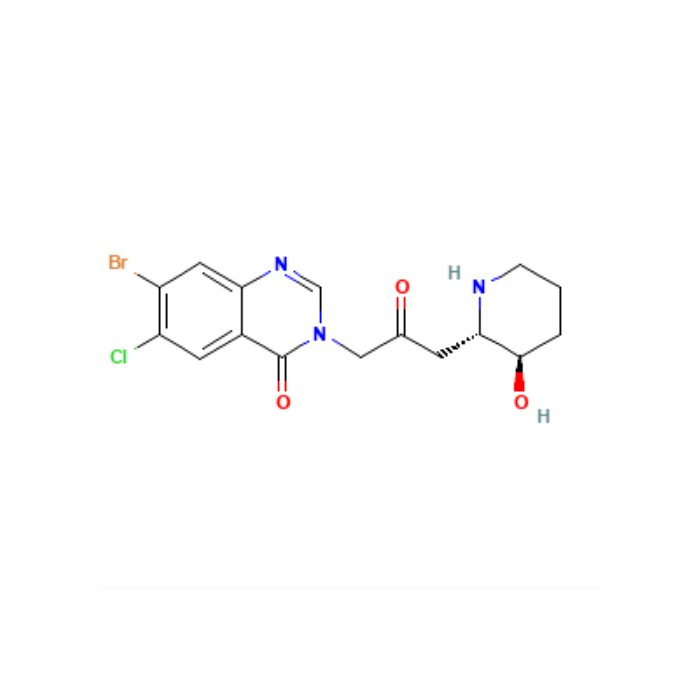
Halofuginone Halofuginone (RU-19110) is the competitively inhibitor of prolyl-tRNA synthetase with Ki of 18.3 nM.It could also down-regulate Smad3 and blocked TGF-β signaling at 10 ng/ml in mammal.
Targets
Smad3 ; prolyl-tRNA synthetase (Cell-free assay) ; 18.3nM(Ki)
In vitro
In mammals, halofuginone at 10 ng/ml down-regulates Smad3, blocking TGF-β signaling and preventing both the differentiation of fibroblasts to myofibroblasts and the transitioning of epithelial cells to mesenchymal cells.
In vivo
Halofuginone clearly extends the survival times of the parasite-infected mice. Oral treatment with halofuginone at doses of 0.2 and 1 mg/kg has an apparent curative effect for the infected mice.The subcutaneous administration of 0.2 mg of halofuginone per kg likewise extends the survival times of the infected mice, but none of the mice is cured. The mice in the 5-mg/kg dose groups die before the completion of treatment with the drug either orally or subcutaneously. Subcutaneous treatment with halofuginone appears to be more toxic to mice than oral treatment.
Cell Research(from reference)
Cell lines:primary murine CD4+ CD25− T cells/MEFs
Concentrations:5-20nM
Incubation Time:4 or 24hrs
Taxonomy Tree
| Kingdom | Organic compounds |
|---|---|
| Superclass | Organoheterocyclic compounds |
| Klasse | Diazanaphthalenes |
| Subclass | Benzodiazines |
| Intermediate Tree Nodes | Not available |
| Direct Parent | Quinazolines |
| Alternative Parents | Pyrimidones Piperidines Aryl bromides Aryl chlorides Benzenoids Beta-amino ketones Heteroaromatic compounds Secondary alcohols 1,2-aminoalcohols Lactams Azacyclic compounds Dialkylamines Hydrocarbon derivatives Organic oxides Organobromides Organochlorides Organopnictogen compounds |
| Molecular Framework | Aromatic heteropolycyclic compounds |
| Substituents | Quinazoline - Pyrimidone - Aryl bromide - Aryl chloride - Aryl halide - Beta-aminoketone - Benzenoid - Pyrimidine - Piperidine - Heteroaromatic compound - 1,2-aminoalcohol - Ketone - Lactam - Secondary alcohol - Secondary aliphatic amine - Azacycle - Secondary amine - Organobromide - Organohalogen compound - Amine - Alcohol - Organic nitrogen compound - Carbonyl group - Hydrocarbon derivative - Organic oxide - Organopnictogen compound - Organic oxygen compound - Organochloride - Organonitrogen compound - Organooxygen compound - Aromatic heteropolycyclic compound |
| Beschreibung | This compound belongs to the class of organic compounds known as quinazolines. These are compounds containing a quinazoline moiety, which is made up of two fused six-member aromatic rings, a benzene ring and a pyrimidine ring. |
| External Descriptors | Not available |
| Activity Type | Relation | Activity value | Units | Action Type | Journal | PubMed Id | doi | Assay Aladdin ID |
|---|
| Activity Type | Relation | Activity value | Units | Action Type | Journal | PubMed Id | doi | Assay Aladdin ID |
|---|
Find and download the COA for your product by matching the lot number on the packaging.
| Lot Number | Certificate Type | Datum | Artikel |
|---|---|---|---|
 J2331063 | Certificate of Analysis | Aug 04, 2026 | H413919 |
| H2513666 | Certificate of Analysis | Jul 26, 2025 | H413919 |
| H2513667 | Certificate of Analysis | Jul 26, 2025 | H413919 |
| H2513668 | Certificate of Analysis | Jul 26, 2025 | H413919 |
| H2513669 | Certificate of Analysis | Jul 26, 2025 | H413919 |
| G2215614 | Certificate of Analysis | Apr 03, 2025 | H413919 |
| G2215615 | Certificate of Analysis | Apr 03, 2025 | H413919 |
| F2428465 | Certificate of Analysis | Apr 26, 2024 | H413919 |
| F2428466 | Certificate of Analysis | Apr 26, 2024 | H413919 |
| F2428467 | Certificate of Analysis | Apr 26, 2024 | H413919 |
| F2428468 | Certificate of Analysis | Apr 26, 2024 | H413919 |
| F2528074 | Certificate of Analysis | Apr 26, 2024 | H413919 |
| G2412322 | Certificate of Analysis | Apr 26, 2024 | H413919 |
| C2426061 | Certificate of Analysis | Jun 05, 2022 | H413919 |
| Löslichkeit | Solubility (25°C) In vitro DMSO: 8 mg/mL (19.29 mM); Water: Insoluble; Ethanol: Insoluble; |
|---|---|
| Empfindlichkeit | air sensitive |
| DMSO (mg/ml) Maximale Löslichkeit | 20 |
| DMSO (mM) Maximale Löslichkeit | 48.22996045 |
| Wasser (mg/ml) Maximale Löslichkeit | <1 |
| Molekulargewicht | 414.7 |
| XLogP3 | 1.400 |
| Hydrogen Bond Donor Count | 2 |
| Hydrogen Bond Acceptor Count | 5 |
| Rotatable Bond Count | 4 |
| Exact Mass | 413.014 Da |
| Monoisotopic Mass | 413.014 Da |
| Topological Polar Surface Area | 82.000 Ų |
| Heavy Atom Count | 24 |
| Formal Charge | 0 |
| Complexity | 533.000 |
| Isotope Atom Count | 0 |
| Defined Atom Stereocenter Count | 2 |
| Undefined Atom Stereocenter Count | 0 |
| Defined Bond Stereocenter Count | 0 |
| Undefined Bond Stereocenter Count | 0 |
| The total count of all stereochemical bonds | 0 |
| Covalently-Bonded Unit Count | 1 |
Unser Leitfaden zur Qualitätsauswahl behandelt Reinheit, Stabilisatorstatus und Anwendungseignung für alle Varianten in unserem Katalog.
Moligand™ Qualitätsleitfaden ansehen →