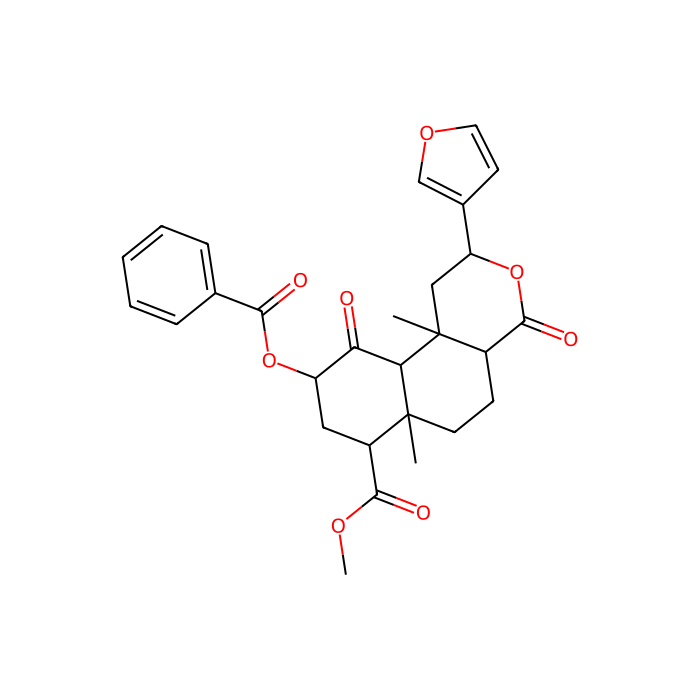
Selective μ opioid receptor agonist derived from the plant product, salvinorin A. Does not promote the recruitment of beta-arrestin-2 or lead to receptor internalization.
Storage
Store at 2-8°C,Desiccated
Verschickt in
Wet ice
Dieses Produkt erfordert Kühlkettenversand. Grundversand und andere Economy-Optionen sind nicht verfügbar.
Aktionsart
AGONIST
Hinweis
Wherever possible, you should prepare and use solutions on the same day. However, if you need to make up stock solutions in advance, we recommend that you store the solution as aliquots in tightly sealed vials at -20°C. Generally, these will be useable for up to one month. Before use, and prior to opening the vial we recommend that you allow your product to equilibrate to room temperature for at least 1 hour. Need more advice on solubility, usage and handling? Please visit our frequently asked questions (FAQ) page for more details.
This compound belongs to the class of organic compounds known as diterpene lactones. These are diterpenoids containing a lactone moiety.
External Descriptors
Not available
1. Djoumbou Feunang Y, Eisner R, Knox C, Chepelev L, Hastings J, Owen G, Fahy E, Steinbeck C, Subramanian S, Bolton E, Greiner R, and Wishart DS. ClassyFire: Automated Chemical Classification With A Comprehensive, Computable Taxonomy. Journal of Cheminformatics, 2016, 8:61.
Zertifikate (CoA, COO, BSE/TSE und Analyse-Diagramm)
C of A & Other Certificates(BSE/TSE, COO):
Analytical Chart:
Chemische und physikalische Eigenschaften
Löslichkeit
Soluble in DMSO to 100 mM
Molekulargewicht
494.500 g/mol
XLogP3
4.200
Hydrogen Bond Donor Count
0
Hydrogen Bond Acceptor Count
8
Rotatable Bond Count
6
Exact Mass
494.194 Da
Monoisotopic Mass
494.194 Da
Topological Polar Surface Area
109.000 Ų
Heavy Atom Count
36
Formal Charge
0
Complexity
909.000
Isotope Atom Count
0
Defined Atom Stereocenter Count
7
Undefined Atom Stereocenter Count
0
Defined Bond Stereocenter Count
0
Undefined Bond Stereocenter Count
0
The total count of all stereochemical bonds
0
Covalently-Bonded Unit Count
1
Lösungsrechner
Molarity Calculator
Determine the necessary mass, volume, or concentration for preparing a solution.
Dilution Calculator
Determine the dilution needed to prepare a stock solution.
Reconstitution Calculator
Bewertungen
Kundenbewertungen
Application Protocols
No supplier-validated application protocols are provided for this item in the Product Data.
General guidance for use as a research ligand/standard
Prepare a concentrated DMSO stock (e.g., 10–50 mM), aliquot, and store cold and protected from light.
For cell-based assays, titrate across a broad concentration range (e.g., 10-point 1:3 or 1:10 serial dilutions) with matched vehicle controls to define efficacy and potency.
Record solvent percentages and incubation times; verify compound integrity by LC–MS/HPLC where critical.
Please consult peer-reviewed literature and your lab’s SOPs for assay-specific parameters.
Biological Roles
Classification (literature/general)
Herkinorin is a semi-synthetic neoclerodane diterpenoid analog of salvinorin, used as a tool compound in receptor pharmacology research.
Experimental utility
Employed to interrogate G protein–coupled receptor signaling pathways using cell-based systems (e.g., cAMP, β-arrestin, ERK readouts), enabling comparative analyses of efficacy and signaling bias among related ligands.
Supports studies of ligand–receptor structure–function relationships by varying substituents on the diterpene core and assessing functional outcomes.
The presence of ester and lactone functionalities suggests potential susceptibility to hydrolysis by esterases; metabolic stability and plasma protein binding are typically evaluated empirically in discovery settings.
Important caveats
No clinical or therapeutic claims are made. Data interpretation should account for vehicle effects (e.g., DMSO) and nonspecific binding to membranes or plastics, which can alter apparent potency.
Species- and cell line–dependent response differences are common in GPCR research; use appropriate controls and replicate across systems when feasible.
Item-specific biological role statements are not provided in the Product Data; the above reflects general, literature-based use as a research ligand.
Buffer Applications
Herkinorin is not a buffering agent and is not used to control solution pH. Accordingly, classic buffer recipes and pKa-based buffering ranges do not apply.
Practical guidance
When preparing assay media, introduce herkinorin from a concentrated organic stock (e.g., DMSO) into pre-made physiological buffers (HBSS, PBS, HEPES-buffered media) at low final solvent percentages.
Ensure the buffer contains appropriate carriers (e.g., 0.1–0.5% BSA) if needed to reduce adsorption and enhance apparent solubility, provided this is compatible with the assay.
No item-specific buffering information is provided; focus on solvent selection and dosing accuracy instead.
Green Alternatives
As a solid bioactive standard, herkinorin is used in very small quantities. Environmental impact is primarily associated with the choice of dissolution and workup solvents.
Greener solvent strategies (general)
Prefer DMSO over halogenated solvents for stock solutions. DMSO offers high solvency and is biodegradable, reducing reliance on dichloromethane or chloroform for dissolution.
If alcoholic stocks are acceptable, ethanol (renewable origin possible) may substitute for DMF/ACN in some workflows, noting lower solubility and stricter tolerability in bioassays.
For extractions or preparative work, consider ethyl acetate or 2-methyltetrahydrofuran (2-MeTHF) as greener alternatives to DCM/THF when compatible with stability.
Trade-offs (balanced view)
DMSO can affect biological systems above ~0.1–0.5% v/v; careful control is required. Ethanol is more volatile and may introduce dosing variability.
2-MeTHF and CPME are less miscible with water than THF, potentially complicating aqueous workups but offering lower peroxide propensity and better EHS profiles.
Waste minimization
Prepare minimal-volume, single-use aliquots to avoid discards from repeated thaw/freeze cycles.
Consolidate solvent waste streams (non-halogenated vs halogenated) to enable optimal disposal.
Note: The product itself has no direct “green alternative”; improvements are achieved by optimizing solvent choices and minimizing waste in your workflow.
Pharmaceutical Uses
No pharmacopeial or excipient status is provided for this item. This product is supplied strictly for research use only.
Appropriate laboratory uses (non-clinical)
Analytical reference standard for method development and validation (e.g., LC–MS/MS) in discovery research contexts.
Positive control or comparator compound in in vitro pharmacology or receptor-signaling experiments.
Not for use in
Human or veterinary diagnosis, treatment, or any clinical application.
GMP manufacturing or regulated product release unless otherwise qualified by your organization’s procedures and specifications.
For any regulated use, obtain full documentation (CoA, SDS, method transfer packages) and perform internal qualification as required.
Physical Properties
Item-specific specs
Appearance: Not specified for this item; refer to CoA/Spec Sheet.
Grade/Purity: Not specified for this item; refer to CoA/Spec Sheet.
Storage and shipping (from Product Data)
Storage: Store at 2–8 °C, desiccated.
Shipping: Shipped on wet ice.
General/literature expectations for herkinorin-class neoclerodanes (non-spec, for context only)
Physical state: typically an off-white to pale solid when isolated; amorphous or crystalline depending on preparation.
Solubility: low in water; soluble in polar aprotic organic solvents (e.g., DMSO) and moderately soluble in alcohols (e.g., methanol, ethanol). Often formulated as concentrated DMSO stocks for bioassays.
Volatility: negligible at ambient temperature; decomposition may precede boiling.
Partition behavior: expected high lipophilicity due to polycyclic terpene core and multiple esters (logP >3 common for related analogs; literature, qualitative guidance only).
Spectroscopic characterization: 1H/13C NMR, IR ester/lactone C=O bands, and HRMS are routinely used for identity confirmation in research reports (literature).
Important
Quantitative values such as exact mp, bp, density, logP, pKa, refractive index for this catalog item are not specified; refer to the item’s CoA/Spec Sheet and SDS for authoritative data.
Quality and Grades
Item-specific quality information
Grade/Purity: Not specified for this item; refer to CoA/Spec Sheet for lot-specific assay and impurity profile.
How to interpret typical grades (general guidance)
Reference/analytical grade: intended for use as a qualified standard in analytical or biochemical assays; emphasizes identity and purity verification (e.g., NMR, HPLC/UPLC, HRMS).
Research grade: suitable for discovery biology and medicinal chemistry; may not carry pharmacopeial compliance or quantitative potency assignment.
Key quality attributes for herkinorin as a research ligand (general)
Identity confirmation: 1H/13C NMR with diagnostic lactone/ester signals; HRMS within ±5 ppm; IR with strong C=O stretches.
Purity profile: Chromatographic purity by HPLC/UPLC with diode-array detection to assess UV homogeneity; optional orthogonal methods (GC not typically applicable due to thermal lability).
Residual solvents/water: Monitor by KF and GC where relevant for solid-state stability; exact limits for this item are not specified.
Solid-state form: Amorphous vs crystalline can influence dissolution and assay reproducibility; check CoA for form and any polymorph notes if available.
Stabilizers/additives
No stabilizer is stated in Product Data. If an antioxidant or carrier is present, it will be listed on the CoA/Spec Sheet.
Recommendation: For quantitative pharmacology, verify lot potency via independent assay or rely on supplier’s potency assignment if provided in the CoA.
Reaction and Applications
This product is supplied as a bioactive research small molecule standard rather than a general synthetic reagent. Accordingly, its primary “applications” are in chemical biology and analytical characterization rather than serving as a reaction solvent or reagent.
Research applications (general/literature; no medical claims)
Ligand characterization: Employed in GPCR-focused studies to profile signaling efficacy and bias using assays such as cAMP modulation, GTPγS binding, β-arrestin recruitment, and ERK phosphorylation in recombinant systems.
Binding studies: Utilized in radioligand displacement or kinetic binding assays to determine affinity/kinetic parameters versus reference radioligands.
Structure–activity relationship (SAR): Functions as a benchmark analog within neoclerodane diterpenoids for probing substituent effects at ester/lactone positions.
Analytical methods development: Serves as a positive control for LC–MS/MS method validation (retention, ionization, fragmentation) in matrices relevant to pharmacology research.
Practical tips
Stock preparation: Dissolve in anhydrous DMSO; verify complete dissolution visually. Gentle warming (≤40 °C) and sonication can assist; avoid prolonged heating.
Assay compatibility: Keep final DMSO concentration low (typically ≤0.1–0.5% v/v in biological assays) and match vehicle controls.
Adsorptive losses: Pre-rinse plasticware with dilute DMSO or use low-bind plastics/glass to reduce loss at low nM concentrations.
Note: No manufacturer-specific application notes were provided; adapt conditions to your assay platform and consult primary literature for assay-specific parameters.
Reaction Conditions
As a research standard rather than a reagent, herkinorin is not associated with canonical “reaction conditions.” The most relevant laboratory conditions concern solution preparation and stability for assays and analytics.
Stock solution preparation (general)
Solvent: Anhydrous DMSO preferred; ethanol or methanol as secondary options depending on assay constraints.
Concentration: Commonly 10–50 mM, limited by solubility. Verify complete dissolution by visual inspection and, if needed, brief sonication.
Filtration: If particle-free solutions are required, use 0.2 µm PTFE filters; avoid adsorption-prone membranes.
Working solution handling
Dilute into buffers or media to a final organic content typically ≤0.1–0.5% v/v. Include matching vehicle controls.
Light/moisture sensitivity: Protect from light; minimize time in aqueous media to reduce potential ester/lactone hydrolysis.
Stability checks (good practice)
Assess short-term stability by LC–MS or HPLC after incubation under assay conditions; monitor for hydrolysis products.
Use single-use aliquots to avoid multiple freeze–thaw cycles.
No item-specific kinetic/stability constants or half-lives are provided; determine empirically under your laboratory conditions.
Safety and Handling
Regulatory/SDS status
Research Use: For research use only (Product Data). Not for human or veterinary use.
GHS classification, signal word, pictograms, H-statements: Not specified for this item; consult the SDS for official hazard classification.
General hazard considerations for lipophilic bioactive small molecules (context; defer to SDS)
May cause irritation to skin, eyes, or respiratory tract upon exposure. Avoid ingestion, inhalation of dust, or contact with skin and eyes.
Use appropriate engineering controls (chemical fume hood) when weighing or preparing solutions.
Personal protective equipment (PPE)
Safety glasses, lab coat, and appropriate chemically resistant gloves (e.g., nitrile). Avoid aerosol generation; use microspatulas for solids.
Handling practices
Work on a clean, inert surface. Minimize exposure of the solid to ambient humidity given the product’s desiccated storage requirement.
Prepare concentrated stock solutions in dry, oxygen-stable solvents (e.g., anhydrous DMSO). Filter sterilize (0.2 µm) only if needed and compatible; avoid excessive shear/adsorptive losses.
Incompatibilities and stability (general)
Protect from prolonged light and moisture. Hydrolysis of ester/lactone functionalities can be promoted by strong acids/bases and aqueous media.
Avoid strong oxidizers and strong nucleophiles.
First aid (overview; consult SDS)
Skin/eye contact: Rinse with water for several minutes. Remove contaminated clothing.
Inhalation: Move to fresh air. Seek medical advice if symptoms occur.
Ingestion: Rinse mouth. Do not induce vomiting; seek medical attention.
Always consult the official SDS accompanying the lot for definitive safety and response measures.
Solvent Selection
Herkinorin is a hydrophobic, oxygenated diterpenoid. Solvent choice primarily targets complete dissolution and chemical stability during handling and assays.
Primary solvents: DMSO (anhydrous) is preferred for concentrated stock solutions (e.g., 10–50 mM). DMF can be used as an alternative; ethanol or methanol for less concentrated stocks.
Aqueous systems: Poor intrinsic water solubility. Use co-solvent strategies (e.g., 0.1–1% DMSO final), or include solubilizers such as cyclodextrins or serum albumin in biological media when compatible.
Adsorption: Minimize nonspecific binding to plastics; use glass vials or low-bind polypropylene.
Polarity/miscibility context (literature/general)
Expected high lipophilicity; favors polar aprotic solvents. DMSO is miscible with water and enables accurate dilution into buffers at low final percentages.
Comparison with alternatives (general)
DMSO vs ethanol: DMSO offers higher solubility and lower volatility; ethanol is more volatile and has tighter biological tolerability limits.
DMF: Good solvency but less favored in bioassays due to cytotoxicity concerns at modest percentages; acceptable for synthetic or analytical prep.
Tips for solution stability
Prepare single-use aliquots to avoid repeated freeze–thaw.
Protect from light; store at 2–8 °C for working solutions (short term) or −20 °C for long-term stocks, as permitted by CoA/SDS.
Note: Exact solubility values for this item are not specified; confirm experimentally under your conditions.
Storage and Reconstitution
Item-specific storage (from Product Data)
Store at 2–8 °C, desiccated. Shipments are on wet ice. Keep container tightly closed.
Reconstitution (general best practices for hydrophobic small molecules)
Allow vial to equilibrate to room temperature in a desiccator before opening to prevent moisture condensation.
Dissolve the required amount in anhydrous DMSO to prepare a concentrated stock. If needed, gentle warming (≤40 °C) and brief sonication aid dissolution.
Prepare single-use aliquots in inert, light-protective vials or low-bind tubes to minimize adsorption and freeze–thaw.
Solution storage
Short-term: 2–8 °C, protected from light (hours to a few days, verify by assay needs).
Long-term: For extended storage, consider −20 °C or below in sealed aliquots. Avoid repeated freeze–thaw.
Stability notes
Moisture and strong acids/bases can promote hydrolysis of ester/lactone groups; maintain dry, neutral conditions for solids and solutions.
Exact shelf-life and retest intervals are not specified for this item; refer to the CoA/Spec Sheet and perform periodic QC (e.g., HPLC) for critical applications.
Always consult the SDS for compatibility and handling specifics during storage and reconstitution.
Structure and Identity
Herkinorin is a semi-synthetic neoclerodane diterpenoid analog derived from the salvinorin scaffold, offered as a research small molecule standard.
Item-specific identifiers (from Product Data)
CAS: 862073-77-6
InChIKey: Provided as “290043” in catalog; full standardized InChIKey not specified for this item; refer to CoA/Spec Sheet.
SMILES: Not specified for this item; refer to CoA/Spec Sheet.
Molecular formula: Not specified for this item; refer to CoA/Spec Sheet.
Molecular weight: Not specified for this item; refer to CoA/Spec Sheet.
Structural features (general/literature description, not item-specific specs)
Core scaffold: neoclerodane diterpene with a fused polycyclic ring system and a characteristic methyl-bearing bicyclic framework.
Functional groups: lactone ring, multiple ester functions, and several oxygenated stereocenters common to salvinorin analogs.
Stereochemistry: multiple defined chiral centers inherited from the diterpene core; herkinorin retains the rigid, stereochemically dense topology of the salvinorin family.
2D structure, described in words (literature)
A tricyclic diterpenoid backbone bearing an intracyclic ester (lactone) and an exocyclic ester at C2 replaced by an aromatic-containing substituent relative to salvinorin A; oxygenation at several ring positions and a lipophilic periphery confer low aqueous solubility.
Notes
Exact atom connectivity (SMILES/InChI) and empirical formula for this specific catalog item are not provided here; consult the CoA/SDS for definitive identifiers.
Synthetic Utility
Herkinorin itself is typically a final tool compound rather than a synthon; thus, it is not commonly used as a reagent or intermediate. However, understanding its functional groups informs potential chemical manipulations during analog synthesis or derivatization for probes.
Functional group landscape (general)
Contains a lactone and at least one exocyclic ester; multiple oxygenated stereocenters on a rigid polycyclic diterpenoid core.
Representative transformations (literature/general for neoclerodanes)
Selective ester hydrolysis/transesterification at the C2 position (relative to salvinorin A numbering) to generate analog panels.
Carbamate/urethane formation on accessible hydroxyls to modulate polarity and receptor interactions.
Etherifications and acylations leveraging secondary alcohols where sterics permit.
Installation of reporter handles (e.g., azide/alkyne tags) via linker strategies for chemoproteomics or imaging, ensuring retention of core pharmacophore interactions.
Retrosynthetic context
Semi-synthesis from salvinorin B or related intermediates via selective acyl activation/coupling under mild conditions to preserve the sensitive lactone.
Note: The above relates to general synthetic chemistry around the scaffold. No specific reaction-grade specifications or reactivity data are assigned to this catalog item.
Target Specificity
Target specificity parameters (e.g., target name, binding constants, assay-validated selectivity) are not provided for this catalog item.
General note (literature)
Herkinorin is used in receptor pharmacology research as a tool ligand; consult the primary literature for system-dependent potency and selectivity data relevant to your assay design.
For authoritative, lot-specific details, refer to the CoA and any accompanying technical notes.
Häufig gestellte Fragen
What is the purity of this product?
This product is supplied at ≥98% purity (chemical assay). Lot-specific values are stated on the Certificate of Analysis.
How should this product be stored?
Store at 2–8 °C, desiccated. Keep the container tightly closed with desiccant — the material is moisture-sensitive.
How is this product shipped?
This product ships chilled on wet ice. Unpack on arrival and transfer it to the storage condition stated above.
What are the CAS number, molecular formula and molecular weight?
The CAS Number is 862073-77-6, the molecular formula is C28H30O8, and the molecular weight is 494.53 g/mol. InChIKey PYDQMXRFUVDCHC-XAGHGKQISA-N.
What documentation is provided?
Available product documentation, including Certificates of Analysis (COA), Safety Data Sheets (SDS), and specification sheets, is shown in the product document area. Document availability and access follow the current site policy.
Wir verwenden Cookies, um die ordnungsgemäße Funktion der Website sicherzustellen und, soweit zulässig, Ihr Nutzererlebnis zu verbessern. Sie können Ihre Einstellungen jederzeit unter „Einstellungen“ verwalten. Weitere Informationen finden Sie in unserer Cookie-Richtlinie.
Dürfen wir Sie über Rabattaktionen informieren?
Später erinnern
Vielen Dank! Bitte überprüfen Sie Ihren E-Mail-Posteingang, um zu bestätigen.
Products are supplied to verified businesses, institutions, and qualified professionals for research and development use only. Not for use in humans, animals, diagnosis, or therapy.