This compound belongs to the class of organic compounds known as diphenylmethanes. These are compounds containing a diphenylmethane moiety, which consists of a methane wherein two hydrogen atoms are replaced by two phenyl groups.
External Descriptors
Not available
1. Djoumbou Feunang Y, Eisner R, Knox C, Chepelev L, Hastings J, Owen G, Fahy E, Steinbeck C, Subramanian S, Bolton E, Greiner R, and Wishart DS. ClassyFire: Automated Chemical Classification With A Comprehensive, Computable Taxonomy. Journal of Cheminformatics, 2016, 8:61.
Determine the necessary mass, volume, or concentration for preparing a solution.
Dilution Calculator
Determine the dilution needed to prepare a stock solution.
Reconstitution Calculator
Bewertungen
Kundenbewertungen
Application Protocols
No tested biological or analytical application protocols are provided for this item. For synthetic and materials use, consider the following general practices (non-item-specific):
Solution preparation: Dissolve in an appropriate organic solvent (e.g., toluene or dichloromethane) to prepare stock solutions at known concentrations for dosing into reactions or for spectroscopy.
Purification: Use normal-phase silica with nonpolar eluents (hexanes/toluene). For very lipophilic material, add a small percentage of DCM or MTBE to initiate elution. Confirm purity by 1H/13C/19F NMR and HRMS if available.
Analytical tracking: 19F NMR is a sensitive handle; two equivalent CF3 groups often appear as a singlet in the −60 to −75 ppm region (solvent dependent), aiding quick quantification by external standard.
Always adapt protocols to your specific aims and consult the CoA/SDS for item-specific constraints.
Biological Roles
This product is a small, nonpolar, fluorinated aromatic compound intended for research and materials chemistry. No biological function or role is specified for this catalog item.
General context (non-item-specific):
CF3-substituted aromatics are widely used as probes in 19F NMR due to the high sensitivity and zero natural background of fluorine in biological matrices. However, this compound is highly hydrophobic and is not designed for aqueous biological systems without formulation.
The –C(CF3)2– unit increases lipophilicity and may alter membrane interactions if embedded in amphiphiles or polymers, but such uses require dedicated safety and compatibility evaluation.
Important: Do not use for diagnostic, therapeutic, or clinical applications. For research use only (Product Data).
Buffer Applications
Not typically applicable. Hexafluoro-2,2-diphenylpropane is a neutral, water-insoluble organic compound and does not function as a buffering agent. For laboratory work, choose standard biological or biochemical buffers (e.g., phosphate, HEPES, Tris) as appropriate to your system, and consult the sections on Solvent Selection and Synthetic Utility for handling this hydrophobic material.
Green Alternatives
This material is a hydrophobic fluorinated building block/additive rather than a process solvent. “Greener alternatives” considerations relate to processing choices and to whether its function (e.g., hydrophobic/low-k contribution) can be met with less fluorinated or bio-based motifs.
Options and trade-offs (general guidance):
Solvent choice: Prefer toluene, ethyl acetate, or cyclopentyl methyl ether (CPME) over chlorinated solvents when feasible. Use heptane instead of hexane to reduce n-hexane neurotoxicity concerns.
Alternative motifs: To decrease fluorine usage, bulky hydrocarbon cores (e.g., di-tert-butyl-diphenylmethane) or siloxane-bridged diaryls can impart hydrophobicity and free volume, though typically with higher dielectric constants and different thermal/chemical resistance than –C(CF3)2– units.
Energy and EHS: Run aromatic substitutions under catalytic conditions (e.g., Pd-catalyzed cross-coupling after aryl halogenation) to reduce stoichiometric Lewis acids, minimize acid waste, and enable milder temperatures.
Comparison (qualitative):
–C(CF3)2– diaryls: excellent chemical resistance, low surface energy; higher embodied environmental impact due to fluorine content.
Hydrocarbon alternatives: lower EHS footprint; may sacrifice solvent resistance and low-k performance.
Practical approach:
Justify the use of this fluorinated unit where its performance is uniquely required.
Optimize workups to minimize halogenated solvent use; employ solvent recovery where available.
Pharmaceutical Uses
No pharmacopeial or excipient role is specified for this item; it is sold for research use only.
General, non-therapeutic context:
Hydrophobic, fluorinated aromatic scaffolds like this are occasionally explored in pre-formulation or materials contexts (e.g., as hydrophobic domains in experimental drug delivery matrices or as 19F NMR tracers). Such applications are highly specialized and require full toxicological and compatibility assessment.
This compound is not a known standard excipient and has no established compendial monograph.
Regulatory note: Not for human or veterinary use; not for clinical or diagnostic applications.
Physical Properties
Item-specific specifications:
Appearance: Not specified for this item; refer to CoA/Spec Sheet.
Molecular weight, formula, SMILES: Not specified for this item; refer to CoA/Spec Sheet.
Boiling point, melting point, density, refractive index, UV cutoff, water/peroxide/metal limits: Not specified for this item; refer to CoA/Spec Sheet.
Literature/general expectations for this structural class (qualitative; not item specifications):
Phase/volatility: Highly fluorinated arylalkanes of comparable size are typically low-volatility solids or high-boiling liquids due to increased molar mass and polarizability of CF3 groups.
Solubility profile: Expected to be insoluble in water and soluble in nonpolar/aprotic organic solvents (e.g., toluene, dichloromethane, chloroform, carbon tetrachloride, hexanes) owing to the hydrophobic aryl + CF3 content.
Polarity/logP: Very hydrophobic with large positive logP (literature trend for diarylmethanes bearing multiple CF3 groups). No pKa (non-ionizable under neutral conditions).
Practical notes (general):
Thermal behavior: CF3-substituted aryl frameworks are often thermally robust; avoid temperatures where decomposition of aryl–CF3 could occur (>250–300 C; qualitative guidance).
Spectroscopy: 19F NMR shows two equivalent CF3 groups in symmetric environments for the idealized structure; 1H/13C NMR similar to diphenylmethane derivatives but lacking benzylic CH.
Quality and Grades
Grade/Purity: Not specified for this item; refer to CoA/Spec Sheet.
Appearance: Not specified for this item; refer to CoA/Spec Sheet.
How to interpret quality for this product class (general guidance):
Research grade organofluorine building blocks are typically supplied with NMR (1H, 19F, 13C) and HPLC/GC purity metrics. If HPLC grade is specified for solvents, it implies low UV background; for solids/building blocks, reported “purity %” usually reflects area normalization on HPLC/GC or qNMR.
Stabilizers: None indicated for this item. If present in other listings (e.g., BHT), stabilizers can impact downstream reactions or analytical baselines; remove by preparative chromatography or recrystallization if necessary.
Trace analysis: Water, residual solvents, and metal content can affect moisture/air-sensitive syntheses and catalysis. For this listing, water/metal/peroxide limits are Not specified for this item; refer to CoA/Spec Sheet.
Recommendations:
Verify lot-specific purity, residual solvent profile, and identity against the Certificate of Analysis prior to use in critical applications (e.g., materials synthesis, SAR libraries).
If ultra-high purity is required (e.g., for photophysical measurements), consider additional purification (short-path distillation if liquid, or recrystallization) after confirming physical state from the CoA.
Reaction and Applications
Manufacturer Applications: Not specified in Product Data.
General research uses for this structural motif (non-item-specific):
Materials chemistry: The hexafluoroisopropylidene (–C(CF3)2–) unit is valued for imparting low dielectric constant, chemical resistance, and hydrophobicity. Diaryl frameworks bearing –C(CF3)2– are used as monomer fragments or additives to tune polymer free volume, gas permeability, and surface energy.
Physical organic probes: Two strongly electron-withdrawing CF3 groups adjacent to aryl rings provide a useful benchmark for assessing substituent effects (Hammett σ, polarizability) in electrophilic aromatic substitution and photophysical studies.
Substrate for derivatization: Although the parent compound lacks obvious functional handles, the aryl rings can undergo EAS (nitration, sulfonation, Friedel–Crafts acylation/alkylation) to introduce reactive groups for further diversification (e.g., convert to aryl halides → cross-coupling, or to nitro → aniline → cross-coupling/condensation chemistry).
Fluorous tagging without fluorous solvents: The twin CF3 groups increase fluorine content for applications that desire elevated 19F NMR signal or to modulate partitioning, while remaining compatible with conventional organic phases (not a perfluoroalkyl chain).
Practical tips:
CF3 groups are inert under most conditions; plan transformations on the aromatic rings.
Strongly deactivating –C(CF3)2– can reduce EAS reactivity versus diphenylmethane; use stronger Lewis/Brønsted acids or elevated temperatures as required, or employ directed metalation after installing a directing group.
For photophysical work, confirm absence of fluorescent impurities; purify by recrystallization or chromatography as needed.
Reaction Conditions
No item-specific reaction conditions are provided. The following are general, literature-style guidelines for common transformations on deactivated aryl systems like –C(CF3)2–-substituted diphenylmethanes (not specifications for this item):
Electrophilic aromatic halogenation: Br2/FeBr3 or NBS with Lewis acid in dichloroethane or acetic acid; 0–80 C; monitor by TLC/GC–MS. Deactivation by –C(CF3)2– may require elevated temperature or stronger catalysts.
Nitration: HNO3/H2SO4 mixed acid at 0–25 C for mono-nitration; control temperature to avoid over-nitration; work up into ice/water and extract with DCM/toluene.
Friedel–Crafts acylation: Acyl chloride/AlCl3 in DCM or nitrobenzene; 0–80 C; quench cautiously into ice to destroy Al complexes. Expect slower rates vs unsubstituted diphenylmethane.
Halogen → cross-coupling: Suzuki–Miyaura (Pd(PPh3)4, base such as K2CO3 or Cs2CO3; solvent: toluene/H2O, dioxane/H2O, or DMAc; 60–110 C). Buchwald–Hartwig amination (Pd or Ni, appropriate ligands; 80–120 C). Sonogashira (Pd/Cu, amine base; 25–80 C) under inert atmosphere.
Directed ortho metalation: With a preinstalled directing group, use s-BuLi or n-BuLi (1.1–2.0 equiv) in THF/Et2O at −78 to −40 C; quench with electrophiles (CO2, iodide, DMF). Inert atmosphere and rigorous anhydrous technique required.
Notes:
CF3 groups are stable; avoid strongly reducing or defluorinating conditions (e.g., low-valent metals at high temperature). Monitor for potential HF formation at elevated temperatures; ensure proper ventilation.
Safety and Handling
Authoritative safety data for this catalog item have not been specified. Always consult the product SDS before use.
Item-specific (from Product Data):
GHS classification, signal word, hazard (H) statements, and pictograms: Not specified for this item; refer to SDS.
Storage conditions: Room temperature (Product Data). Shipments: Normal (ambient) (Product Data).
General safety guidance for fluorinated, hydrophobic aromatic compounds (non-item-specific):
Likely hazards: May cause skin/eye irritation and respiratory irritation to dust/vapors. Treat as combustible organic material. Avoid generating dust or aerosols; use in a fume hood.
PPE: Wear lab coat, safety glasses, and appropriate chemical-resistant gloves (e.g., nitrile). Use splash protection when handling larger quantities.
Incompatibilities: Strong oxidizers (risk of exothermic reaction), strong electrophiles, and very strong bases under forcing conditions. Avoid contact with reactive metals in the presence of strong bases.
Thermal decomposition: Overheating can generate HF and other corrosive/irritating fluorinated byproducts; ensure adequate ventilation and temperature control.
First aid (overview): If inhaled—move to fresh air; seek medical attention if symptoms persist. Skin/eye contact—rinse with water for at least 15 minutes; remove contaminated clothing; seek medical attention as needed. If ingested—rinse mouth; do not induce vomiting; seek medical care.
Waste: Collect and dispose in accordance with institutional and local regulations for fluorinated organic waste.
Solvent Selection
Because Hexafluoro-2,2-diphenylpropane is a neutral, highly hydrophobic aryl–CF3 framework rather than a solvent, “solvent selection” concerns optimal media to dissolve and process it.
Polarity/miscibility expectations (general): Poorly soluble in water; good solubility anticipated in nonpolar to moderately polar aprotic organics such as toluene, xylene, chlorinated solvents (DCM, chloroform), and possibly ethers (THF, diethyl ether). Limited solubility expected in highly polar protic media (MeOH, H2O).
Selection by task:
Reaction medium for electrophilic aromatic substitution (EAS): nitrobenzene, dichloroethane, or CS2 are classical; toluene/DCM often sufficient with modern protocols.
Halogenation/metalation sequences: use ethereal solvents (THF/Et2O) at low temperature for directed ortho-lithiation after pre-functionalization; ensure rigorous dryness.
Purification: normal-phase silica gel with nonpolar eluents (hexanes/toluene) is typical; chlorinated solvents can help elute very lipophilic material.
Handling concentration: Prepare stock solutions in toluene or DCM for dosing into reactions or for analytical injections; verify stability and solubility beforehand.
Quick comparison (general, qualitative):
Toluene: greener than chlorinated solvents, good solubilizer for aryls, high bp for thermal steps.
DCM/CHCl3: excellent solvency; higher environmental/health burdens—use when necessary and capture vapors.
THF: useful for organometallic steps; ensure inhibitor and peroxide testing as appropriate (general solvent practice).
Storage and Reconstitution
Storage temperature: Room temperature (Product Data). Protect from moisture and strong oxidants; store tightly capped in a dry place.
Shipping: Normal ambient conditions (Product Data).
Reconstitution/solution preparation: Not applicable (neat solid/liquid). To prepare solutions, dissolve the material in a suitable organic solvent (e.g., toluene, dichloromethane, THF) under ambient conditions. Sonication or gentle warming may assist dissolution; avoid excessive heat.
Stability: Item-specific stability data are Not specified for this item; refer to CoA/Spec Sheet. In general, aryl–CF3 compounds are stable to air and light; minimize prolonged exposure to strong UV and high heat.
Freeze–thaw: Not typically relevant. If storing solutions, keep in sealed amber vials under inert gas at 2–8 C to limit solvent evaporation and oxidation of co-dissolved species.
Container compatibility: Use glass. Avoid reactive metals and ensure caps/liners are compatible with chosen solvent (PTFE-lined closures are recommended for chlorinated solvents).
Structure and Identity
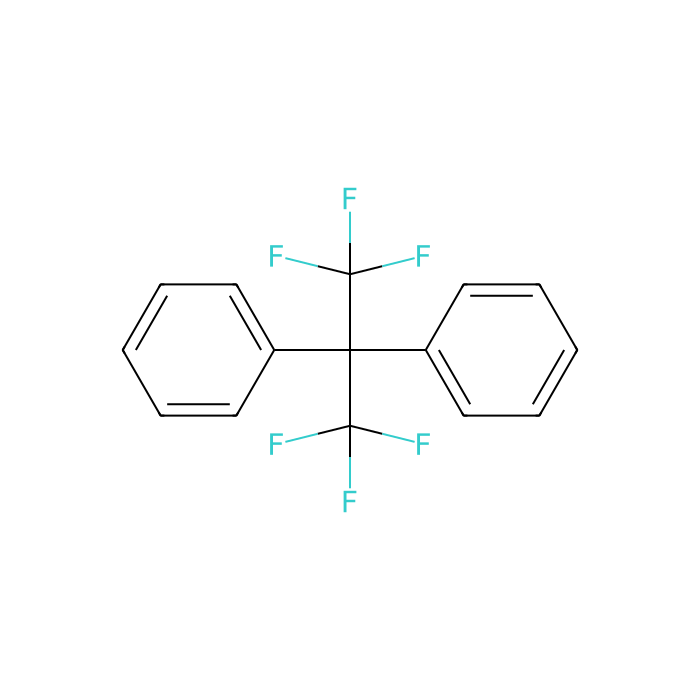
Hexafluoro-2,2-diphenylpropane is a perfluoroalkylated diarylmethane featuring two phenyl rings attached to a quaternary central carbon that also bears two trifluoromethyl groups, giving a rigid, highly lipophilic framework.
CAS: 83558-76-3 (Product Data)
InChIKey: Not specified for this item; refer to CoA/Spec Sheet. (Product Data provided value appears incomplete)
SMILES: Not specified for this item; refer to CoA/Spec Sheet.
Molecular Formula: Not specified for this item; refer to CoA/Spec Sheet.
Molecular Weight: Not specified for this item; refer to CoA/Spec Sheet.
Structural features (general description):
Core scaffold: a quaternary sp3 carbon bound to two phenyl rings (diphenylmethyl core) and two –CF3 groups (hexafluoroisopropylidene unit).
Functional groups: two electron-withdrawing trifluoromethyl substituents; two neutral, conjugated phenyl rings.
Stereochemistry: none (achiral quaternary center with two identical CF3 groups and two identical aryl groups; meso/optical activity not expected).
2D description: Ph–C(–CF3)(–CF3)–Ph, with both phenyl rings coplanar with respect to the central carbon to varying degrees, and CF3 groups oriented to minimize steric clash (qualitative, general knowledge).
Literature note (non-item-specific): similar hexafluoroisopropylidene diaryl motifs are found in fluorinated materials chemistry; exact identifiers for this specific compound should be confirmed on the item CoA.
Synthetic Utility
Reactivity overview (general):
The –C(CF3)2– substituent is strongly electron withdrawing and sterically demanding, rendering the aryl rings deactivated toward electrophilic aromatic substitution (EAS) relative to diphenylmethane. Nonetheless, EAS can proceed under stronger conditions (e.g., nitration, sulfonation, halogenation) to introduce functional handles.
The CF3 groups are normally inert to nucleophiles, bases, and oxidants under standard conditions, providing a robust perfluoroalkyl motif.
Strategic transformations:
Ring functionalization → cross-coupling: Introduce halogens (Br/I) via EAS or directed metalation followed by quench; then perform Suzuki–Miyaura, Buchwald–Hartwig, or Sonogashira couplings to elaborate the aryl positions.
Nitration/reduction pathway: Nitrate under controlled conditions; reduce to anilines and diversify via diazotization (Sandmeyer) or urea/amidation chemistry.
Electrophilic acylation/alkylation: Friedel–Crafts reactions can install carbonyl or alkyl groups; Lewis acid loading and temperature may need to be higher due to deactivation by –C(CF3)2–.
Directed ortho metalation (DoM): After installing a directing group (e.g., acyl, amide), ortho lithiation in THF/Et2O at low temperature allows access to otherwise inaccessible substitution patterns; quench with electrophiles (CO2, aldehydes, halogens).
Utility:
Serves as a bulky, lipophilicity-raising core in target molecules where steric shielding and low polarizability at the periphery are desired.
Useful as a 19F NMR-labeled scaffold (two equivalent CF3 groups) for tracking and quantification in organic media.
Target Specificity
Not applicable. This product is a small organic compound, not an antibody, enzyme, or affinity reagent. No target, epitope, clone, isotype, or species reactivity is associated with this catalog item.
Wir verwenden Cookies, um die ordnungsgemäße Funktion der Website sicherzustellen und, soweit zulässig, Ihr Nutzererlebnis zu verbessern. Sie können Ihre Einstellungen jederzeit unter „Einstellungen“ verwalten. Weitere Informationen finden Sie in unserer Cookie-Richtlinie.
Shall we send you a message when we have discounts available?
Remind me later
Thank you! Please check your email inbox to confirm.
Products are supplied to verified businesses, institutions, and qualified professionals for research and development use only. Not for use in humans, animals, diagnosis, or therapy.

 I2621579