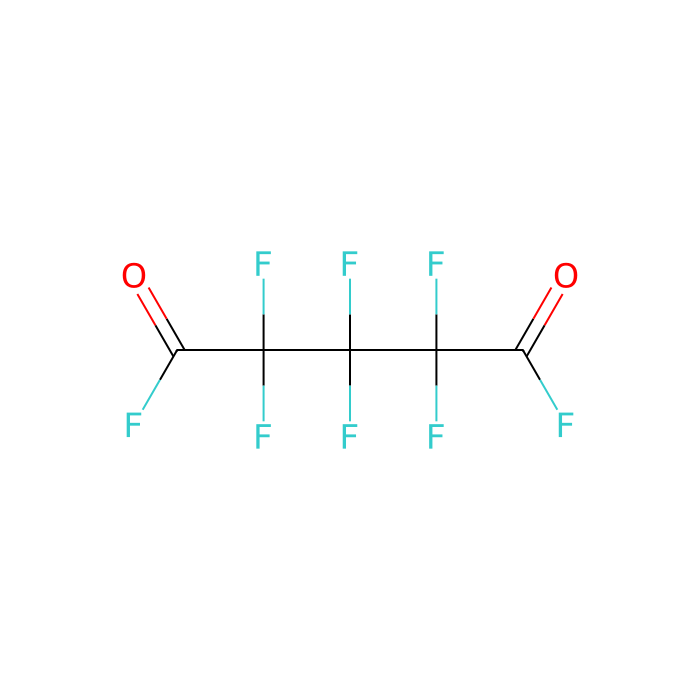
This compound belongs to the class of organic compounds known as acyl fluorides. These are organic compounds containing the functional group -CO-F.
External Descriptors
Not available
1. Djoumbou Feunang Y, Eisner R, Knox C, Chepelev L, Hastings J, Owen G, Fahy E, Steinbeck C, Subramanian S, Bolton E, Greiner R, and Wishart DS. ClassyFire: Automated Chemical Classification With A Comprehensive, Computable Taxonomy. Journal of Cheminformatics, 2016, 8:61.
Zertifikate (CoA, COO, BSE/TSE und Analyse-Diagramm)
C of A & Other Certificates(BSE/TSE, COO):
Analytical Chart:
Chemische und physikalische Eigenschaften
Siedepunkt (°C)
46-47° C
Molekulargewicht
244.040 g/mol
XLogP3
2.300
Hydrogen Bond Donor Count
0
Hydrogen Bond Acceptor Count
10
Rotatable Bond Count
4
Exact Mass
243.977 Da
Monoisotopic Mass
243.977 Da
Topological Polar Surface Area
34.100 Ų
Heavy Atom Count
15
Formal Charge
0
Complexity
267.000
Isotope Atom Count
0
Defined Atom Stereocenter Count
0
Undefined Atom Stereocenter Count
0
Defined Bond Stereocenter Count
0
Undefined Bond Stereocenter Count
0
The total count of all stereochemical bonds
0
Covalently-Bonded Unit Count
1
Lösungsrechner
Molarity Calculator
Determine the necessary mass, volume, or concentration for preparing a solution.
Dilution Calculator
Determine the dilution needed to prepare a stock solution.
Reconstitution Calculator
Bewertungen
Kundenbewertungen
Application Protocols
Not applicable in the context of immunoassays or bioassays (e.g., WB, IHC, IF, FC). This product is a reactive chemical used in synthetic chemistry. For practical use, refer to the Reaction Conditions and Application notes sections for step-by-step guidance on handling and coupling reactions.
Biological Roles
This product is a synthetic, perfluorinated diacyl fluoride intended for research and chemical synthesis. It is not a metabolite or biomolecule and has no known endogenous biological role.
General context (literature)
Perfluorinated aliphatic linkers are sometimes used to modulate surface energy, hydrophobicity, and chemical resistance of materials and coatings; incorporation can affect biomaterial–protein interactions through reduced surface energy.
Acyl fluorides are reactive electrophiles that can acylate nucleophilic residues in proteins under forcing conditions; however, this reagent is not designed for biological labeling and is not typically used in bioconjugation due to HF hazards and broader reactivity.
Research-use framing
For research use only (per Product Data). Not for diagnostic, therapeutic, or other clinical applications.
If contacting biological matrices, anticipate rapid quenching by amines and hydroxyls and potential HF formation; apply rigorous containment and quench protocols.
In practice, chemists employ this reagent in synthetic/materials workflows rather than biological systems. For biochemical applications requiring fluorinated linkers, consider pre-formed amide/ester building blocks derived from this reagent instead of the acid fluoride itself.
Buffer Applications
Not typically applicable. Hexafluoroglutaryl fluoride is a moisture-sensitive, reactive acylating agent and is unsuitable for aqueous buffer preparation or use. If aqueous workup is required after a reaction, hydrolysis will convert it to the corresponding diacid with concomitant HF formation; neutralize carefully and follow HF-safe procedures.
Green Alternatives
When choosing an acylating reagent, consider reactivity, byproducts, and solvent/process mass intensity. Acyl fluorides like hexafluoroglutaryl fluoride can offer cleaner byproduct profiles (HF) compared to acid chlorides (HCl + chlorinated waste), but HF poses significant safety and waste-neutralization challenges.
Comparison of options (literature-based)
| Option | Reactivity | Hydrolytic stability | Byproduct | Safety/Waste considerations |
|---|---|---|---|---|
| Hexafluoroglutaryl fluoride | High toward amines/alcohols | Moderate (better than acid chlorides; still moisture sensitive) | HF | HF hazards; neutralization needed (Ca/Mg salts) |
| Corresponding diacid + coupling agent (e.g., CDI, DCC, EDC) | Tunable | Good (diacid stable) | Urea salts/imidazole | Solid waste generation; easier handling, often less corrosive |
| Acid chloride analogue | Very high | Lower (more prone to hydrolysis) | HCl | Corrosive gas evolution; often higher chlorinated waste |
| Symmetric anhydride | Moderate–high | Moderate | Carboxylate | Fewer inorganic wastes; may require activating catalysts |
Greener process tips
Favor solvents with better EHS profiles (e.g., 2-MeTHF or CPME vs DCM/THF) if compatible; verify stability toward the reagent.
Employ micro- or flow-chemistry to minimize HF exposure and improve heat/mass transfer.
Implement in-line HF scrubbing/neutralization (e.g., basic resin or CaCO3-packed traps) and closed transfers to reduce emissions.
Evaluate using the diacid with catalytic coupling (e.g., organocatalysts, enzymatic systems where feasible) when the perfluoro-spacer is still desired but direct acyl fluoride handling is to be avoided.
Pharmaceutical Uses
This product is not an excipient and is not intended for clinical use. No pharmacopeial monograph is indicated.
Formulation/manufacturing context (general)
Highly reactive acid fluorides are occasionally used in process development settings to form amide/ester linkages en route to APIs or fluorinated intermediates, but their corrosivity and HF hazards typically preclude use in finished dosage forms.
For GMP or scale-up, alternative activation strategies (e.g., coupling reagents with the corresponding diacid, in situ mixed anhydrides) are often preferred to reduce HF handling and improve process safety.
Regulatory considerations
Any application would require robust controls for HF generation, containment, and neutralization, along with impurity fate-and-purge assessments.
No therapeutic claims are made. For research and development use only (per Product Data).
Physical Properties
Item-specific specifications are not provided in the Product Data; consult the CoA/Spec Sheet for certified values.
Item-specific values
Appearance: Not specified for this item; refer to CoA/Spec Sheet.
Grade/Purity: Not specified for this item; refer to CoA/Spec Sheet.
Literature/computed properties (non-binding, for guidance only)
Molecular formula: C5F8O2 (computed from structure rationale)
Molecular weight: ~244.04 g/mol (calculated)
Physical state: Typically a colorless to pale liquid for related short-chain diacyl fluorides (literature generalization)
Boiling point: Not firmly established in common handbooks for this exact compound; diacyl fluorides of similar size often distill under reduced pressure (literature trend). Use short-path under inert atmosphere if purification is required.
Density: Not specified in authoritative sources for this exact compound.
Refractive index: Not specified.
Solubility: Miscible with many aprotic organic solvents (e.g., DCM, toluene, acetonitrile, ethers) and reacts with water to give the diacid and HF (literature behavior of acyl fluorides).
LogP: Not established; perfluoro-spacer generally increases hydrophobicity.
Practical notes (general)
Moisture sensitivity: Hydrolyzes; handle under dry inert gas.
Volatility: Expect appreciable vapor pressure; use a well-ventilated hood and cold traps during evaporation to minimize HF/acyl fluoride exposure.
All numerical values above are literature/computed guidance only; do not treat as product specifications.
Quality and Grades
Item-specific grade/purity: Not specified for this item; refer to CoA/Spec Sheet.
Interpreting grades for reactive acid derivatives (general guidance)
High-purity/lowsalt grades minimize adventitious water and ionic impurities that can catalyze hydrolysis or side reactions. For acyl fluoride couplings, low hydrolysable halide/acid content helps reduce HF evolution during storage and handling.
Chromatography-suitable (if offered) implies low UV-absorbing impurities and compatibility with moisture-controlled workflows.
Stabilizers and inhibitors
None are specified for this item. For related acyl fluorides, stabilizers are uncommon; instead, dryness and low-temperature storage are used to suppress hydrolysis. If any stabilizer is present, it will be listed on the CoA and may need to be removed prior to sensitive syntheses.
Recommended QC checks prior to use (general best practice)
Titrate acid fluoride content by 19F NMR integration vs. internal standard, or verify purity by GC/GC-MS under inert conditions.
Check for hydrolysis to the corresponding diacid (appearance of strong acid impurities) by IR (loss of ν(CO–F) and growth of ν(C=O)acid/ν(OH)).
Water content: Karl Fischer on a quickly withdrawn, cold aliquot (if feasible) to assess handling losses. Treat values as process control; item-specific limits are not provided.
Reaction and Applications
Hexafluoroglutaryl fluoride (literature: perfluoroglutaroyl difluoride) functions as a bifunctional acylating reagent enabling incorporation of a perfluoroalkylene spacer into molecules and materials.
Representative transformations (literature)
Formation of diamides/oligoamides by coupling with diamines; HF is generated and must be scavenged by base (e.g., DIPEA, pyridine). Useful for fluorinated linkers and surface modifiers.
Diester and half-ester formation with alcohols/diols under base or Lewis base catalysis (e.g., DMAP), enabling perfluoroalkylene diesters.
Conversion to the corresponding diacid via controlled hydrolysis; subsequent transformations to salts, esters, or anhydrides.
Step-growth polymerizations with aromatic diamines to access fluorinated poly(amide-acid) precursors followed by cyclodehydration to polyimides (perfluoro-spacer can enhance chemical resistance and lower dielectric constant).
Chemoselectivity and mechanism
The –C(=O)F group is a strong acylating moiety; nucleophilic acyl substitution proceeds via tetrahedral intermediate collapse with HF expulsion.
Amines generally react faster than alcohols; intramolecular catalysis (e.g., DMAP) accelerates esterification.
The perfluorinated chain is electronically withdrawing, potentially increasing acyl electrophilicity relative to hydrocarbon analogues.
Practical considerations
Maintain anhydrous conditions to limit competitive hydrolysis to diacid.
Include stoichiometric or slight excess tertiary amine base to neutralize HF and prevent product/protonation.
For step-growth formations, use high dilution and precise stoichiometry to control molecular weight; monitor by 19F and 13C NMR (loss of acyl fluoride signal, growth of amide/ester carbonyl signals).
Reaction Conditions
General literature guidance for using diacyl fluorides; adjust to your substrates and consult primary sources. Values below are not product specifications.
Amidation (diamine coupling to diamide)
Solvent: DCM, DCE, toluene, or MeCN (anhydrous)
Base: 2.0–2.5 equiv DIPEA or triethylamine per acyl fluoride equivalent to neutralize HF
Temperature: 0–25°C; start cold to manage exotherm, then allow to warm
Time: 1–6 h typically; monitor by 19F/IR
Notes: Add diamine solution to acid fluoride under inert gas; maintain stoichiometry to avoid crosslinking in polymerizations.
Esterification (diol to diester)
Solvent: DCM or toluene; catalytic DMAP (0.05–0.20 equiv) plus 2.0–2.5 equiv tertiary amine per acyl group
Temperature: 0–40°C
Notes: If selective monoester desired, limit equivalents and perform at lower temperature in more polar solvent (MeCN) to tune rates.
Hydrolysis to diacid (for reference/quench)
Medium: Aqueous bicarbonate with external cooling
Caution: HF formation; use CaCO3/Ca(OH)2 scrubs and PPE; maintain pH > 7 during quench and neutralization.
Workup and purification
Quench residual acyl fluoride with cold, buffered aqueous base in a controlled manner.
Remove inorganic salts; for sensitive products, avoid silica gel containing residual moisture/acidity. Neutral alumina or rapid chromatography recommended.
Typical outcomes (literature)
Diamide/diester formations often proceed in good to excellent yields (60–90%) under dry, base-scavenged conditions.
Safety and Handling
Always consult the SDS for authoritative safety information. Item-specific GHS details are not provided in Product Data.
Item-specific hazard data
Signal word: Not specified for this item; refer to SDS.
H-statements: Not specified for this item; refer to SDS.
GHS classification/pictograms: Not specified for this item; refer to SDS.
General hazards of acyl fluorides and perfluorinated diacyl fluorides (literature)
Corrosive and lachrymatory; hydrolysis releases hydrogen fluoride (HF), a severe systemic toxin and corrosive.
Reacts vigorously with water, alcohols, amines, and bases; exotherms possible.
Vapors may irritate eyes and respiratory tract; use only in a certified chemical fume hood.
PPE and engineering controls (good practice)
Wear chemical-resistant gloves (e.g., heavy nitrile or laminated barrier; verify HF breakthrough data), lab coat, and splash goggles or face shield.
Work under dry inert atmosphere when charging reactions; use HF-rated compatible materials where possible.
Keep calcium gluconate gel available in laboratories handling potential HF-releasing substances; follow institutional HF protocols.
Incompatibilities and storage cautions (general)
Avoid moisture, alcohols, strong bases, strong nucleophiles, and oxidizers.
Store tightly closed under dry inert gas at 2–8°C (Product Data) away from acids/bases and sources of heat.
First-aid overview (general guidance; defer to SDS)
Skin/eye: Immediate decontamination with copious water; for suspected HF exposure, apply calcium gluconate gel and seek urgent medical attention.
Inhalation: Move to fresh air; seek medical evaluation.
Ingestion: Do not induce vomiting; seek immediate medical help.
Solvent Selection
This compound is a moisture-sensitive, electrophilic diacyl fluoride. Solvent choice should balance substrate solubility, control of reactivity, and suppression of hydrolysis.
Polarity and miscibility (general)
Expected to be soluble in common aprotic organic solvents: dichloromethane (DCM), 1,2-dichloroethane (DCE), toluene, acetonitrile (MeCN), ethers (THF, MTBE), and polar amide solvents (DMF, DMAc). Avoid protic solvents and water.
Selection by transformation
Amidation with diamines: DCM or toluene with a tertiary amine base (e.g., DIPEA, triethylamine) to scavenge HF; MeCN can enhance rates with polar substrates.
Esterification with alcohols: DCM or toluene; include base or catalytic DMAP while maintaining anhydrous conditions.
Controlled partial acylation: Use lower temperatures (0–10°C) in DCM/MeCN to favor monoacylation of difunctional nucleophiles.
Comparison notes (literature trends)
Versus acid chlorides: Acyl fluorides are often slightly less hydrolytically labile yet remain highly reactive toward amines/alcohols; they can offer improved selectivity and cleaner byproduct profiles (HF vs HCl).
Versus anhydrides: Greater chemoselectivity toward amines; reduced scrambling in some coupling scenarios.
Practical tips
Dry solvents rigorously (molecular sieves or distillation) and maintain inert atmosphere.
Avoid coordinating bases that could form stable acyl–base adducts; tertiary amines are generally suitable.
Consider phase-transfer setups for challenging nucleophiles, but ensure strictly anhydrous conditions.
Storage and Reconstitution
Item-specific storage and shipping
Storage conditions: Store at 2–8°C (Product Data). Maintain in a tightly sealed container under dry inert gas to minimize hydrolysis.
Shipped: Wet ice (Product Data).
General handling/storage best practices (literature)
Moisture sensitive: Open only in a dry box or under a dry inert gas blanket. Backfill with nitrogen/argon after use.
Container choice: Use compatible fluoropolymer-lined caps or glass with PTFE-lined seals to resist HF/byproduct.
Dispensing: Pre-chill, use gas-tight syringes or cannula transfer to limit vapor exposure. Quickly recap and return to cold storage.
Stability considerations
Susceptible to hydrolysis forming the corresponding diacid and HF; rate increases with temperature and moisture.
Periodically verify integrity by IR (ν(C=O) of acyl fluoride) or 19F NMR if stored long-term.
Reconstitution
Not applicable. If solidification occurs at low temperature, gently warm to room temperature under inert gas to ensure homogeneity before use; do not add solvents containing water or protic impurities.
For research use only (per Product Data). Always consult the CoA/SDS for authoritative guidance on storage, stability, and safe handling.
Structure and Identity
A perfluorinated bifunctional acyl fluoride derived from glutaric acid; useful as a highly reactive diacylating reagent.
Item-specific identifiers (from Product Data)
SKU: H331066
Product name: Hexafluoroglutaryl fluoride
CAS: 678-78-4
CID: 69622
InChIKey: 412841 (as provided)
Literature/computed identifiers (for reference; not item-specific specs)
Note: Structural/literature identifiers are for educational reference; consult the product CoA/SDS for definitive item-specific identity data.
Synthetic Utility
As a symmetrical diacyl fluoride, hexafluoroglutaryl fluoride is a powerful bifunctional electrophile for constructing fluorinated linkers and materials.
Functional group behavior (literature)
–C(=O)F groups undergo nucleophilic acyl substitution with amines (amide formation), alcohols (ester formation), and thiols (thioesters), liberating HF. The perfluoroalkylene spacer is strongly electron-withdrawing, often increasing acylation rates.
Relative to acid chlorides, acyl fluorides can show enhanced selectivity and reduced side reactions (e.g., fewer rearrangements, less overacylation in some cases), while remaining sufficiently reactive under mild conditions.
Uses in synthesis
Step-growth polymerizations with diamines/diols to access fluorinated polyamides and polyesters; subsequent cyclodehydration affords polyimides when paired with aromatic diamines/diacids.
Preparation of bifunctional handles: Convert to monoamide–acid fluoride intermediates for sequential, orthogonal couplings (first amide, then ester/amide at the remaining fluoride).
Surface modification: Reaction with aminosilanes or amino-terminated polymers to introduce perfluorinated segments that reduce surface energy.
Retrosynthetic value
Serves as an activated equivalent of perfluoroglutaric acid, circumventing separate activation steps (e.g., mixed anhydrides or carbodiimides) and minimizing urea byproducts.
Characterization tips
19F NMR: Distinct signals for acyl fluoride fluorines vs. CF2 groups; monitor disappearance of acyl fluoride resonances upon reaction.
IR: Strong ν(C=O) near 1810–1840 cm−1 typical for acyl fluorides; disappearance indicates consumption.
Target Specificity
Not applicable. This product is a small-molecule acylating reagent and is not an antibody, enzyme, or affinity reagent. No target/epitope specificity information is associated with this item.
Wir verwenden Cookies, um die ordnungsgemäße Funktion der Website sicherzustellen und, soweit zulässig, Ihr Nutzererlebnis zu verbessern. Sie können Ihre Einstellungen jederzeit unter „Einstellungen“ verwalten. Weitere Informationen finden Sie in unserer Cookie-Richtlinie.
Shall we send you a message when we have discounts available?
Remind me later
Thank you! Please check your email inbox to confirm.
Products are supplied to verified businesses, institutions, and qualified professionals for research and development use only. Not for use in humans, animals, diagnosis, or therapy.