QUALITÄT & REINHEITExactAb™?ExactAb™ — Aladdin's antibody line emphasizing precision and validated quality. Use for reliable, specificity-validated antibody applications.Validated?Validated grade — performance confirmed in defined applications before release. Use when you want documented assurance the reagent works as stated.0.5 mg/mL
ExactAb™, Validated, 0.5 mg/mL ExactAb™,Validated für empfindliche chromatographische und analytische Workflows, die minimale Basislinieninterferenzen erfordern.
🌡
Lagerung & Versand
Store at 2-8°C,Protected from light,Do not freeze Versand Wet ice,Do not freeze. Genaue Spezifikationen finden Sie im chargenspezifischen COA.
📋
Qualitätsdokumente
SDS, COA, Datenblatt und Spezifikationsblatt stehen zum Download bereit. Chargenspezifische COA über Chargennummernsuche abrufbar.
📚
Literaturbeleg
In 0 peer-reviewten Publikationen zu Chromatographie, organischer Synthese und Kreuzkupplungsreaktionen zitiert.
Übersicht
Human IgG2, Recombinant (IB2), Isotype Control, could be used for Flow Cytometry.
Spezifikationen
Product Name
Human IgG2-Kappa (Biotin) - Isotyp-Kontrollantikörper
Synonyme
Human IgG2 | Human IgG2 Isotype Control | Human IgG2 antibody | Human IgG2 Isotype Control antibody
Spezifikationen & Reinheit
ExactAb™, Validated, 0.5 mg/mL
Wirtsspezies
Mensch
Konjugation
Biotin
Note
ExactAb™, Validated
Lichterketten-Typ
kappa
Verfahren zur Reinigung
Protein G purified
Konzentration
0.5 mg/mL
Product Line
Biologische Produkte
Lagerung und Versand
Storage
Store at 2-8°C,Protected from light,Do not freeze
Verschickt in
Wet ice,Do not freeze
Stabilität und Lagerung
The antibody solution should be stored undiluted between 2°C and 8°C, and protected from prolonged exposure to light. Do not freeze.
Bilder
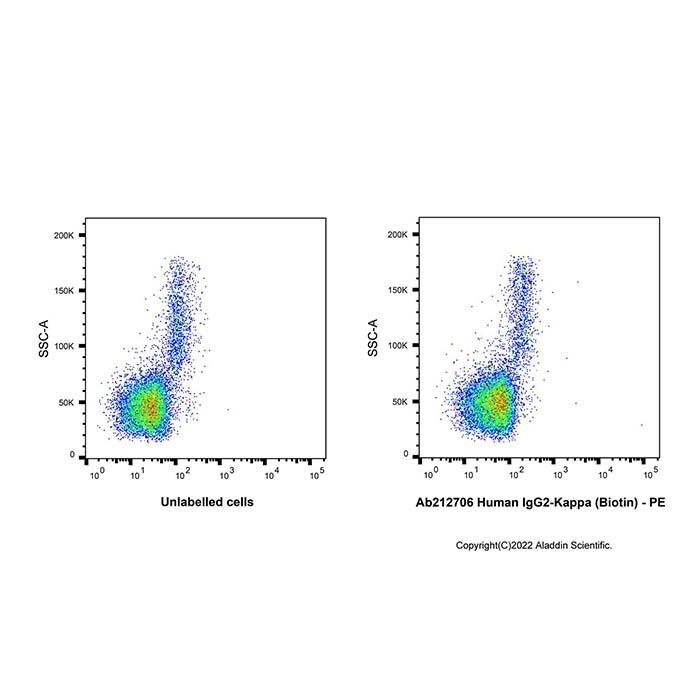
Human IgG2-Kappa (Biotin) (Ab212706) - Flow Cytometry Human peripheral blood cells were stained with Human IgG2-Kappa (Biotin) (Ab212706) (right panel) at 0.1μg/test for 1 hour at 4°C. Then incubated with Recombinant Streptavidin Protein (R-PE) (rp156150) at 0.1μg/test for 30 minutes at 4°C in the dark. Left panel - Unlabelled control, cells without incubation with primary antibody.
Human IgG2-Kappa (Biotin) (Ab212706) - Flow Cytometry Human peripheral blood lymphocytes were stained with Human IgG2-Kappa (Biotin) (Ab212706) (blue) at 0.1μg/test for 1 hour at 4°C. Then incubated with Recombinant Streptavidin Protein (R-PE) (rp156150) at 0.1μg/test for 30 minutes at 4°C in the dark. Black - Unlabelled control, cells without incubation with primary antibody.
Anwendung
Anwendung
Dilution info
Flow Cytometry
Use at an assay dependent concentration. Each lot of this antibody is quality control tested by flow cytometric analysis as negative control. Use at concentrations comparable to those of the speci
Dokumentation
📋 Sicherheitsdatenblatt (SDS)
Umfassendes Dokument zu Gefahren, Handhabung, Lagerung und Einhaltung regulatorischer Vorschriften.
Determine the necessary mass, volume, or concentration for preparing a solution.
Dilution Calculator
Determine the dilution needed to prepare a stock solution.
Reconstitution Calculator
Bewertungen
Kundenbewertungen
Application Protocols
Item-specific, tested applications and recommended conditions are not provided for this product.
Validated applications (e.g., WB, IHC, IF, FC), suggested dilutions, retrieval methods, and positive control samples: Not specified for this item; refer to CoA/Spec Sheet.
Note
For general usage guidance, see Reaction & Applications and Buffer Applications sections; however, final conditions should be determined empirically and verified against the product’s CoA/SDS when available.
Biological Roles
General biology of human IgG2κ (literature; not item-specific claims)
Function: IgG antibodies mediate antigen recognition via Fab regions and effector functions via Fc. IgG2 is associated with responses to polysaccharide antigens and displays a more rigid hinge compared to IgG1, influencing flexibility and antigen reach.
Light chain type: κ (kappa) light chain pairs with γ2 heavy chains to form the IgG2κ isotype. In humans, κ:λ ratio is ~2:1 in serum (population-dependent).
Fc interactions: Human IgG2 has reduced affinity for certain Fcγ receptors relative to IgG1, affecting ADCC/ADCP potential; complement activation is generally weaker (literature trends).
Glycosylation: Conserved N-glycan at Asn297 modulates Fc conformation and interactions; glycoform heterogeneity influences biophysical behavior.
Serum abundance: IgG2 constitutes roughly 20–25% of total IgG in adult human serum (literature ranges).
Relevance to laboratory use
Isotype controls: IgG2κ is often selected to match subclass and light chain of a test mAb, allowing assessment of non-antigen-specific binding under identical conditions.
Conjugation with biotin: Provides a universal handle for high-affinity linkage to streptavidin/avidin, enabling signal amplification and modular assay design.
Caveats
Endogenous biotin: Tissues/cells with high endogenous biotin can yield background; include appropriate blocking or controls.
This product is for research use only; no clinical or diagnostic claims are made.
Buffer Applications
Applicability
Buffer selection is central to performance and stability of biotinylated IgG2κ.
Common buffer systems (general)
PBS (10 mM phosphate, 137 mM NaCl, 2.7 mM KCl, pH 7.2–7.6): Broadly compatible with ELISA, blotting, and most immunoassays.
TBS (25–50 mM Tris, 150 mM NaCl, pH 7.4–8.0): Preferred when phosphate interferes (e.g., alkaline phosphatase detection) or for certain surface chemistries.
Blocking buffers: 1–5% BSA, casein, fish gelatin, or commercial blockers to reduce nonspecific binding in streptavidin-based systems.
Wash buffers: PBS or TBS + 0.05% Tween-20 to reduce background without compromising biotin–streptavidin interactions.
Storage stabilizers: Sugars (e.g., 2–5% trehalose/sucrose), amino acids (arginine), and carrier proteins can mitigate aggregation; presence in this item is not specified.
Metal ions: Typically have minimal direct impact; chelators (EDTA) are generally compatible with biotin–streptavidin.
Filtration: 0.22 µm sterile filtration can reduce bioburden and particulates if compatible with the formulation.
Biotin background: Use biotin-free blockers and verify that sample matrices (serum, cell lysates) do not introduce free biotin that competes with binding.
Item-specific information
Exact buffer formulation and any preservative for SKU Ab212706: Not specified for this item; refer to CoA/Spec Sheet.
Green Alternatives
Context
Antibody workflows are typically aqueous and align well with green chemistry principles by avoiding volatile organic solvents. Environmental impact often stems from preservatives, chromogenic substrates, and wash solutions rather than the antibody itself.
Greener practice suggestions (general)
Detection chemistries: Prefer enzymatic substrates with lower hazard profiles (e.g., TMB over OPD; avoid DAB where feasible) and implement proper waste segregation.
Preservatives: Where regulatory and biosafety conditions permit, use low-toxicity preservatives or single-use aliquots to eliminate azide/mercurials. Presence of preservatives in this item is not specified.
Wash buffers: Use minimal effective volumes and optimize surfactant concentration (e.g., 0.05% Tween-20) to reduce chemical load while maintaining performance.
Reusability: Employ regenerable streptavidin biosensors with mild regeneration buffers to extend consumable lifetimes.
Plastics reduction: Transition to reusable reservoirs and wash manifolds; select low-adsorption plastics to minimize protein waste.
Comparison (general)
Biotin–streptavidin vs direct labeling:
Biotin–streptavidin: High sensitivity and modularity; added step and potential for endogenous biotin background.
Direct conjugates (e.g., HRP, fluorophores): Fewer steps and less reagent use; potentially lower sensitivity and reduced flexibility.
Note
No green-related item-specific specifications are provided; adapt best practices to your assay while following institutional EHS guidance.
Pharmaceutical Uses
Scope
This product is designated for research use only. No clinical, diagnostic, or therapeutic uses are claimed.
Analytical standards: Biotinylated human IgG can serve as a process control or system suitability standard for streptavidin-based analytical platforms (e.g., ELISA qualification, biosensor calibration).
Device/assay development: Useful during early-stage development of biotin–streptavidin capture modalities for in vitro diagnostics (R&D phase only), facilitating optimization of surface densities and detection limits.
Conjugation benchmarking: Provides a reference for evaluating in-house biotinylation procedures (e.g., comparing degree of labeling and functional binding post-conjugation).
Manufacturing support: Employed as a surrogate reagent to qualify avidin/streptavidin-coated consumables and to study leachable/extractable interactions under controlled conditions.
Notes
Pharmacopeial status, residuals, endotoxin specifications, viral safety claims, and GMP status: Not specified for this item; refer to CoA/Spec Sheet if needed for quality assessments in regulated method development.
Any use in human administration, companion diagnostics, or lot release of therapeutics requires separate qualification and is outside the scope of this research reagent.
Physical Properties
Item-specific properties
Appearance: Not specified for this item; refer to CoA/Spec Sheet.
Concentration, buffer composition, preservative, degree of labeling (DOL): Not specified for this item; refer to CoA/Spec Sheet.
Molecular weight (exact): Not specified for this item; refer to CoA/Spec Sheet.
Literature/general values for human IgG2κ (for context only; not item specifications)
Isoelectric point (pI): IgG subclasses generally pI ~6–9; specific pI depends on sequence and glycoform.
Solubility: Freely soluble in common isotonic aqueous buffers (PBS, TBS) over pH ~6.5–8.5; sensitive to extreme pH and high ionic detergents.
Stability: Enhanced in buffers with stabilizers (e.g., BSA, sugars, amino acids) and at 2–8°C; avoid repeated freeze–thaw to prevent aggregation.
Extinction coefficient (ε280): Typically ~1.35–1.6 (mg/mL)−1 cm−1 for human IgG; sequence- and glycan-dependent.
Physical state: Proteins do not have defined BP/MP; thermal denaturation onset commonly 60–75°C for IgG depending on buffer and subclass.
Notes
Biotin does not materially change gross solubility but enables high-affinity capture/detection via avidin/streptavidin systems.
For any parameter required for method validation (e.g., exact ε280, DOL, buffer composition), consult the item’s CoA/Spec Sheet.
Quality and Grades
Item-specific quality information
Grade/Purity: ExactAb™, Validated (as listed). While specific acceptance criteria are not provided here, this designation indicates the product has undergone defined characterization and functional checks appropriate to its intended research use.
What “Validated” commonly entails (general description; not item specifications)
Identity/Integrity: Verification of IgG heavy/light chains by SDS-PAGE under reducing/non-reducing conditions and/or SEC for monomer content.
Conjugation assessment: Degree of biotin labeling (DOL) measured by HABA/Avidin or MS-based methods; absence of free biotin to minimize competition in assays.
Functional performance: Demonstrated performance in typical biotin–streptavidin detection formats (e.g., ELISA signal generation), and retention of IgG structure (literature expectations).
Implications for your workflow
Lot-to-lot reproducibility: Validated reagents help reduce assay variability, particularly in streptavidin-based capture/detection cascades.
Background control: Human IgG2κ is frequently used as an isotype control to assess non-specific binding; validation supports consistent background profiling.
Not provided for this item (consult CoA/Spec Sheet)
Exact concentration, buffer composition, preservative content, endotoxin/bioburden limits, aggregate percentage, DOL, and UV cutoff: Not specified for this item; refer to CoA/Spec Sheet.
Reaction and Applications
This section focuses on laboratory applications rather than chemical reactions, which are not typical for antibodies.
Common research applications for biotinylated human IgG2κ (literature/general)
Streptavidin-based detection: Use as a biotinylated reagent in ELISA, Western blot, dot blot, or IHC where streptavidin–HRP/AP or streptavidin–fluorophore provides amplification.
Isotype control: Human IgG2κ is widely used to gauge non-specific/background binding in flow cytometry, IHC, and IF when the primary antibody of interest is also an IgG2κ; biotinylation enables uniform detection via labeled streptavidin.
Capture/immobilization: Biotin enables oriented immobilization on streptavidin/avidin-coated surfaces (biosensor tips, plates, magnetic beads) for binding studies, kinetics (BLI/SPR), or immunoprecipitation workflows.
Assay standardization: Serves as a process control for biotin–streptavidin assay performance and lot qualification of streptavidin conjugates.
Practical considerations (general)
Degree of labeling (DOL): Optimal signal-to-noise is often achieved with moderate DOL (e.g., 3–7 biotins/IgG); excessive labeling can impair binding or increase background. DOL for this item is not specified.
Blocking: Prior block with BSA/casein reduces non-specific streptavidin binding to surfaces.
Order of addition: In sandwich ELISA, pair biotinylated detection antibodies with a compatible capture antibody; avoid biotin contamination from sample matrices.
Controls: Include unlabeled IgG2κ and “no-streptavidin” controls to diagnose background arising from endogenous biotin.
Reaction Conditions
Not typically applicable in the sense of chemical reaction optimization.
General experimental conditions for assay use (informational; not item-specific)
Temperature: Perform binding/incubation steps commonly at room temperature (20–25°C) or 2–8°C for overnight incubations to enhance specificity.
Incubation times: 30–90 minutes per step for ELISA/flow/IHC is common; optimize empirically.
Diluent: PBS or TBS with 0.1–1% BSA and 0.01–0.05% Tween-20 often balances signal and background.
Order of addition: In streptavidin detection schemes, ensure removal of unbound biotinylated antibody before adding labeled streptavidin to minimize background.
Item-specific recommended conditions (dilutions, incubation times, positive controls): Not specified for this item; refer to CoA/Spec Sheet.
Safety and Handling
Item-specific safety and storage
GHS classification, signal word, hazard statements, pictograms: Not specified for this item; refer to SDS.
Storage: 2–8°C, protected from light. Do not freeze (to prevent aggregation/functional loss). Ship on wet ice; keep cold upon receipt.
General laboratory safety guidance for proteins/antibodies (not a substitute for SDS)
PPE: Laboratory coat, gloves (nitrile), and safety glasses. Handle using aseptic technique to avoid microbial contamination.
Light sensitivity: Biotinylated antibodies and any co-formulated dyes can be light-sensitive; minimize light exposure.
Incompatibilities: Avoid strong oxidizers, extreme pH (<5 or >9 for prolonged periods), and organic solvents that can denature proteins. Do not mix with reducing agents if downstream streptavidin systems contain disulfide-sensitive linkages.
Biological origin considerations: Although purified and intended for research use only, treat as a potential biohazard per institutional biosafety policy. Avoid ingestion, inhalation, or skin contact; prevent aerosol generation.
Spill/first aid (general): Wipe small spills with absorbent material, then disinfect with appropriate surface disinfectant. In case of skin/eye contact, rinse with water for 15 minutes. Seek medical attention for persistent irritation.
Waste: Dispose according to local regulations for non-hazardous biological lab waste unless your protocol introduces hazardous additives.
Always consult the product SDS for authoritative hazard, exposure control, and ecological information.
Solvent Selection
Applicability
As a biotinylated antibody, solvent selection maps to aqueous buffer selection rather than organic solvents.
General guidance (literature/general)
Preferred media: Isotonic, neutral buffers such as PBS (pH 7.2–7.6) or TBS (pH 7.4–8.0).
Additives for stability: 0.05–0.1% carrier proteins (e.g., BSA), sugars (trehalose, sucrose), or amino acids (glycine, arginine) can enhance stability during handling; presence or absence in this item is not specified—consult CoA.
Detergents: Low non-ionic detergents (e.g., 0.01–0.05% Tween-20) may reduce nonspecific binding in assays; excessive detergent can affect binding.
Preservatives: Sodium azide or ProClin are commonly used in antibody formulations; presence in this item is not specified. Note incompatibility of azide with HRP in certain immobilized formats.
pH/ionic strength: Maintain near-neutral pH; avoid low ionic strength buffers during long-term storage to limit aggregation.
Organic cosolvents: Minimize or avoid; even small percentages of DMSO/MeOH can reduce antibody stability.
When to choose PBS vs TBS (general)
PBS: Broadly compatible, supports most ELISA and IHC protocols.
TBS: Preferred where phosphate can interfere (e.g., alkaline phosphatase detection) or where reduced background in certain tissues is observed.
Item-specific note
Exact buffer composition and recommended diluents for SKU Ab212706: Not specified for this item; refer to CoA/Spec Sheet.
Storage and Reconstitution
Item-specific instructions (from Product Data)
Storage temperature: Store at 2–8°C.
Light sensitivity: Protect from light.
Freezing: Do not freeze.
Shipping: Shipped on wet ice; do not freeze.
Additional guidance (general)
Aliquoting: If repeated use is expected and formulation supports it, prepare working aliquots to minimize temperature cycling and light exposure. Maintain sterility.
Freeze–thaw avoidance: Even a single freeze can induce aggregation or reduce activity; adhere strictly to the “do not freeze” directive.
Handling: Mix gently by inversion; avoid vigorous vortexing that can cause foaming and aggregation.
Compatibility: Use low-protein-binding tips and tubes to limit adsorption losses at low concentrations.
Reconstitution: If provided as a liquid, no reconstitution is needed. If a lyophilized format is encountered for a related product, reconstitute with the recommended buffer at the stated concentration; for this specific SKU, reconstitution instructions are Not specified for this item; refer to CoA/Spec Sheet.
Stability note
Long-term stability, exact buffer composition, and preservative content for SKU Ab212706 are Not specified for this item; refer to CoA/Spec Sheet. Adhere to the stated storage range and protect from light to preserve biotin functionality.
Research use
For research use only.
Structure and Identity
Item-specific facts (from Product Data)
Name: Human IgG2-Kappa (Biotin)
SKU: Ab212706
Grade: ExactAb™, Validated
Conjugation: Biotin (biotinylated antibody)
Storage: 2–8°C, protected from light; do not freeze
Shipping: Wet ice; do not freeze
CAS, CID, InChIKey, SMILES: Not assigned/not applicable for this macromolecular biologic
Molecular formula and exact molecular weight: Not specified for this item; refer to CoA/Spec Sheet.
Literature/general description of structure
Molecular class: Human immunoglobulin G, subclass 2, kappa light chain (IgG2κ); a glycoprotein composed of two identical γ2 heavy chains and two identical κ light chains (H2L2), linked by inter- and intra-chain disulfide bonds.
Quaternary structure: Tetrameric; Fc region (CH2–CH3 domains) plus two Fab arms (VH–CH1 with VL–CL).
Biotinylation: Typically targets accessible lysine ε-amines on the antibody surface via NHS-ester chemistry (general practice), yielding multiple biotin moieties per IgG; exact degree of labeling is not specified for this item; refer to CoA/Spec Sheet.
Glycosylation: Conserved N-linked glycan at Asn297 on each heavy chain Fc (human IgG consensus; literature).
Approximate mass: ~148–155 kDa for human IgG (literature, glycoform-dependent). Biotinylation slightly increases apparent mass.
2D/feature description: Two antigen-binding Fabs with complementarity-determining regions (CDRs); hinge region with subclass-specific disulfide pattern (IgG2 has a more rigid hinge vs IgG1); Fc contains the biotin-independent constant domains used for protein A/G interactions (literature).
Synthetic Utility
Not typically applicable.
As a biotinylated antibody, Human IgG2-Kappa (Biotin) is not employed as a synthetic building block or reagent in classical organic synthesis. Instead, its value lies in affinity interactions (biotin–streptavidin) and immunoassay workflows.
For practical guidance on assay use, see Reaction & Applications, Buffer Applications, and Application Protocols (when available).
Target Specificity
Item-specific information required for this section is not provided.
Antigen/epitope, species reactivity, clonality/clone ID, and isotype-specific binding details: Not specified for this item; refer to CoA/Spec Sheet.
General note
Human IgG2κ reagents are often used as isotype controls (non-antigen-specific) to assess background binding. Whether this lot is antigen-specific or serves as an isotype control is not specified herein.
Häufig gestellte Fragen
What does ExactAb? mean?
ExactAb? indicates the product has been validated for use in rigorous antibody validation workflows. Validation may include positive/negative control samples, signal-to-noise testing, and protocol-specific QC. Lot-specific test data is published on the Certificate of Analysis where available.
How should this product be stored?
Store at 2–8 °C, protected from light. Do not freeze. Freezing may cause irreversible damage to this material.
What does Validated mean?
Validated indicates the product has been validated for use in rigorous antibody validation workflows. Validation may include positive/negative control samples, signal-to-noise testing, and protocol-specific QC. Lot-specific test data is published on the Certificate of Analysis where available.
How is this product shipped?
This product ships chilled on wet ice. Unpack on arrival and transfer it to the storage condition stated above.
What documentation is provided?
Available product documentation, including Certificates of Analysis (COA), Safety Data Sheets (SDS), and specification sheets, is shown in the product document area. Document availability and access follow the current site policy.
Which species reactivity has this antibody been validated against?
Validated reactivity is listed on the PDP and on each lot's datasheet. We validate against the most commonly tested species for the target (Human IgG2-Kappa (Biotin)); cross-reactivity in untested species may exist but is not guaranteed. Contact technical support for specific species inquiries.
Benötigen Sie Hilfe bei der Auswahl der Qualität?
Unser Leitfaden zur Qualitätsauswahl behandelt Reinheit, Stabilisatorstatus und Anwendungseignung für alle Varianten in unserem Katalog.
Wir verwenden Cookies, um die ordnungsgemäße Funktion der Website sicherzustellen und, soweit zulässig, Ihr Nutzererlebnis zu verbessern. Sie können Ihre Einstellungen jederzeit unter „Einstellungen“ verwalten. Weitere Informationen finden Sie in unserer Cookie-Richtlinie.
Dürfen wir Sie über Rabattaktionen informieren?
Später erinnern
Vielen Dank! Bitte überprüfen Sie Ihren E-Mail-Posteingang, um zu bestätigen.
Products are supplied to verified businesses, institutions, and qualified professionals for research and development use only. Not for use in humans, animals, diagnosis, or therapy.

 ZJ25F0217997