Determine the necessary mass, volume, or concentration for preparing a solution.
| Activity Type | Activity Value -log(M) | Mechanism of Action | Activity Reference | Publications (PubMed IDs) |
|---|

Moligand™, 10mM in DMSO Moligand™ für empfindliche chromatographische und analytische Workflows, die minimale Basislinieninterferenzen erfordern.
Protected from light,Store at -80°C Versand Dry ice packs + Cold packs. Genaue Spezifikationen finden Sie im chargenspezifischen COA.
SDS, COA, Datenblatt und Spezifikationsblatt stehen zum Download bereit. Chargenspezifische COA über Chargennummernsuche abrufbar.
In 0 peer-reviewten Publikationen zu Chromatographie, organischer Synthese und Kreuzkupplungsreaktionen zitiert.
Information
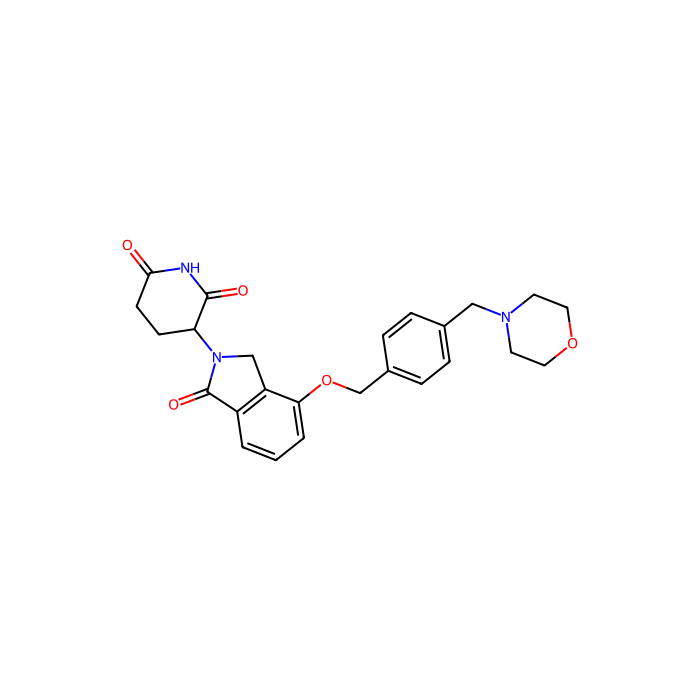
Iberdomide (CC-220) is a novel oral immunomodulatory compound that targets cereblon , part of the CRL4CRBN E3 ubiquitin ligase complex, with an IC50 of 60 nM in a competitive TR-FRET assay. Iberdomide (CC-220) induces apoptosis with antitumor and immunostimulatory activities.
Targets
cereblon 60 nM
In vitro
In cellular degradation assays, treatment with CC-220 results in the loss of Ikaros protein levels with an EC50 of 1 nM compared to 67 nM for lenalidomide and 24 nM for pomalidomide. CC-220 is similarly potent toward Aiolos, with an EC50 of 0.5 nM compared to 87 nM for lenalidomide and 22 nM for pomalidomide. CC-220 is a potent anti-proliferative and pro-apoptotic compound that shows activity in several MM cell line categories with differing sensitivity to lenalidomide, pomalidomide and dexamethasone. CC-220 induces PBMC-mediated killing of all MM cell lines regardless of the level of Cereblon expression and cell autonomous sensitivity. CC-220 acts through binding of Cereblon, leading to the degradation of the hematopoietic transcription factors Ikaros and Aiolos, followed by disruption of the MM promoting c-Myc/IRF4 axis.
Umfassendes Dokument zu Gefahren, Handhabung, Lagerung und Einhaltung regulatorischer Vorschriften.
<<<<<<< HEAD SDS herunterladen → ======= SDS herunterladen → >>>>>>> release248-p3Chargenspezifische Qualitätsdaten. Geben Sie Ihre Chargennummer ein, um das genaue COA abzurufen.
COA nachschlagen →Vollständige Qualitätsmerkmale und Akzeptanzkriterien für diese Qualität.
Spezifikationsblatt ansehen →Taxonomy Tree
| Kingdom | Organic compounds |
|---|---|
| Superclass | Organoheterocyclic compounds |
| Klasse | Isoindoles and derivatives |
| Subclass | Isoindolines |
| Intermediate Tree Nodes | Not available |
| Direct Parent | Isoindolones |
| Alternative Parents | Alpha amino acids and derivatives Isoindoles Benzylamines Phenol ethers Phenylmethylamines Piperidinediones Delta lactams Alkyl aryl ethers Aralkylamines Morpholines N-unsubstituted carboxylic acid imides Tertiary carboxylic acid amides Dicarboximides Trialkylamines Dialkyl ethers Oxacyclic compounds Azacyclic compounds Organic oxides Hydrocarbon derivatives Carbonyl compounds |
| Molecular Framework | Aromatic heteropolycyclic compounds |
| Substituents | Alpha-amino acid or derivatives - Isoindolone - Isoindole - Benzylamine - Piperidinedione - Phenylmethylamine - Phenol ether - Alkyl aryl ether - Delta-lactam - Aralkylamine - Piperidinone - Monocyclic benzene moiety - Morpholine - Benzenoid - Oxazinane - Piperidine - Tertiary carboxylic acid amide - Dicarboximide - Carboxylic acid imide - Carboxylic acid imide, n-unsubstituted - Amino acid or derivatives - Carboxamide group - Tertiary aliphatic amine - Tertiary amine - Lactam - Dialkyl ether - Azacycle - Oxacycle - Carboxylic acid derivative - Ether - Amine - Organic oxygen compound - Carbonyl group - Hydrocarbon derivative - Organic oxide - Organic nitrogen compound - Organooxygen compound - Organonitrogen compound - Aromatic heteropolycyclic compound |
| Beschreibung | This compound belongs to the class of organic compounds known as isoindolones. These are aromatic polycyclic compounds that an isoindole bearing a ketone. |
| External Descriptors | Not available |
| Activity Type | Activity Value -log(M) | Mechanism of Action | Activity Reference | Publications (PubMed IDs) |
|---|
| Activity Type | Relation | Activity value | Units | Action Type | Journal | PubMed Id | doi | Assay Aladdin ID |
|---|
| Activity Type | Relation | Activity value | Units | Action Type | Journal | PubMed Id | doi | Assay Aladdin ID |
|---|
| Activity Type | Relation | Activity value | Units | Action Type | Journal | PubMed Id | doi | Assay Aladdin ID |
|---|
| Activity Type | Relation | Activity value | Units | Action Type | Journal | PubMed Id | doi | Assay Aladdin ID |
|---|
| Activity Type | Relation | Activity value | Units | Action Type | Journal | PubMed Id | doi | Assay Aladdin ID |
|---|
| Activity Type | Relation | Activity value | Units | Action Type | Journal | PubMed Id | doi | Assay Aladdin ID |
|---|
| Activity Type | Relation | Activity value | Units | Action Type | Journal | PubMed Id | doi | Assay Aladdin ID |
|---|
| Activity Type | Relation | Activity value | Units | Action Type | Journal | PubMed Id | doi | Assay Aladdin ID |
|---|
| Activity Type | Relation | Activity value | Units | Action Type | Journal | PubMed Id | doi | Assay Aladdin ID |
|---|
| Empfindlichkeit | Light sensitive |
|---|---|
| DMSO (mg/ml) Maximale Löslichkeit | 90 |
| DMSO (mM) Maximale Löslichkeit | 200.222469410456 |
| Wasser (mg/ml) Maximale Löslichkeit | <1 |
| Molekulargewicht | 449.500 g/mol |
| XLogP3 | 1.100 |
| Hydrogen Bond Donor Count | 1 |
| Hydrogen Bond Acceptor Count | 6 |
| Rotatable Bond Count | 6 |
| Exact Mass | 449.195 Da |
| Monoisotopic Mass | 449.195 Da |
| Topological Polar Surface Area | 88.200 Ų |
| Heavy Atom Count | 33 |
| Formal Charge | 0 |
| Complexity | 732.000 |
| Isotope Atom Count | 0 |
| Defined Atom Stereocenter Count | 1 |
| Undefined Atom Stereocenter Count | 0 |
| Defined Bond Stereocenter Count | 0 |
| Undefined Bond Stereocenter Count | 0 |
| The total count of all stereochemical bonds | 0 |
| Covalently-Bonded Unit Count | 1 |
Unser Leitfaden zur Qualitätsauswahl behandelt Reinheit, Stabilisatorstatus und Anwendungseignung für alle Varianten in unserem Katalog.
Moligand™ Qualitätsleitfaden ansehen →