Homogeneous halogen - Inorganic chloride salt - Inorganic salt
Beschreibung
This compound belongs to the class of inorganic compounds known as homogeneous halogens. These are inorganic non-metallic compounds in which the largest atom is a nobel gas.
External Descriptors
Not available
1. Djoumbou Feunang Y, Eisner R, Knox C, Chepelev L, Hastings J, Owen G, Fahy E, Steinbeck C, Subramanian S, Bolton E, Greiner R, and Wishart DS. ClassyFire: Automated Chemical Classification With A Comprehensive, Computable Taxonomy. Journal of Cheminformatics, 2016, 8:61.
Determine the necessary mass, volume, or concentration for preparing a solution.
Dilution Calculator
Determine the dilution needed to prepare a stock solution.
Reconstitution Calculator
Bewertungen
Kundenbewertungen
Application Protocols
No application protocols are item-validated in the Product Data. For general use as a halogenating reagent:
Standardization (iodometry, literature):
Dissolve an accurately weighed excess of potassium iodide in water/acetic acid mixture; add an aliquot of the ICl solution under stirring; titrate liberated I2 with standardized sodium thiosulfate using starch indicator to endpoint. Calculate molarity of ICl.
Representative iodochlorination (literature example outline):
Dry DCM (0.05–0.1 M substrate) under N2/Ar.
Cool to 0 °C; add ICl solution dropwise (1.1 equiv) over 10–30 min.
Stir 0–25 °C until completion by TLC/LC–MS.
Quench with aq. Na2S2O3; separate, wash, dry, and purify.
Safety workflow:
Perform all transfers in a fume hood; keep container under inert gas and protected from light (as specified for this item).
These outlines are general literature practices and must be adapted to your substrate and to the actual solvent/concentration listed on the CoA/label.
Biological Roles
This product is a chemical reagent solution intended for laboratory synthesis and analysis; it is not intended for biological use in living systems.
General biochemical context (literature, not item-specific):
Iodine species participate in halogenation chemistry relevant to biomolecules, but iodine monochloride itself is a harsh electrophile and is not a native metabolite.
Historically, ICl has been used in analytical biochemistry to probe unsaturation (e.g., iodine value of lipids/fats) via addition across C=C bonds; this is a chemical assay, not a biological function.
Protein/peptide iodination under mild conditions typically employs alternative reagents (e.g., Iodogen, chloramine-T with I−/I2), not ICl, due to its strong, nonselective reactivity and corrosivity.
Implications for lab work:
If halogenating biomolecules or complex natural products, consider milder iodinating protocols to preserve functional group integrity.
Ensure thorough removal/reduction of residual halogen (e.g., with thiosulfate) before any downstream bioassays to prevent nonspecific oxidative damage.
No endogenous pathways, receptors, or transporters are relevant to iodine monochloride in research contexts; treat strictly as a reactive chemical reagent.
Buffer Applications
Not typically applicable. Iodine monochloride is incompatible with aqueous buffer systems due to rapid hydrolysis and oxidizing/halogenating behavior. For work-up, aqueous thiosulfate/sulfite solutions can be used to quench residual halogen, followed by standard buffer preparation for downstream steps if needed.
Green Alternatives
Iodine monochloride is effective but corrosive, moisture-sensitive, and typically used in halogenated or polar aprotic media. Greener choices may be available depending on the target transformation.
Comparison (literature, general guidance):
ICl vs N-Iodosuccinimide (NIS)
Pros for NIS: Solid, easier handling, often milder/selective I+ source; compatible with greener solvents (MeCN, ethyl acetate).
Pros for ICl: Higher reactivity; effective for challenging iodinations and iodochlorinations.
Tradeoff: NIS may require catalysts/activators; ICl can over-iodinate or chlorinate without careful control.
ICl vs I2/oxidant systems (I2/H2O2, I2/TBHP, I2/Selectfluor)
Pros for I2 systems: Elemental iodine is less corrosive; oxidants can be chosen to be greener; fewer halogenated solvent needs.
Pros for ICl: Direct, predictable electrophile; no additional oxidant waste streams.
Tradeoff: Oxidant choice impacts EHS profile; reaction scope/selectivity may differ.
ICl vs Electrochemical iodination (I− anodic oxidation)
Pros: On-demand I+ from iodide; minimal chemical oxidants; potential solvent recycling.
Favor acetonitrile or ethyl acetate where compatible; minimize DCM/chloroform. Avoid CCl4/CS2.
Waste minimization:
Quench with thiosulfate to reduce halogens; segregate halogenated waste; titrate solutions to avoid overcharging.
Note: Choice of alternative should be guided by substrate sensitivity, EHS priorities, and required chemoselectivity.
Pharmaceutical Uses
This product is for research use only and is not intended for use in humans or clinical formulations.
Relevant non-clinical/analytical roles (literature, not item-specific):
Analytical reagent: Iodine monochloride in glacial acetic acid (often termed Wijs solution) is classically used to determine iodine value (degree of unsaturation) of fats and oils, which can be relevant to excipient quality assessment (e.g., vegetable oils) in industrial QC.
Synthetic intermediate generation: In medicinal chemistry, ICl can introduce iodide handles (Ar–I, vinyl–I) via electrophilic iodination, enabling subsequent cross-coupling (Suzuki, Sonogashira) to access analog libraries.
Functionalization for SAR: Regioselective aromatic iodination produces versatile coupling partners while minimizing protecting-group manipulations.
Operational considerations:
Residual halogen must be fully removed from intermediates destined for further processing; employ validated quench and purification procedures.
For regulated environments, use standardized solutions with documented titer and uncertainty; retain CoA and solution age/titer verification records.
Grade/Purity: Not specified for this item; refer to CoA/Spec Sheet.
Appearance: Not specified for this item; refer to CoA/Spec Sheet.
Literature/general properties of neat iodine monochloride (ICl) for reference (not item-specific):
Physical state: Red-brown solid/liquid near ambient temperature (melts just above room temperature).
Melting point: ~27–28 °C (literature).
Boiling point: ~97–101 °C at 1 atm, often noted to fume/decompose (literature).
Density: ~3.0–3.1 g/mL at 20 °C (literature).
Vapor pressure: Low at room temperature; fumes in moist air (literature, qualitative).
Solubility: Reacts/hydrolyzes with water; miscible with/accommodated by many non-protic organic solvents (e.g., acetonitrile, dichloromethane, glacial acetic acid, carbon tetrachloride) (literature).
Refractive index: High (literature, qualitative); specific nD values vary with solvent in solutions.
Partitioning/polarity: Highly polarizable interhalogen; handled as a reagent rather than a solvent.
Practical notes for solutions (general guidance):
ICl solutions are commonly prepared in acetonitrile, dichloromethane, or glacial acetic acid; exact solvent and concentration for this item are not specified—refer to the CoA/label.
ICl can darken over time and may form I2; color changes can indicate partial decomposition. Always verify titer/strength if quantitative outcomes are required.
Quality and Grades
Item-specific quality information:
Grade/Purity: Not specified for this item; refer to CoA/Spec Sheet.
Stabilizer/Inhibitors: Not specified for this item; refer to CoA/Spec Sheet.
Concentration/Solvent system: Not specified for this item; refer to CoA/Spec Sheet.
Guidance on grades and implications (general):
Iodine monochloride is often supplied as standardized solutions (e.g., in acetic acid or acetonitrile) for halogenation and analytical assays (e.g., iodine value). When a concentration is specified (e.g., 0.1 M), batch-specific titration data are typically provided on the CoA.
For synthetic applications (electrophilic iodination, iodochlorination), low water content and minimal free iodine (I2) are important to ensure selectivity. Vendors may purge/blanket with inert gas (as this product is) and package in amber containers to mitigate photolysis.
HPLC/UV-trace solvent grades are relevant to the solvent component of a solution: acetonitrile or dichloromethane of low UV absorbance is useful for photometric monitoring of reactions. If the product is intended for analytical titration (e.g., Wijs-type), look for standardization and uncertainty on the CoA.
Recommendations:
Verify concentration by iodometric thiosulfate back-titration prior to critical work.
Inspect color; excessive purple hue can indicate elevated I2. If observed, consider re-standardization or fresh material.
Always defer to the CoA/Spec Sheet for item-specific grade, stabilizers, and acceptance criteria.
Reaction and Applications
Iodine monochloride is a versatile electrophilic halogenating reagent. As a solution, it is immediately deployable in a variety of halogenation/iodination contexts.
Key transformations (literature):
Electrophilic aromatic iodination: ICl serves as an I+ donor; conditions (solvent, temperature, additives) tune against undesired chlorination.
Iodochlorination of alkenes/alkynes: Anti-addition across C=C/C≡C to give vicinal chloro–iodo products; often proceeds via cyclic iodonium intermediates.
Iodolactonization/iodocyclization: Intramolecular capture of iodonium by carboxylate or heteroatoms to assemble lactones, lactams, and heterocycles.
Activation to iodonium salts: Reaction with hypervalent iodine or Lewis acids generates iodonium intermediates for further substitution.
N-/S-iodination: Iodination of amides, imides, and thiols/thioethers for functionalization or as activation handles.
Enolate/enol-ether halogenation: α-Iodination under mild conditions.
Practical tips:
Dry, oxygen-free setup under inert gas (argon is specified for this item) improves reproducibility and limits I2 formation.
Metered addition (syringe pump) at 0–25 °C helps control exotherm and stereoselectivity in alkene additions.
For aromatic iodination, adding substoichiometric acid or Ag salts can enhance I+ availability; monitor to suppress competitive chlorination.
Quenches: Sodium thiosulfate or sulfite effectively reduce residual halogens; follow with bicarbonate wash when appropriate.
Analysis: TLC under iodine stain is less informative—use UV/TLC and LC/MS or GC/MS; titrate ICl solutions if stoichiometry is critical.
Applications include small-molecule synthesis, polymer modification (halogenation), and classical analytical assays (e.g., iodine value determinations in lipids, with appropriate standardization).
Reaction Conditions
Guidance below reflects literature precedent and typical practice for iodine monochloride reactions; adjust to your substrate and consult primary sources. These are not item-specific specifications.
Electrophilic aromatic iodination:
Solvent: MeCN or glacial AcOH.
Conditions: 0–25 °C; 0.5–1.5 equiv ICl.
Additives: Catalytic acid (e.g., H2SO4 trace) or Ag salts can enhance I+ delivery.
Notes: Monitor for chlorinated byproducts; lower temperature favors iodination.
Iodochlorination of alkenes:
Solvent: DCM or MeCN, dry.
Temperature: −20 to +25 °C; slow addition controls exotherm.
Stoichiometry: 1.05–1.2 equiv ICl.
Outcome: Anti addition to give I–C and Cl–C across the double bond; regioselectivity often Markovnikov-like via iodonium opening.
Iodolactonization/iodocyclization:
Solvent: DCM/MeCN; sometimes with base scavengers.
Temperature: 0–25 °C.
Tips: Use dilute conditions (0.02–0.1 M) to limit polymerization and intermolecular capture.
Alpha-iodination of ketones/enol ethers:
Solvent: MeCN or AcOH.
Temperature: 0–25 °C.
Control: Buffer acidity to avoid over-iodination; quench promptly.
Work-up:
Quench residual halogen with aqueous sodium thiosulfate or sodium sulfite.
Washes: Bicarbonate (if acidic medium used), brine, dry over MgSO4/Na2SO4.
Expected yields:
Substrate-dependent; many literature examples report 60–90% for well-matched systems under optimized conditions.
Always verify the concentration of the ICl solution (titration) for accurate stoichiometry.
Safety and Handling
Item-specific hazard fields were not provided in the Product Data; consult the product SDS for authoritative classification and response measures.
General GHS expectations for iodine monochloride and its solutions (not item-specific):
Likely hazards: Corrosive to skin/eyes, causes severe burns; harmful if inhaled; very toxic to aquatic life; strong oxidizing/halogenating agent; fumes in moist air forming HCl/HOI/I2.
Possible pictograms: Corrosion, Exclamation mark, Environment (consult SDS for the exact set).
PPE and engineering controls:
Wear chemical-resistant gloves (e.g., butyl rubber, Viton; check compatibility with the actual solution solvent), splash goggles/face shield, lab coat.
Use in a fume hood; avoid inhalation of vapors/fumes.
Handling precautions:
Keep under inert atmosphere (argon as specified) and protect from light to minimize I2 formation.
Avoid contact with water, alcohols, bases, strong reducing agents, amines, and most metals. May liberate halogen and heat upon contact with incompatibles.
Use glass apparatus; avoid ground joints seizing due to halogenation—lightly grease or use PTFE sleeves.
First-aid overview (consult SDS):
Skin/eye contact: Immediate decontamination with copious water for ≥15 minutes; remove contaminated clothing; seek medical attention.
Inhalation: Move to fresh air; maintain airway; seek medical attention.
Ingestion: Do not induce vomiting; rinse mouth; seek urgent medical attention.
Spill/fire:
Small spills: Neutralize cautiously with sodium thiosulfate solution in an appropriate solvent system; absorb with inert material.
Fire: Use dry chemical, CO2; avoid water streams that can spread corrosives; firefighters require full protective gear.
Solvent Selection
Applicability: This product is a reagent solution rather than a solvent. Solvent selection here refers to choosing reaction media compatible with iodine monochloride chemistry.
General solvent compatibility (literature):
Polar aprotic: Acetonitrile (MeCN) is widely used—good solubility, supports clean electrophilic iodination and iodochlorination.
Chlorinated: Dichloromethane (DCM) and chloroform often provide fast additions to alkenes/alkynes; monitor for HCl formation.
Protic/acidic: Glacial acetic acid is classical for aromatic iodination and “Wijs-type” analytical methods; water must be rigorously excluded to minimize hydrolysis.
Nonpolar: Carbon tetrachloride and CS2 are traditional but less favored today for safety/green reasons.
Avoid/limit:
Water and lower alcohols (hydrolysis to HOI/HCl and I2, side reactions).
Strongly basic media (rapid quench and disproportionation).
Selection tips:
For chemo-/regioselective aromatic iodination: MeCN or AcOH with catalytic acid may favor I+ transfer with reduced chlorination.
For halolactonization/iodocyclization: DCM or MeCN at 0–25 °C often balances rate and selectivity; add ICl slowly.
For sensitive substrates: Use low-temperature conditions in dry, oxygen-free solvents; pre-test on small scale.
Note: The actual solvent composing this catalog “iodine monochloride solution” is not specified—consult the CoA/label for exact medium and concentration before planning.
Storage and Reconstitution
Item-specific instructions (from Product Data):
Storage: Store at 2–8 °C, protected from light, argon charged.
Shipping: Wet ice, FedEx DG Service.
Additional handling guidance (general best practice for ICl solutions; not item-specific specifications):
Keep container tightly closed in an amber, chemically compatible bottle. Maintain inert headspace (argon as supplied) to minimize oxidation/disproportionation and iodine formation.
Avoid temperature cycling and moisture ingress. Open only briefly; purge with argon before re-closing.
If crystallization or phase separation is observed (depending on solvent system), allow to warm gradually to room temperature and mix thoroughly before use. Do not heat above ambient without confirming solvent composition and pressure rating.
Inspect color periodically. A pronounced purple hue can indicate free iodine; if critical, re-standardize the solution by iodometry prior to use.
Reconstitution: Not applicable—this is a ready-to-use solution. Do not dilute or concentrate unless the solvent system and stability have been confirmed from the CoA/Spec Sheet.
Disposal: Quench small residues with aqueous sodium thiosulfate under controlled conditions; dispose of according to local regulations for halogenated oxidizers/corrosives.
Structure and Identity
Brief overview: Iodine monochloride (ICl) is a diatomic interhalogen reagent widely used as an electrophilic iodinating/chloro-iodinating agent. This product is supplied as a solution.
From Product Data (item-specific):
SKU: I434152
Product name: Iodine monochloride solution
CAS: 7790-99-0
InChIKey: 310663 (as provided)
Storage: 2–8 °C, protected from light, argon charged
Shipped: Wet ice, FedEx DG Service
Research use: For research use only
Literature/computed (general reference for ICl, not item-specific):
Molecular formula: ICl
Molecular weight: 162.35 g/mol
Preferred IUPAC name: Iodine monochloride
SMILES: ICl (also represented as [I-][Cl+])
InChI (canonical): InChI=1S/ClI/c1-2
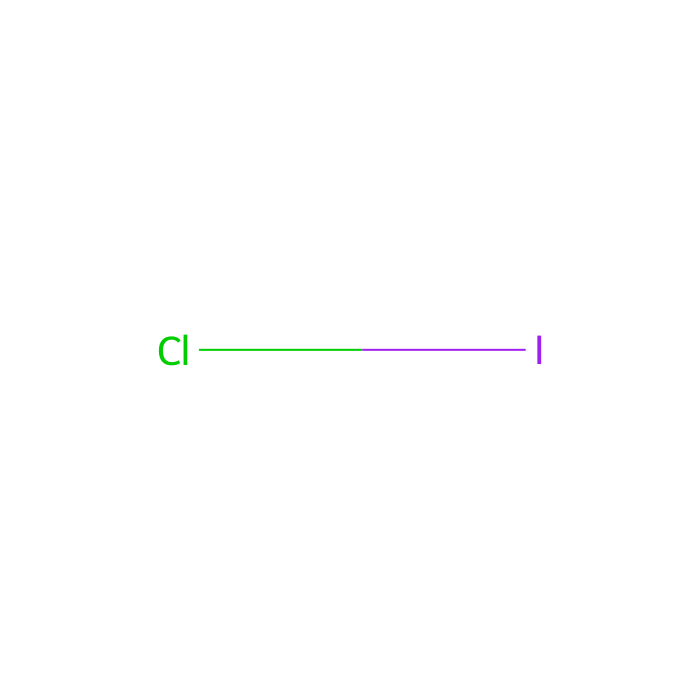
Structural features: Linear diatomic interhalogen composed of iodine and chlorine; highly polarizable; strong I–Cl bond with significant electrophilic character at iodine (Iδ+–Clδ− description in many reactions).
2D structure description (general):
A single I–Cl bond between iodine and chlorine atoms; no rings or additional functional groups; no stereocenters.
Notes:
Identity parameters above labeled as literature/computed are provided for chemical context only and are not item-specific specifications.
Synthetic Utility
Functional group and reactivity profile (literature):
ICl is a potent electrophile delivering I+ (and Cl−) to π-systems and heteroatoms. Reactions commonly proceed via iodonium intermediates with anti-stereochemistry in additions to alkenes/alkynes.
Strategic applications:
Install iodide handles: Aromatic/vinylic iodides prepared via ICl serve as high-reactivity partners in cross-coupling (Suzuki–Miyaura, Sonogashira, Buchwald–Hartwig via oxidative addition to Pd(0)).
Halolactonization/iodocyclization: Forms O/N-heterocycles with predictable regiocontrol; subsequent substitution or reduction diversifies scaffolds.
Alpha-iodination: Enol/enolate capture by ICl sets up subsequent eliminations (E2 to vinyl halides) or metal–halogen exchange.
Directed iodination: Lewis acids (e.g., BF3·OEt2) or Ag+ salts can promote selective iodination of deactivated aromatics.
Selectivity and compatibility:
Electron-rich arenes react rapidly; deactivated rings may require catalysts or elevated temperatures.
Competing chlorination can occur; solvent choice (MeCN/AcOH) and temperature control mitigate this.
Sensitive functionalities (thiols, tertiary amines, silyl groups) can be over-halogenated or cleaved—protect or avoid.
Workflow tips:
Standardize solution strength by iodometry; dose stoichiometrically.
Quench with sodium thiosulfate; verify halogen removal by starch test or iodometric back-titration.
Target Specificity
Not applicable. This product is a small-molecule reagent solution (iodine monochloride), not a biological targeting agent or antibody. No antigen/epitope specificity, clone, isotype, or species reactivity data apply.
Wir verwenden Cookies, um die ordnungsgemäße Funktion der Website sicherzustellen und, soweit zulässig, Ihr Nutzererlebnis zu verbessern. Sie können Ihre Einstellungen jederzeit unter „Einstellungen“ verwalten. Weitere Informationen finden Sie in unserer Cookie-Richtlinie.
Dürfen wir Sie über Rabattaktionen informieren?
Später erinnern
Vielen Dank! Bitte überprüfen Sie Ihren E-Mail-Posteingang, um zu bestätigen.
Products are supplied to verified businesses, institutions, and qualified professionals for research and development use only. Not for use in humans, animals, diagnosis, or therapy.

 H2526552