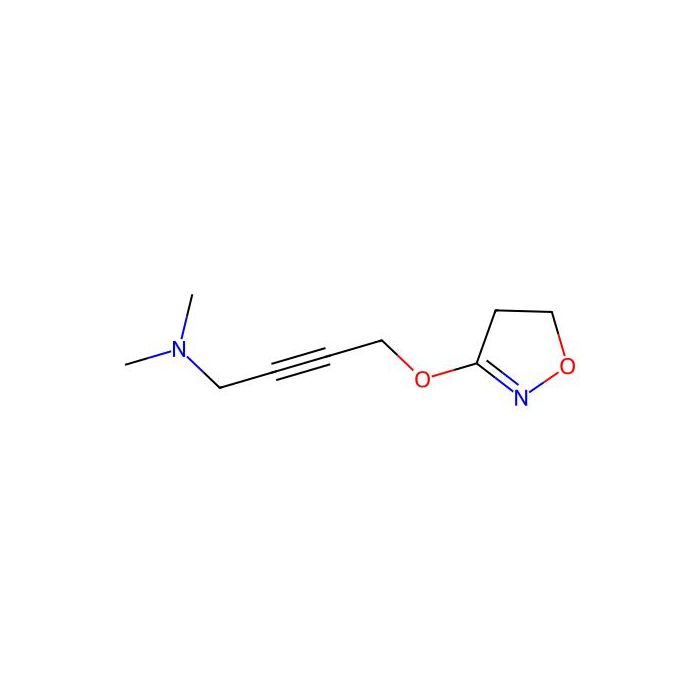
Iperoxo is a potent superagonist of muscarinic acetylcholine receptor (mAChR). [ 3 H]Iperoxo can be used for direct probing activation-related conformational transitions of muscarinic receptors.
Form:Solid
Spezifikationen
Spezifikationen & Reinheit
≥99%
Biochemische und physiologische Mechanismen
Iperoxo is a potent superagonist of muscarinic acetylcholine receptor (mAChR) . [ 3 H]Iperoxo can be used for direct probing activation-related conformational transitions of muscarinic receptors.
Storage
Store at -20°C
Verschickt in
Ice chest + Ice pads
Dieses Produkt erfordert Kühlkettenversand. Grundversand und andere Economy-Optionen sind nicht verfügbar.
This compound belongs to the class of organic compounds known as isoxazolines. These are compounds containing a five-member unsaturated aliphatic ring, with an oxygen atom adjacent to a nitrogen atoms, and three carbon atoms.
External Descriptors
Not available
1. Djoumbou Feunang Y, Eisner R, Knox C, Chepelev L, Hastings J, Owen G, Fahy E, Steinbeck C, Subramanian S, Bolton E, Greiner R, and Wishart DS. ClassyFire: Automated Chemical Classification With A Comprehensive, Computable Taxonomy. Journal of Cheminformatics, 2016, 8:61.
Zertifikate (CoA, COO, BSE/TSE und Analyse-Diagramm)
C of A & Other Certificates(BSE/TSE, COO):
Analytical Chart:
Chemische und physikalische Eigenschaften
Löslichkeit
DMSO : 62.5 mg/mL (192.81 mM; ultrasonic and warming and heat to 60°C)
Lösungsrechner
Molarity Calculator
Determine the necessary mass, volume, or concentration for preparing a solution.
Dilution Calculator
Determine the dilution needed to prepare a stock solution.
Reconstitution Calculator
Bewertungen
Kundenbewertungen
Application Protocols
Item-specific, validated application protocols are not provided for this catalog entry. The following are general, literature-based examples for using a potent muscarinic agonist in common GPCR assays. Adjust to your system.
Example A: Calcium mobilization (Gq-coupled mAChRs)
Cell prep: plate cells expressing M1 or M3 receptors in black-walled, clear-bottom 96-well plates (e.g., 20–40k cells/well) 24 h prior.
Dye loading: incubate with Ca2+ indicator dye per kit instructions (30–60 min, 37°C) in HEPES–HBSS + 0.1% BSA.
Agonist dosing: prepare serial dilutions from a DMSO stock; final DMSO ≤0.1% v/v. Add using an automated injector; record fluorescence in real-time.
Data: fit concentration–response to obtain EC50 and Emax; include vehicle and reference agonist controls.
Example B: IP1 accumulation (Gq/11 pathway)
Incubate cells with agonist for 30–60 min in LiCl-containing buffer; quantify IP1 using an HTRF kit. Normalize to maximal reference response.
Example C: cAMP inhibition (Gi/o-coupled M2/M4)
Stimulate with forskolin; add agonist; measure cAMP with HTRF or luciferase reporter. Maintain constant solvent.
General notes
Use low-bind plastics and include time-course studies to assess desensitization.
Prepare fresh working solutions immediately before use; protect from light.
All procedures are for research use only.
Biological Roles
Scope: literature-based, non-item-specific overview of Iperoxo as a research ligand. No clinical or therapeutic claims are made.
Pharmacological role: Iperoxo is widely cited as an exceptionally potent orthosteric agonist of mAChRs, often used as a reference standard to elicit robust receptor-mediated signaling at very low concentrations.
Signaling pathways: activation of Gq/11-coupled mAChR subtypes (e.g., M1, M3, M5) typically triggers phospholipase C activation, IP3 formation, Ca2+ mobilization, and PKC engagement. For Gi/o-coupled subtypes (M2, M4), pathways may include inhibition of adenylyl cyclase, modulation of ion channels, and βγ-mediated signaling.
Biased agonism and probe dependence: Iperoxo has been employed to explore ligand bias and operational efficacy, particularly in systems where allosteric modulators tune orthosteric agonist responses.
Receptor reserve and system bias: due to its high intrinsic efficacy, Iperoxo is useful in quantifying receptor reserve and dissecting system-specific signaling efficiency across cell lines and tissues.
Experimental contexts: heterologous expression lines (e.g., CHO/HEK expressing defined mAChR subtypes), native neuronal or smooth muscle preparations, and biosensor-based GPCR assays (e.g., BRET/FRET, label-free impedance) often use Iperoxo as an agonist control.
Note: Potency and efficacy can vary with receptor density, G-protein complement, and assay type. Establish concentration–response relationships de novo in your system.
Buffer Applications
Not a buffering agent.
Practical assay buffer guidance (general, for GPCR pharmacology with small-molecule agonists)
Standard extracellular buffers: HEPES-buffered HBSS or Krebs–Henseleit solution are common for functional assays (calcium flux, IP1). Maintain physiological pH (7.3–7.4) and osmolarity.
Protein supplementation: 0.1% BSA can reduce nonspecific adsorption of hydrophobic ligands and stabilize responses.
Solvent carryover: keep DMSO or ethanol ≤0.1–0.5% v/v in final assay media (optimize per cell type). Include vehicle controls.
Ionic composition: ensure Ca2+/Mg2+ presence for Ca2+ mobilization assays; for Gi/o readouts (cAMP inhibition), use appropriate stimulators (e.g., forskolin) within the buffer recipe.
Light and temperature: protect agonist working solutions from light where relevant and maintain consistent temperature during readouts to reduce variability.
For exact buffer recipes and compatibility with your detection kit, follow the assay kit supplier’s recommendations.
Green Alternatives
Context
Iperoxo is a bioactive reference ligand rather than a bulk solvent or process reagent; therefore, green-chemistry substitution frameworks (e.g., solvent replacement matrices) are not directly applicable.
General considerations for greener practice with small-molecule ligands
Minimize solvent volumes: prepare the highest practical stock concentration to reduce DMSO/EtOH usage, ensuring solubility and pipetting accuracy.
Aqueous-first dilution: when feasible, transition rapidly from organic stock to buffered aqueous media to limit organic solvent exposure to cells and reduce VOC emissions.
Waste reduction: pool compatible assay wastes; use microplate formats and miniaturized assays to lower chemical consumption.
Storage efficiency: aliquot into minimal-volume, single-use vials to reduce freeze–thaw cycles and material loss.
Comparison (general, non-item-specific)
DMSO vs bio-based co-solvents: while DMSO remains the standard for bioactive stocks, some bio-based co-solvents (e.g., glycerol, propylene glycol) might be explored at low percentages in specific biochemical assays; verify compatibility with your readout and compound stability.
Given the role of Iperoxo as a specialized research tool, the primary “green” leverage is efficient experimental design rather than substituting the compound itself.
Pharmaceutical Uses
No therapeutic or clinical applications are claimed for this product. Research use only.
General, non-item-specific roles in pharmaceutical R&D
Reference standard: used as a high-potency muscarinic receptor agonist control in in vitro assay development, screening, and mechanistic pharmacology.
System qualification: establishes assay windows, evaluates receptor expression/functionality, and benchmarks positive control responses in cell-based tests.
Analytical use: may serve as a qualitative control for LC–MS or HPLC method development related to muscarinic agonist analyses; verify detection wavelengths/ionization behavior empirically.
Regulatory/pharmacopeial status
No pharmacopeial monograph known for this research compound; consult regulatory guidelines only if repurposing for non-research contexts (not recommended without appropriate approvals).
Formulation context
For cell and tissue assays, small aliquots of DMSO stock are typically diluted into physiological buffers immediately prior to use. Excipient discussions (e.g., stabilizers, tonicity agents) are not generally applicable to this research reagent.
Physical Properties
Item-specific properties
Appearance: Not specified for this item; refer to CoA/Spec Sheet.
Molecular weight: Not specified for this item; refer to CoA/Spec Sheet.
Molecular formula: Not specified for this item; refer to CoA/Spec Sheet.
Literature/general information (non-item-specific; verify against primary sources for your use case)
State/form: Iperoxo is generally supplied as a solid for research use, typically prepared as concentrated DMSO stock solutions for biological assays.
Solubility (qualitative, literature): commonly soluble in high-purity DMSO; limited aqueous solubility unless aided by acidification or co-solvents/surfactants. Ethanol or methanol may also dissolve at assay-relevant concentrations.
pKa (qualitative): muscarinic agonists with tertiary amines are usually protonated near physiological pH; expect strong basic center facilitating water miscibility when converted to salts.
LogP/logD: potent orthosteric ligands often show moderate lipophilicity; precise values for Iperoxo should be checked in databases.
Melting point, boiling point, density, refractive index, UV cutoff: Not widely standardized in secondary sources; consult primary literature or the CoA/SDS for lot-specific information.
Practical notes
Prepare fresh aliquots in dry, anhydrous DMSO and dilute into assay buffer immediately before use to minimize adsorption and degradation.
Filter sterilization (0.22 µm) of final working solutions may be employed for cell-based assays when compatible with concentration and solvent content.
Quality and Grades
Item-specific
Grade/Purity: Not specified for this item; refer to CoA/Spec Sheet.
Guidance on quality for small-molecule bioactive ligands (general)
Research grade: typically suitable for in vitro and ex vivo research applications; purity is commonly assessed by HPLC/UPLC with MS/UV. Low levels of residual solvents/water or inorganic salts may be present within acceptable research limits.
Identity confirmation: NMR, MS, and HPLC purity traces are standard. If your application requires stringent specifications (e.g., quantitative pharmacology, radioligand competition), request the CoA with full analytical panel and lot-specific purity.
Stabilizers: Not specified for this item; refer to CoA/Spec Sheet. Many amine-containing ligands require no stabilizer but benefit from desiccation and light protection.
UV profile: Not specified for this item; refer to CoA/Spec Sheet. When using for HPLC quantitation, verify extinction coefficients empirically.
Best practices
For reproducible pharmacology, use a single lot across studies and prepare single-use aliquots to avoid freeze–thaw and adsorption losses.
If LC–MS quantitation is planned, acquire a reference standard and, if possible, an isotopically labeled internal standard to control for matrix effects.
Reaction and Applications
Chemical reaction usage
This product is not primarily employed as a synthetic reagent or catalyst. It is a bioactive ligand used in receptor pharmacology; therefore, conventional synthetic reaction applications (e.g., cross-coupling, reductions) are not typically applicable.
Research applications (literature/general)
GPCR activation studies: widely used to activate muscarinic acetylcholine receptors (mAChRs) in heterologous expression systems and native tissues for signal transduction measurements (e.g., calcium mobilization, IP1 accumulation, ERK phosphorylation).
Probe dependence/allosteric modulation: serves as an orthosteric partner in studies of positive/negative allosteric modulators to dissect cooperativity and signaling bias.
Receptor reserve and efficacy: useful for quantifying receptor reserve and operational efficacy in systems expressing M1–M5 subtypes due to its high agonist efficacy.
Benchmarking tool: provides a high-potency reference agonist for potency/efficacy comparisons versus endogenous acetylcholine or other synthetic agonists.
Practical tips
Prepare fresh working dilutions immediately before assays to maintain potency and minimize adsorption.
Include solvent-only controls; verify response windows and desensitization kinetics in your cell model.
For cumulative concentration–response experiments, allow adequate equilibration time and monitor for receptor desensitization.
Note: All uses are for research and laboratory purposes only.
Reaction Conditions
Not applicable as a synthetic reagent.
General laboratory handling for assay preparation (non-item-specific)
Stock solution: dissolve in anhydrous DMSO at an empirically determined concentration (commonly 1–10 mM) to ensure complete solubilization.
Working solutions: dilute into assay buffer immediately before use to the desired range. Maintain constant solvent percentage across wells/samples.
Temperature and timing: pre-equilibrate cells/tissues to assay temperature (typically 22–37°C). Allow adequate equilibration time after addition for maximal response while avoiding receptor desensitization.
Light/moisture: protect from light and moisture during preparation; keep containers closed to limit atmospheric CO2/H2O uptake which may alter pH or compound form.
These are general best practices for bioactive ligands and are not item-specific reaction conditions.
Safety and Handling
Authoritative safety information must be taken from the product SDS. The following are general laboratory guidelines.
Item-specific data (from Product Data)
GHS classification: Not specified for this item; refer to SDS.
Signal word / H-statements / Pictograms: Not specified for this item; refer to SDS.
Storage conditions: Store at -20°C.
Shipping: Ice chest + ice pads (cold chain).
General safety guidance (not a substitute for SDS)
PPE: wear lab coat, safety glasses, and appropriate chemical-resistant gloves. Use in a chemical fume hood when handling powders or concentrated solutions.
Handling: avoid inhalation of dust/aerosols and skin contact. Use dedicated tools to minimize cross-contamination in bioassay labs.
Incompatibilities: strong oxidizers and strong acids/bases may degrade amine-containing organics; keep away from moisture and light to preserve potency.
First aid (general): in case of skin/eye contact, rinse with water for at least 15 minutes; if inhaled, move to fresh air; if ingested, rinse mouth. Seek medical attention as per SDS guidance.
Environmental precautions: prevent release to drains; collect spills with inert absorbent.
Special note: as a highly potent receptor agonist, avoid accidental exposure and practice meticulous micro-dosing and labeling of aliquots.
Always defer to the official SDS and your institutional EHS protocols for definitive hazard classification and response procedures.
Solvent Selection
Applicability: Iperoxo is a bioactive small molecule used primarily in receptor pharmacology assays; solvent selection focuses on preparing stable, accurately dosed stock and working solutions.
General (literature/practice-based) solvent guidance
Primary solvent: high-purity, anhydrous DMSO is commonly used to prepare concentrated stock solutions (e.g., 1–10 mM) due to good solubility for many cationic ligands.
Secondary solvents/co-solvents: ethanol or methanol can dissolve at lower concentrations; aqueous buffers may require co-solvent (≤0.1–0.5% DMSO or EtOH) and/or mild acidification to enhance solubility of protonated amines.
Aqueous vehicles: HEPES- or phosphate-buffered saline (PBS) with BSA (0.1% w/v) can mitigate nonspecific binding to plastics for hydrophobic ligands. Verify compatibility with your assay (e.g., calcium flux dyes, IP1 kits).
Adsorption minimization: use low-binding polypropylene, pre-rinse tips/vials with diluted analyte, and avoid prolonged storage at working concentration.
Not item-specific (practical comparison)
DMSO vs ethanol: DMSO offers higher solvency and chemical stability; ethanol may be preferable when minimizing DMSO carryover is critical but can impact cell membranes at >0.5–1% v/v.
Aqueous-only: feasible if the compound is supplied as a salt and sufficiently soluble; otherwise, use minimal co-solvent.
Always titrate solvent percentage controls in parallel with bioassays.
Store desiccated, protected from light, at -20°C in the original, tightly closed container.
Allow the container to equilibrate to room temperature before opening to prevent condensation.
Reconstitution
Solvent: use anhydrous, high-purity DMSO for initial stock solutions. Alternative solvents (ethanol, methanol) may be used if compatible with your assay.
Concentration: prepare a concentrated stock (e.g., 1–10 mM) ensuring complete dissolution; verify visually and, if critical, by UV or LC–MS.
Filtration: if sterility is required, filter the working solution (not the DMSO stock) through a 0.22 µm PVDF filter.
Aliquoting and stability
Dispense into single-use, low-bind microtubes to avoid repeated freeze–thaw cycles and adsorption losses.
Store aliquots at -20°C or below; avoid frost-free freezers that cycle temperatures.
Working solutions in aqueous buffer should be prepared fresh and used promptly; discard unused portions after the experiment.
Light/moisture protection: keep solutions and solids protected from light and humidity to maintain potency.
Always consult the product’s CoA and SDS for lot-specific stability and reconstitution guidance.
Structure and Identity
Brief overview: Iperoxo is a research-only small-molecule ligand widely used as a high-potency muscarinic acetylcholine receptor agonist in GPCR pharmacology.
Item-specific (from Product Data)
SKU: I651708
Product name: Iperoxo
CAS: 247079-84-1
PubChem CID: 46855274
InChIKey: 38782 (note: truncated/not standard length as provided in Product Data)
SMILES: Not specified for this item; refer to CoA/Spec Sheet.
Molecular formula: Not specified for this item; refer to CoA/Spec Sheet.
Molecular weight: Not specified for this item; refer to CoA/Spec Sheet.
Compound class: synthetic orthosteric agonist of muscarinic acetylcholine receptors (GPCR family A).
Structural features (general): tertiary amine-containing muscarinic agonists typically present a cationic center and an aromatic/heteroaromatic or acetal/oxonium-like moiety enabling high-affinity binding to the orthosteric site; Iperoxo is commonly cited as an exceptionally potent agonist in this class. Consult primary literature or PubChem (CID: 46855274) for full 2D structure and canonical SMILES.
2D structure description (general, literature)
Expected functional elements: a protonatable amine (positively charged at physiological pH) and oxygenated substituents contributing to hydrogen-bonding and ionic interactions with the muscarinic receptor orthosteric pocket.
Notes
For definitive structure identifiers (canonical SMILES, full InChI/InChIKey), please refer to the Certificate of Analysis (CoA) or authoritative databases cited above.
Synthetic Utility
This compound is not typically used as a building block, catalyst, or reagent in synthetic organic chemistry. Its value lies in pharmacological studies as a potent muscarinic receptor agonist.
If chemical modification is desired (general considerations)
Derivatization strategy: medicinal chemistry efforts may explore amine acylation/alkylation, heteroatom substitution, or bioisosteric replacement to tune subtype selectivity and pharmacokinetics.
SAR exploration: changes near the cationic center and aromatic/oxygenated moieties often impact affinity/efficacy at mAChRs.
For conventional synthetic methodologies (cross-coupling, oxidations, reductions), this product is not the reagent of choice; select dedicated reagents from those categories.
Target Specificity
Item-specific target data were not provided for this product; refer to CoA/Spec Sheet and primary literature.
Literature-based overview (non-item-specific)
Primary targets: muscarinic acetylcholine receptors (M1–M5). Iperoxo is broadly characterized as a potent orthosteric agonist across muscarinic subtypes.
Selectivity considerations: reports typically describe high potency with limited subtype selectivity when used alone; functional selectivity or apparent bias may emerge in the presence of subtype-selective allosteric modulators or in systems with different receptor reserves.
Off-targets: comprehensive selectivity panels should be consulted if required; none are claimed here.
Recommendation
Determine potency and efficacy de novo in your expression system or tissue preparation. Include endogenous agonist (acetylcholine or carbachol) as comparators and perform Schild/operational analyses where needed.
Häufig gestellte Fragen
What are the CAS number, molecular formula and molecular weight?
The CAS Number is 247079-84-1, the molecular formula is C9H14N2O2, and the molecular weight is 182.22 g/mol. InChIKey CADHNBBPGYVTOA-UHFFFAOYSA-N.
What documentation is provided?
Available product documentation, including Certificates of Analysis (COA), Safety Data Sheets (SDS), and specification sheets, is shown in the product document area. Document availability and access follow the current site policy.
What is the purity of this product?
This product is supplied at ≥99% purity (chemical assay). Lot-specific values are stated on the Certificate of Analysis.
How should this product be stored?
Store at ?20 °C. Freezer storage is required to maintain the specified shelf life.
How is this product shipped?
This product ships in an insulated container with ice pads. Unpack on arrival and transfer it to the storage condition stated above.
Wir verwenden Cookies, um die ordnungsgemäße Funktion der Website sicherzustellen und, soweit zulässig, Ihr Nutzererlebnis zu verbessern. Sie können Ihre Einstellungen jederzeit unter „Einstellungen“ verwalten. Weitere Informationen finden Sie in unserer Cookie-Richtlinie.
Dürfen wir Sie über Rabattaktionen informieren?
Später erinnern
Vielen Dank! Bitte überprüfen Sie Ihren E-Mail-Posteingang, um zu bestätigen.
Products are supplied to verified businesses, institutions, and qualified professionals for research and development use only. Not for use in humans, animals, diagnosis, or therapy.