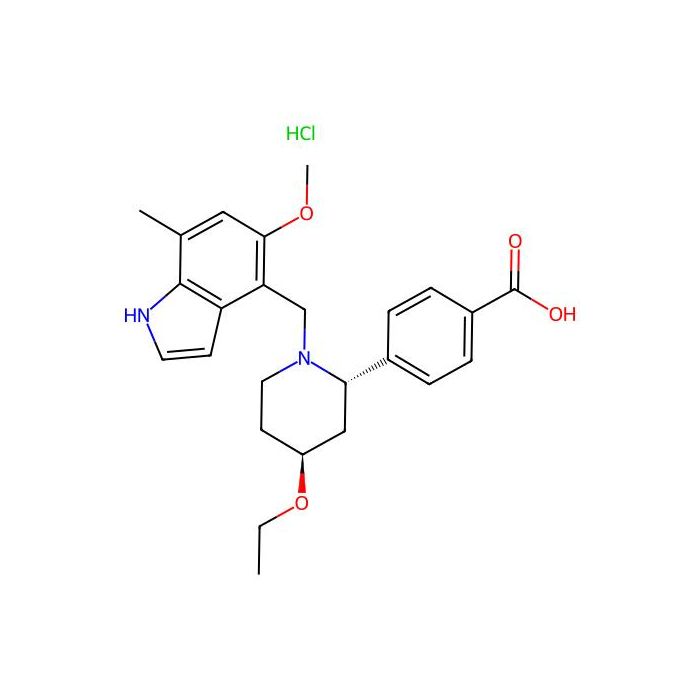
LNP023 hydrochloride is an orally bioavailable, highly potent and highly selective factor B inhibitor. LNP023 shows direct, reversible, and high-affinity binding to human factor B with a K D of 7.9 nM. LNP023 inhibits factor B with an IC 50 value of 10 nM
In Vitro
LNP023 demonstrates potent inhibition of alternative complement pathway (AP)-induced membrane attack complex (MAC) formation in 50% human serum (IC 50 value of 130 nM). ?\nLNP023 exhibits excellent selectivity over other proteases affording IC 50 values of >30 μM across a panel of 41 human proteases, including the AP protein factor D (>100 μM). MCE has not independently confirmed the accuracy of these methods. They are for reference only.
In Vivo
LNP023 (20-180 mg/kg; oral administration) prevents KRN (150 μL)-induced arthritis in mice and is effective upon prophylactic and therapeutic dosing in an experimental model of membranous nephropathy in rats. ?\nLNP023 exhibits moderate half-lives (T 1/2 ; Wistar Han rats 3.4 h, beagle dogs 5.5 h) and C max (Wistar Han rats 410 nM, beagle dogs 2200 nM) following oral administration (rat 30 and, dog 10 mg/kg). ?\nLNP023 exhibits terminal elimination half-lives (T 1/2 ; Wistar Han rats 7 h, beagle dogs 5.6 h) due to high plasma clearance (8, and 2 mL/min/kg respectively combined with large volumes of distribution (2.3, and 0.6 L/kg respectively) following intravenous administration (rat 1.0 and, dog 0.1 mg/kg). MCE has not independently confirmed the accuracy of these methods. They are for reference only. Animal Model: C57BL/6 mice with KRN-induced arthritisDosage: 20, 60, and 180 mg/kg Administration: Orally gavaged; twice a day (b.i.d.) for 14 days Result: Blocked KRN-induced arthritis.
IC50& Target:KD: 7.9 nM (factor B),IC50: 10 nM (factor B)
Spezifikationen
Spezifikationen & Reinheit
10mM in DMSO
Biochemische und physiologische Mechanismen
LNP023 hydrochloride is an orally bioavailable, highly potent and highly selective factor B inhibitor. LNP023 shows direct, reversible, and high-affinity binding to human factor B with a K D of 7.9 nM. LNP023 inhibits factor B with an IC 50 value of 10 nM
Storage
Desiccated,Store at -80°C
Verschickt in
Dry ice packs + Cold packs
Dieses Produkt erfordert Kühlkettenversand. Grundversand und andere Economy-Optionen sind nicht verfügbar.
Zertifikate (CoA, COO, BSE/TSE und Analyse-Diagramm)
C of A & Other Certificates(BSE/TSE, COO):
Analytical Chart:
Lösungsrechner
Molarity Calculator
Determine the necessary mass, volume, or concentration for preparing a solution.
Dilution Calculator
Determine the dilution needed to prepare a stock solution.
Reconstitution Calculator
Bewertungen
Kundenbewertungen
Application Protocols
No item-specific, validated application protocols are provided in the Product Data for this compound.
General guidance for small-molecule screening (to be adapted by the user):
Prepare a master stock in anhydrous DMSO (e.g., 10–50 mM, as solubility permits). Aliquot to avoid repeated freeze–thaw.
Perform serial dilutions to generate a concentration range appropriate for your assay; include vehicle controls.
Equilibrate solutions to the assay temperature, and preincubate with target proteins if time-dependent binding is suspected.
Record exact final solvent composition and plate maps for reproducibility.
For detailed, assay-specific protocols (enzyme kinetics, cellular readouts, SPR/BLI, etc.), refer to standard methods or the primary literature relevant to your system. Always confirm performance with a small-scale pilot before full studies.
Biological Roles
Context provided for research use only; no medical or clinical claims are made.
Literature context (compound class and pathway):
Iptacopan is reported in the literature as a small-molecule inhibitor targeting the complement system, with selectivity for components involved in the alternative pathway. Such molecules enable dissection of complement-mediated biochemical processes in vitro.
Research utility (general):
Facilitates mechanistic studies of complement activation, convertase formation, and regulation under defined biochemical conditions.
Useful in enzyme kinetics and binding assays to evaluate potency, selectivity, and mode of action vs. related proteases or complement factors.
Supports systems biology approaches exploring crosstalk between complement activation and downstream signaling (e.g., opsonization biochemistry, not clinical outcomes).
Assay design considerations:
Control ionic strength and pH to reflect physiological conditions when modeling complement activity; include calcium/magnesium as appropriate for pathway components.
Monitor compound stability in protein-rich media (serum, complement sources) due to potential binding or metabolism; verify free concentration where relevant.
Incorporate orthogonal readouts (activity assays, mass spectrometry-based proteomics, surface plasmon resonance/biolayer interferometry) to triangulate mechanism.
Caveats:
The exact target engagement and kinetics may be assay-format dependent; confirm under your specific conditions.
Refer to primary literature and your institution’s protocols for handling complement-active materials.
Buffer Applications
This product is a bioactive small molecule and is not a buffering agent. As such, it does not define or maintain pH by itself.
Practical guidance:
Prepare compound stocks in DMSO or suitable co-solvent, then dilute into your pre-formulated assay buffer (e.g., HEPES, phosphate, or Tris, selected for your biological system) while ensuring the final solvent percentage does not perturb the assay.
If precipitation is observed on dilution, consider using slightly acidic buffers (where compatible) to help keep the amine salt protonated and in solution.
For detailed buffer recipes and pH ranges, consult standard references for your chosen buffer system; the compound itself does not provide buffering capacity.
Green Alternatives
Greenness considerations here revolve around solvent choice and workflow design rather than replacement of the active entity (a specific small-molecule salt). The active compound has no direct “green substitute” if your research specifically requires iptacopan.
Greener handling strategies (general):
Prefer aqueous assay buffers with minimal DMSO content (≤1% v/v) while maintaining solubility and activity.
Evaluate ethanol as an alternative co-solvent for certain biochemical assays where compatible, noting differing solvency and biological effects.
Minimize organic solvent volume by preparing more concentrated stocks and using low-dead-volume dispensing.
Implement microscale assays (96/384/1536-well) to reduce chemical and plastic waste.
Comparison of common vehicles (general):
DMSO: high solvency; persistent; potential bioeffects at higher %.
EtOH: renewable routes available; lower solvency for many drug-like salts; higher volatility aids recovery.
Aqueous buffers: lowest environmental burden when feasible; may require pH control to maintain solubility of amine salts.
Operational improvements:
Use pre-weighed aliquots to reduce repeated thaw/open cycles and waste.
Adopt closed, humidity-controlled handling to avoid degradation and maintain salt form, improving shelf life and reducing re-synthesis needs.
Documentation:
Record solvent choices and waste streams to facilitate EHS reporting and continuous improvement in laboratory sustainability.
Pharmaceutical Uses
No therapeutic or clinical claims are made. The following notes address formulation and development research contexts only.
Small-molecule hydrochloride salts are often preferred in R&D due to enhanced solid-state stability, more predictable dissolution, and improved handling compared with free bases (general observation).
In preformulation research, scientists may explore:
Salt screening (confirming HCl stoichiometry, hygroscopicity, and polymorphs).
Solubility and dissolution profiling across biorelevant media to understand behavior in model systems.
Excipient compatibility (e.g., with common diluents, binders, and lubricants) for solid oral prototype development in non-clinical research.
Stability studies (temperature/relative humidity, light) to establish degradation pathways and packaging needs.
Analytical support typically includes XRPD, DSC/TGA, Karl Fischer, and HPLC/LC–MS to characterize the salt form and detect impurities.
Item-specific pharmacopeial status, excipient listings, and clinical development details are not provided for this catalog entry. For any regulated use, obtain the CoA/Spec Sheet and consult internal QA/regulatory guidelines. This product is supplied for research use only.
Physical Properties
Item-specific physicochemical specifications have not been provided for this catalog entry. Consult the CoA/Spec Sheet for definitive values.
Appearance: Not specified for this item; refer to CoA/Spec Sheet.
Molecular weight: Not specified for this item; refer to CoA/Spec Sheet.
Melting point (MP): Not specified for this item; refer to CoA/Spec Sheet.
Boiling point (BP): Not applicable to salts under ambient pressure; decomposition may occur before boiling (general observation for organic HCl salts; literature-level note).
Density: Not specified for this item; refer to CoA/Spec Sheet.
pKa: Not specified for this item; refer to CoA/Spec Sheet. (General note: HCl salts are formed from basic amines; protonation enhances aqueous compatibility.)
LogP/logD: Not specified for this item; refer to CoA/Spec Sheet.
Solubility: Not specified for this item; refer to CoA/Spec Sheet. (General handling: small-molecule HCl salts often dissolve in polar organic solvents such as DMSO and may show improved water/buffer solubility relative to the free base.)
Refractive index: Not applicable to solids; Not specified for this item; refer to CoA/Spec Sheet.
Practical guidance (general):
Begin dissolution trials with anhydrous DMSO, followed by dilution into assay buffers if needed. Assess pH- and counterion-dependent solubility empirically.
Perform a small-scale solubility screen (water, PBS, DMSO, MeOH, EtOH, DMF) to define working stocks for your workflow.
Quality and Grades
Grade/purity: Not specified for this item; refer to CoA/Spec Sheet.
Interpretation and best practices:
In the absence of a declared grade (e.g., analytical, HPLC, bioactive screening), rely on the Certificate of Analysis for assay purity, impurity profile, identity confirmation (NMR/LC–MS/HRMS), and residual solvent limits.
For bioactive small molecules, pay particular attention to:
Assay purity (% area by HPLC/UPLC) and acceptance criteria.
Counterion content (chloride) and stoichiometry of the salt form.
Water content (KF) and polymorphic form, if reported.
Residual solvents and inorganic residues.
If your application involves quantitative pharmacology/biochemistry, verify lot-to-lot consistency using a small fit-for-purpose qualification: retention time match, purity check, and potency assessment in a reference assay where applicable.
UV behavior: If using for analytical chromatography, low baseline UV absorbance impurities are preferred; when unspecified, perform a blank gradient with your mobile phase to ensure suitability.
Stabilizers/antioxidants:
None are specified for this item. If stabilizers are present in a given lot, they will be listed on the CoA/SDS; consider any effects on bioassays.
Documentation:
Request the full specification sheet for acceptance criteria and recommended analytical methods for incoming QC.
Reaction and Applications
This product is supplied as a characterized, bioactive small molecule for research use; it is not typically employed as a reagent or catalyst in synthetic transformations.
Research applications (general/literature use of iptacopan):
Employed in target validation and pathway interrogation studies related to the complement system in biochemical and cellular assays (no clinical claims; literature-level context).
Suitable for concentration–response experiments, mechanistic enzyme assays, and selectivity profiling against related serine proteases, when applicable to the user’s research.
Assay-focused practical notes:
Prepare high-concentration DMSO stocks under dry conditions; verify solubility and stability over the assay timeframe.
Use serial dilutions (e.g., 3× or 10×) in DMSO or DMSO:buffer to minimize freeze–thaw cycles and ensure accurate dosing.
Include vehicle controls matched for DMSO% and buffer composition to deconvolute solvent effects.
When assessing enzymatic inhibition, confirm reversibility/time-dependence and consider preincubation protocols if literature suggests slow binding.
Analytical characterizations to support applications:
LC–MS to confirm integrity in assay media.
Stability-indicating HPLC during incubation (e.g., 37°C, relevant pH, and co-factors) to monitor degradation or adsorption.
Note:
For any synthetic derivatization or conjugation, consult primary literature for functional handles; this catalog item is not positioned as a synthetic building block.
Reaction Conditions
Not typically applicable. This product is not offered as a reagent for named organic reactions or catalysis, and no item-specific reaction conditions are provided.
Guidance for assay preparation (practical, non-synthetic conditions):
Dissolve the solid in anhydrous DMSO to prepare a concentrated stock; confirm complete dissolution by visual inspection and, if needed, gentle sonication.
Dilute into assay media while keeping final DMSO ≤1–2% v/v (or per your system’s tolerance) to limit solvent effects.
Verify stability at working temperature (e.g., ambient or 37°C) over the assay duration by LC–MS or analytical HPLC.
For users intending to perform chemical transformations on the molecule, consult primary literature; no recommended synthetic reaction conditions are provided for this catalog item.
Safety and Handling
Authoritative safety information must be obtained from the product-specific SDS. The following are general laboratory precautions for small-molecule hydrochloride salts.
GHS classification / pictograms / H-statements: Not specified for this item; refer to SDS.
Signal word: Not specified for this item; refer to SDS.
General precautions:
Handle in a chemical fume hood to avoid inhalation of dust or aerosols.
Wear appropriate PPE: lab coat, safety glasses, and nitrile gloves; change gloves frequently when working with DMSO solutions which can enhance dermal absorption.
Avoid contact with strong bases (may free-base the salt), strong oxidizers, and moisture. Keep containers tightly closed; minimize exposure to ambient humidity.
Prevent inhalation/ingestion; avoid skin/eye contact. Wash hands thoroughly after handling.
First-aid overview (general):
Skin/eye contact: Rinse immediately with water for ≥15 min; remove contaminated clothing; seek medical attention if irritation persists.
Inhalation: Move to fresh air; seek medical attention if symptoms occur.
Ingestion: Rinse mouth; do not induce vomiting; seek medical attention.
Spill & disposal (general):
Collect solids with disposable tools; adsorb solutions with inert absorbent. Dispose according to institutional and local regulations for organic laboratory chemicals.
Storage-related risks:
Follow product guidance: Desiccated, Store at −80°C; warm to room temperature in a desiccator before opening to avoid condensation.
Solvent Selection
Optimizing solvent systems for small-molecule hydrochloride salts focuses on achieving reliable stock solutions and assay compatibility.
Polarity and miscibility (general/literature for HCl salts):
Primary solvent: Anhydrous DMSO—excellent solvating power for drug-like salts; miscible with water and many organics.
Secondary options:DMF, methanol, ethanol, and water/buffer (solubility depends on basicity and salt stoichiometry). Some salts exhibit improved solubility in mildly acidic aqueous media.
Practical selection guidance:
For screening stocks, prepare a concentrated DMSO solution (e.g., 10–50 mM, solubility permitting), then dilute into assay buffer to ≤1% DMSO final where feasible to minimize solvent effects.
If precipitation occurs upon aqueous dilution, consider:
Adjusting pH slightly acidic (e.g., pH 5.5–6.5) to maintain protonation.
Using co-solvent systems (DMSO:buffer 1–5%) and gentle warming/sonication.
Filtering through 0.22 µm PTFE or PVDF if compatible with your assay.
Comparison snapshot (general):
DMSO: highest solvency; may affect cells/enzymes at >1–2% v/v.
DMF: similar solvency; higher toxicity, less favored in bioassays.
MeOH/EtOH: good for analytics; limited for live-cell systems.
Water/buffer: ideal for assays if compound remains fully dissolved; consider ionic strength and pH.
Tip:
Document final vehicle composition (DMSO%, buffer, pH, additives) for reproducibility and reporting.
Storage and Reconstitution
Follow the item-specific storage guidance and general best practices for small-molecule hydrochloride salts.
Reconstitution (general guidance, not a specification):
Allow the vial to equilibrate to room temperature in a desiccator before opening to prevent moisture condensation.
Prepare a concentrated stock (e.g., 10–50 mM) in anhydrous DMSO. If aqueous stocks are required, consider mildly acidic buffers to maintain solubility of the protonated form.
Filter sterilize solutions if sterility is required (0.22 µm PTFE or PVDF, if solvent-compatible).
Aliquoting and stability (general):
Dispense single-use aliquots in inert vials or low-bind tubes; minimize headspace and moisture.
Store solutions at −80°C, protected from light as appropriate. Avoid repeated freeze–thaw; thaw on ice and use promptly.
Monitor stability by HPLC/LC–MS at defined intervals; discard if degradation or precipitation is observed.
Note:
Where precise solubility, extinction coefficients, or long-term stability data are critical, consult the CoA/Spec Sheet and verify under your laboratory conditions.
Research Use Only.
Structure and Identity
A research-grade small molecule hydrochloride salt supplied for screening and biochemical studies.
PubChem CID: 117823351 (literature identifier for iptacopan)
Molecular formula: Not specified for this item; refer to CoA/Spec Sheet.
Molecular weight: Not specified for this item; refer to CoA/Spec Sheet.
SMILES: Not specified for this item; refer to CoA/Spec Sheet.
InChIKey: Not specified for this item; refer to CoA/Spec Sheet.
Structural features (general/literature):
Iptacopan (also known as LNP023 in literature) is a drug-like, heteroatom-rich small molecule bearing multiple hydrogen-bond donors/acceptors and aromatic/heteroaromatic motifs; the hydrochloride indicates a protonated basic center (typically a tertiary or secondary amine) paired with Cl−.
As an HCl salt, the compound is usually isolated as a crystalline solid with enhanced aqueous compatibility relative to the free base (general salt behavior).
2D structure (described, literature-level):
A polycyclic, largely planar aromatic/heteroaromatic core decorated with basic nitrogen(s) and polar substituents. Protonation (•HCl) is expected at the most basic nitrogen, improving salt stability and handling compared to the neutral form.
Notes:
Exact stereochemistry, tautomeric preferences, and definitive structural drawing are not specified in the Product Data and should be confirmed from the CoA/Spec Sheet or primary references if critical to your application.
Synthetic Utility
Iptacopan hydrochloride is supplied as a finished bioactive small molecule rather than a synthetic intermediate. It is not typically used as a reagent, catalyst, or building block in routine organic synthesis.
General considerations (if derivatization is desired in exploratory research):
Drug-like salts often contain functional groups (e.g., amines, heteroaromatics) that could, in principle, be derivatized, but salt deprotection (free-basing) and protection strategies would be needed.
Any semisynthetic modifications should be guided by primary literature and require analytical verification (NMR, LC–MS, HRMS) to confirm identity and purity.
Recommendation:
If your goal is to introduce reporter tags or linkers, consider sourcing or synthesizing structurally related intermediates with protected handles rather than modifying the final optimized molecule, to avoid compromising activity.
Conclusion:
For most laboratories, the primary value of this product is in biochemical and cellular evaluation, not as a general synthetic reagent.
Target Specificity
Target, affinity, and selectivity data are not provided in the Product Data for this item.
Item-specific biological target information: Not specified for this item; refer to CoA/Spec Sheet.
No clone, isotype, epitope, or species-reactivity data are applicable (this is a small molecule, not an antibody or protein).
For research planning, consult the primary literature on iptacopan to understand reported targets and selectivity profiles, and validate under your laboratory conditions.
Häufig gestellte Fragen
How should this product be stored?
Store at ?80 °C, desiccated. Keep the container tightly closed with desiccant — the material is moisture-sensitive.
How is this product shipped?
This product ships frozen with dry ice and cold packs. Unpack on arrival and transfer it to the storage condition stated above; handle dry ice with insulated gloves in a ventilated area.
What are the CAS number, molecular formula and molecular weight?
The CAS Number is 1646321-63-2, the molecular formula is C25H31ClN2O4, and the molecular weight is 458.98 g/mol.
What documentation is provided?
Available product documentation, including Certificates of Analysis (COA), Safety Data Sheets (SDS), and specification sheets, is shown in the product document area. Document availability and access follow the current site policy.
Wir verwenden Cookies, um die ordnungsgemäße Funktion der Website sicherzustellen und, soweit zulässig, Ihr Nutzererlebnis zu verbessern. Sie können Ihre Einstellungen jederzeit unter „Einstellungen“ verwalten. Weitere Informationen finden Sie in unserer Cookie-Richtlinie.
Dürfen wir Sie über Rabattaktionen informieren?
Später erinnern
Vielen Dank! Bitte überprüfen Sie Ihren E-Mail-Posteingang, um zu bestätigen.
Products are supplied to verified businesses, institutions, and qualified professionals for research and development use only. Not for use in humans, animals, diagnosis, or therapy.