Determine the necessary mass, volume, or concentration for preparing a solution.
| Activity Type | Activity Value -log(M) | Mechanism of Action | Activity Reference | Publications (PubMed IDs) |
|---|

Moligand™, ≥98% Moligand™ for sensitive chromatographic and analytical workflows requiring minimal baseline interference.
Protected from light,Store at -20°C Ships Ice chest + Ice pads Check lot-specific COA for exact specifications.
SDS, COA, datasheet, and spec sheet available for download. Lot-specific COA accessible via lot number lookup.
Cited in 3 peer-reviewed publications across chromatography, organic synthesis, and cross-coupling reactions.
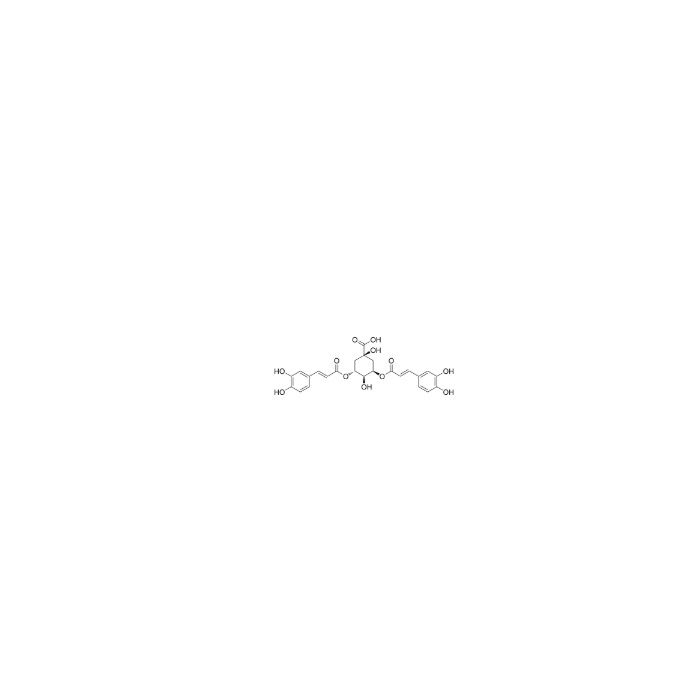
Isochlorogenic acid A is a phenolic acid found in the flowerbud of Lonicera japonica Thunb. It has been used in pharmacologic, as well as food and cosmetic, research.
An antioxidant that has been shown to have antiproliferative activity.
Product description:
3,5-Dicaffeoylquinic acid is a phenolic acid found in the flower buds of Lonicera japonica Thunb. It has been used in pharmacologic, as well as food, and cosmetic research.
Application:
3,5-Di-caffeoylquinic acid has been used as a reference standard for quantification of the phenolic compound of Artemisia species using high-performance liquid chromatography with diode array detection (HPLC-DAD). It has also been used as a reference standard to quantify the polyphenolic compounds found in Helianthus tuberosus L. (Jerusalem artichoke) using high-performance liquid chromatography-ultraviolet (HPLC-UV) technique.
Comprehensive hazard, handling, storage, and regulatory compliance document.
Download SDS →Lot-specific quality data. Enter your lot number to retrieve the exact COA.
Look up COA →Full quality attributes and acceptance criteria for this grade.
View spec sheet →Taxonomy Tree
| Kingdom | Organic compounds |
|---|---|
| Superclass | Organic oxygen compounds |
| Klasse | Organooxygen compounds |
| Subclass | Alcohols and polyols |
| Intermediate Tree Nodes | Cyclic alcohols and derivatives - Cyclitols and derivatives |
| Direct Parent | Quinic acids and derivatives |
| Alternative Parents | Coumaric acids and derivatives Cinnamic acid esters Tricarboxylic acids and derivatives Styrenes Catechols 1-hydroxy-2-unsubstituted benzenoids 1-hydroxy-4-unsubstituted benzenoids Fatty acid esters Cyclohexanols Alpha hydroxy acids and derivatives Tertiary alcohols Enoate esters Carboxylic acids Organic oxides Hydrocarbon derivatives Carbonyl compounds |
| Molecular Framework | Aromatic homomonocyclic compounds |
| Substituents | Quinic acid - Cinnamic acid or derivatives - Coumaric acid or derivatives - Hydroxycinnamic acid or derivatives - Cinnamic acid ester - Tricarboxylic acid or derivatives - Catechol - Styrene - 1-hydroxy-4-unsubstituted benzenoid - 1-hydroxy-2-unsubstituted benzenoid - Cyclohexanol - Fatty acid ester - Phenol - Fatty acyl - Hydroxy acid - Monocyclic benzene moiety - Alpha-hydroxy acid - Benzenoid - Tertiary alcohol - Alpha,beta-unsaturated carboxylic ester - Enoate ester - Carboxylic acid ester - Secondary alcohol - Carboxylic acid derivative - Carboxylic acid - Hydrocarbon derivative - Carbonyl group - Organic oxide - Aromatic homomonocyclic compound |
| Beschreibung | This compound belongs to the class of organic compounds known as quinic acids and derivatives. These are compounds containing a quinic acid moiety (or a derivative thereof), which is a cyclitol made up of a cyclohexane ring that bears four hydroxyl groups at positions 1,3.4, and 5, as well as a carboxylic acid at position 1. |
| External Descriptors | Not available |
| Activity Type | Activity Value -log(M) | Mechanism of Action | Activity Reference | Publications (PubMed IDs) |
|---|
Find and download the COA for your product by matching the lot number on the packaging.
| Lot Number | Certificate Type | Datum | Artikel |
|---|---|---|---|
 J2515490 | Certificate of Analysis | Oct 18, 2025 | I407329 |
| J2515487 | Certificate of Analysis | Oct 17, 2025 | I407329 |
| J2515488 | Certificate of Analysis | Oct 17, 2025 | I407329 |
| J2515489 | Certificate of Analysis | Oct 17, 2025 | I407329 |
| K2329376 | Certificate of Analysis | Sep 04, 2025 | I407329 |
| K2329377 | Certificate of Analysis | Sep 04, 2025 | I407329 |
| K2329400 | Certificate of Analysis | Sep 04, 2025 | I407329 |
| K2329403 | Certificate of Analysis | Sep 04, 2025 | I407329 |
| K2329404 | Certificate of Analysis | Sep 04, 2025 | I407329 |
| D2507124 | Certificate of Analysis | Nov 18, 2023 | I407329 |
| K2329401 | Certificate of Analysis | Nov 18, 2023 | I407329 |
| Empfindlichkeit | Light sensitive. |
|---|---|
| Schmelzpunkt (°C) | 170℃ |
| Molekulargewicht | 516.400 g/mol |
| XLogP3 | 1.500 |
| Hydrogen Bond Donor Count | 7 |
| Hydrogen Bond Acceptor Count | 12 |
| Rotatable Bond Count | 9 |
| Exact Mass | 516.127 Da |
| Monoisotopic Mass | 516.127 Da |
| Topological Polar Surface Area | 211.000 Ų |
| Heavy Atom Count | 37 |
| Formal Charge | 0 |
| Complexity | 825.000 |
| Isotope Atom Count | 0 |
| Defined Atom Stereocenter Count | 2 |
| Undefined Atom Stereocenter Count | 0 |
| Defined Bond Stereocenter Count | 2 |
| Undefined Bond Stereocenter Count | 0 |
| The total count of all stereochemical bonds | 2 |
| Covalently-Bonded Unit Count | 1 |
Our grade selection guide covers purity, stabilizer status, and application suitability for all variants in our catalog.
View Moligand™ grade guide →