GRADE & PURITYMoligand™?Moligand™ — Aladdin's line of ligands and bioactive small molecules. Use for receptor, pathway, and binding studies needing defined small-molecule tools.10 mM in DMSO
Moligand™, 10 mM in DMSO Moligand™ for sensitive chromatographic and analytical workflows requiring minimal baseline interference.
🌡
Storage & shipping
Store at -80°C Ships Dry ice packs + Cold packs Check lot-specific COA for exact specifications.
📋
Quality documents
SDS, COA, datasheet, and spec sheet available for download. Lot-specific COA accessible via lot number lookup.
📚
Literature proof
Cited in 0 peer-reviewed publications across chromatography, organic synthesis, and cross-coupling reactions.
Übersicht
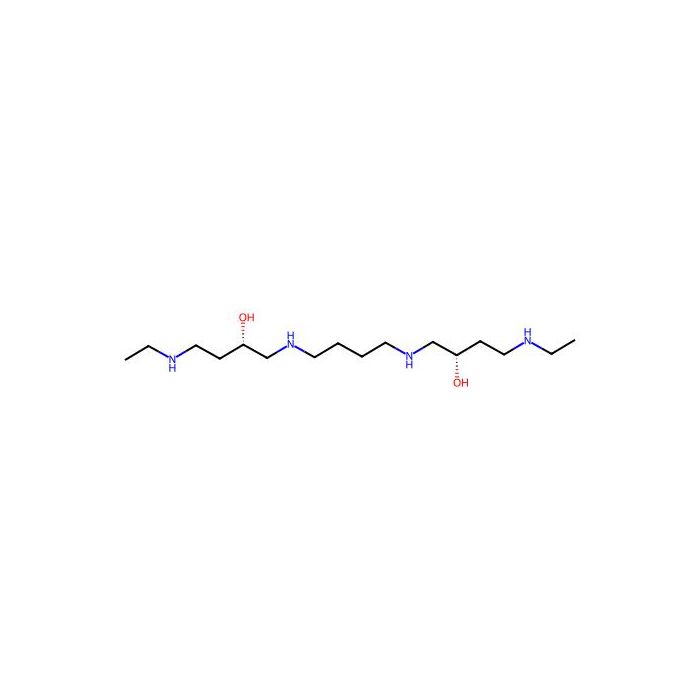
Ivospemin (SBP-101) is an antineoplastic spermine analog. Ivospemin has shown efficacy in slowing pancreatic and ovarian tumor progression in vitro and in vivo. Ivospemin shows modest induction of polyamine catabolism, but stronger repression of ornithine decarboxylase activity. Ivospemin is promising for research of cancers.
Specifications
Spezifikationen & Reinheit
Moligand™, 10 mM in DMSO
Storage
Store at -80°C
Verschickt in
Dry ice packs + Cold packs
Dieses Produkt erfordert Kühlkettenversand. Grundversand und andere Economy-Optionen sind nicht verfügbar.
Note
Moligand™
Aktionsart
INHIBITOR
Documentation
📋 Safety Data Sheet (SDS)
Comprehensive hazard, handling, storage, and regulatory compliance document.
Zertifikate (CoA, COO, BSE/TSE und Analyse-Diagramm)
C of A & Other Certificates(BSE/TSE, COO):
Analytical Chart:
Lösungsrechner
Molarity Calculator
Determine the necessary mass, volume, or concentration for preparing a solution.
Dilution Calculator
Determine the dilution needed to prepare a stock solution.
Reconstitution Calculator
Bewertungen
Kundenbewertungen
Application Protocols
No vendor-validated application protocols are provided for Ivospemin in this listing. The following are general, non–item-specific recommendations for deploying small-molecule ligands in discovery assays.
General screening protocol (outline)
Prepare a 10–50 mM DMSO stock; vortex and, if necessary, sonicate briefly.
Perform an 8–12 point, 3-fold serial dilution in DMSO.
Dose into assay plates to achieve desired top concentration; keep final DMSO constant across wells (typically 0.1–0.5% v/v).
Include vehicle controls and reference inhibitors/activators where applicable.
Read endpoints per assay modality (fluorescence/absorbance/HTRF/luminescence) and correct for any intrinsic compound interference.
CETSA/TPP: Treat cells/lysates with compound, apply temperature gradient, analyze soluble protein by MS or WB.
SPR/biolayer interferometry: If a purified target is available, determine KD/kon/koff using multiple concentrations and replicate injections.
Note: Optimize conditions empirically for Ivospemin once structural and solubility data are confirmed. Record lot number, stock concentration, and dilution scheme for reproducibility.
Biological Roles
Item-specific biological/mechanistic information for Ivospemin is not provided in this listing. No target, pathway, or mode-of-action annotations are available here.
General guidance for small-molecule ligands (non–item-specific)
Functional role: Research ligands may act as enzyme modulators, receptor ligands, or pathway probes. Establish potency, selectivity, and off-target profiles using appropriate biochemical/cellular assays.
ADME considerations: Basic physicochemical properties (logP, pKa, TPSA) influence permeability and solubility; microsomal stability and plasma protein binding can impact observed cellular effects.
Aggregation/assay interference: Screen for colloidal aggregation (detergent tests, dynamic light scattering) and optical interference (intrinsic fluorescence or quenching) to ensure data quality.
PAINS/REOS filters: If the structure is available, perform substructure alerts and redox activity assessments to avoid artifacts.
Note: Any reported biological roles from external sources should be validated against the structure and lot-specific documentation. Avoid extrapolating in vitro observations to clinical outcomes; this product is for research use only.
Buffer Applications
Ivospemin is a discrete small-molecule ligand and not a buffering agent. As such, it does not define or maintain pH and is not used to prepare standard laboratory buffers.
Practical note (general)
When dosing into buffered systems (e.g., PBS, HBSS, assay media), verify that the chosen buffer does not induce precipitation upon dilution from organic stock (DMSO/EtOH). Titrate the organic content and consider surfactants (e.g., 0.01% Tween-80) if compatible with your assay.
Adjust buffer pH to favor the ionization state that maximizes solubility only if the compound’s pKa is known. Without structural data, empirical solubility screening across pH 2–9 is recommended.
Green Alternatives
Because Ivospemin is a discrete small-molecule ligand rather than a process solvent or bulk reagent, “green alternative” considerations focus on solvent choices and assay formats rather than on replacing the compound itself.
Greener solvent choices for handling (general)
Prefer water and aqueous buffers where solubility and stability permit.
Use EtOH or MeOH in place of DMF/NMP when feasible for intermediate dissolutions (balance with biological compatibility and volatility).
Keep DMSO concentrations at the lowest level compatible with assay performance (typically ≤0.1–0.5% v/v in final well).
Buffer-only systems: Ideal from a green perspective but require ionizable motifs and careful pH control.
Operational best practices
Miniaturize assays (384–1536 well) to reduce solvent and compound consumption.
Use sealed plates to reduce VOC emissions.
Plan aliquots to avoid freeze–thaw losses and waste.
Pharmaceutical Uses
No excipient or pharmacopeial status is provided for Ivospemin in this listing. This material is supplied strictly for research use (e.g., discovery screening and mechanistic studies) and is not intended for human or veterinary use.
General formulation context for research ligands (non–item-specific)
Preclinical enabling studies (in vitro): Prepare DMSO stocks and dilute into assay media with careful control of final solvent concentration.
Preclinical enabling studies (in vivo research): If permitted within your institution, typical vehicles include combinations of aqueous buffer, PEG400, ethanol/propylene glycol, and surfactants (e.g., Tween-80); perform full solubility and stability assessments. This listing provides no guidance specific to Ivospemin; consult internal SOPs.
Regulatory status: Not specified for this item; no USP/EP monograph implied.
Always refer to the CoA/SDS and institutional review before any non-clinical animal work; no clinical/therapeutic claims are made or implied.
Physical Properties
Item-specific values
Appearance: Not specified for this item; refer to CoA/Spec Sheet.
Molecular weight: Not specified for this item; refer to CoA/Spec Sheet.
Melting point: Not specified for this item; refer to CoA/Spec Sheet.
Boiling point: Not applicable or not determined for solid research ligands; refer to CoA/Spec Sheet.
Density: Not specified for this item; refer to CoA/Spec Sheet.
Refractive index: Not applicable for solids; refer to CoA/Spec Sheet if provided.
Solubility (water/organics): Not specified for this item; refer to CoA/Spec Sheet.
LogP / cLogP, pKa: Not specified for this item; refer to CoA/Spec Sheet.
General/literature guidance (non–item-specific)
Many discovery ligands are provided as amorphous or microcrystalline solids and are commonly reconstituted in DMSO to prepare 10–50 mM stocks for screening. Verify solubility and stability empirically for your system.
If the chemical structure is available, computed descriptors (e.g., cLogP, TPSA, pKa) can be generated to inform solvent selection and storage. These are not item specifications and should be validated experimentally.
Hygroscopicity and polymorphism can impact handling and massing; equilibrate closed vials to ambient temperature before opening to minimize condensation when stored at −80°C.
Intended use: Discovery and screening workflows (e.g., target engagement, chemoproteomics, phenotypic assays). Not for diagnostic or therapeutic use.
Documentation: Each lot should be accompanied by a CoA/Spec Sheet indicating identity confirmation (e.g., LC–MS, HRMS, NMR, or HPLC purity). If a specific purity value is required for your application, request the CoA for your lot.
Purity reporting: Not specified for this item; refer to CoA/Spec Sheet. Moligand™ materials typically emphasize identity and suitability for screening over analytical reagent specifications (e.g., UV cutoff, trace metals), which are not applicable for most bioassays.
Stabilizers/inhibitors: Not specified for this item; refer to CoA/Spec Sheet.
Batch-to-batch: For screening reproducibility, standardize stock preparation (solvent, concentration, freeze–thaw cycles) and reference the lot number in data records.
Analytical expectations (general guidance)
Identity: LC–MS or HRMS match to theoretical mass; optional 1H NMR for structural confirmation.
Purity: HPLC/UPLC at multiple wavelengths (e.g., 220/254/280 nm). Where chromophores are weak, ELSD or CAD detection may be used.
Water/peroxide/metal limits: Not specified for this item; refer to CoA/Spec Sheet.
Reaction and Applications
This product is supplied as a research ligand in the Moligand™ collection and is not primarily intended as a synthetic reagent. Consequently, classical synthetic “reaction applications” are not typically applicable.
Relevant applications for discovery workflows (general guidance)
Biochemical and cell-based screening: Use Ivospemin as a discrete test article in enzymatic or phenotypic assays to probe pathway responses. Define concentration–response curves and basic DMPK properties (solubility, stability in media, microsomal stability) as needed.
Target deconvolution: Apply chemoproteomic strategies (e.g., CETSA, DARTS, thermal proteome profiling) to identify protein targets, if structural data suggest tractable handles. Any derivatization for probes should be performed on separate, purpose-synthesized analogs.
Orthogonal validation: Pair with genetic perturbation (siRNA/CRISPR knockdown/knockout) to correlate phenotypes.
Analytical use: Establish LC–MS methods for quantitation in assay samples; determine retention time, ionization mode, and fragmentation using a reference solution prepared from the supplied material.
Note: If you plan to use Ivospemin as a building block or in chemical synthesis, obtain the structure first to assess functional-group compatibility, protectability, and stability. Without structural information, no specific reaction classes can be recommended.
Reaction Conditions
Classical chemical reaction conditions are not applicable because Ivospemin is supplied as a research ligand rather than a reagent. No catalysts, stoichiometries, or preparative protocols are provided for this item.
General handling conditions for assay deployment (non–item-specific)
Stock preparation: Dissolve in anhydrous DMSO to 10–50 mM. Gentle warming (25–37°C) and sonication may aid dissolution. Document exact concentration by gravimetry or quantitative NMR when high precision is required.
Dilution: Add stock to assay buffer/media with thorough mixing; maintain final DMSO ≤0.1–0.5% v/v unless your system tolerates more.
Light/oxygen: If the compound is conjugated or suspected photosensitive, protect from light and minimize air exposure.
Stability checks: Assess stability in storage solvent and in working media by LC–MS over relevant time frames; look for precipitation or degradation.
Determine concentration–response (8–12 points, 3-fold serial dilutions) with technical replicates. Include vehicle controls and, when available, a positive control ligand.
Safety and Handling
Item-specific hazard data
GHS classification: Not specified for this item; refer to SDS.
Signal word / pictograms / H-statements: Not specified for this item; refer to SDS.
General laboratory precautions (non–item-specific; always defer to SDS)
Use in a fume hood with appropriate PPE: lab coat, safety glasses, and suitable gloves (e.g., nitrile). Avoid inhalation of dust or aerosols and prevent skin/eye contact.
Storage incompatibilities: Segregate from strong oxidizers and bases/acids unless compatibility is known. Keep tightly sealed under dry, inert atmosphere if moisture- or air-sensitive; store as directed at −80°C.
First-aid overview: In case of skin contact, wash with soap and water; eye contact, rinse cautiously with water for several minutes; inhalation, move to fresh air; ingestion, rinse mouth. Seek medical attention and provide SDS to responders.
Spill/cleanup: Avoid dust generation. Absorb with inert material, place in chemical waste container. Decontaminate area per institutional procedures.
Waste disposal: Dispose of in accordance with local regulations for organic laboratory chemicals.
Note: Some heteroaromatic or conjugated ligands may be photosensitive—minimize light exposure until compound-specific data are confirmed.
Solvent Selection
Item-specific solubility data are not provided for Ivospemin; consult the CoA or perform a small-scale solubility screen.
General guidance for small-molecule research ligands
Primary stock solvent: DMSO is commonly preferred due to broad solubilizing power and biological compatibility at low v/v in assays. Start with 10–50 mM stocks.
Secondary cosolvents: If DMSO alone is insufficient, consider DMF or NMP (for screening only), or ternary mixtures (e.g., DMSO:water with surfactant like 0.01% Tween-80) after confirming assay tolerance.
Aqueous buffers: Direct dissolution in water or PBS may be feasible for ionizable compounds; determine pKa from structure to select buffer pH. Avoid high ionic strength if salt formation/precipitation occurs upon dilution.
Volatile solvents: For preparative handling, MeCN, MeOH, or EtOH can be used to create intermediate concentrates before final DMSO stock; ensure complete removal where required.
Comparison (general)
DMSO: Highest success rate for initial dissolution; low volatility; cell-compatible at ≤0.1–0.5% v/v.
MeCN/MeOH: Useful for analytical sample prep; higher volatility aids drying but can precipitate compound during buffer dilution.
PEG400: Enhances solubility for hydrophobic ligands; viscosity and biological effects must be considered.
Practical tips
Warm (25–37°C) and vortex/sonicate to aid dissolution. Filter only if known to be stable and non-binding to membranes. Verify clarity after dilution into assay media.
Storage and Reconstitution
Item-specific instructions
Storage temperature: Store at −80°C.
Shipping: Shipped on dry ice packs + cold packs.
Appearance: Not specified for this item; refer to CoA/Spec Sheet.
General reconstitution guidance (non–item-specific)
Solvent: Use anhydrous DMSO for initial stock preparation unless item-specific solubility dictates otherwise. Start at 10–50 mM.
Aliquoting: Divide into single-use aliquots in low-bind tubes to avoid repeated freeze–thaw cycles.
Freeze–thaw: Minimize cycles; thaw on ice or at room temperature, mix gently, and promptly return unused material to −80°C.
Light/moisture: Protect from light if chromophoric; allow vials from −80°C to equilibrate to room temperature in a sealed container before opening to prevent condensation.
Working solutions: Prepare fresh dilutions into assay buffer/media immediately before use. Verify clarity after dilution; filter only if compatible and non-adsorptive.
Stability notes
Long-term stability, hygroscopicity, and solution shelf-life: Not specified for this item; refer to CoA/Spec Sheet and perform pilot stability assessments by LC–MS or HPLC under your storage conditions.
Research use only: Not for human or veterinary use.
Structure and Identity
Product name: Ivospemin (SKU: I1496200)
CAS: 748119-79-1
Category: Small molecule / compound library (Moligand™ series)
Item-specific identifiers
Molecular formula: Not specified for this item; refer to CoA/Spec Sheet.
Molecular weight: Not specified for this item; refer to CoA/Spec Sheet.
SMILES: Not specified for this item; refer to CoA/Spec Sheet.
InChI / InChIKey: Not specified for this item; refer to CoA/Spec Sheet.
Structural features (general guidance)
Structural class: Not provided. Ivospemin is supplied as a research ligand in the Moligand™ collection; confirm exact scaffold and functional groups from the certificate of analysis (CoA) or structural data file supplied with your lot.
Stereochemistry: Not specified for this item; consult lot documentation if stereocenters or atropisomerism are relevant.
2D description (general): Without a provided structure, a functional-group description cannot be given. Request the SDF/Molfile for substructure queries, PAINS screening, or physicochemical calculations prior to assay deployment.
Synthetic Utility
Ivospemin is provided as a finished research ligand and not as a chemical building block. In the absence of structural information, specific synthetic transformations cannot be recommended.
General considerations if derivatization is planned (non–item-specific)
Scaffold assessment: Once structure is available, identify functional handles (e.g., anilines, phenols, carboxylates, halides) for diversification (amide coupling, Suzuki/Miyaura, Buchwald–Hartwig, SNAr).
Probe design: For target identification, append linkers at positions predicted to tolerate modification (guided by SAR or docking). Choose bioorthogonal tags (alkynes/azides) or photoreactive groups if chemoproteomics is intended.
Stability: Evaluate sensitivity to oxidation, hydrolysis, or light before planning protecting groups or late-stage functionalization.
Analytical control: Use LC–MS and NMR to verify integrity of the parent compound after any modification; compare to the supplied reference.
If Ivospemin is to be used purely as a screening hit, retain it unmodified and synthesize analogs de novo based on the disclosed structure rather than altering the supplied material.
Target Specificity
No target, pathway, or binding specificity information is provided for Ivospemin in this listing.
Item-specific data
Target/epitope: Not specified for this item; refer to CoA/Spec Sheet or internal records.
Species reactivity/selectivity: Not specified for this item; refer to CoA/Spec Sheet.
Assay-validated activities (IC50/Ki/EC50): Not specified for this item; refer to CoA/Spec Sheet.
General guidance
Establish primary target engagement using biochemical assays or biophysical methods (e.g., SPR, ITC, DSF, CETSA) once a putative target is hypothesized.
Profile selectivity against relevant off-target panels to contextualize phenotypic outcomes before committing to extensive follow-up studies.
Need help choosing the grade?
Our grade selection guide covers purity, stabilizer status, and application suitability for all variants in our catalog.
Wir verwenden Cookies, um die ordnungsgemäße Funktion der Website sicherzustellen und, soweit zulässig, Ihr Nutzererlebnis zu verbessern. Sie können Ihre Einstellungen jederzeit unter „Einstellungen“ verwalten. Weitere Informationen finden Sie in unserer Cookie-Richtlinie.
Shall we send you a message when we have discounts available?
Remind me later
Thank you! Please check your email inbox to confirm.
Products are supplied to verified businesses, institutions, and qualified professionals for research and development use only. Not for use in humans, animals, diagnosis, or therapy.