QUALITÄT & REINHEITMoligand™?Moligand™ — Aladdin's line of ligands and bioactive small molecules. Use for receptor, pathway, and binding studies needing defined small-molecule tools.≥99%
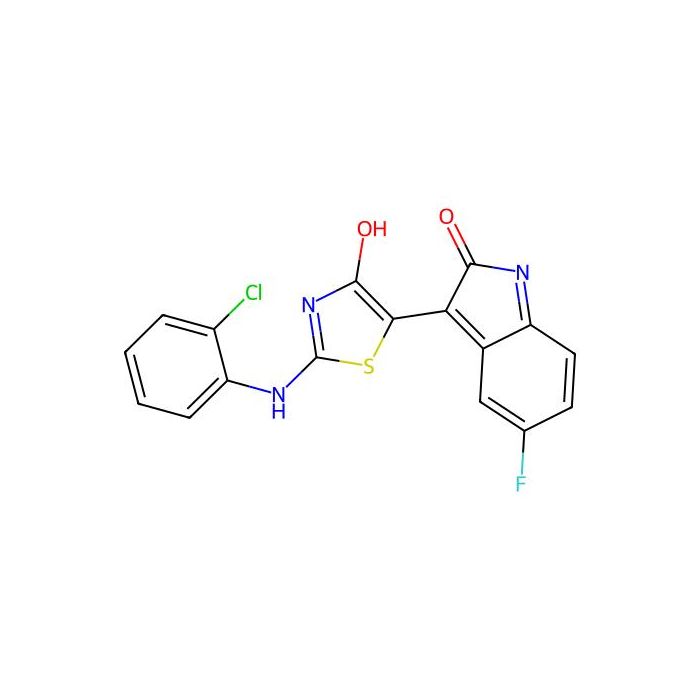
J30-8 is a potent and isoform-selective inhibitor of c-Jun N-terminal kinase 3 (JNK3) with an IC50 of 40 nM, which 2500-fold isoform selectivity against JNK1α1 and JNK2α2. J30-8 exhibits neuroprotective activity in vitro and potential for the treatment of neurodegenerative diseases.
DMSO : 6.67 mg/mL (17.84 mM; ultrasonic and warming and heat to 60°C)
Empfindlichkeit
Light sensitive, Moisture sensitive
Molekulargewicht
373.8
XLogP3
3.900
Hydrogen Bond Donor Count
2
Hydrogen Bond Acceptor Count
6
Rotatable Bond Count
3
Exact Mass
373.009 Da
Monoisotopic Mass
373.009 Da
Topological Polar Surface Area
103.000 Ų
Heavy Atom Count
25
Formal Charge
0
Complexity
721.000
Isotope Atom Count
0
Defined Atom Stereocenter Count
0
Undefined Atom Stereocenter Count
0
Defined Bond Stereocenter Count
0
Undefined Bond Stereocenter Count
0
The total count of all stereochemical bonds
0
Covalently-Bonded Unit Count
1
Lösungsrechner
Molarity Calculator
Determine the necessary mass, volume, or concentration for preparing a solution.
Dilution Calculator
Determine the dilution needed to prepare a stock solution.
Reconstitution Calculator
Bewertungen
Kundenbewertungen
Application Protocols
Item-specific tested applications
Not specified for this item; refer to CoA/Spec Sheet.
General protocols for small-molecule screening stocks (not item-specific)
Stock solution (example workflow):
Equilibrate vial to room temperature in the dark within a desiccated container.
Open under inert gas if possible. Add anhydrous DMSO to prepare 10–50 mM stock. Vortex and, if needed, sonicate briefly. Filter through 0.22 μm PTFE if particulates remain.
Aliquot into amber, low-bind microtubes or assay plates; backfill with inert gas; store at −20 °C.
Working dilutions:
Prepare serial dilutions in DMSO, then spike into assay buffer to desired final concentration keeping constant final DMSO (e.g., 0.5–1.0% v/v across all wells).
Mix gently to avoid foaming; inspect for precipitation. If precipitate forms, reduce concentration or increase co-solvent within assay limits.
Analytical confirmation:
Verify concentration by UV–vis or qNMR when chromophore/proton count allows; alternatively, use LC–MS with external calibration.
Adjust the above to your assay’s tolerance and the compound’s solubility/stability once structural data are available.
Biological Roles
Item-specific
No biological function, target, or pathway annotations are provided for J30-8.
General context (not item-specific; no medical/clinical claims)
Library members such as Moligand™ compounds are often utilized to explore target engagement, binding preferences, and SAR in research settings after internal validation.
Any putative biological role must be established experimentally (e.g., enzyme inhibition constants, binding affinities) and is highly structure-dependent.
Until target and mechanism data are disclosed/validated, no specific biological role can be assigned to this item.
Buffer Applications
This product is not a buffering reagent. However, buffer handling is relevant when preparing working solutions for screening.
General guidance for preparing assay solutions (not item-specific)
Stock preparation: Dissolve in anhydrous DMSO (10–50 mM typical), then dilute into assay buffer immediately before use.
Common buffers: PBS (pH 7.2–7.4), HEPES (pH 7.0–7.5), Tris (pH 7.4–8.0). Choose based on assay biology and compound stability (avoid nucleophiles for acylating species; avoid high pH for base-labile moieties).
Co-solvent considerations: Maintain final DMSO ≤1–2% v/v unless your assay tolerates higher. Match co-solvent across control and test wells.
Surfactants: For highly lipophilic compounds, 0.01–0.05% nonionic surfactant (e.g., Tween 20 or Pluronic F-127) may reduce aggregation; verify compatibility.
All buffer recipes and tolerances should be validated empirically for this specific compound once the structure and stability profile are confirmed.
Green Alternatives
In the absence of structure-specific data, green considerations focus on dissolution and assay workflow solvents rather than on the compound itself.
General guidance (not item-specific)
Prefer lower-toxicity solvents for dilutions: EtOH or water (buffered) can partially replace DMSO/DMF when the compound’s solubility and assay allow.
Minimize DMSO: Keep final DMSO ≤1% v/v in aqueous assays; use concentrated stocks to reduce total solvent volume.
Avoid chlorinated solvents in routine handling; if required analytically (e.g., dichloromethane for sample transfer), confine to fume hood and recover via solvent waste streams.
Comparison (general, literature)
DMSO vs. EtOH: DMSO offers broader solvency but can affect enzyme activity at higher %; EtOH is greener but less universal.
MeCN vs. IPA: MeCN is effective for LC but has higher environmental burden; IPA may substitute in some extractions and rinses.
Operational improvements
Use micro-volume, sealed, inert-atmosphere plating to reduce evaporative losses.
Validate room-temperature aqueous stability to avoid chilled storage during short assay windows.
Item-specific green metrics (E-factor, life cycle) are Not specified for this item; refer to CoA/Spec Sheet if available.
Pharmaceutical Uses
No pharmacopeial status or excipient role is specified for this product. It is supplied strictly for research use only.
General information (not item-specific; no therapeutic claims)
Small-molecule library members can be used in formulation feasibility studies (e.g., solubility screening, preformulation research) within R&D, but this item is not approved for human or veterinary use.
Any GMP suitability, impurity profiling, or ICH stability data are outside the scope of this listing and, if needed, must be developed under appropriate quality systems.
For regulated applications, source pharmacopeial-grade materials or implement full CMC characterization; this product is intended for discovery-stage research only.
Physical Properties
Item-specific (from Product Data)
Physical state/appearance: Not specified for this item; refer to CoA/Spec Sheet.
Molecular weight: Not specified for this item; refer to CoA/Spec Sheet.
Typical physicochemical descriptors (literature/general guidance for small-molecule library members; not item-specific)
Melting point (MP), boiling point (BP), density, refractive index, pKa, logP/logD, and aqueous solubility are structure-dependent and must be obtained from the item’s CoA or measured experimentally.
Free-base vs. salt form: If the compound is supplied as a salt (e.g., HCl, TFA), pH-dependent solubility and hygroscopicity may differ substantially from the free base/acid form.
Solubility screening approach (general):
Start with anhydrous DMSO at 10–50 mM to prepare a primary stock; if insoluble, consider DMF, MeOH, or 1:1 DMSO:MeCN, then dilute into assay buffers.
For aqueous work, evaluate co-solvent tolerance (commonly ≤1–2% DMSO v/v in biological assays).
If poor solubility persists, assess salt formation (for ionizable molecules), gentle warming (<40 °C), or sonication; avoid strong base/acid unless compatible with downstream use.
Important
Do not treat the above as specifications. For this SKU, all numeric physical properties are Not specified for this item; refer to CoA/Spec Sheet.
Quality and Grades
Item-specific (from Product Data)
Grade/Purity: Moligand™ (library-grade small molecule for discovery workflows). Numerical purity, residual solvent, water content, and metal limits: Not specified for this item; refer to CoA/Spec Sheet.
What Moligand™ implies (general context, not item-specific specifications)
Curated for screening: Compounds are selected or formatted for use as ligands/chemotypes in screening collections (HTS, target validation, chemoproteomics). This typically prioritizes identity confirmation and usability in DMSO stocks.
Documentation: Expect batch-validated identity (e.g., LC–MS, HRMS, or NMR) as outlined in the CoA. Request spectral data as needed for internal QA.
Assay readiness: Library-grade materials are often supplied in forms amenable to dissolution and plating; however, final concentration/solubility must be verified in your own matrices.
Stabilization/format
The product is supplied under argon and light protection, indicating potential sensitivity. No stabilizer is specified for this item.
Recommendations
Verify: Purity, identity, and water content with the lot CoA prior to critical experiments.
Track: Use barcode/ELN linkage to the SKU and lot to ensure reproducibility across screening campaigns.
Reaction and Applications
Item-specific
Manufacturer applications: Not specified for this item beyond inclusion in the Moligand™ small-molecule/compound library.
General applications for Moligand™ library members (not item-specific; no biological claims)
Screening and hit identification: Use in biochemical, biophysical (e.g., DSF, SPR), or cell-free assays to prioritize chemotypes.
Chemical biology workflows: Probe optimization, structure–activity relationship (SAR) exploration, and orthogonal target deconvolution (e.g., CETSA, pull-down with tagged analogs) after internal validation.
Analytical reference: Standard for method development (LC–MS retention mapping, ionization behavior) within a focused chemotype series.
Practical tips
Prepare concentrated anhydrous DMSO stocks (e.g., 10–50 mM) under inert gas if air/moisture sensitive; filter (0.22 μm PTFE) if particulate remains.
Plate handling: Use inert gas backfilling for source plates; limit freeze–thaw cycles by aliquoting.
Stability checks: Run quick LC–UV/MS stability assays (time 0 vs 24–48 h in assay buffer at ambient temperature) to flag hydrolysis or oxidation.
Note: Without a disclosed structure, synthetic reaction roles (as reagent or intermediate) cannot be meaningfully detailed for this specific item.
Reaction Conditions
Reaction conditions are inherently structure- and functional-group-dependent. For J30-8, no structural information is provided.
General method-development guidance (not item-specific)
Solution preparation: Use anhydrous solvents and inert atmosphere when the compound is sensitive to oxygen/moisture (suggested by argon-charged storage).
Analytical tracking: Employ LC–MS to monitor reaction progress and detect degradation pathways (hydrolysis, oxidation, isomerization).
Stability scouting: Screen pH (2–10), temperature (4–50 °C), and light exposure to define compatible handling windows for any downstream chemistry.
To propose concrete temperatures, catalysts, or solvent systems, the exact functional groups of J30-8 are required.
Safety and Handling
Item-specific (from Product Data)
Storage: Store at −20 °C, protected from light, argon charged.
Shipping: Ice chest + ice pads.
GHS/CLP: Not specified for this item; refer to SDS.
Signal word/H-statements/Pictograms: Not specified for this item; refer to SDS.
General safety guidance (not item-specific; always defer to the SDS for the batch)
Personal protective equipment: Lab coat, safety glasses, and suitable chemical-resistant gloves (e.g., nitrile). Work in a fume hood to avoid inhalation of dust or vapors.
Handling: Avoid exposure to air and moisture if the item is air/moisture sensitive (argon-charged storage suggests sensitivity). Minimize light exposure during weighing and solution prep.
Incompatibilities (general): Strong oxidizers or reducers, strong acids/bases, and reactive metals may be incompatible depending on functional groups. Use inert, dry glassware for air-sensitive solids.
First aid overview: In case of skin/eye contact, rinse with water for at least 15 minutes; remove contaminated clothing. If inhaled, move to fresh air. If ingested, rinse mouth; do not induce vomiting; seek medical attention. Provide the SDS to medical personnel.
Spill response: Cover small spills with inert absorbent, collect in labeled waste. Avoid dust formation; ventilate area.
Waste: Dispose of according to institutional and local regulations; segregate halogenated vs non-halogenated organic waste as applicable.
Always consult the batch-specific SDS for authoritative hazard classification and first-aid measures.
Solvent Selection
Given the undisclosed structure, solvent selection should follow general best practices for small-molecule library members.
Item-specific
No solubility or polarity data are provided for this item; refer to CoA/Spec Sheet.
General guidance (not item-specific)
Primary stock solvent: Anhydrous DMSO is the default for discovery libraries due to broad solvency and compatibility with most assay systems at ≤1–2% v/v.
Secondary options: DMF, MeCN, MeOH, or EtOH can be used depending on functional groups and assay tolerance.
Aqueous work: Use co-solvent strategies (DMSO or EtOH spikes), pH adjustment for ionizable compounds, or cyclodextrin inclusion when appropriate.
Moisture/air sensitivity: The argon-charged packaging suggests handling under inert atmosphere. Use dry solvents and minimize headspace oxygen/water during dissolution.
Quick comparison (general, literature)
DMSO: widest solvency; high boiling point; hygroscopic; generally compatible at low %.
MeCN: polar aprotic; volatile; limited solvency for highly lipophilic solids.
MeOH/EtOH: protic; useful for salts and polar analytes; may affect bioassays more than DMSO.
Select the solvent based on your assay matrix, target co-solvent limits, and the compound’s ionization/functional groups once available.
Storage and Reconstitution
Item-specific (from Product Data)
Storage conditions: Store at −20 °C, protected from light, argon charged.
Shipping: Ice chest + ice pads.
General reconstitution guidance (not item-specific; tailor once structure is known)
Atmosphere: Open and handle under inert gas (argon or nitrogen) when possible to maintain the protective environment indicated by the packaging.
Solvent: Use anhydrous DMSO for initial stock solutions unless the CoA specifies otherwise. Alternative dry solvents (DMF, MeCN, MeOH) may be used based on solubility and downstream compatibility.
Concentration: Prepare concentrated stocks (e.g., 10–50 mM) to minimize assay co-solvent. Document exact concentration and lot number in ELN.
Aliquoting: Divide into single-use amber vials/tubes to avoid repeated freeze–thaw and light exposure. Backfill headspace with inert gas.
Freeze–thaw: Minimize cycles; thaw at room temperature in the dark. Do not heat above ambient unless stability has been verified.
Stability check: Periodically confirm integrity by LC–MS/LC–UV after storage; discard aliquots showing degradation or precipitation that cannot be redissolved.
Any additional stabilizers, hydrates/solvates, water content, or salt forms are Not specified for this item; refer to CoA/Spec Sheet and the batch SDS for authoritative guidance.
Structure and Identity
Item-specific (from Product Data)
CAS: 2366255-71-0
Catalog SKU: J651095 (Product name: J30-8)
Category: Small molecule and compound library (Moligand™)
PubChem CID: 4078145
InChIKey: 21707 (note: atypical format as provided)
Molecular formula: Not specified for this item; refer to CoA/Spec Sheet.
Molecular weight: Not specified for this item; refer to CoA/Spec Sheet.
SMILES: Not specified for this item; refer to CoA/Spec Sheet.
Interpretive notes
The structural formula, stereochemistry, and functional group composition are not provided in the product data and should be verified from the Certificate of Analysis (CoA) or structure file supplied with the library collection.
As a Moligand™ library member, J30-8 is positioned as a ligand-like small molecule suitable for screening and discovery workflows. Without a disclosed structure, no detailed 2D/3D description can be given.
Recommendations
For informatics integration, request or download the structure definition file (SDF/MOL/SMILES) associated with this CAS/CID from Aladdin’s product page or the batch-specific CoA to ensure correct identity handling in ELNs and screening databases.
Synthetic Utility
Without a disclosed structure, functional-group-based reactivity and named-reaction applicability cannot be detailed for J30-8 specifically.
General considerations for library members (not item-specific)
Derivatization: If functional handles (e.g., amine, acid, halide, alkyne/alkene) are present, late-stage diversification or probe attachment (biotin/fluorophore) can be pursued.
Analytical readiness: Confirm identity via LC–MS/HRMS and, where feasible, 1H/13C NMR before derivatization.
Protecting-group strategy: If pursuing analog synthesis, select orthogonal protection compatible with the most sensitive moieties inferred from preliminary stability tests.
Provide the specific structure (SMILES/SDF) to enable tailored synthetic planning, reactivity prediction, and conditions selection.
Target Specificity
No target, epitope, or binding specificity data are provided for J30-8.
As a Moligand™ library member, it should be treated as an unannotated chemical entity until target engagement is demonstrated by your internal assays (e.g., enzymology, biophysics, or chemoproteomics). Any specificity claims must be supported by primary data.
Häufig gestellte Fragen
What is the purity of this product?
This product is supplied at ≥99% purity (chemical assay). Lot-specific values are stated on the Certificate of Analysis.
What is Moligand??
Moligand? is one of Aladdin Scientific's premium product lines, formulated for high-purity applications across multiple workflows. Compared to standard grades in the same workflow, Moligand? products typically offer tighter specifications, more rigorous QC, and stronger lot-to-lot consistency.
How should this product be stored?
Store at ?20 °C, protected from light, under argon. It is supplied under an argon blanket; reseal under inert gas after each use.
How is this product shipped?
This product ships in an insulated container with ice pads. Unpack on arrival and transfer it to the storage condition stated above.
What are the CAS number, molecular formula and molecular weight?
The CAS Number is 2366255-71-0, the molecular formula is C17H9ClFN3O2S, and the molecular weight is 373.79 g/mol. InChIKey BDCJVPSBCYWSSS-UHFFFAOYSA-N.
What documentation is provided?
Available product documentation, including Certificates of Analysis (COA), Safety Data Sheets (SDS), and specification sheets, is shown in the product document area. Document availability and access follow the current site policy.
Benötigen Sie Hilfe bei der Auswahl der Qualität?
Unser Leitfaden zur Qualitätsauswahl behandelt Reinheit, Stabilisatorstatus und Anwendungseignung für alle Varianten in unserem Katalog.
Wir verwenden Cookies, um die ordnungsgemäße Funktion der Website sicherzustellen und, soweit zulässig, Ihr Nutzererlebnis zu verbessern. Sie können Ihre Einstellungen jederzeit unter „Einstellungen“ verwalten. Weitere Informationen finden Sie in unserer Cookie-Richtlinie.
Dürfen wir Sie über Rabattaktionen informieren?
Später erinnern
Vielen Dank! Bitte überprüfen Sie Ihren E-Mail-Posteingang, um zu bestätigen.
Products are supplied to verified businesses, institutions, and qualified professionals for research and development use only. Not for use in humans, animals, diagnosis, or therapy.

 J2616396