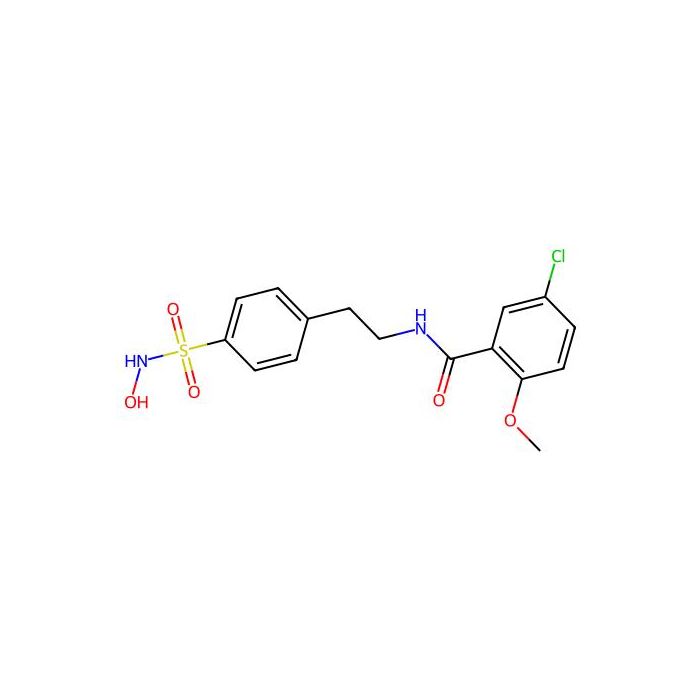
JC-171 is a selective NLRP3 inflammasome inhibitor, with an IC 50 of 8.45 μM for inhibiting LPS/ATP-induced interleukin-1β (IL-1β) release from J774A.1 macrophages.
In Vitro
JC-171 (0-100 μM) blocks NLRP3 inflammasome activation and IL-1β production in primary macrophages dose dependently. MCE has not independently confirmed the accuracy of these methods. They are for reference only. Cell Viability AssayCell Line: J774A.1 murine macrophage cells Concentration: 0-100 μM. Incubation Time: 0.5 h (before LPS (1 μg/mL) treatment for 4.5 h). Result: Inhibited the release of IL-1β in J774A.1 cells upon stimulation with LPS/ATP.
In Vivo
JC-171 treatment delays the progression and reduces the severity of experimental autoimmune encephalomyelitis (EAE) in mouse . MCE has not independently confirmed the accuracy of these methods. They are for reference only. Animal Model: Mice immunized subcutaneously with 200 μg Myelin oligodendrocyte glycoprotein (MOG) 35–55 peptide emulsified in Complete Freund’s Adjuvant (CFA) on day 0 followed by injection of 200 ng of pertussis toxin. Dosage: 100 mg/kg, 10 mg/kg. Administration: IP days 0, 1 and 2; and every other days thereafter (100 mg/kg). Initiated when the clinical scores of individual mice have reached 1 (flaccid tail), and given every other day (10 mg/kg). Result: Efficiently suppressed EAE progression compared with vehicle treatment. Resulted in a substantial decrease in the frequency of MOG 35–55 -specific Th17 cells in the spleens and spinal cords of EAE mice.
Form:Solid
Spezifikationen
Spezifikationen & Reinheit
≥99%
Biochemische und physiologische Mechanismen
JC-171 is a selective NLRP3 inflammasome inhibitor, with an IC 50 of 8.45 μM for inhibiting LPS/ATP-induced interleukin-1β (IL-1β) release from J774A.1 macrophages.
Storage
Store at -20°C
Verschickt in
Ice chest + Ice pads
Dieses Produkt erfordert Kühlkettenversand. Grundversand und andere Economy-Optionen sind nicht verfügbar.
This compound belongs to the class of organic compounds known as benzenesulfonamides. These are organic compounds containing a sulfonamide group that is S-linked to a benzene ring.
External Descriptors
Not available
1. Djoumbou Feunang Y, Eisner R, Knox C, Chepelev L, Hastings J, Owen G, Fahy E, Steinbeck C, Subramanian S, Bolton E, Greiner R, and Wishart DS. ClassyFire: Automated Chemical Classification With A Comprehensive, Computable Taxonomy. Journal of Cheminformatics, 2016, 8:61.
Zertifikate (CoA, COO, BSE/TSE und Analyse-Diagramm)
C of A & Other Certificates(BSE/TSE, COO):
Analytical Chart:
Chemische und physikalische Eigenschaften
Löslichkeit
DMSO : 250 mg/mL (649.64 mM; Need ultrasonic)
Lösungsrechner
Molarity Calculator
Determine the necessary mass, volume, or concentration for preparing a solution.
Dilution Calculator
Determine the dilution needed to prepare a stock solution.
Reconstitution Calculator
Bewertungen
Kundenbewertungen
Application Protocols
No tested applications are specified in the product data for JC-171. The following general protocols are provided as non-specific guidance for small-molecule use in research.
Preparing stock solutions (general):
Allow vial to equilibrate to room temperature in a desiccator before opening. Weigh quickly to minimize moisture uptake.
Prepare a 10–50 mM stock in anhydrous DMSO. Vortex and sonicate briefly to assist dissolution. If insoluble, consider DMF or acetonitrile.
Sterile filtration (0.22 µm PTFE) may be used for cell-based assays; verify no adsorption losses.
Assay dilution (general):
Dilute into assay buffer to the desired concentration range (e.g., 0.1 nM to 100 µM) while keeping the final DMSO constant (typically 0.1–0.5% v/v). Include vehicle and positive/negative controls.
Prepare serial dilutions freshly to minimize adsorption and degradation. Inspect visually for precipitation.
Analytical QC before use:
Confirm identity/purity by LC–MS/UPLC and, when needed, 1H NMR. Re-check after prolonged storage or multiple freeze–thaw events.
Note: These are general guidelines; adapt to your target system and institutional SOPs. No specific biological applications are claimed for JC-171 in this listing.
Biological Roles
No biological role, target, or pathway annotation is provided for JC-171 in this catalog entry. Accordingly, no claims can be made regarding its mechanism or selectivity.
General considerations for small-molecule library members (not item-specific):
Potential roles, if any, must be established empirically via biochemical binding assays, phenotypic screens, and orthogonal confirmation (e.g., CETSA/TPP, SPR, ITC, BLI, CRISPR-based genetic validation).
Evaluate aggregation, redox activity, metal chelation, or fluorescent interference to exclude pan-assay interference (PAINS)-like behavior. Employ detergent controls and dynamic light scattering where feasible.
Build a target deconvolution workflow: competition assays with analogs, photoaffinity or clickable probes (if structure allows), thermal shift assays, and proteomics pull-downs.
Characterize liabilities such as chemical instability, photoreactivity, or covalent reactivity that may confound biological readouts.
Documentation:
Record the precise lot, stock concentration, solvent composition, and plate history in ELNs. Where possible, publish or share structures and QC datasets to enable reproducibility.
Note: This product is for research use only and is not intended for diagnostic, therapeutic, or clinical applications.
Buffer Applications
JC-171 is not a buffering reagent and no pKa data are provided. Therefore, it is not typically used to prepare or maintain specific pH environments.
Practical guidance (general):
When using this compound in biochemical or cell-based assays, prepare stock solutions in DMSO and dilute into a validated assay buffer (e.g., HEPES, PBS, Tris) appropriate for your target system.
Maintain constant vehicle percentages across wells or treatment groups to avoid solvent-driven pH or ionic strength artifacts.
If the compound is suspected to be acid/base sensitive, assess stability in the intended buffer over the assay timeframe (e.g., LC–MS at t = 0, 1, 4, 24 h).
For buffer recipes and pH control, consult standard buffering agents rather than JC-171.
Green Alternatives
For small-molecule dissolution and analytics, solvent choice drives a large share of environmental impact. While item-specific solubility is unknown, the following general strategies can lower solvent hazard without compromising data quality.
Greener preparation options (general guidance):
Prefer aqueous buffers with minimal DMSO (≤0.1–0.5% v/v) when compatible with solubility and assay tolerability.
Replace DMF/NMP where possible with less hazardous media (e.g., propylene carbonate or PEG 300/400 for preparative work; verify assay compatibility).
Evaluate Cyrene (dihydrolevoglucosenone) as a renewable dipolar aprotic solvent for sample preparation or synthesis; note its reactivity with strong bases and nucleophiles.
Use ethanol or isopropanol as intermediate wetting agents for plate coating or film casting when DMSO alone leads to precipitation on dilution.
Comparison snapshot (general, literature-based):
DMSO: EHS profile moderate; excellent solvency; widely accepted in bioassays at low %.
DMF/NMP: Effective but reproductive toxins—avoid in routine bioassays; confine to closed systems/analytics.
Propylene carbonate/PEG 400: Safer profiles; higher viscosity can hinder pipetting and LC compatibility.
Ethanol/iPrOH: Renewable routes available; flammable; limited capacity for very hydrophobic scaffolds.
Implementation tips:
Start with DMSO stocks but optimize aqueous formulations to reduce solvent load. Validate that greener substitutions do not alter assay readouts (control for solvent effects and evaporation).
Pharmaceutical Uses
No pharmaceutical excipient role, dosage form, or pharmacopeial status is provided for JC-171 in this catalog entry. This material is supplied strictly for research use only.
General notes (not item-specific claims):
Library compounds used in discovery are not manufactured under GMP and are not intended for human or veterinary administration.
If preformulation studies are performed for research, characterize solid form (XRPD, DSC/TGA), hygroscopicity, and solution stability. These data inform salt or co-crystal screening should future medicinal chemistry be pursued.
Evaluate adsorption losses to lab plastics at low µM–nM concentrations; use low-bind consumables where appropriate.
Disclaimer: No clinical or therapeutic claims are made or implied for this product.
Physical Properties
Item-specific physicochemical properties were not included in the catalog entry and must be verified from the CoA/Spec Sheet or SDS.
Physical state/appearance: Not specified for this item; refer to CoA/Spec Sheet.
Melting point (MP): Not specified for this item; refer to CoA/Spec Sheet.
Boiling point (BP): Not specified for this item; refer to CoA/Spec Sheet.
Density: Not specified for this item; refer to CoA/Spec Sheet.
Solubility: Not specified for this item; refer to CoA/Spec Sheet.
LogP/logD: Not specified for this item; refer to CoA/Spec Sheet.
pKa(s): Not specified for this item; refer to CoA/Spec Sheet.
Refractive index: Not applicable or not specified; refer to CoA/Spec Sheet.
General laboratory guidance (literature/practice, not item-specific):
Small-molecule screening compounds are commonly soluble in high-boiling polar aprotic solvents (e.g., DMSO, DMF) at 10–50 mM. Actual solubility may vary widely with heteroatom content, salt form, and crystallinity.
If formulation in aqueous media is desired, consider cosolvent systems (e.g., 0.1–1% DMSO in buffer), pH adjustment for ionizable compounds, or use of solubilizers (Captisol, HP-β-CD) as experimentally justified.
Record and report lot-specific appearance and any observed phase behavior upon dissolution (haze, precipitation, color) when establishing working stocks.
Quality and Grades
Grade/purity (item-specific): Not specified for this item; refer to CoA/Spec Sheet.
Appearance (item-specific): Not specified for this item; refer to CoA/Spec Sheet.
Interpretation and best practices (general guidance, not item-specific claims):
Library/screening compounds are commonly supplied at ≥95% purity by HPLC/UPLC with LC–MS identity confirmation; however, do not assume—verify the lot-specific purity, retention time, and mass data on the CoA.
If a stabilizer or counterion/salt form is used, the CoA should declare it. Stabilizers can affect UV baselines, bioassay readouts, and drying behavior; account for them in controls and analytical methods.
Recommended incoming QC (when mission-critical): orthogonal purity check (UPLC with PDA + MS), 1H NMR for gross integrity, water content by Karl Fischer if hygroscopic, and residual solvents by GC.
For analytical use (e.g., reference standard), ensure the listing meets your UV-cutoff and background absorbance requirements; if not disclosed, request UV/PDA spectra.
Batch traceability: Record SKU, lot number, and retest/expiry date from the product label/CoA. Archive the CoA/SDS with your ELN entry to maintain data integrity.
Note: This product is labeled “For research use only” and is not intended for human or veterinary use.
Reaction and Applications
This listing is for a small-molecule library compound intended primarily for discovery research rather than as a synthetic reagent. No manufacturer application notes are provided for JC-171.
Typical research applications (general; not item-specific claims):
Assay development and screening: Evaluate activity in biochemical or cell-based assays; establish concentration–response curves; include vehicle controls and counterscreens to identify assay interference.
Chemical biology: If the structure permits, prepare tagged or photoaffinity analogs for target engagement studies (ABPP, pull-downs), followed by proteomics-based identification.
ADME/stability profiling: Assess microsomal stability, plasma protein binding, solubility, and chemical stability (pH 2–9, oxidative stress) to inform follow-up studies.
Analytical development: Build LC–MS/MS methods for quantification; confirm peak purity and potential in-source fragments or adducts.
Practical considerations:
Prepare fresh DMSO stocks as needed; aliquot and minimize freeze–thaw cycles.
Confirm compound integrity periodically (UPLC–PDA–MS) after storage or repeated handling.
If SAR exploration is planned, ensure access to the disclosed structure or analoging routes; lack of structural information limits rational optimization.
Note: No target, pathway, or mechanism is specified for JC-171 in this catalog entry; any functional activity should be established experimentally by the end user.
Reaction Conditions
No reaction conditions specific to JC-171 can be recommended without a disclosed structure and functional group information.
General experimental considerations (not item-specific):
For library compound modification, choose conditions orthogonal to sensitive motifs (avoid strong base/nucleophiles in the presence of labile esters, epoxides, or activated aryl fluorides unless intended).
Conduct small-scale scouting (5–20 mg) to screen catalyst/solvent/base matrices. Parallel experimentation with UPLC monitoring is efficient for route selection.
Maintain anhydrous/oxygen-free conditions for air/moisture-sensitive couplings; degas with argon or nitrogen as needed.
Purification: Use flash chromatography with gradient elution (hexanes/EtOAc or MeOH/DCM) or preparative HPLC for highly polar or closely eluting species. Document solvent usage for green metrics.
Yield expectations: Highly scaffold-dependent; establish internal benchmarks using analytical conversion and isolated yield for each step post-optimization.
Safety and Handling
Safety data provided with this listing are incomplete. Always consult the official SDS for JC-171 for authoritative hazard classifications and first-aid instructions.
GHS/Hazard statements (item-specific):
Signal word: Not specified for this item; refer to SDS.
H-statements: Not specified for this item; refer to SDS.
GHS classification & pictograms: Not specified for this item; refer to SDS.
General laboratory precautions (good practice):
Handle in a chemical fume hood wearing appropriate PPE: lab coat, nitrile gloves, and splash-resistant safety glasses. For powders/unknown toxicity, consider double-gloving and minimizing dust formation.
Avoid inhalation, ingestion, skin/eye contact. Do not pipette by mouth. Wash thoroughly after handling. Keep away from food and feed areas.
Storage incompatibilities are unknown. As a prudent default for small organic molecules: segregate from strong oxidizers/acids/bases and sources of ignition; protect from moisture and light unless otherwise specified.
Spill response: For solids, gently cover to prevent dispersion; collect with disposable tools; dispose as organic hazardous waste. For solutions, absorb with inert material. Decontaminate work surfaces after cleanup.
First aid (overview; defer to SDS): Eye/skin contact—rinse with water for ≥15 min; remove contaminated clothing. Inhalation—move to fresh air; seek medical attention if symptoms persist. Ingestion—rinse mouth; do not induce vomiting; obtain medical advice.
Waste disposal: Collect residues and contaminated materials in labeled containers; dispose per institutional and local regulations for organic laboratory chemicals.
Solvent Selection
Because structure and polarity are not disclosed in this entry, select solvents empirically beginning with broadly compatible options for discovery compounds.
General solvent strategy (not item-specific):
Primary stock solvent: DMSO (anhydrous) at 10–50 mM is the standard for HTS and chemical biology; filter-sterilize through 0.22 µm if required for cell-based work.
Alternative strong solvents: DMF, NMP, or acetonitrile for LC/MS method development and difficult dissolutions.
Aqueous use: Prepare concentrated DMSO stocks, then dilute into assay buffer to a final 0.1–1% DMSO, verifying no precipitation. For hydrophobic molecules, consider 0.01–0.1% nonionic surfactants (e.g., Pluronic F-68) or cyclodextrin complexation if compatible with the assay.
pH adjustment: If the compound is ionizable (unknown here), modest pH shifts toward the ionized state can improve solubility. Confirm chemical stability at the chosen pH.
Quick comparison (general, literature-based):
DMSO: Excellent solvency; broadly biocompatible at ≤0.5–1% v/v in many assays; hygroscopic and can oxidize sensitive motifs over time.
DMF/NMP: Strong solvency; less preferred in biological assays due to cytotoxicity—use mainly for sample prep or analytics.
Acetonitrile: LC-friendly; limited for hydrophobics; volatile and miscible with water.
Tips:
Warm gently (up to ~37 °C) and vortex/sonicate to assist dissolution; avoid prolonged heating. Document solubility limits and any precipitation on dilution.
Storage and Reconstitution
Item-specific storage and shipping:
Storage conditions: Store at -20°C (Product Data).
Shipped in: Ice chest + ice pads (Product Data).
General storage guidance (not item-specific guarantees):
Protect from light and moisture. Keep container tightly closed in a desiccated environment. Allow vial to warm to room temperature in a desiccator before opening to prevent condensation.
If hygroscopicity or photolability is suspected, use amber vials and desiccants; purge headspace with inert gas after use.
Record the date opened and manage inventory by first-expire-first-out (FEFO). Consult the CoA for retest/expiry dating.
Reconstitution (general):
Prepare concentrated stocks (e.g., 10–50 mM) in anhydrous DMSO. Mix thoroughly (vortex/brief sonication) until fully dissolved. If necessary, gently warm to ~37°C; avoid extended heating.
Filter sterilize (0.22 µm PTFE) for cell-based assays if compatible. Aliquot into single-use volumes to avoid repeated freeze–thaw cycles.
Storage of solutions: Freeze DMSO stocks at -20°C to -80°C in tightly sealed vials. Minimize headspace and light exposure. Document freeze–thaw count; discard upon evidence of precipitation, discoloration, or LC–MS purity loss.
Note: Molecular formula, molecular weight, and solubility are not specified for this item; adjust reconstitution volumes accordingly once these parameters are confirmed from the CoA/Spec Sheet.
Structure and Identity
Brief overview: JC-171 (SKU J648756) is provided as a research-only small-molecule library member. Structure-level identifiers are limited in this entry; please consult the CoA/Spec Sheet for definitive identity data before use in regulated workflows.
Product name: JC-171
CAS: 2112809-98-8 (Product Data)
PubChem CID: 134600183 (Product Data)
InChIKey: 187083 (as provided in Product Data)
Molecular formula: Not specified for this item; refer to CoA/Spec Sheet.
Molecular weight: Not specified for this item; refer to CoA/Spec Sheet.
SMILES: Not specified for this item; refer to CoA/Spec Sheet.
Structural features (general note):
The supplier listing does not include functional group annotations, ring systems, or stereochemical descriptors for JC-171. Users intending to derivatize, immobilize, or model the compound should request the full structural file set (SDF/MOL, SMILES, InChI) and spectral package (1H/13C NMR, LC–MS, HRMS) from the CoA/Spec Sheet.
2D structure in words (general guidance):
Not specified for this item. If a structure is disclosed in your release package, describe: core scaffold (aliphatic vs. aromatic), count/type of heteroatoms (N/O/S/halogens), ionizable sites, and any defined stereocenters or atropisomerism. This facilitates planning for solubility, salt formation, and analytical methods.
Synthetic Utility
This catalog entry does not disclose the chemical structure of JC-171; therefore, specific synthetic reactivity or transformation guidance cannot be provided for this item.
General guidance for users intending to derivatize or immobilize the compound (not item-specific):
Obtain the full structure and functional group map (SMILES/SDF) from the CoA/Spec Sheet. Identify potential handles (amines, carboxylates, phenols, halides, alkynes/alkenes) for conjugation or probe synthesis.
If the scaffold contains anilines/phenols, consider carbamates/ureas or etherification; for aryl halides, cross-couplings (Suzuki, Buchwald–Hartwig); for carbonyls, oxime/hydrazone ligations; for alkynes/azides, click chemistry (CuAAC or SPAAC).
When introducing linkers, assess the impact on solubility and activity; include negative controls and linkers of varied polarity/length.
Establish robust analytical methods (UPLC–PDA–MS, 1H/13C NMR, HRMS) to monitor conversions and purity.
If synthetic elaboration is central to your project, consider procuring analogs or building blocks with known positions for substitution on the core scaffold to facilitate SAR.
Target Specificity
Item-specific biological target, selectivity profile, and binding constants are not provided for JC-171 in this catalog entry.
Target(s): Not specified for this item; refer to CoA/Spec Sheet or associated publications.
Mechanism of action: Not specified for this item; refer to CoA/Spec Sheet.
Off-targets/counterscreens: Not specified for this item; determine experimentally using orthogonal assays.
Recommendation: Develop a target validation plan incorporating concentration–response, orthogonal biophysical confirmation (e.g., SPR/ITC), and cellular target engagement where relevant.
Häufig gestellte Fragen
What is the purity of this product?
This product is supplied at ≥99% purity (chemical assay). Lot-specific values are stated on the Certificate of Analysis.
How should this product be stored?
Store at ?20 °C. Freezer storage is required to maintain the specified shelf life.
How is this product shipped?
This product ships in an insulated container with ice pads. Unpack on arrival and transfer it to the storage condition stated above.
What are the CAS number, molecular formula and molecular weight?
The CAS Number is 2112809-98-8, the molecular formula is C16H17ClN2O5S, and the molecular weight is 384.83 g/mol. InChIKey KQRQPMUPYDOTCA-UHFFFAOYSA-N.
What documentation is provided?
Available product documentation, including Certificates of Analysis (COA), Safety Data Sheets (SDS), and specification sheets, is shown in the product document area. Document availability and access follow the current site policy.
Wir verwenden Cookies, um die ordnungsgemäße Funktion der Website sicherzustellen und, soweit zulässig, Ihr Nutzererlebnis zu verbessern. Sie können Ihre Einstellungen jederzeit unter „Einstellungen“ verwalten. Weitere Informationen finden Sie in unserer Cookie-Richtlinie.
Dürfen wir Sie über Rabattaktionen informieren?
Später erinnern
Vielen Dank! Bitte überprüfen Sie Ihren E-Mail-Posteingang, um zu bestätigen.
Products are supplied to verified businesses, institutions, and qualified professionals for research and development use only. Not for use in humans, animals, diagnosis, or therapy.