QUALITÄT & REINHEITMoligand™?Moligand™ — Aladdin's line of ligands and bioactive small molecules. Use for receptor, pathway, and binding studies needing defined small-molecule tools.
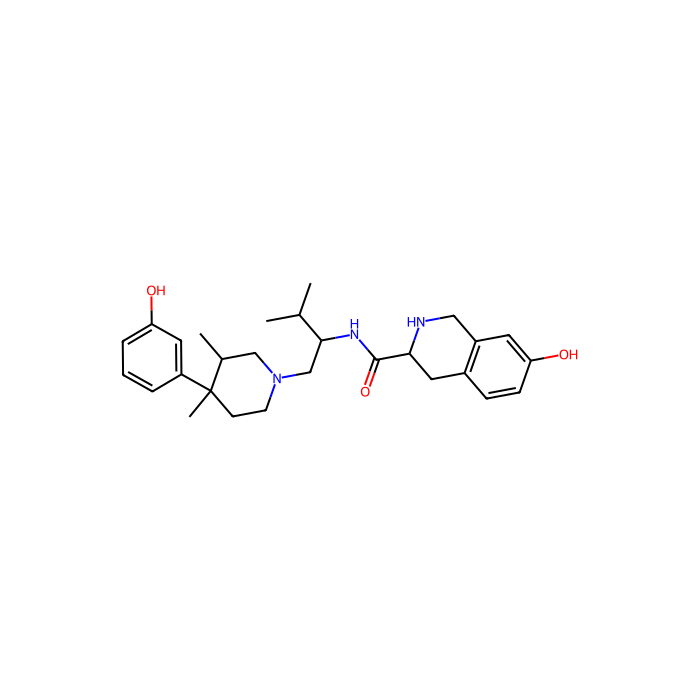
JDTic is a drug that acts as an opioid antagonist, which is highly selective for the κ-opioid receptor. JDTic blocks this receptor without affecting the μ- or δ-opioid receptors. JDTic is a 4-phenylpiperidine derivative, distantly structurally related to analgesic drugs such as meperidine and ketobemidone, and more closely to the mu opioid antagonist alvimopan, and is structurally distinct from other kappa antagonists such as norbinaltorphimine. JDTic has a very long duration of action, with effects in animals seen for up to several weeks after administration of a single dose, although its binding to the kappa opioid receptor is not irreversible and its long-acting effects are instead caused by altered activity of c-Jun N-terminal kinases. Animal studies suggest that it may produce antidepressant and anxiolytic effects, as well as having possible application in the treatment of addiction to cocaine and morphine.
Storage
Store at -20°C
Verschickt in
Ice chest + Ice pads
Dieses Produkt erfordert Kühlkettenversand. Grundversand und andere Economy-Optionen sind nicht verfügbar.
This compound belongs to the class of organic compounds known as phenylpiperidines. These are compounds containing a phenylpiperidine skeleton, which consists of a piperidine bound to a phenyl group.
External Descriptors
Not available
1. Djoumbou Feunang Y, Eisner R, Knox C, Chepelev L, Hastings J, Owen G, Fahy E, Steinbeck C, Subramanian S, Bolton E, Greiner R, and Wishart DS. ClassyFire: Automated Chemical Classification With A Comprehensive, Computable Taxonomy. Journal of Cheminformatics, 2016, 8:61.
Zertifikate (CoA, COO, BSE/TSE und Analyse-Diagramm)
C of A & Other Certificates(BSE/TSE, COO):
Analytical Chart:
Chemische und physikalische Eigenschaften
Löslichkeit
DMSO
Molekulargewicht
465.600 g/mol
XLogP3
4.600
Hydrogen Bond Donor Count
4
Hydrogen Bond Acceptor Count
5
Rotatable Bond Count
6
Exact Mass
465.299 Da
Monoisotopic Mass
465.299 Da
Topological Polar Surface Area
84.800 Ų
Heavy Atom Count
34
Formal Charge
0
Complexity
688.000
Isotope Atom Count
0
Defined Atom Stereocenter Count
4
Undefined Atom Stereocenter Count
0
Defined Bond Stereocenter Count
0
Undefined Bond Stereocenter Count
0
The total count of all stereochemical bonds
0
Covalently-Bonded Unit Count
1
Lösungsrechner
Molarity Calculator
Determine the necessary mass, volume, or concentration for preparing a solution.
Dilution Calculator
Determine the dilution needed to prepare a stock solution.
Reconstitution Calculator
Bewertungen
Kundenbewertungen
Application Protocols
Validated/titration guidance specific to this catalog item is not provided.
Tested applications (WB, IHC, IF, FC, ELISA, binding assays, cell-based assays): Not specified for this item; refer to CoA/Spec Sheet.
General protocol guidance (for small-molecule research ligands):
Prepare a concentrated DMSO stock solution. Perform serial dilutions to achieve the desired concentration range while keeping final DMSO consistent across controls and test wells.
Include vehicle controls and, where possible, an orthogonal reference compound to confirm assay performance.
For binding assays, equilibrate at the recommended temperature/time for your receptor system; for functional assays, confirm dynamic range and signal window prior to compound testing.
Document solvent composition, pH, and incubation details to ensure reproducibility.
These are general best practices and not product-validated protocols.
Biological Roles
General/literature context (not item-specific claims and not a substitute for the Target Specificity tab):
JDTic is widely cited in the literature as a potent and selective κ-opioid receptor (KOR) antagonist used as a tool compound in receptor pharmacology. Researchers employ it to probe KOR-mediated signaling pathways and to benchmark selectivity in GPCR panels.
Conceptual roles in research settings:
Target engagement: Serves as a reference antagonist to validate KOR assay systems (radioligand binding, β-arrestin recruitment, G-protein signaling readouts).
Pathway dissection: Helps differentiate KOR-dependent cellular responses from off-target effects in complex biological models.
Chemical biology controls: Used as a positive/negative control in studies assessing ligand bias, receptor internalization, and downstream transcriptional signatures.
Important notes:
No medical or clinical utility is implied; this product is for research use only.
Potency, selectivity, and kinetics reported in literature can vary with assay format, receptor expression, and experimental conditions. Users should calibrate conditions and verify activity with their own controls before drawing conclusions.
Salt form and lot-specific purity can influence apparent activity and solubility; consult the CoA and verify working concentrations analytically when possible.
Buffer Applications
This product is a small-molecule research ligand and is not itself a buffering agent. Therefore, standard buffer system recipes (e.g., phosphate, HEPES, Tris) are not directly applicable to the compound as a reagent.
Practical guidance for use in buffers (general):
Prepare a concentrated stock in a miscible organic solvent (commonly DMSO), then dilute into the desired physiological buffer (e.g., HEPES, PBS) while maintaining consistent final solvent percentage across all samples.
If solubility is limited, gentle acidification of the buffer (if compatible with the assay and the compound’s stability) or inclusion of acceptable surfactants/carriers can help. Validate that these adjustments do not affect assay readouts.
Filter working solutions if sterility or particulate removal is required. Avoid repeated freeze–thaw cycles of diluted aqueous stocks.
Green Alternatives
As a research ligand, JDTic itself is not substitutable by a “green” reagent in the way that common solvents or bulk reagents are. However, greener choices can be made around its use, especially for solution preparation and assay workflows.
Greener handling choices (general guidance):
Prefer aqueous buffers with minimal organic cosolvent when feasible; titrate pH to improve solubility if compatible (e.g., slight acidification for basic compounds), reducing DMSO/MeOH usage.
If organic solvent is required, consider ethanol (renewable source, lower toxicity) over DMF or acetonitrile for intermediate dilutions when assay-compatible.
Minimize solvent volumes by preparing higher-concentration master stocks (within solubility limits) and using precise low-dead-volume dispensing.
DMSO: Excellent solvency, biodegradable but with aquatic toxicity concerns at scale; very common in screening labs.
Ethanol: Renewable and lower hazard profile; may provide lower solubility for hydrophobic ligands.
Waste considerations:
Segregate organic-solvent waste from aqueous biohazard waste per institutional protocols. Rinse glassware with minimal solvent. Implement microplate-based assays to reduce total reagent and solvent consumption.
Pharmaceutical Uses
Formulation/manufacturing context (general; no therapeutic claims):
JDTic is provided strictly for research use and is not manufactured or qualified as a pharmaceutical active ingredient or excipient.
Relevance to drug discovery workflows (general):
Functions as a reference tool compound in screening cascades, enabling assay calibration, control arms, and selectivity benchmarking.
Useful in formulation feasibility studies at micro-scale (e.g., solvent selection, pH/vehicle effects) to support early-stage medicinal chemistry programs. Such studies are exploratory and not indicative of clinical suitability.
Regulatory and compendial status:
Not specified for this item; there is no claim of compliance with pharmacopeial monographs (USP/EP/JP). Any use beyond basic research would require independent qualification and regulatory evaluation.
Practical considerations:
When preparing test formulations for in vitro research, document solvent systems, pH, osmolality, and excipients to ensure reproducibility. For in vivo research in animals (if applicable under local regulations), follow institutional and ethical guidelines; this listing does not provide dosing or vehicle recommendations.
Physical Properties
Item-specific physical constants are not provided in the current record. Do not treat external/literature data as specifications for this lot.
Appearance: Not specified for this item; refer to CoA/Spec Sheet. (Product Data)
Molecular weight: Not specified for this item; refer to CoA/Spec Sheet. (Product Data)
Melting point: Not specified for this item; refer to CoA/Spec Sheet.
Boiling point: Not applicable/irrelevant for typical solid small-molecule ligands; Not specified for this item.
Density: Not specified for this item.
Refractive index: Not applicable for solids; Not specified for this item.
LogP, pKa, solubility: Not specified for this item; refer to CoA/Spec Sheet.
General/literature context (non-spec):
Small-molecule basic GPCR ligands similar to JDTic are commonly supplied as crystalline or amorphous solids and are frequently soluble for biological use in DMSO at millimolar concentrations. Actual solubility and ionization parameters for this item must be verified experimentally or via the CoA.
Practical notes:
When preparing analytical or bioassay solutions, begin with a small DMSO stock (e.g., 10–50 mM) then dilute into assay buffer while monitoring for precipitation. Filter sterilize if required by your protocol. These are general practices and not specifications for this product.
Quality and Grades
Grade/Purity: Moligand (Product Data)
About Moligand grade (general description):
Moligand is Aladdin’s small-molecule ligand collection intended for discovery screening, target validation, and chemical biology research. Materials in this line are curated for identity and utility as research ligands rather than for synthetic reagent grades (e.g., AR/HPLC) or clinical use.
What Moligand implies in practice:
Focus on confirmed identity and suitability for biological assay preparation (e.g., compatibility with DMSO stock solutions and common assay buffers), rather than low-UV impurity control or inorganic trace specifications needed for analytical/synthetic grades.
Batch documentation: For lot-specific identity, purity determination method, and any counter-ion or salt form, refer to the Certificate of Analysis (CoA) and SDS. Item-specific numeric specifications (e.g., HPLC area %, residual solvents, water content) are Not specified for this item; refer to CoA/Spec Sheet.
Stabilizers/salt form:
Not specified for this item; refer to CoA/Spec Sheet. If a salt form is provided, note that counter-ions can influence solubility and mass balance in assay preparation.
Suitability:
Intended for research use only. Not qualified to pharmacopeial monographs (USP/EP/JP) unless explicitly stated in documentation.
Reaction and Applications
Chemical reaction use:
JDTic is not typically employed as a synthetic reagent, catalyst, or solvent. As such, there are no standard named-reaction roles to highlight for this product. For synthetic chemistry content, see the “Synthetic Utility” and “Reaction Conditions” tabs, which are minimally applicable here.
Research applications (general/literature context — not item-specific claims):
JDTic is widely referenced as a research ligand used in receptor pharmacology and chemical biology studies. Typical laboratory uses include:
As a reference compound or tool in target engagement studies (e.g., receptor binding, functional antagonism/agonism assays) to benchmark assay performance.
In selectivity profiling panels across GPCRs to evaluate assay specificity.
In structure–activity relationship (SAR) investigations as a comparator when optimizing new analogs.
Practical assay tips (general):
Prepare concentrated DMSO stocks and serially dilute into assay buffer/media to reach the intended test range; maintain consistent solvent content across wells.
For binding assays, pre-incubation times and temperature can influence apparent potency; standardize conditions and include vehicle controls.
Confirm compound integrity by LC–MS/HPLC prior to critical experiments, especially after extended storage or multiple freeze–thaw cycles.
Note: The above are general research practices and not validated protocols for this specific lot.
Reaction Conditions
Not typically applicable: JDTic is supplied as a research ligand and is not used as a reagent in standard organic reactions. Therefore, there are no canonical reaction conditions (solvent, temperature, catalysts) to report for chemical transformations involving this compound.
Assay preparation conditions (general research practice):
Stock solutions: Commonly prepared in DMSO at millimolar concentrations; exact solubility for this item is Not specified; verify empirically.
Working solutions: Dilute stocks into assay buffers (e.g., HEPES, PBS, Krebs) or culture media while maintaining uniform solvent content across all samples to avoid confounding effects.
Temperature/time: Pre-incubation times in receptor assays can range from minutes to hours depending on the readout (binding vs functional). Optimize per assay protocol.
Light/moisture: Protect solutions from light and excessive moisture to minimize degradation; use amber vials/plates when feasible.
These notes are general and not specifications for this product lot.
Safety and Handling
Safety details specific to this catalog item have not been provided. Always consult the product SDS for authoritative hazard information.
GHS signal word: Not specified for this item; refer to SDS. (Product Data)
H-statements and pictograms: Not specified for this item; refer to SDS. (Product Data)
GHS classification: Not specified for this item; refer to SDS. (Product Data)
General laboratory precautions (good practice):
Use appropriate PPE: lab coat, safety glasses, and chemically resistant gloves.
Work in a chemical fume hood when weighing or preparing solutions to avoid dust/aerosol exposure.
Avoid inhalation, ingestion, and skin/eye contact. Wash thoroughly after handling.
Storage incompatibilities: Keep away from strong oxidizers and strong acids/bases unless compatibility is known. Avoid prolonged exposure to light and moisture for small-molecule ligands unless stability data indicate otherwise.
First aid (overview; defer to SDS): If inhaled, move to fresh air; for skin/eye contact, rinse with water for at least 15 minutes; if ingested, seek medical attention. Provide SDS to medical personnel.
Transport/temperature:
Shipped in ice chest with ice pads (Product Data) to maintain a cool chain. Do not consider shipment conditions as long-term storage guidance.
Note: This product is for research use only. Not for human or animal diagnostic or therapeutic use.
Solvent Selection
Solvent guidance for preparing assay stocks and working solutions of small-molecule ligands like JDTic.
Item-specific solubility and pKa are not provided; verify experimentally or consult the CoA.
Typical primary solvents (general guidance):
DMSO: Widely used to prepare concentrated stocks (e.g., 10–50 mM) for biological assays due to broad solvency and compatibility with aqueous dilution.
Ethanol or methanol: Alternative organic cosolvents for less DMSO-tolerant assays; verify assay compatibility.
Aqueous buffers: Direct dissolution is often limited for hydrophobic/basic ligands unless the compound is in a protonated salt form; mild acidification (e.g., ≤0.1% HCl) can improve solubility if compatible.
Maintain final DMSO content in cell-based assays typically ≤0.1–0.5% v/v to minimize solvent effects; follow lab/assay guidelines.
Filter sterilize working solutions through 0.22 µm if sterility is required.
Comparison notes (non-spec):
DMSO vs ethanol: DMSO generally affords higher solubility for polycyclic, basic ligands; ethanol may improve tolerance in sensitive bioassays but often at lower achievable stock concentration.
Always confirm clarity after dilution into buffer/media and monitor for precipitation over time.
Storage and Reconstitution
Storage conditions (Product Data):
Store at −20°C.
Shipped in an ice chest with ice pads; upon receipt, promptly transfer to the recommended storage temperature.
General handling recommendations:
Keep container tightly closed in a dry, inert atmosphere. If provided as a solid, allow the vial to equilibrate to room temperature in a desiccator before opening to minimize moisture uptake.
Protect from light as a precaution for small-molecule ligands unless stability data indicate otherwise.
Reconstitution (general guidance; not item-specific specs):
To prepare assay stocks, dissolve the compound in an appropriate anhydrous solvent (commonly DMSO) to a convenient concentration (e.g., 10–50 mM), then aliquot and store at −20°C or below.
Avoid repeated freeze–thaw cycles; dispense single-use aliquots. Inspect for precipitation or discoloration before use; if observed, confirm integrity by LC–MS/HPLC.
For aqueous working solutions, dilute the organic stock slowly into buffer with mixing; maintain consistent final solvent percentage across samples.
Stability:
Item-specific stability, hygroscopicity, and light sensitivity are Not specified for this item; refer to CoA/Spec Sheet and SDS for authoritative guidance.
Research Use Only: Not for human or animal diagnostic or therapeutic use.
Structure and Identity
Brief overview: JDTic is a research small molecule listed in our Moligand screening collection. Item-specific structural identifiers are limited in the current product record.
CAS: 361444-66-8 (Product Data)
PubChem CID: 9956146 (Product Data)
InChIKey: 460495 (as provided; note this appears truncated; refer to CoA/SDS for the full key) (Product Data)
SMILES: Not specified for this item; refer to CoA/Spec Sheet. (Product Data)
Molecular formula: Not specified for this item; refer to CoA/Spec Sheet. (Product Data)
Molecular weight: Not specified for this item; refer to CoA/Spec Sheet. (Product Data)
Structural features (general/literature context — not item-specific):
JDTic is widely cited in the literature as a conformationally constrained, polycyclic amide bearing multiple basic nitrogen atoms, consistent with a basic small-molecule ligand class. Do not use this as a specification; consult the CoA for the definitive structure for this lot.
2D structure description (general guidance):
Literature reports depict a multi-ring scaffold with at least one amide linkage and tertiary amine functionality, typical of GPCR ligands. Exact atom connectivity and stereochemistry must be confirmed from an authoritative structure record (CoA, vendor SDS, or curated databases).
Synthetic Utility
Synthetic reagent role:
JDTic is not typically used as a building block or reagent in organic synthesis. Its primary value is as a finished research ligand for biological studies. Consequently, there are no standard functional-group transformations or named-reaction roles associated with its use in synthesis.
Context for medicinal chemistry (general):
While JDTic itself is a tool compound, chemists may reference its scaffold when designing analogs. Strategies include modifying basic amine substituents, amide isosteres, or ring topology to tune potency and selectivity. Any such efforts are part of de novo synthesis campaigns rather than transformations of JDTic.
If derivatization is attempted (general cautions):
Multi-ring, basic ligands often possess limited sites amenable to late-stage diversification without compromising integrity. Protecting-group strategies and careful control of chemoselectivity are typically required.
Analytical confirmation (LC–MS, NMR, HRMS) is essential after any modification due to the risk of salt/counter-ion exchange and microheterogeneity.
Bottom line: Treat JDTic as a reference ligand, not a synthetic intermediate.
Target Specificity
Item-specific target data (antigen/epitope/clone/species) are not applicable to small-molecule ligands and none are provided for this product.
Target name, selectivity profile, and binding constants: Not specified for this item; refer to CoA/Spec Sheet or primary literature for general background.
Note: While JDTic is discussed in literature as a receptor ligand, this tab only reports product-provided details; no item-specific specificity data are available here.
Häufig gestellte Fragen
What is Moligand??
Moligand? is one of Aladdin Scientific's premium product lines, formulated for high-purity applications across multiple workflows. Compared to standard grades in the same workflow, Moligand? products typically offer tighter specifications, more rigorous QC, and stronger lot-to-lot consistency.
How should this product be stored?
Store at ?20 °C. Freezer storage is required to maintain the specified shelf life.
How is this product shipped?
This product ships in an insulated container with ice pads. Unpack on arrival and transfer it to the storage condition stated above.
What are the CAS number, molecular formula and molecular weight?
The CAS Number is 361444-66-8, the molecular formula is C28H39N3O3, and the molecular weight is 465.63 g/mol. InChIKey ZLVXBBHTMQJRSX-VMGNSXQWSA-N.
What documentation is provided?
Available product documentation, including Certificates of Analysis (COA), Safety Data Sheets (SDS), and specification sheets, is shown in the product document area. Document availability and access follow the current site policy.
Benötigen Sie Hilfe bei der Auswahl der Qualität?
Unser Leitfaden zur Qualitätsauswahl behandelt Reinheit, Stabilisatorstatus und Anwendungseignung für alle Varianten in unserem Katalog.
Wir verwenden Cookies, um die ordnungsgemäße Funktion der Website sicherzustellen und, soweit zulässig, Ihr Nutzererlebnis zu verbessern. Sie können Ihre Einstellungen jederzeit unter „Einstellungen“ verwalten. Weitere Informationen finden Sie in unserer Cookie-Richtlinie.
Dürfen wir Sie über Rabattaktionen informieren?
Später erinnern
Vielen Dank! Bitte überprüfen Sie Ihren E-Mail-Posteingang, um zu bestätigen.
Products are supplied to verified businesses, institutions, and qualified professionals for research and development use only. Not for use in humans, animals, diagnosis, or therapy.