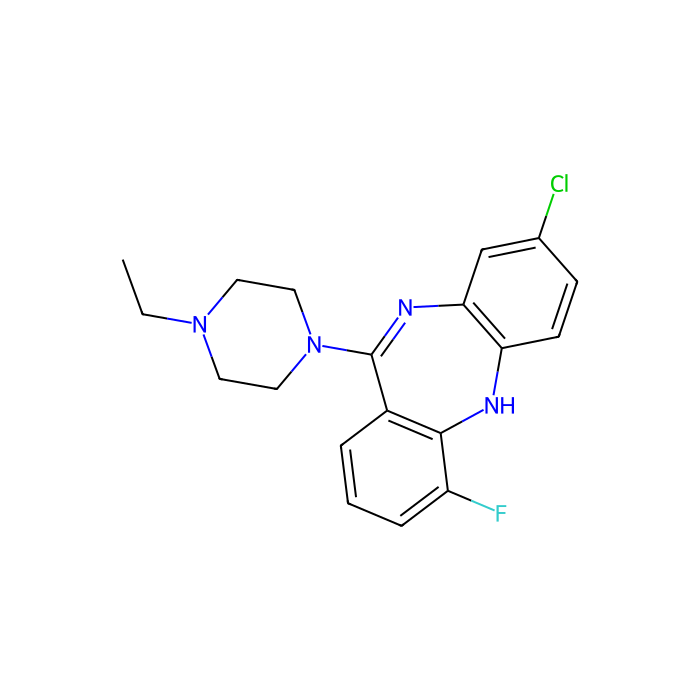
High affinity and highly potent activator of hM3Dqand hM4DiDREADDs (Kivalues are 1.9 nM and 3.6 nM for hM3Dqand hM4Diin vitro, respectively; EC50values are 18.5 nM and 0.2 nM for hM3Dqand hM4Diin vitro, respectively). Displays approximately 25-fold higher
This compound belongs to the class of organic compounds known as dibenzodiazepines. These are compounds containing a dibenzodiazepine moiety, which consists of two benzene connected by diazepine ring.
External Descriptors
Not available
1. Djoumbou Feunang Y, Eisner R, Knox C, Chepelev L, Hastings J, Owen G, Fahy E, Steinbeck C, Subramanian S, Bolton E, Greiner R, and Wishart DS. ClassyFire: Automated Chemical Classification With A Comprehensive, Computable Taxonomy. Journal of Cheminformatics, 2016, 8:61.
Solvent:DMSO, Max Conc. mg/mL: 17.94, Max Conc. mM: 50
Molekulargewicht
358.800 g/mol
XLogP3
3.500
Hydrogen Bond Donor Count
1
Hydrogen Bond Acceptor Count
4
Rotatable Bond Count
2
Exact Mass
358.136 Da
Monoisotopic Mass
358.136 Da
Topological Polar Surface Area
30.900 Ų
Heavy Atom Count
25
Formal Charge
0
Complexity
494.000
Isotope Atom Count
0
Defined Atom Stereocenter Count
0
Undefined Atom Stereocenter Count
0
Defined Bond Stereocenter Count
0
Undefined Bond Stereocenter Count
0
The total count of all stereochemical bonds
0
Covalently-Bonded Unit Count
1
Lösungsrechner
Molarity Calculator
Determine the necessary mass, volume, or concentration for preparing a solution.
Dilution Calculator
Determine the dilution needed to prepare a stock solution.
Reconstitution Calculator
Bewertungen
Kundenbewertungen
Application Protocols
No tested applications or protocols are specified for JHU 37160 in the Product Data.
General starting points (non-item-specific; adjust empirically):
Prepare a 10 mM DMSO stock (if soluble); vortex and sonicate as needed. Filter through 0.22 µm PTFE if particulates persist.
For cell-based assays, dilute to working concentrations keeping final DMSO ≤0.1–0.5% v/v where possible. Include vehicle controls.
For biochemical assays, confirm absence of assay interference (fluorescence/absorbance overlap, aggregation). Employ detergent (0.01–0.05% Tween-20) or BSA where appropriate to reduce nonspecific effects.
For stability, prepare single-use aliquots to avoid multiple freeze–thaw cycles if storing below ambient.
Because target, readouts, and handling characteristics are not defined for this item, users should validate conditions under their specific assay requirements and consult institutional SOPs.
Biological Roles
Item-specific biological targets and mechanisms are not provided for JHU 37160. No assumptions should be made about its mode of action without primary data.
Known biological function/target: Not specified for this item; consult literature or internal screening results if available.
Endogenous role: As a synthetic small molecule, none; any biological activity would be assay- and context-dependent.
Use context: Typically evaluated as a research test article in biochemical or cellular assays to explore activity profiles, potency, and selectivity.
Best practices for evaluation (general, not item-specific):
Start with concentration–response experiments across multiple assay formats (biochemical vs cell-based) to triangulate activity and eliminate false positives (e.g., aggregation, redox cycling, fluorescence interference).
Employ counterscreens (orthogonal readouts, interference panels) and pan-assay interference compound (PAINS) filters where appropriate.
Assess stability in assay media and protein binding (e.g., HSA) if potency shifts across matrices.
Consider early ADME profiling (metabolic stability, permeability, solubility) to contextualize observed biology.
All uses are strictly for laboratory research; no clinical, diagnostic, or therapeutic claims are made or implied for this product.
Buffer Applications
This product is a small-molecule library member and is not itself a buffering agent. Therefore, specific buffer system recipes or pKa-based buffering guidance do not apply.
If the compound is to be tested in biological buffers (e.g., PBS, HBSS, HEPES, Tris), prepare concentrated stocks (commonly in DMSO) and dilute into the buffer immediately before use to minimize precipitation and degradation.
Verify compatibility with buffer components (e.g., amines in Tris or primary amine-containing media) if the compound bears reactive functionalities—unknown here; test empirically.
Monitor for precipitation upon dilution and adjust cosolvent percentage or temperature accordingly. Gentle warming and brief sonication can aid dissolution, provided assay integrity is maintained.
Because pKa and solubility are not specified for JHU 37160, optimize buffer selection and pH empirically under the conditions of your specific assay.
Green Alternatives
With no structure or solvent/process context provided for JHU 37160, green chemistry guidance focuses on handling practices and generic solvent choices used to dissolve small molecules.
Prefer safer polar aprotic alternatives when feasible (e.g., propylene carbonate or Cyrene for certain applications) over traditional solvents like DMF or NMP, acknowledging solubility and assay-compatibility tradeoffs.
Where alcohols suffice, ethanol or isopropanol can replace methanol for some preparations (balance toxicity vs solubility and assay requirements).
For chromatography, evaluate supercritical CO2 or green solvent systems (e.g., EtOAc/hexane replaced by EtOAc/MeTHF/heptane variants) if purification is required.
Implement microscale assays and high-throughput miniaturization to reduce solvent usage and waste.
Utilize closed-cap vialing, minimize headspace, and employ reusable glassware to reduce plastic waste and VOC emissions.
Tradeoffs (general):
Greener solvents may have different solvency parameters, water miscibility, or higher viscosity, affecting dissolution rates and assay reproducibility.
DMSO remains widely used for library stocks due to unmatched solvency and compatibility; greener substitutes may not provide equivalent performance and can complicate biological assays.
Actionable step: Pilot a solvent-mapping study (small-scale) to compare DMSO, EtOH, MeOH, MeCN, and a greener candidate (e.g., 2-MeTHF for non-aqueous tasks) to determine the minimal-impact option that maintains assay integrity for this item.
Pharmaceutical Uses
No pharmacopeial status, excipient role, or manufacturing use information is provided for JHU 37160. This product is sold strictly for research use only and is not intended for human or veterinary applications.
Context (general, not item-specific):
Small molecules used in discovery research may serve as tool compounds in target validation or as starting points for medicinal chemistry optimization, but such roles require extensive characterization and are outside the scope of this product listing.
Without explicit quality designations (e.g., GMP, USP/NF, EP), materials are not suitable for clinical development or formulation work intended for administration.
If your work involves pre-formulation research (in vitro only):
Characterize solubility, stability, and compatibility in simple vehicles (e.g., aqueous buffers with cosolvent) for screening. Avoid any in vivo use unless covered by institutional approvals and using materials qualified for that purpose.
Summary for this item: No pharmaceutical or excipient applications are specified. Refer to the CoA/SDS and institutional policies for any non-clinical research use.
Physical Properties
Item-specific physicochemical properties were not provided in the Product Data. Do not substitute generic values for unknowns; consult the lot-specific CoA.
Appearance: Not specified for this item; refer to CoA/Spec Sheet.
Molecular Weight: Not specified for this item; refer to CoA/Spec Sheet.
Melting Point (MP): Not specified for this item; refer to CoA/Spec Sheet.
Boiling Point (BP): Not specified for this item; refer to CoA/Spec Sheet.
Density: Not specified for this item; refer to CoA/Spec Sheet.
Refractive Index: Not applicable/unknown (solid vs liquid not specified); refer to CoA/Spec Sheet.
pKa / logP / logD: Not specified for this item; refer to literature or CoA if provided.
Solubility: Not specified for this item; refer to CoA/Spec Sheet. For assay setup, users commonly evaluate solubility in DMSO first, then aqueous buffers with cosolvent (literature practice; not item-specific).
General lab guidance (non-item-specific):
For novel screening compounds, determine solubility and stability empirically in intended assay media (e.g., DMSO stocks serially diluted into buffer). Assess precipitation visually and by LC–UV/LC–MS.
If volatility or hygroscopicity is unknown, minimize exposure to air and moisture until basic handling characteristics are established experimentally.
Quality and Grades
Item-specific grade and purity are not provided in the Product Data.
Grade/Purity: Not specified for this item; refer to CoA/Spec Sheet.
Intended Use: For research use only (as stated). Not for human or veterinary use.
Context on grades (general information; not item-specific):
Analytical/Research Grade indicates suitability for laboratory research with typical analytical characterization (e.g., NMR/LC–MS). HPLC or LC–MS purity specifications, when provided, indicate composition under specified chromatographic conditions.
Bioactive screening compounds often include LC–MS purity thresholds (e.g., ≥95% area-normalized by UV); impurities may differ by lot and detection method. Verify suitability for sensitive assays (biochemical/cellular) by reviewing the lot CoA and, where needed, running in-house QC.
What to check on receipt:
Identity confirmation: 1H NMR, HRMS/LC–MS, and retention time match if reference available.
Purity assessment: HPLC/UPLC with multi-wavelength UV; consider ELSD or CAD for non-UV active impurities.
Residual solvents/water: If assay sensitivity demands, run KF for water and GC for residual solvents (values are lot-dependent and not specified here).
If a stabilizer or special form (salt, solvate, polymorph) is used, it will be indicated on the CoA. No such details are provided in this listing.
Reaction and Applications
Manufacturer Applications: Not provided in the Product Data for this item.
Positioning (general, non-item-specific):
Compounds in small-molecule libraries like JHU 37160 are typically used in hit identification, chemical biology assays, and mechanism-of-action studies as tool compounds, rather than as reagents or solvents.
In medicinal chemistry workflows, such molecules may be evaluated in binding, functional (e.g., reporter gene, second messenger), or phenotypic assays to establish SAR once analog sets are available.
Analytical considerations:
Establish a robust LC–MS method for quantitation and stability-indicating analysis under assay conditions.
Screen for chemical stability in DMSO and in assay buffer (e.g., 37 °C over 24–72 h), monitoring for hydrolysis, oxidation, or isomerization.
If synthetic derivatization is intended (not typical for a purchased screening hit without structural disclosure):
Obtain or determine the structure first; identify functional handles and potential liabilities (e.g., anilides, esters, benzylic positions) before planning transformations.
Because the structure for JHU 37160 is not provided here, specific reaction classes (e.g., cross-coupling, nucleophilic substitutions) cannot be recommended. Users should treat this product primarily as a test article for biological or physicochemical evaluation consistent with research-use-only status.
Reaction Conditions
No reaction conditions are applicable because this listing does not define JHU 37160 as a reagent for a specific transformation, and its structure is not provided.
If performing analytical or stability studies (general guidance):
Prepare stock solutions in DMSO under inert atmosphere if oxidation is a concern; store aliquots at low temperature when appropriate (see Storage tab) to reduce freeze–thaw cycles.
For stability assays, test at ambient temperature and 37 °C in intended matrices (buffered aqueous systems with defined DMSO percentage), monitoring by LC–MS over time.
If synthetic modification is planned (structure required):
Establish compatibility with bases, acids, and common catalysts on micro-scale. Absent concrete functional group data, avoid strong conditions until reactivity is profiled.
Expected yields/times: Not applicable for this item due to lack of defined reactions or known transformations in the Product Data. Consult primary literature associated with the specific structure if available.
Safety and Handling
Safety data for this specific item were not provided. Always treat research compounds as potentially hazardous until data are confirmed.
GHS/CLP Classification: Not specified for this item; refer to the SDS.
Signal Word / Pictograms / H-Statements: Not specified for this item; refer to the SDS.
Primary Hazards (general): Small organic molecules may present risks of irritation, sensitization, or systemic toxicity. Dusts and powders can become airborne; avoid inhalation.
Recommended precautions (general best practice):
Wear appropriate PPE: lab coat, nitrile gloves, and safety glasses or goggles.
Handle in a chemical fume hood; avoid inhalation of dust, vapors, or aerosols.
Prevent skin and eye contact; wash thoroughly after handling.
Avoid incompatible reagents until compatibility is known (strong oxidizers, strong acids/bases, and reducing agents as a default caution).
Use clean, dry tools for weighing; minimize static and aerosol formation.
First-aid (overview; defer to SDS):
Inhalation: move to fresh air; seek medical attention if symptoms occur.
Skin/eye contact: rinse with water for at least 15 minutes; remove contaminated clothing; seek medical advice if irritation persists.
Ingestion: rinse mouth; do not induce vomiting; seek medical attention.
Spill and disposal:
Collect small spills with inert absorbent; place in compatible waste container.
Dispose of material and contaminated PPE according to institutional and local regulations.
Always consult the product’s SDS for authoritative safety information.
Solvent Selection
Item-specific solubility data are not provided. For small-molecule screening workflows, a rational solvent selection sequence minimizes time to a workable stock solution.
General decision path (not item-specific):
Start with anhydrous DMSO (common for library stocks at 10–50 mM). Vortex, sonicate, and warm gently (≤40 °C) as needed.
If DMSO solubility is limited, trial DMF or NMP (laboratory use only, with appropriate PPE), or mixed solvents (e.g., DMSO:MeOH, DMSO:ACN).
For aqueous assays, prepare DMSO concentrates and dilute into buffer to ≤0.1–1% DMSO final, monitoring for precipitation.
If acid/base functionality is suspected (unknown here), explore pH-assisted solubilization: dilute mineral acid for basic amines; dilute base for acidic compounds. Avoid conditions that compromise assay components.
Notes on compatibility (general):
Avoid strong oxidizers and reactive media until reactivity is known.
Check for adsorption losses on plastics; glass vials with PTFE-lined caps are preferred for stocks.
Documentation:
Record solvent lot, concentration, temperature, and time to dissolution. Filter 0.22 µm if particulate persists (confirm no compound retention).
Because no structure or polarity class is specified for JHU 37160, final solvent choice should be established empirically for the intended application.
Storage and Reconstitution
Follow the item-specific storage guidance provided and complement with general best practices for small molecules.
Appearance: Not specified for this item; refer to CoA/Spec Sheet.
Best practices (general):
Store in a tightly sealed, inert-cap vial (preferably amber glass with PTFE-lined cap). Protect from excess light, heat, and moisture until handling characteristics are established.
If hygroscopicity or photolability is unknown, consider a desiccator and minimized light exposure.
For long-term storage or to reduce degradation, many users maintain solid form at ambient (or cooler) and prepare fresh solutions immediately before use.
Reconstitution guidance (not item-specific):
Start with anhydrous DMSO to prepare a concentrated stock (e.g., 10–50 mM), then dilute into assay buffer as needed. Adjust based on actual solubility.
Record solvent, concentration, and date. Prepare single-use aliquots to avoid repeated freeze–thaw.
Inspect solutions for precipitation or color change; discard if instability is observed.
For definitive instructions (including any lot-specific constraints such as salt form or stabilizers), consult the CoA/Spec Sheet and SDS supplied with your shipment.
Structure and Identity
Brief description: JHU 37160 is listed as a small-molecule library member intended for research screening and discovery. Item-specific structural identifiers are largely not provided in the Product Data.
Product Name: JHU 37160
SKU: J288154
CAS: 2369979-68-8
PubChem CID: 139033723
InChIKey: 347338 (as provided; note: this does not follow the typical 27-character InChIKey format)
SMILES: Not specified for this item; refer to CoA/Spec Sheet.
Molecular Formula: Not specified for this item; refer to CoA/Spec Sheet.
Molecular Weight: Not specified for this item; refer to CoA/Spec Sheet.
Structural features (general guidance):
Without a provided SMILES or structure diagram, specific functional groups, ring systems, or stereochemical elements cannot be confirmed for this item.
For structural verification, consult the CoA/Spec Sheet, SDS, or the referenced CAS/CID records. If available, orthogonal checks (1H/13C NMR, HRMS, and, if applicable, LC–MS purity profile) are recommended to confirm identity and assay suitability.
2D structure (verbal description):
Not available from the supplied Product Data. Users should obtain a structural depiction from primary documentation (CoA/SDS) or authoritative databases corresponding to the exact lot.
Synthetic Utility
Because no structure, functional groups, or reactivity patterns are provided for JHU 37160, specific synthetic transformations cannot be recommended.
General considerations (non-item-specific):
If the structure is obtained and the compound is to be used as a reference standard, ensure a well-documented synthetic route or vendor provenance, with supporting analytical data (1H/13C NMR, HRMS, LC–MS, and purity by HPLC/UPLC).
If derivatization is intended (e.g., biotinylation, photoaffinity probes, fluorophore conjugation), identify latent handles (amines, phenols, carboxylic acids, halides) and plan orthogonal protection as needed. None can be assumed here without structural data.
For SAR expansion, design analog libraries focused on hypothesized pharmacophores and liabilities; employ parallel synthesis with robust purification and analytical QC.
In the absence of a disclosed structure, treat JHU 37160 primarily as a test article rather than a synthetic building block. Consult the CoA or literature corresponding to CAS 2369979-68-8/CID 139033723 for definitive structural and reactivity information before planning chemistry.
Target Specificity
No target, pathway, or selectivity data are provided for JHU 37160 in the Product Data.
Primary target: Not specified for this item; refer to CoA/Spec Sheet or peer-reviewed literature if available.
Selectivity profile: Not specified.
Assay validation: Not specified.
Guidance (general):
Establish target engagement using orthogonal assays (e.g., biochemical binding vs. cellular functional readouts).
Determine selectivity with counterscreens against homologous targets and liability panels early in project workflows.
Confirm results with freshly prepared stocks and independent analytical verification of identity and purity to rule out artifacts.
All information herein pertains to research use only.
Häufig gestellte Fragen
What is the purity of this product, and how is it determined?
This product is supplied at ≥98% purity, determined by HPLC. Lot-specific values are stated on the Certificate of Analysis.
How should this product be stored?
Store at room temperature.
How is this product shipped?
This product ships under standard ambient conditions. No temperature-controlled packaging is required.
What are the CAS number, molecular formula and molecular weight?
The CAS Number is 2369979-68-8, the molecular formula is C??H??ClFN?, and the molecular weight is 358.85 g/mol. InChIKey SWSCWOSASZXIRK-UHFFFAOYSA-N.
What documentation is provided?
Available product documentation, including Certificates of Analysis (COA), Safety Data Sheets (SDS), and specification sheets, is shown in the product document area. Document availability and access follow the current site policy.
Wir verwenden Cookies, um die ordnungsgemäße Funktion der Website sicherzustellen und, soweit zulässig, Ihr Nutzererlebnis zu verbessern. Sie können Ihre Einstellungen jederzeit unter „Einstellungen“ verwalten. Weitere Informationen finden Sie in unserer Cookie-Richtlinie.
Dürfen wir Sie über Rabattaktionen informieren?
Später erinnern
Vielen Dank! Bitte überprüfen Sie Ihren E-Mail-Posteingang, um zu bestätigen.
Products are supplied to verified businesses, institutions, and qualified professionals for research and development use only. Not for use in humans, animals, diagnosis, or therapy.

 F2230360