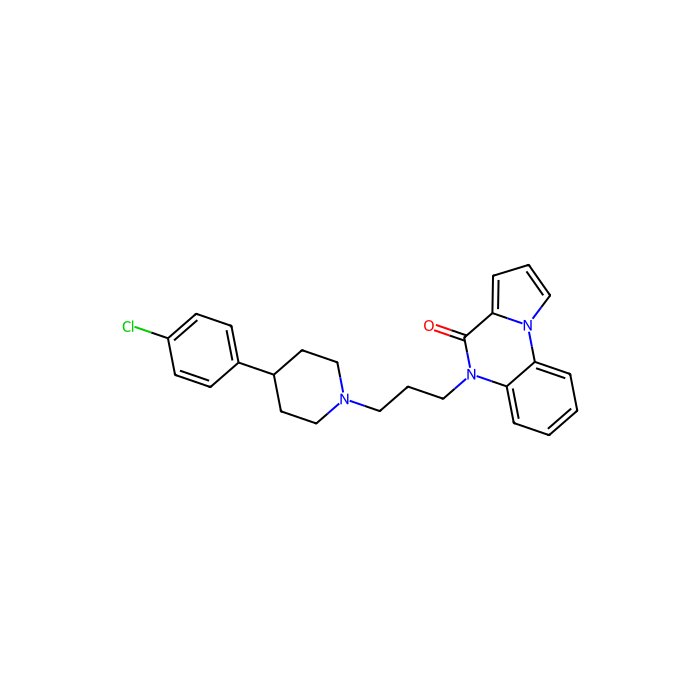
JMS-17-2 - Moligand™, 10mM in DMSO , Antagonist of CX 3CR1, CAS No.1380392-05-1, Antagonist of CX 3CR1

CAS: 1380392-05-1 Cat. No.: J421437 Summenformel: C25H26ClN3O Molekulargewicht: 419.95
Zu bestellen verfügbar
QUALITÄT & REINHEIT Moligand™ ? Moligand™ — Aladdin's line of ligands and bioactive small molecules. Use for receptor, pathway, and binding studies needing defined small-molecule tools. 10mM in DMSO
Synonyms
5-(3-(4-(4-chlorophenyl)piperidin-1-yl)propyl)pyrrolo[1,2-a]quinoxalin-4(5H)-one
Storage
Protected from light,Store at -80°C
Shipped In
Dry ice packs + Cold packs
★
Größe
Deutschland (EU)
USA*
Preis
Menge
1ml
J421437-1ml
—
2 Auf Lager

129,21€

189,08€
Speichern 59,87 € (31.67%)
Enter a quantity for the sizes you want to add.

Übersicht

Information

JMS-17-2 JMS-17-2 is a potent and selective small-molecule antagonist of CX3C chemokine receptor 1 (CX3CR1/GPR13) with IC50 of 0.32 nM. JMS-17-2 is used in the research of metastatic disease in breast cancer patients.

Targets

GPR13 (Cell-free assay) 0.32 nM

Spezifikationen

Synonyme
5-(3-(4-(4-chlorophenyl)piperidin-1-yl)propyl)pyrrolo[1,2-a]quinoxalin-4(5H)-one
Spezifikationen & Reinheit
Moligand™, 10mM in DMSO
Biochemische und physiologische Mechanismen
JMS-17-2 is a potent and selective small-molecule antagonist of CX3C chemokine receptor 1 (CX3CR1/GPR13) with IC50 of 0.32 nM. JMS-17-2 is used in the research of metastatic disease in breast cancer patients.
Storage
Protected from light,Store at -80°C
Verschickt in
Dry ice packs + Cold packs
Dieses Produkt erfordert Kühlkettenversand. Grundversand und andere Economy-Optionen sind nicht verfügbar.
Note
Moligand™
Aktionsart
ANTAGONIST
Mechanismus der Wirkung
Antagonist of CX 3CR1
Produkteigenschaften
ALogP
5.224
hba_count
1
Rotationsfähige Bindung
5
Namen und Kennungen
Pubchem Sid
SMILES
C1CN(CCC1C2=CC=C(C=C2)Cl)CCCN3C4=CC=CC=C4N5C=CC=C5C3=O
IUPAC Name
5-[3-[4-(4-chlorophenyl)piperidin-1-yl]propyl]pyrrolo[1,2-a]quinoxalin-4-one
InChIKey
WOSMCMULWWHMIV-UHFFFAOYSA-N
InChI
1S/C25H26ClN3O/c26-21-10-8-19(9-11-21)20-12-17-27(18-13-20)14-4-16-29-23-6-2-1-5-22(23)28-15-3-7-24(28)25(29)30/h1-3,5-11,15,20H,4,12-14,16-18H2
Isomere SMILES
C1CN(CCC1C2=CC=C(C=C2)Cl)CCCN3C4=CC=CC=C4N5C=CC=C5C3=O
Molekulargewicht
419.95
Reaxys
22550723
Reaxys-RN_link_address
https://www.reaxys.com/reaxys/secured/hopinto.do?context=S&query=IDE.XRN=22550723&ln=

Erweiterte Daten

Taxonomic Classification

Taxonomy Tree

KingdomOrganic compounds
SuperclassOrganoheterocyclic compounds
KlasseDiazanaphthalenes
SubclassBenzodiazines
Intermediate Tree Nodes Quinoxalines
Direct ParentPyrroloquinoxalines
Alternative Parents Phenylpiperidines  Pyrrolopyrazines  Chlorobenzenes  Aralkylamines  Pyrazines  Aryl chlorides  Pyrroles  Heteroaromatic compounds  Trialkylamines  Lactams  Azacyclic compounds  Organooxygen compounds  Organochlorides  Organic oxides  Hydrocarbon derivatives  
Molecular FrameworkAromatic heteropolycyclic compounds
Substituents Pyrroloquinoxaline - Phenylpiperidine - Pyrrolopyrazine - Chlorobenzene - Halobenzene - Aralkylamine - Aryl chloride - Aryl halide - Monocyclic benzene moiety - Piperidine - Pyrazine - Benzenoid - Pyrrole - Heteroaromatic compound - Lactam - Tertiary amine - Tertiary aliphatic amine - Azacycle - Amine - Organic oxide - Organooxygen compound - Organonitrogen compound - Organochloride - Organohalogen compound - Organic oxygen compound - Hydrocarbon derivative - Organic nitrogen compound - Aromatic heteropolycyclic compound
BeschreibungThis compound belongs to the class of organic compounds known as pyrroloquinoxalines. These are organic heterocyclic compounds containing a pyrrole ring fused to a quinoxaline ring system.
External Descriptors Not available
3D-Struktur
Interaktives chemisches Strukturmodell


Zugehörige Ziele (menschlich)
CX3CR1 Tchem CX3C chemokine receptor 1 (0 Activities)
Activity TypeActivity Value -log(M)Mechanism of ActionActivity ReferencePublications (PubMed IDs)
ADRB2 Tclin Beta-2 adrenergic receptor (11824 Activities)
Activity TypeRelationActivity valueUnitsAction TypeJournalPubMed IddoiAssay Aladdin ID
ADRA2A Tclin Alpha-2a adrenergic receptor (9450 Activities)
Activity TypeRelationActivity valueUnitsAction TypeJournalPubMed IddoiAssay Aladdin ID
AGTR1 Tclin Type-1 angiotensin II receptor (5176 Activities)
Activity TypeRelationActivity valueUnitsAction TypeJournalPubMed IddoiAssay Aladdin ID
S1PR1 Tclin Sphingosine 1-phosphate receptor Edg-1 (5806 Activities)
Activity TypeRelationActivity valueUnitsAction TypeJournalPubMed IddoiAssay Aladdin ID
GLP1R Tclin Glucagon-like peptide 1 receptor (111429 Activities)
Activity TypeRelationActivity valueUnitsAction TypeJournalPubMed IddoiAssay Aladdin ID
C5AR1 Tclin C5a anaphylatoxin chemotactic receptor (2677 Activities)
Activity TypeRelationActivity valueUnitsAction TypeJournalPubMed IddoiAssay Aladdin ID
U2OS (164939 Activities)
Activity TypeRelationActivity valueUnitsAction TypeJournalPubMed IddoiAssay Aladdin ID
CX3CR1 Tchem C-X3-C chemokine receptor 1 (1686 Activities)
Activity TypeRelationActivity valueUnitsAction TypeJournalPubMed IddoiAssay Aladdin ID
FPR2 Tchem Lipoxin A4 receptor (3472 Activities)
Activity TypeRelationActivity valueUnitsAction TypeJournalPubMed IddoiAssay Aladdin ID
FFAR4 Tchem G-protein coupled receptor 120 (2999 Activities)
Activity TypeRelationActivity valueUnitsAction TypeJournalPubMed IddoiAssay Aladdin ID
GPR35 Tchem G-protein coupled receptor 35 (2643 Activities)
Activity TypeRelationActivity valueUnitsAction TypeJournalPubMed IddoiAssay Aladdin ID
HEK-293T (167025 Activities)
Activity TypeRelationActivity valueUnitsAction TypeJournalPubMed IddoiAssay Aladdin ID
Zugehörige Ziele (nicht menschlich)
Aplnr Apelin receptor (201 Activities)
Activity TypeRelationActivity valueUnitsAction TypeJournalPubMed IddoiAssay Aladdin ID
Gpr119 Glucose-dependent insulinotropic receptor (270 Activities)
Activity TypeRelationActivity valueUnitsAction TypeJournalPubMed IddoiAssay Aladdin ID
Wirkungsmechanismen
Zertifikate (CoA, COO, BSE/TSE und Analyse-Diagramm)
C of A & Other Certificates(BSE/TSE, COO):
Analytical Chart:

Find and download the COA for your product by matching the lot number on the packaging.

1 results found

Lot NumberCertificate TypeDatumArtikel
G2401110G2401110Certificate of AnalysisMay 13, 2026 J421437
Chemische und physikalische Eigenschaften
EmpfindlichkeitLight sensitive
DMSO (mg/ml) Maximale Löslichkeit40
DMSO (mM) Maximale Löslichkeit95.2494344564829
Wasser (mg/ml) Maximale Löslichkeit<1
Molekulargewicht419.9
XLogP35.000
Hydrogen Bond Donor Count0
Hydrogen Bond Acceptor Count2
Rotatable Bond Count5
Exact Mass419.176 Da
Monoisotopic Mass419.176 Da
Topological Polar Surface Area28.500 Ų
Heavy Atom Count30
Formal Charge0
Complexity585.000
Isotope Atom Count0
Defined Atom Stereocenter Count0
Undefined Atom Stereocenter Count0
Defined Bond Stereocenter Count0
Undefined Bond Stereocenter Count0
The total count of all stereochemical bonds0
Covalently-Bonded Unit Count1
Sicherheit und Gefahren (GHS)
Piktogramm(e)
Signal
Warning
Gefahrenhinweise

H315:Causes skin irritation

H319:Causes serious eye irritation

H335:May cause respiratory irritation

Sicherheitshinweise

P261:Avoid breathing dust/fume/gas/mist/vapors/spray.

P280:Wear protective gloves/protective clothing/eye protection/face protection.

P301+P312:IF SWALLOWED: call a POISON CENTER/doctor/... IF you feel unwell.

P302+P352:IF ON SKIN: wash with plenty of water.

P305+P351+P338:IF IN EYES: Rinse cautiously with water for several minutes. Remove contact lenses if present and easy to do - continue rinsing.

Reaxys
22550723
Reaxys-RN_link_address
https://www.reaxys.com/reaxys/secured/hopinto.do?context=S&query=IDE.XRN=22550723&ln=
Lösungsrechner
Bewertungen

Kundenbewertungen

Benötigen Sie Hilfe bei der Auswahl der Qualität?

Unser Leitfaden zur Qualitätsauswahl behandelt Reinheit, Stabilisatorstatus und Anwendungseignung für alle Varianten in unserem Katalog.

Moligand™ Qualitätsleitfaden ansehen →

Dürfen wir Sie über Rabattaktionen informieren?

Später erinnern

Vielen Dank! Bitte überprüfen Sie Ihren E-Mail-Posteingang, um zu bestätigen.

Hoppla! Benachrichtigungen sind deaktiviert.