JZL195 - Moligand™, ≥98% , Inhibitor of acyloxyacyl hydrolase;Inhibitor of Fatty acid amide hydrolase;Inhibitor of Monoacylglycerol lipase, CAS No.1210004-12-8, Inhibitor of acyloxyacyl hydrolase;Inhibitor of Fatty acid amide hydrolase;Inhibitor of Monoacylglycerol lipase
JZL195 - Moligand™, ≥98% , Inhibitor of acyloxyacyl hydrolase;Inhibitor of Fatty acid amide hydrolase;Inhibitor of Monoacylglycerol lipase, CAS No.1210004-12-8, Inhibitor of acyloxyacyl hydrolase;Inhibitor of Fatty acid amide hydrolase;Inhibitor of Monoacylglycerol lipase
QUALITÄT & REINHEITMoligand™?Moligand™ — Aladdin's line of ligands and bioactive small molecules. Use for receptor, pathway, and binding studies needing defined small-molecule tools.≥98%
as a selective inhibitor of endocannabinoid (eCB) clearance enzymes to induce in vivo long-term depression at CA3-CA1 synapses and at prelimbic (PrL)-nucleus accumbens (NAc)synapses, to study the neuroprotective action of eCB
to inhibit the action of hydrolytic enzymes that limit eCB activity, to study the effect of 2-linoleoylglycerol (2-LG) on the human CB1 receptor activity
as a dual fatty acid amide hydrolase (FAAH)/monoacylglycerol lipase (MAGL) inhibitor to study its dose-related antipruritic effect on the serotonin (5-HT)-induced scratching model
Spezifikationen
Synonyme
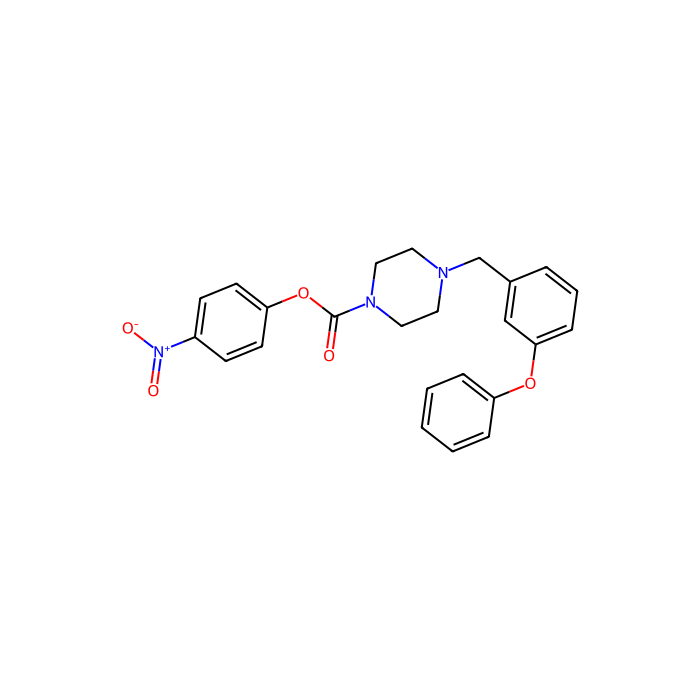
4-nitrophenyl 4-(3-phenoxybenzyl)piperazine-1-carboxylate | ZINC ACETATE [INCI] | JZL-195; JZL 195 | 4-[(3-Phenoxyphenyl)methyl]-1-piperazinecarboxylic acid 4-nitrophenyl ester | 4-Nitrophenyl 4-[(3-phenoxyphenyl)methyl]-1-piperazinecarboxylate | Sumitex H 10 | 1-Piperazinecarboxylic acid, 4-[(3-phenoxyphenyl)methyl]-, 4-nitrophenyl ester Show more
Spezifikationen & Reinheit
Moligand™, ≥98%
Biochemische und physiologische Mechanismen
JZL195 is a potent dual inhibitor of Monoacylglycerol lipase (MAGL) and fatty acid amide hydrolase (FAAH), enzymes that degrade the endocannabinoids 2-arachidonoylglycerol (2-AG) and anandamide (AEA), the endogenous ligands for the cannabinoid G-protein coupled receptors CB1 and CB2. IC50 values are 2 nM for MAGL and 4 nM for FAAH. JZL195 has been shown to inhibit endocannabinoid hydrolysis and elevate 2-AG and AEA levels in vivo.
Storage
Store at -20°C,Desiccated
Verschickt in
Ice chest + Ice pads
Dieses Produkt erfordert Kühlkettenversand. Grundversand und andere Economy-Optionen sind nicht verfügbar.
Note
Moligand™
Aktionsart
INHIBITOR
Mechanismus der Wirkung
Inhibitor of acyloxyacyl hydrolase;Inhibitor of Fatty acid amide hydrolase;Inhibitor of Monoacylglycerol lipase
Hinweis
Wherever possible, you should prepare and use solutions on the same day. However, if you need to make up stock solutions in advance, we recommend that you store the solution as aliquots in tightly sealed vials at -20°C. Generally, these will be useable for up to one month. Before use, and prior to opening the vial we recommend that you allow your product to equilibrate to room temperature for at least 1 hour. Need more advice on solubility, usage and handling? Please visit our frequently asked questions (FAQ) page for more details.
This compound belongs to the class of organic compounds known as diphenylethers. These are aromatic compounds containing two benzene rings linked to each other through an ether group.
External Descriptors
Not available
1. Djoumbou Feunang Y, Eisner R, Knox C, Chepelev L, Hastings J, Owen G, Fahy E, Steinbeck C, Subramanian S, Bolton E, Greiner R, and Wishart DS. ClassyFire: Automated Chemical Classification With A Comprehensive, Computable Taxonomy. Journal of Cheminformatics, 2016, 8:61.
Determine the necessary mass, volume, or concentration for preparing a solution.
Dilution Calculator
Determine the dilution needed to prepare a stock solution.
Reconstitution Calculator
Bewertungen
Kundenbewertungen
Application Protocols
No tested applications, protocols, or recommended dilutions are provided in the product data for this item.
General guidance for small-molecule tool compounds (to be adapted and validated by the user):
Stock preparation: Dissolve in anhydrous DMSO to a convenient concentration (e.g., 10–50 mM). Sonication or gentle warming may aid dissolution. Filter if needed (0.22 µm, low-binding).
Assay setup: Prepare serial dilutions in assay-compatible buffer with constant final DMSO percentage across all wells/conditions. Include vehicle controls and, when possible, orthogonal tool compounds.
Exposure: For cell-based experiments, verify tolerability of the final DMSO percentage (commonly ≤0.1–0.5% v/v) and evaluate compound stability over the exposure period.
Readouts: Choose mechanistically aligned assays (e.g., enzyme activity, target occupancy, pathway biomarkers) and confirm linear response ranges.
Data quality: Use appropriate plate controls (positive/negative), replicate across plates/days, and perform curve-fitting with suitable models (e.g., 4PL) including Hill slope.
Important: The above points are generic good practices. Develop and validate item-specific protocols empirically. Refer to the product’s CoA/SDS for any constraints or cautions unique to your lot.
Biological Roles
No target specificity or mechanism is provided in the product data for this item.
Literature-level context (for orientation only; verify with primary sources before use):
JZL195 has been described in chemical biology literature as a tool compound in endocannabinoid pathway research, where small-molecule inhibitors are used to perturb lipid hydrolases and assess downstream biochemical consequences. Exact targets, kinetics, and selectivity data for JZL195 should be taken from peer-reviewed publications and not inferred here.
Research utility typically relates to modulating endogenous lipid mediator levels and assessing pathway flux via analytical methods such as LC-MS/MS. Such studies often include parallel measurements of enzyme activity and lipid concentrations to establish causality.
Best practices when probing biological roles (general):
Use orthogonal assays (biochemical, target occupancy, chemoproteomics) to confirm on-target action.
Include structure-unrelated tool compounds with similar nominal targets to control for scaffold-dependent off-target effects.
Confirm cellular permeability, stability, and potential efflux interactions where relevant.
Monitor potential cytotoxicity at working concentrations and include vehicle controls.
Important: The above discussion is general and literature-based. This product record does not specify any biological target, potency, or selectivity; no claims are made for therapeutic or clinical use. All use is for research only.
Buffer Applications
This item is a bioactive small molecule, not a buffering reagent. Conventional buffer preparation guidance (pH ranges, recipes, ionic strength) does not apply.
Practical notes for using small molecules in buffers (general good practice):
Prepare a concentrated stock in a water-miscible organic solvent (commonly DMSO), then dilute into the desired assay buffer while mixing to avoid precipitation.
Keep final co-solvent content as low as assay tolerance allows (often ≤0.1–0.5% v/v for biochemical assays).
Pre-screen for solubility/precipitation by visual inspection and, if critical, by nephelometry or light scattering.
Include vehicle-only controls to account for any buffer effects introduced by the co-solvent.
For buffer composition or pH stability specific to JZL195, consult empirical testing and the product’s CoA/SDS. No item-specific buffer data are provided.
Green Alternatives
Green chemistry considerations are typically framed for solvents and bulk reagents. For specialized bioactive small molecules like JZL195, substitution with a “green alternative” is generally not applicable because the molecular structure defines the biological activity.
Nevertheless, you can incorporate greener practices around its use:
Solvent minimization: Prepare concentrated DMSO stocks to reduce total solvent volume in assays. Use microplate formats and miniaturized reaction volumes where feasible.
Safer solvent choices for workup/cleanup: When dissolving or rinsing labware, prefer ethanol or isopropanol over chlorinated solvents, provided they are compatible with your assay and safety constraints.
Waste management: Segregate halogenated vs non-halogenated solvent waste. Collect biohazardous waste separately if used in cell-based assays.
Energy efficiency: Store only as cold as required (−20°C per product data) and avoid unnecessary freeze–thaw cycles to limit energy use and material losses.
Inventory control: Order quantities aligned with experimental plans to minimize expired or unused material.
Comparison table (practice-level, not a compound replacement):
Greener practice: Miniaturized assays, aliquoted single-thaw vials, alcohol-based rinses when compatible, and rigorous planning to reduce repeats.
Conclusion: There is no direct “green substitute” for JZL195’s bioactivity. Focus sustainability efforts on solvents, scale, waste, and energy around its experimental use.
Pharmaceutical Uses
This product is supplied strictly for research use and is not intended for human or veterinary applications. No pharmacopeial status, excipient role, or manufacturing use is provided in the product data.
Contextual notes (general, non-clinical):
Bioactive small molecules like JZL195 are often used in discovery research to probe target biology, SAR, and mechanism of action in preclinical systems. Such use does not imply suitability for formulation or therapeutic development.
If formulation-like studies are conducted for research (e.g., improving solubility for in vitro assays), common laboratory vehicles include DMSO-based concentrates further diluted into aqueous media, with attention to stability, aggregation, and nonspecific binding. These practices are research tools, not pharmaceutical development.
Compliance reminder:
Do not use in humans or animals intended for food/consumption.
No claims are made about safety, efficacy, dosage, or therapeutic indications.
Conclusion: There are no pharmaceutical or clinical uses associated with this catalog item. Any formulation discussions should remain within the scope of laboratory research and method development only.
Physical Properties
Item-specific physical data are not provided in the product data. Do not infer specifications from literature. For lot-specific values, consult the CoA/Spec Sheet.
Appearance: Not specified for this item; refer to CoA/Spec Sheet.
Melting point: Not specified for this item; refer to CoA/Spec Sheet.
Boiling point: Not applicable/unknown for this class of bioactive solids; refer to CoA/Spec Sheet if provided.
Density: Not specified for this item; refer to CoA/Spec Sheet.
Solubility: Not specified for this item; refer to CoA/Spec Sheet.
LogP/logD: Not specified for this item; refer to CoA/Spec Sheet.
pKa: Not specified for this item; refer to CoA/Spec Sheet.
Refractive index: Not applicable for solids; refer to CoA/Spec Sheet if a solution is provided.
General, literature-level handling guidance for hydrophobic bioactive small molecules (not item-specific):
Stock solutions are commonly prepared in dry DMSO (e.g., 10–50 mM), then diluted into aqueous systems with appropriate co-solvent or carrier protein to avoid precipitation (literature/good practice).
Many enzyme-targeting probes are light- and moisture-sensitive; minimize exposure to air and light during weighing and solution prep (good practice).
Important: Treat any literature property values you may find for JZL195 as informational only unless they are explicitly listed on the CoA for this catalog item. Always defer to the provided CoA/SDS for authoritative specifications.
Quality and Grades
Grade/Purity: Moligand™ (product data)
What Moligand™ generally denotes (catalog context; not an item-specific guarantee):
The Moligand™ line comprises bioactive, target-engaging small molecules intended for use in chemical biology, screening, and mechanistic studies. Materials are provided for research use only.
Typical expectations for library/screening compounds include confirmed identity and a purity level suitable for biochemical/biophysical assays; however, exact analytical methods, acceptance criteria, and stabilizers (if any) are lot-specific. Always confirm via the CoA/Spec Sheet for this item.
How to use quality information effectively:
Verify identity/purity: Consult the item’s CoA for analytical confirmation (e.g., LC, MS, NMR) before initiating critical experiments.
Baseline testing: For sensitive applications (e.g., quantitative enzyme kinetics, in-cell target engagement), consider running an incoming QC check aligned with your assay readout (e.g., a short LC-MS identity check and purity area%).
Stabilizers/inhibitors: None are specified for this item. If stabilizers are present, they will be declared on the CoA/label. Do not assume presence/absence of stabilizers without documentation.
Notes on comparisons to other grades:
Unlike commodity solvent grades (AR/HPLC/ACS), Moligand™ focuses on bioactivity-oriented small molecules. UV cutoff, metal content, and other chromatographic solvent parameters are not typically applicable for such compounds unless explicitly stated on the CoA.
Conclusion: Rely on the lot-specific CoA for exact purity, identification methods, and any stabilizer information.
Reaction and Applications
This product is a bioactive research compound rather than a general-purpose synthetic reagent. No manufacturer application notes were provided for this listing.
General, literature-level research uses of JZL195 (context only; verify against primary sources):
JZL195 has been reported as a chemical biology tool in endocannabinoid metabolism studies, where it is used to modulate enzymatic pathways for mechanistic investigations. Specific target details, potency, and selectivity should be taken from peer-reviewed publications and the CoA/SDS; they are not specified in this product record.
Biochemical enzyme assays to quantify inhibition kinetics and mode of action.
Cellular assays to observe pathway-level changes upon target engagement, using LC-MS lipidomics or targeted metabolite readouts.
Target occupancy or activity-based profiling workflows, when applicable to the compound class under study.
Practical tips (non-item-specific):
Prepare fresh working solutions and validate stability over assay time. Adsorption losses can occur on plastic; low-binding labware is recommended for low-nanomole work.
Include vehicle controls (e.g., DMSO-only) and, where possible, orthogonal tool compounds to corroborate on-target effects.
For concentration–response experiments, cover ≥8 points over relevant ranges with replicates; confirm absence of aggregation/assay interference (e.g., with detergent controls or light scattering checks).
Important: The above are general research practices. No compound-specific claims (targets, IC50s, or selectivity) are made here beyond literature context due to lack of item-specific data.
Reaction Conditions
Not applicable. JZL195 is supplied as a bioactive research compound rather than a reagent for promoting or mediating chemical reactions. No catalytic or stoichiometric reaction conditions are associated with this product in the provided data.
General handling for solution preparation (good practice, not item-specific):
Dissolve the compound in an appropriate organic solvent (commonly anhydrous DMSO) to prepare a concentrated stock.
Dilute into assay medium with vigorous mixing to avoid precipitation; maintain low final organic solvent content consistent with assay tolerance.
Confirm short-term solution stability under intended assay temperatures (e.g., 4–37°C) and light exposure.
If you intend to use JZL195 in a chemical reaction context (e.g., as a substrate or derivatization partner), such conditions must be established empirically and are outside the scope of this product listing.
Safety and Handling
Safety information specific to this item is not provided in the product data. Always consult the SDS supplied with the product for definitive hazard classifications and response measures.
GHS classification: Not specified for this item; refer to SDS.
Signal word / Hazard statements / Pictograms: Not specified for this item; refer to SDS.
General laboratory safety guidance for bioactive small molecules (good practice):
PPE: Wear lab coat, safety glasses, and appropriate chemically resistant gloves. Handle powders in a fume hood to avoid inhalation of dust or aerosols.
Avoid skin/eye contact and ingestion. Prevent inhalation of dust; avoid generating aerosols when reconstituting.
Handling: Use clean, dry tools. For hygroscopic or moisture-sensitive compounds, work rapidly and keep container tightly closed under desiccation.
Incompatibilities: Avoid strong oxidizers and strong acids/bases unless compatibility is verified. For potential electrophilic inhibitors, avoid contact with nucleophilic reducing agents or amines unless intended (general caution).
First aid overview: In case of skin contact, wash with soap and water. For eye contact, rinse cautiously with water for several minutes and seek medical attention. If inhaled, move to fresh air; if ingested, rinse mouth and seek medical attention. Follow SDS instructions.
Spill/leak: Avoid dust formation, ventilate area, collect with inert absorbent, and dispose of according to local regulations.
Note: This product is for research use only; not for human or veterinary use.
Solvent Selection
Item-specific solubility data are not provided. The following guidance reflects common practice for hydrophobic bioactive small molecules and should be validated empirically for JZL195.
Primary stock solvent (general): Anhydrous DMSO is the most common choice due to broad solubilizing power and compatibility with biological assays at low final percentages (≤0.1–0.5% v/v). DMF or ethanol may also be used depending on assay tolerance (literature/good practice).
Aqueous dilution: Prepare a concentrated DMSO stock (e.g., 10–50 mM), then dilute into buffer with vigorous mixing. To mitigate precipitation, add organic co-solvent slowly into pre-warmed buffer or include a small percentage of co-solvent (e.g., 0.1–1% DMSO or ethanol) and, where appropriate, carrier proteins (e.g., 0.1% BSA) (good practice).
Polarity/miscibility (general): DMSO is fully miscible with water; DMF and ethanol are also water-miscible. Avoid nonpolar solvents (hexanes, toluene) for biological assays due to immiscibility and cytotoxicity concerns.
Filtration: If particulates persist, filter stock/buffered working solutions through low-protein-binding 0.22 µm filters. Verify no significant adsorption to filter material.
Light/moisture sensitivity: Prepare and store solutions under low light and dry conditions to limit degradation.
Comparison (general guidance):
DMSO: Highest solvating power; most common for screening. Potential enzyme inhibition at high %.
Ethanol: Lower solvating power; better volatility for rapid removal; limited tolerance in cells.
Aqueous buffers alone: Often insufficient for hydrophobic inhibitors; risk of precipitation.
Always confirm solubility and stability with a small-scale pilot before committing precious samples.
Storage and Reconstitution
Storage conditions (product data): Store at −20°C, desiccated. Protect from moisture and minimize exposure to air and light.
Shipping (product data): Shipped in an ice chest with ice pads to maintain a low-temperature environment during transit.
Good practice for reconstitution and handling (general):
Equilibration: Allow the sealed container to warm to room temperature in a desiccator before opening to prevent moisture condensation on the solid.
Aliquoting: Upon first opening, promptly prepare single-use aliquots of solid (if feasible) or concentrated DMSO stock solutions to avoid repeated freeze–thaw cycles.
Stock solutions: Prepare in anhydrous DMSO (typical research practice). Document concentration, solvent, and preparation date on aliquot labels. Store aliquots at −20°C or below, desiccated and protected from light.
Stability: Without item-specific data, assume limited stability in solution at room temperature. Use freshly thawed aliquots and avoid multiple freeze–thaw cycles. Discard solutions showing precipitation, discoloration, or unexpected assay behavior.
Thawing: Thaw on ice or at room temperature just before use. Mix thoroughly to ensure homogeneity before diluting into assay buffer.
Specifications not provided for this item:
Exact shelf life, solution stability window, and reconstitution solvent purity limits are not specified; refer to the CoA/Spec Sheet and perform small-scale pilot tests to confirm suitability for your application.
Research use only: Not for human or veterinary use.
Structure and Identity
Brief description: JZL195 is a cataloged bioactive small molecule supplied in the Moligand™ line for research use.
Product name: JZL195 (SKU: J276066)
CAS: 1210004-12-8 (product data)
PubChem CID: 46232606 (product data)
InChIKey: Not specified for this item; refer to CoA/Spec Sheet. (the numeric string provided is not a valid InChIKey)
SMILES: Not specified for this item; refer to CoA/Spec Sheet.
Molecular formula: Not specified for this item; refer to CoA/Spec Sheet.
Molecular weight: Not specified for this item; refer to CoA/Spec Sheet.
Structural features (general, literature-level description without item-specific assertion):
JZL195 is reported in the literature as a bioactive inhibitor used in endocannabinoid metabolism studies; published structures depict an electrophilic warhead capable of engaging serine hydrolases (literature). Exact functional group details should be verified against primary literature or the CoA for this specific item.
2D structure overview (literature-level): an aryl-containing small molecule with features consistent with lipophilic, enzyme-targeting probes commonly used in chemical biology. The precise ring substitution pattern and stereochemistry (if any) should be confirmed from authoritative databases (literature) rather than inferred here.
Notes:
Identity and structure confirmation for the supplied lot should be taken from the accompanying CoA/SDS and the manufacturer’s analytical data (e.g., NMR/HRMS/LC).
Synthetic Utility
JZL195 is offered as a bioactive probe compound rather than a general synthetic building block. Consequently, “synthetic utility” in classical organic methodology (e.g., as a reagent, catalyst, or monomer) is limited or non-applicable.
General considerations (if incorporating into chemical biology workflows):
Derivatization for probe development: Researchers sometimes derivatize tool compounds to install reporter handles (e.g., biotin, fluorophores) or linkers. Whether JZL195’s scaffold permits such modifications without loss of activity is target- and position-dependent and must be guided by structure–activity relationship (SAR) data available in the literature.
Analytical standards: Authentic reference materials may be used as calibrants or internal standards in LC-MS workflows if stability and ionization properties are suitable. Validate response factors and stability before use.
Immobilization: If affinity matrices are contemplated, ensure a tethering position remote from key pharmacophores to preserve target binding (requires SAR knowledge from literature).
Not applicable:
It is not commonly used as a stoichiometric reagent, protecting group, or coupling partner in mainstream synthetic transformations.
Recommendation: Treat JZL195 as a finished tool compound. If chemical modification is desired, consult primary literature for tolerance of substitutions and perform stepwise SAR validation.
Target Specificity
No target information is provided in the product data for this item.
Antigen/epitope/clone/isotype: Not applicable; this is not an antibody product.
Biochemical targets, potency, and selectivity: Not specified for this item; refer to CoA/Spec Sheet and primary literature if investigating potential targets.
Guidance (general, for planning experiments):
Establish target engagement using orthogonal readouts (biochemical inhibition, activity-based probes, or thermal shift/cellular target engagement assays) before interpreting phenotypic outcomes.
Include counter-screens against related enzymes/receptors to define selectivity in your system.
All use is for research only; no clinical or diagnostic claims are made.
Benötigen Sie Hilfe bei der Auswahl der Qualität?
Unser Leitfaden zur Qualitätsauswahl behandelt Reinheit, Stabilisatorstatus und Anwendungseignung für alle Varianten in unserem Katalog.
Wir verwenden Cookies, um die ordnungsgemäße Funktion der Website sicherzustellen und, soweit zulässig, Ihr Nutzererlebnis zu verbessern. Sie können Ihre Einstellungen jederzeit unter „Einstellungen“ verwalten. Weitere Informationen finden Sie in unserer Cookie-Richtlinie.
Dürfen wir Sie über Rabattaktionen informieren?
Später erinnern
Vielen Dank! Bitte überprüfen Sie Ihren E-Mail-Posteingang, um zu bestätigen.
Products are supplied to verified businesses, institutions, and qualified professionals for research and development use only. Not for use in humans, animals, diagnosis, or therapy.

 A2205242