GRADE & PURITYMoligand™?Moligand™ — Aladdin's line of ligands and bioactive small molecules. Use for receptor, pathway, and binding studies needing defined small-molecule tools.10 mM in DMSO
Zertifikate (CoA, COO, BSE/TSE und Analyse-Diagramm)
C of A & Other Certificates(BSE/TSE, COO):
Analytical Chart:
Lösungsrechner
Molarity Calculator
Determine the necessary mass, volume, or concentration for preparing a solution.
Dilution Calculator
Determine the dilution needed to prepare a stock solution.
Reconstitution Calculator
Bewertungen
Kundenbewertungen
Application Protocols
No validated application protocols are provided for KAN0438757 in the Product Data. The following generic protocols are suggested starting points for small-molecule screening compounds; adapt to your assay and obtain item-specific data where necessary.
Preparation of 10 mM DMSO stock:
Bring vial to room temperature in a desiccator to avoid condensation. Weigh required mass quickly. Add dry DMSO to achieve 10 mM. Vortex until fully dissolved; brief bath sonication if needed. Aliquot into low-bind tubes.
Biochemical assay dilution:
Prepare a 10-point, half-log dilution series in assay buffer while maintaining constant DMSO (e.g., 0.5%). Include vehicle control and, if available, a reference inhibitor/activator.
Cell-based assay dosing:
Confirm that final DMSO concentration (e.g., 0.1–0.5%) is tolerated by the cell line. Pre-warm media, add compound last, and mix gently to avoid precipitation. Consider 0.1% BSA to limit adsorption for hydrophobic compounds.
Solubility/stability check:
After dilution, visually inspect clarity; optional: measure absorbance at 600–800 nm for turbidity. Re-measure potency after 24 h incubation to assess stability in the assay matrix.
Note: These are general, non-validated procedures. For precise, validated protocols, consult literature/CoA specific to KAN0438757 if available.
Biological Roles
The Product Data does not specify a biological target or mechanistic class for KAN0438757. As a Moligand-grade small molecule, it is intended for research screening rather than as a characterized biochemical probe.
General context for small-molecule ligands in discovery research:
Potential roles: Tool compounds in high-throughput screening (HTS), fragment-to-lead, or hit validation workflows to interrogate biochemical pathways. Specific pathway, receptor, enzyme, or ion channel engagement is unknown for this item based on provided data.
Assay modalities: Biochemical inhibition/activation assays, phenotypic cell assays, thermal-shift or CETSA for target engagement, and binding assays (SPR, BLI, ITC) where structure and purity support such studies.
ADME considerations (general): Permeability, stability (chemical and metabolic), and protein binding can affect performance in cellular assays. Without a known structure here, these properties should be empirically determined if relevant to your experiments.
Important limitation:
No clinical, diagnostic, or therapeutic claims are made. This product is for research use only. Any biological role or target attribution must come from independent experimentation or literature specific to KAN0438757.
Buffer Applications
KAN0438757 is a small-molecule screening compound and is not itself a buffering agent. Buffer selection pertains to the assay environment rather than the compound.
Practical guidance (general):
Biochemical assays: Choose buffers compatible with your target (e.g., HEPES, Tris, or phosphate) and maintain ionic strength and pH optimal for enzyme stability. Validate compound solubility after spiking DMSO stocks into buffer; final DMSO ≤0.5–1% is typical.
Protein-binding/biophysical assays: Use low-detergent, low-background buffers (e.g., HEPES or PBS with 0.005–0.01% Tween 20 for SPR) to minimize nonspecific interactions.
Cell-based assays: Use standard culture media with serum as required; confirm that vehicle (DMSO) percentage is tolerated by the cell line. Consider adding 0.1% BSA to reduce nonspecific adsorption for very hydrophobic ligands.
Since pKa and ionization state of KAN0438757 are not provided, there is no item-specific buffer recipe. Refer to target biology and solubility/stability profiling to finalize buffer conditions.
Green Alternatives
Green chemistry considerations are typically applied to solvents and bulk reagents. For KAN0438757—a discovery-stage screening compound—“green alternatives” are not generally applicable to the compound itself. However, greener choices can be made around its handling and assay deployment.
Options and tradeoffs (general guidance):
Solvent selection:
Prefer aqueous buffers with minimal DMSO where solubility allows. Reducing DMSO from 1% to 0.1–0.2% lowers solvent burden without compromising many assays.
Avoid high-toxicity dipolar aprotics (e.g., DMF, NMP) in cell assays when possible; DMSO is typically the greener choice among strong organic solubilizers.
Miniaturization:
Utilize low-volume assay formats (e.g., 1536-well plates) to reduce chemical consumption and waste.
Waste management:
Segregate halogenated vs non-halogenated organic waste if applicable; use solvent recovery where infrastructure exists.
Shipping/packaging:
Consolidate shipments and choose dry-ice alternatives only where validated for stability; for this item, shipping on dry ice + cold packs is specified and should be maintained for quality.
Summary:
No direct “alternative molecule” applies. Focus sustainability efforts on solvent choice, assay scale, and waste minimization consistent with maintaining data quality and compound integrity.
Pharmaceutical Uses
No pharmacopeial status or formulation role is provided for KAN0438757 in the Product Data. This product is supplied strictly for research use only.
General considerations (non-clinical):
Discovery stage: Compounds like KAN0438757 may be evaluated in early research settings (in vitro or ex vivo). Any development toward dosage forms would require extensive preclinical characterization not covered here.
Excipient status: Not indicated. No information suggests suitability as an excipient or processing aid.
Regulatory note: Not GMP, not for human or veterinary use. Do not use in clinical applications, diagnostic procedures, or as an active pharmaceutical ingredient.
If formulation-like tasks are needed for research:
Solubilization for in vivo exploratory studies (where permitted) typically uses vehicles such as PEG/solvent/surfactant systems; however, no recommendations are made here without structure and stability data. Consult institutional guidelines and generate item-specific data first.
Physical Properties
Item-specific physicochemical specifications were not provided in the Product Data for KAN0438757.
Appearance: Not specified for this item; refer to CoA/Spec Sheet.
Molecular weight: Not specified for this item; refer to CoA/Spec Sheet.
Molecular formula: Not specified for this item; refer to CoA/Spec Sheet.
Melting point: Not specified for this item; refer to CoA/Spec Sheet.
Boiling point: Not applicable for most screening solids; Not specified for this item; refer to CoA/Spec Sheet.
Density: Not specified for this item; refer to CoA/Spec Sheet.
Refractive index: Not applicable to solids; Not specified for this item; refer to CoA/Spec Sheet.
Solubility: Item-specific solubility not provided. Typical practice for discovery compounds is to prepare concentrated DMSO stocks (e.g., 10–50 mM), then dilute into assay buffers containing 0.1–1% DMSO (general guidance).
LogP/logD, pKa, TPSA: Not specified for this item; consult literature or compute when structure is available.
Notes (general/literature guidance for small-molecule screening compounds):
If solid, assess hygroscopicity and crystallinity before weighing. Desiccate as needed.
Determine working solubility in DMSO and assay buffer early; use nephelometry or visual inspection for precipitation.
If a salt form, confirm counterion and hydrate level on the CoA since these affect molecular weight for dosing calculations.
Filter sterilization (0.22 µm) of final aqueous dilutions may be used for cell-based assays when compatible with solubility and stability.
Quality and Grades
Grade/Purity: Moligand™
About Moligand-grade compounds (general information):
Moligand designates small-molecule ligands curated for discovery and screening workflows (biochemical, biophysical, and cell-based assays). Emphasis is placed on identity confirmation and suitability for library use. Exact purity specifications, analytical methods, and acceptance criteria are item-specific.
What is specific to this item:
The provided Product Data does not list an exact purity percentage, impurity profile, salt form, or stabilizers. Accordingly: “Not specified for this item; refer to CoA/Spec Sheet.”
Analytical expectations (general):
Identity typically verified by at least one orthogonal method (e.g., NMR, LC–MS, HRMS). Chromatographic purity often assessed by HPLC/UPLC with UV and/or MS detection. If available, review the CoA for: retention time, purity % by area, mass spectrum, and salt/hydrate content.
Implications for use:
For quantitative biology, confirm active concentration by using molecular weight (corrected for salt/hydrate) and consider secondary qualification (e.g., independent LC–MS or qNMR) if your application is highly sensitive to analyte concentration.
Low UV background and low non-volatile residue can be important for optical/biophysical assays; validate in your platform if critical.
Documentation:
For regulatory or publication needs, archive the lot-specific CoA/SDS. Contact Aladdin Scientific for current lot documentation if not included with your shipment.
Reaction and Applications
Use context for KAN0438757 is as a research screening ligand rather than a synthetic reagent. No manufacturer reaction applications were provided for this item.
Primary application domain: Small-molecule screening in biochemical, biophysical, or cellular assays to probe target engagement or phenotype (general guidance for Moligand-grade items).
Not typically used as a solvent, reagent, or catalyst.
Best practices for discovery screening (general):
Prepare concentrated DMSO stocks (e.g., 10 mM), aliquot to minimize freeze–thaw, and store at −80°C as specified.
Validate solubility post-dilution in the assay buffer at intended test concentrations; monitor for colloidal aggregation (e.g., by including low detergent, checking Hill slopes, or using light scattering assays) where appropriate.
For biochemical assays, include a DMSO-matched vehicle control; keep final DMSO ≤0.5–1% unless your assay tolerates more.
For cell-based assays, confirm cytotoxicity of the vehicle and compound independently (e.g., resazurin/ATP readouts) to decouple target effects from general toxicity.
If using in target deconvolution workflows:
Combine with thermal shift, CETSA, or SPR/ITC where feasible (general techniques) to corroborate on-target binding.
Note: No specific target class, pathway, or enzyme family is provided for KAN0438757 in the Product Data; consult literature or internal SAR if available.
Reaction Conditions
No synthetic reaction conditions are applicable or provided for KAN0438757 in the Product Data. It is intended for use as a screening ligand rather than as a reagent.
Assay-related conditions (general guidance):
Stock preparation: Dissolve in anhydrous DMSO to 10–50 mM as solubility permits. Vortex and, if necessary, sonicate briefly to assist dissolution. Avoid water uptake into DMSO stocks (hygroscopicity control).
Working solutions: Dilute into assay buffer to the desired final concentration keeping DMSO typically ≤0.5–1% v/v. Mix thoroughly and inspect for precipitation or opalescence.
Temperature: Prepare and handle solutions at room temperature unless the compound shows known thermal sensitivity; store long-term at −80°C per Product Data.
Light sensitivity: Unknown for this item; protect from light as a precaution during storage and assays until stability is characterized.
Expected outcomes:
Since no target or activity profile is provided, users should determine concentration ranges empirically (e.g., 10-point half-log dilution series) and include appropriate controls (positive, negative, and vehicle controls).
Safety and Handling
Safety information specific to KAN0438757 was not supplied in the Product Data. Always consult the product SDS for authoritative guidance.
GHS classification, pictograms, H-statements: Not specified for this item; refer to SDS.
Signal word: Not specified for this item; refer to SDS.
General laboratory handling for research-only small molecules:
PPE: Wear lab coat, safety glasses, and appropriate chemical-resistant gloves (e.g., nitrile). Use in a chemical fume hood to avoid inhalation of dust or vapors during weighing and solution prep.
Avoid exposure: Prevent ingestion, inhalation, and skin/eye contact. Wash thoroughly after handling.
Incompatibilities: Unknown for this item; as good practice, segregate from strong oxidizers and acids/bases until specific data are known. Avoid moisture if compound is hygroscopic.
First aid (overview; defer to SDS): If on skin/eyes, rinse with water for at least 15 minutes; remove contaminated clothing. If inhaled, move to fresh air. If ingested, seek medical attention—do not induce vomiting unless directed by medical personnel.
Waste: Collect in organic waste stream unless otherwise directed by institutional EHS.
Special risks: For DMSO stock solutions, DMSO can enhance dermal absorption—avoid skin contact. For dry powders, minimize dust generation.
Research Use Note: For research use only. Not for human or veterinary use.
Solvent Selection
Because the exact structure and ionization state of KAN0438757 are not provided here, solvent recommendations follow general best practices for discovery compounds.
Primary stock solvent (general):
DMSO: Widely used for 10–50 mM stocks due to broad solubilizing power and assay compatibility at 0.1–1% v/v.
Secondary options (structure-dependent):
DMF, NMP: High solvating power; consider cytotoxicity in cellular assays and limit final concentration.
Ethanol or isopropanol: Useful for moderately lipophilic compounds; ensure aqueous miscibility upon dilution.
Aqueous buffers: Possible for ionizable salts; verify pH-dependent solubility and stability.
Practical guidance:
Determine solubility ceiling in DMSO via stepwise titration and inspection for turbidity/precipitation after dilution into the assay buffer.
Include surfactants (e.g., 0.01–0.05% Tween 80 or Pluronic F-127) only if validated not to interfere with your assay.
Filter sterilize final working solutions if required for cell culture and compatible with solubility.
Comparison (general):
DMSO vs DMF: DMSO is preferred for bioassays due to lower volatility/odor and common acceptance up to 0.5–1% in many assays; DMF can be harsher to cells and is less favored in phenotypic screens.
Aqueous-only: Feasible if compound is supplied as a water-soluble salt; otherwise, risk of precipitation on dilution is high without a co-solvent.
Storage and Reconstitution
Storage Conditions: Store at −80°C (per Product Data). Maintain desiccation and protect from light as a precaution unless stability data indicate otherwise.
Shipping: Shipped on dry ice packs + cold packs. Inspect upon receipt; if thawing occurred, refreeze promptly and assess integrity before use.
Reconstitution (general guidance for screening compounds):
Equilibrate the sealed vial to room temperature in a desiccator to avoid condensation. Open only after temperature equilibration.
Prepare concentrated DMSO stock solutions (e.g., 10–50 mM) based on intended assay range and solubility. Record exact concentration considering salt/hydrate content if stated on CoA.
Aliquot into small volumes (single-use if possible) in inert, low-bind tubes. Avoid repeated freeze–thaw cycles; each thaw can accelerate degradation and introduce moisture.
Freeze–thaw and handling:
Minimize freeze–thaw by aliquoting. If repeated access is necessary, keep a working aliquot at −20°C for short-term use (days to a week) and retain master aliquots at −80°C.
For long-term storage, purge headspace with inert gas (e.g., nitrogen or argon) when feasible and keep tightly capped to limit oxidation/hydrolysis.
Stability notes:
Item-specific stability, hydrate state, and sensitivity to air/light are not provided: Not specified for this item; refer to CoA/Spec Sheet. Validate stability in your matrix (buffer/media) before extended experiments.
Structure and Identity
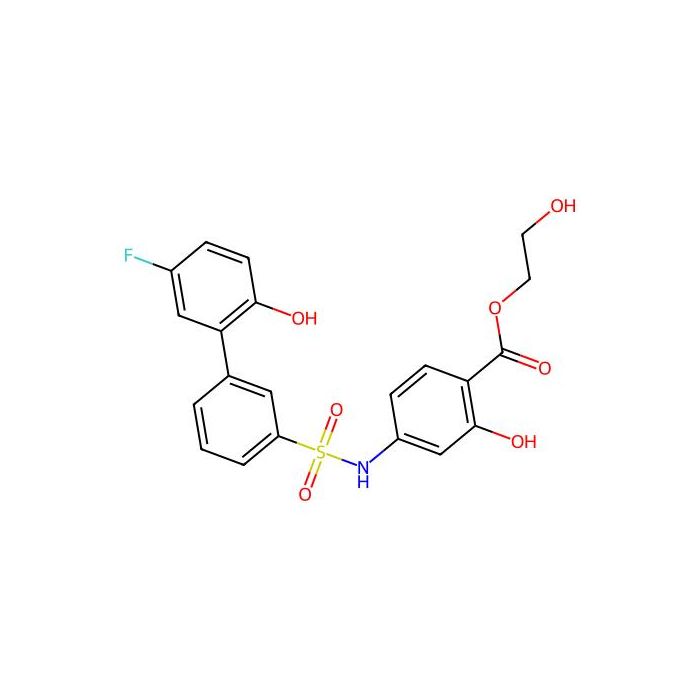
KAN0438757 (SKU K1494686) is supplied as a Moligand-grade small-molecule screening compound. Structure-specific identifiers for this catalog item are not listed in the provided Product Data.
CAS: 1451255-59-6
CID: 71586631 (literature identifier)
Molecular formula: Not specified for this item; refer to CoA/Spec Sheet.
Molecular weight: Not specified for this item; refer to CoA/Spec Sheet.
SMILES: Not specified for this item; refer to CoA/Spec Sheet.
InChIKey: Not specified for this item; refer to CoA/Spec Sheet.
Structural features (general notes):
As a “Moligand” library member, KAN0438757 is intended for ligand-discovery workflows (biochemical, biophysical, or cellular screening). Specific functional groups, ring systems, and stereochemical information are not provided here and should be obtained from the Certificate of Analysis (CoA) or specification sheet if needed for SAR modeling or computational docking.
How to describe the 2D structure (guidance):
When the structure is available, document: core scaffold (e.g., heteroaromatic vs aliphatic), key heteroatoms (N/O/S/halogens), hydrogen bond donors/acceptors, net charge, and any chiral centers. This supports cheminformatics annotation (e.g., Rule-of-5, polar surface area) and storage/handling decisions (e.g., salt form vs neutral).
Synthetic Utility
KAN0438757 is provided as a finished small-molecule screening compound rather than a building block or reagent. Without structure or functional-group disclosure in the Product Data, synthetic transformations or derivatization strategies cannot be outlined for this item specifically.
General notes (when structure is available):
Retrosynthetic leverage: Identify handles for diversification (e.g., aryl halides for cross-coupling, amines/acids for amide coupling, heteroaryl N-oxides for late-stage functionalization).
Protecting-group strategy: If multiple nucleophiles/electrophiles exist, plan orthogonal protections to enable SAR.
Salt and polymorph considerations: If scaling synthesis, assess salt selection and solid-state form as they influence solubility and stability.
For this catalog listing, treat KAN0438757 primarily as an end-use ligand for screening rather than as a substrate for further synthesis unless you have structure disclosures and IP clearance.
Target Specificity
Target, pathway, or mechanism-of-action information for KAN0438757 is not provided in the Product Data.
Target name/class: Not specified for this item; refer to literature or internal data.
Species reactivity/selectivity: Not specified for this item; refer to literature or internal data.
Off-target profile: Not specified for this item; refer to literature or internal data.
Guidance for users:
If you possess structural or literature information for KAN0438757, document hypothesized targets and confirm via orthogonal assays (e.g., enzymology, CETSA, SPR). Incorporate counter-screens to assess selectivity and rule out assay interference (e.g., redox activity, aggregation, fluorescence quenching).
Need help choosing the grade?
Our grade selection guide covers purity, stabilizer status, and application suitability for all variants in our catalog.
Wir verwenden Cookies, um die ordnungsgemäße Funktion der Website sicherzustellen und, soweit zulässig, Ihr Nutzererlebnis zu verbessern. Sie können Ihre Einstellungen jederzeit unter „Einstellungen“ verwalten. Weitere Informationen finden Sie in unserer Cookie-Richtlinie.
Shall we send you a message when we have discounts available?
Remind me later
Thank you! Please check your email inbox to confirm.
Products are supplied to verified businesses, institutions, and qualified professionals for research and development use only. Not for use in humans, animals, diagnosis, or therapy.