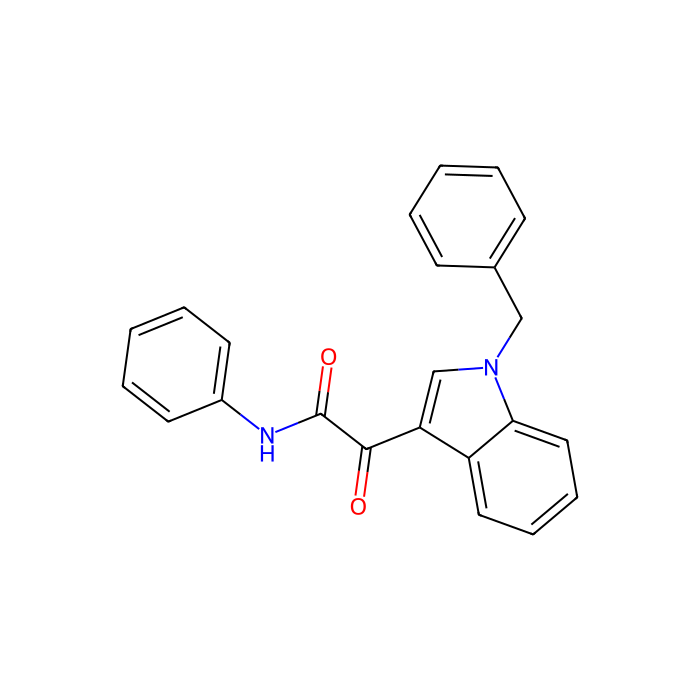
Positiver allosterischer Modulator des Adenosin-A2B-Rezeptors. Potenziert den NECA-induzierten Anstieg der cAMP-Produktion in CHO-Zellen, die A2B-Rezeptoren exprimieren. Potenziert auch die Wirkung von NECA und dem A2B-Rezeptor-AgonistenBAY 60-6583 bei de
This compound belongs to the class of organic compounds known as n-alkylindoles. These are compounds containing an indole moiety that carries an alkyl chain at the 1-position.
External Descriptors
Not available
1. Djoumbou Feunang Y, Eisner R, Knox C, Chepelev L, Hastings J, Owen G, Fahy E, Steinbeck C, Subramanian S, Bolton E, Greiner R, and Wishart DS. ClassyFire: Automated Chemical Classification With A Comprehensive, Computable Taxonomy. Journal of Cheminformatics, 2016, 8:61.
Solvent:DMSO, Max Conc. mg/mL: 17.72, Max Conc. mM: 50
Molekulargewicht
354.400 g/mol
XLogP3
4.300
Hydrogen Bond Donor Count
1
Hydrogen Bond Acceptor Count
2
Rotatable Bond Count
5
Exact Mass
354.137 Da
Monoisotopic Mass
354.137 Da
Topological Polar Surface Area
51.100 Ų
Heavy Atom Count
27
Formal Charge
0
Complexity
522.000
Isotope Atom Count
0
Defined Atom Stereocenter Count
0
Undefined Atom Stereocenter Count
0
Defined Bond Stereocenter Count
0
Undefined Bond Stereocenter Count
0
The total count of all stereochemical bonds
0
Covalently-Bonded Unit Count
1
Lösungsrechner
Molarity Calculator
Determine the necessary mass, volume, or concentration for preparing a solution.
Dilution Calculator
Determine the dilution needed to prepare a stock solution.
Reconstitution Calculator
Bewertungen
Kundenbewertungen
Application Protocols
No item-specific, tested applications are provided for KI-7. The following are general practices for small-molecule tool compounds used in biochemical or cellular assays.
General protocol guidance (not item-specific):
Stock preparation: Weigh under low humidity. Prepare 10–50 mM DMSO stock; vortex to dissolve. Optionally sonicate briefly. Record final concentration and storage date.
Working solutions: Dilute into assay buffer to the desired concentration, keeping final DMSO ≤0.1–0.5% v/v unless the assay tolerates more. Mix thoroughly and inspect for precipitation.
Controls: Include vehicle control and, when available, a mechanistically distinct positive control. Run serial dilutions (e.g., 10-pt 1:3) for concentration–response curves.
Plate handling: Use low-bind plastics for hydrophobic compounds; pre-wet tips to minimize adsorption. Avoid prolonged pre-incubation at room temperature if stability is unknown.
Data quality: Monitor Z′-factor, signal-to-background, and check for time-dependent drift suggesting instability or precipitation.
Assay formats:
Enzyme/cell-based assays, CETSA/thermal shift, binding assays (SPR/ITC), and phenotypic screens may be applicable depending on confirmed target—none is specified here.
Note: Replace with item-specific instructions if provided on the CoA or datasheet.
Biological Roles
Item-specific biological targets, pathways, or roles for KI-7 are not provided in the product data. No assumptions should be made without consulting the literature corresponding to CAS 1489263-00-4 and verifying alignment with the supplied lot via CoA/SDS.
General guidance for small-molecule tool compounds:
Potential roles include modulation of enzyme activity, receptor signaling, protein–protein interactions, ion channels, or transcriptional pathways; however, these are target-dependent and cannot be asserted here.
Before pathway assignments, conduct orthogonal assays to confirm on-target activity and exclude artifacts (e.g., redox cycling, detergent-sensitive aggregation, fluorescence interference, or covalent reactivity).
If using in cells, verify permeability and cytotoxicity windows (e.g., ATP-based viability assays) across relevant exposure times and media compositions.
Documentation and controls:
Record compound batch ID, preparation solvent, and exact final DMSO%.
Include vehicle controls and, when available, a mechanistically distinct positive control.
Conclusion: Biological roles for this item are not specified. Consult peer-reviewed sources for the cited CAS/CID, then corroborate identity and purity for this specific lot before drawing mechanistic conclusions.
Buffer Applications
KI-7 is a small-molecule research compound rather than a buffering agent. Consequently, classical buffer system guidance (pKa, pH ranges, buffer capacity) does not apply.
Practical notes for assay buffers (general):
Vehicle: Prepare concentrated DMSO stocks and dilute into assay buffer to a final DMSO level typically ≤0.1–0.5% v/v to minimize solvent effects.
Precipitation control: Include low levels of non-ionic surfactant (e.g., 0.01–0.05% Tween-20) or protein (e.g., 0.1–0.5% BSA) if compatible with the assay to mitigate aggregation/adsorption.
Adsorption: For low-nanomolar work, pre-rinse plasticware or use low-bind plates/tubes to reduce loss to surfaces.
Item-specific buffer properties (pKa, isoelectric point, etc.): Not applicable/not specified for this item.
Green Alternatives
Green chemistry considerations are best applied to the solvents and workflows surrounding the use of KI-7, since the compound’s structure is not disclosed here.
Greener handling strategies (general):
Prefer aqueous buffers with minimal DMSO content where feasible (≤0.1–0.5% v/v) to reduce solvent burden.
If organic dissolution is necessary, evaluate ethanol or 2-propanol as alternatives to DMF/DMAC, recognizing solvency tradeoffs.
Consolidate assay plates and reduce dead volumes to minimize chemical waste.
Employ miniaturized screening formats (384/1536-well) to cut solvent use and plastic footprint.
Comparison of common vehicles (general; not item-specific):
DMSO: Excellent solvency; moderate environmental impact; widely accepted in screening. Waste reduction via stock concentration optimization.
PEG400 or aqueous cyclodextrin solutions: Can improve solubility; assess downstream environmental and assay impacts.
End-of-life:
Segregate halogenated vs non-halogenated solvent wastes according to institutional policy.
Consider in-house solvent recycling for large-volume operations.
Note: Without a known structure, substitution with a structurally “greener” analog cannot be recommended. Focus on greener solvents, right-first-time experimentation, and reduced scale.
Pharmaceutical Uses
No pharmacopeial status or excipient role is provided for KI-7, and it is sold strictly for research use only.
Research Use Note: For research use only (not for human or veterinary use, not for diagnostic procedures).
Excipients/formulation: Not specified for this item; refer to CoA/Spec Sheet if any formulation information is provided.
General formulation context for research compounds:
Early discovery studies may formulate small molecules in DMSO or ethanol for in vitro assays. For in vivo preclinical research, specialized vehicles (e.g., PEG400/saline, Captisol, or lipid-based systems) are sometimes used; selection must be based on the compound’s confirmed structure, solubility, and stability—none of which are specified here.
No therapeutic claims or clinical applications should be inferred or stated.
Conclusion: There are no declared pharmaceutical or excipient uses for this product. Any formulation discussion must remain within the boundaries of basic laboratory research and be guided by the lot-specific identity and stability information.
Physical Properties
Only limited item-specific physical data are provided. Do not treat any literature values for similarly named compounds as specifications for this item.
Item-specific (as provided):
Appearance: Not specified for this item; refer to CoA/Spec Sheet.
Molecular weight: Not specified for this item; refer to CoA/Spec Sheet.
Molecular formula: Not specified for this item; refer to CoA/Spec Sheet.
Typical properties to confirm (literature/general; not specifications):
Melting point (solid) or boiling point (liquid), density, refractive index, logP/logD, pKa, and UV–vis profile are commonly reported for small molecules but are not provided here. Consult SDS/CoA or measure experimentally (DSC/M.P. apparatus, Karl Fischer for water, HPLC-UV for purity, UV–vis for λmax, potentiometric/UV titration for pKa).
Solubility guidance (general):
For discovery tool compounds, initial dissolution is commonly in anhydrous DMSO (e.g., 10–50 mM stock), followed by dilution into assay buffers containing surfactant (0.01–0.05% Tween-20) or protein (0.1–0.5% BSA) to mitigate precipitation.
If aqueous work is required, perform a solubility screen across pH 2–10 and co-solvent blends (DMSO, ethanol, PEG400) and document any time-dependent precipitation.
Note: Treat all numerical values not present on the product’s CoA/SDS as “Not specified for this item; refer to CoA/Spec Sheet.”
Quality and Grades
Item-specific quality descriptors are not listed.
Grade/Purity: Not specified for this item; refer to CoA/Spec Sheet.
Typical documentation: For screening compounds, suppliers often provide HPLC purity, MS, and sometimes 1H NMR. Confirm what is included on the lot-specific CoA.
Interpretation of common grades (general guidance):
Screening/Library Grade: Prioritizes identity confirmation and high HPLC purity (often ≥95%) with minimal residual solvents/metals data. Suitable for biochemical/cellular screening.
Analytical/Reference Standard Grade: Includes tighter assay uncertainty, full spectral characterization, and stability data; used for quantitative bioanalysis.
HPLC Grade Solvent vs. Compound: “HPLC grade” applies to solvents; for solids, look for “HPLC purity” statements instead.
Stabilizers/impurities:
If a stabilizer is present (e.g., BHT), it will be declared on the CoA/SDS. None is specified here. Do not assume the presence or absence of stabilizers.
Recommendations:
Request CoA prior to time-sensitive studies.
Verify batch-to-batch consistency for potency-sensitive work.
Note: Where a specific value is not provided: “Not specified for this item; refer to CoA/Spec Sheet.”
Reaction and Applications
This product is positioned as a small-molecule research tool/compound library member rather than a synthetic reagent. As such, its primary applications are expected to be in biochemical, cellular, or phenotypic assays.
Assay-focused applications (general guidance):
Target-agnostic screening: Use in high-throughput or focused screens to probe biological pathways. Validate identity and purity by LC–MS prior to hit triage.
Mechanistic studies: If a literature target is identified for this CAS/CID, confirm match to the supplied lot and replicate key controls (orthogonal assays, counterscreens for aggregation/fluorescence interference).
Chemical biology: Pair with thermal shift assays, CETSA, or DARTS to assess target engagement, after confirming solubility and absence of assay-interfering properties.
Not typically applicable:
Named reactions and general organic synthesis roles cannot be assigned without a known structure. If synthetic transformations are intended, obtain the full structure and reactivity profile first.
Good practices:
Implement PAINS/REOS filters and redox/fluorescence interference panels as appropriate.
Confirm concentration–response reproducibility across independent preparations and solvent systems.
Reaction Conditions
This section is generally not applicable because the product is positioned as a small-molecule tool compound rather than a reagent, and no structural data are provided to inform reaction condition planning.
If laboratory transformations are still intended (general advice):
Start with micro-scale trials (1–10 mg) to assess solubility and stability in candidate solvents (DMSO, DMF, MeCN, toluene, alcohols) and under acid/base conditions.
Use analytical HPLC or UPLC–MS to monitor degradation kinetics at room temperature and at elevated temperatures (40–80°C) before committing to scale.
Protect from moisture and light if instability is suspected.
Expected yields, catalysts, or temperature ranges cannot be meaningfully stated without known functional groups. Refer to the CoA/SDS for identity and then consult domain literature for the confirmed scaffold.
Safety and Handling
Safety information specific to this item is not provided in the listing. Always consult the lot-specific SDS for authoritative guidance.
Item-specific hazard details (as provided):
Signal word: Not specified for this item; refer to SDS.
H-statements: Not specified for this item; refer to SDS.
GHS classification: Not specified for this item; refer to SDS.
Pictograms: Not specified for this item; refer to SDS.
General laboratory precautions for small molecules of unknown hazard class:
PPE: Use lab coat, safety glasses, and appropriate chemical-resistant gloves (e.g., nitrile). Handle powders/solids in a fume hood to avoid inhalation.
Avoid skin/eye contact and inhalation of dust or aerosols. Prevent environmental release.
Incompatibilities (general): Strong oxidizers, strong acids/bases, and reactive reducing/oxidizing agents until specific compatibility is known. Keep away from ignition sources if solvent-borne.
First aid (general): In case of skin contact, wash with soap and water. Eye exposure: rinse with water for several minutes, remove contacts if present and easy, and seek medical advice. Inhalation: move to fresh air; seek medical attention if symptoms persist. Ingestion: rinse mouth; do not induce vomiting; seek medical attention.
Waste: Collect and dispose in accordance with institutional and local regulations; do not pour to drain.
Special risks: None can be asserted without SDS; treat as potentially harmful. Defer to the SDS for storage incompatibilities and transport classifications.
Solvent Selection
Without a disclosed structure, solvent choice should follow general best practices for small-molecule tool compounds.
Practical approach:
Primary solvent: Anhydrous DMSO is typically the first-line solvent for stock solutions (e.g., 10–50 mM) due to broad solvency and assay compatibility at ≤0.5% v/v final.
Secondary solvents: DMF or ethanol can be used when DMSO is undesirable; test stability and assay tolerance.
Aqueous work: Assess solubility in buffered aqueous media (pH 2–10) with or without co-solvent (2–10% DMSO, ethanol) and surfactants (0.01–0.05% Tween-20) to reduce aggregation/precipitation.
Stability checks: Monitor solutions by HPLC over time and at experimental temperatures to capture hydrolysis/oxidation or crystallization.
Small comparison (general; not item-specific):
DMSO: Highest solvency; can affect certain enzymes and cell membranes at >0.5–1%.
DMF: Good solvency; higher toxicity; limited use in bioassays.
Ethanol: Biologically tolerated to ~0.1–1% v/v; lower solvency for hydrophobic compounds.
2-Hydroxypropyl-β-cyclodextrin (HP-β-CD) solutions: Can enhance apparent solubility for hydrophobic actives; evaluate binding effects on potency.
Tips:
Filter stocks only if chemically stable; otherwise, prepare by weight and avoid adsorptive losses.
Record exact solvent lot, water content, and final DMSO% to ensure reproducibility.
Storage and Reconstitution
Item-specific storage and shipping information:
Storage Conditions: Store at -20°C (item-specific).
Shipped In: Ice chest + Ice pads (item-specific).
General storage guidance for small-molecule solids:
Keep tightly closed in the original container, protected from moisture and light. Allow the container to warm to room temperature in a desiccator before opening to reduce condensation.
If hygroscopic or air-sensitive (status not specified), handle quickly under dry air or inert gas. Reseal promptly and store with desiccant.
Reconstitution (general; not item-specific):
Prepare concentrated stock solutions in anhydrous DMSO (e.g., 10–50 mM). Mix until fully dissolved; avoid excessive heating. If filtration is necessary, use low-protein-binding 0.2 µm PTFE filters compatible with the solvent and compound.
Aliquot stocks into single-use vials to minimize freeze–thaw cycles. Store aliquots at -20°C to -80°C, protected from light. Record preparation date and lot number.
Thaw on ice or at room temperature; vortex to ensure homogeneity. Discard solutions showing precipitation, discoloration, or unexpected LC–MS impurities.
Stability/shelf life:
Not specified for this item; refer to CoA/Spec Sheet and SDS. Establish in-house stability by periodic HPLC testing if long-term use is planned.
Research Use Note: For research use only.
Structure and Identity
Item-specific data available for KI-7 are limited. The following reflects what is provided versus not specified.
SKU: K288861 (Aladdin Scientific)
Product Name: KI-7
CAS: 1489263-00-4 (item-specific)
CID: 73350966 (item-specific)
InChIKey: 225905 (provided as-is; full InChIKey not specified for this item; refer to CoA/Spec Sheet.)
SMILES: Not specified for this item; refer to CoA/Spec Sheet.
Molecular formula: Not specified for this item; refer to CoA/Spec Sheet.
Molecular weight: Not specified for this item; refer to CoA/Spec Sheet.
Structural description (general guidance):
Because no structure (SMILES/InChI/2D) is provided, detailed functional groups, ring systems, and stereochemical features cannot be enumerated for this specific item.
KI-7 is listed within a “small molecules and compound libraries” category, suggesting it is intended as a research tool compound rather than a synthetic building block. Without a disclosed structure, assume typical small-molecule characteristics and confirm actual identity via the CoA/SDS prior to use in structure-dependent assays.
Identification best practices (general):
Verify the compound identity by CAS and supplier lot-specific CoA (appearance, purity method, and NMR/LC–MS as available).
Cross-reference the PubChem CID provided (73350966) for literature structure, then reconcile with the lot-specific CoA to ensure exact match before quantitative work.
Synthetic Utility
KI-7 is offered as a small-molecule research compound rather than a synthetic building block, and no structural information is provided in the listing. Therefore, synthetic reactivity and transformation roles cannot be assigned.
General considerations if synthetic use is contemplated:
Obtain the exact structure (SMILES/InChI) and functional group profile from the CoA/SDS before planning derivatizations.
Verify chemical stability under prospective reaction conditions (acid/base, redox, heat, photolysis) by small-scale scouting and LC–MS monitoring.
If used as a reference standard or impurity marker, confirm chromatographic behavior and detection response factors relative to analytes of interest.
Because item-specific functional groups and protecting-group patterns are unknown, named-reaction suitability (e.g., cross-coupling, nucleophilic substitutions, condensations) is not evaluated here. For synthetic campaigns, select starting materials with fully disclosed identity and quality data.
Target Specificity
No target, pathway, or selectivity profile is provided in the product data for KI-7.
Antigen/epitope (for biologics): Not applicable.
Target class (enzyme/receptor): Not specified for this item; consult literature for CAS 1489263-00-4 and verify alignment with the supplied lot.
Off-targets and counterscreens: Not specified.
Guidance (general):
If a literature target exists for this CAS/CID, confirm identity and purity of the received lot and reproduce reported potency using the same assay format before extending to new models.
Run orthogonal and counter assays to control for aggregation, redox cycling, photoreactivity, fluorescence/absorbance interference, or covalent nonspecificity.
Conclusion: Target specificity is not defined for this listing; users should derive this from peer-reviewed sources linked to the exact chemical structure and then validate experimentally.
Wir verwenden Cookies, um die ordnungsgemäße Funktion der Website sicherzustellen und, soweit zulässig, Ihr Nutzererlebnis zu verbessern. Sie können Ihre Einstellungen jederzeit unter „Einstellungen“ verwalten. Weitere Informationen finden Sie in unserer Cookie-Richtlinie.
Dürfen wir Sie über Rabattaktionen informieren?
Später erinnern
Vielen Dank! Bitte überprüfen Sie Ihren E-Mail-Posteingang, um zu bestätigen.
Products are supplied to verified businesses, institutions, and qualified professionals for research and development use only. Not for use in humans, animals, diagnosis, or therapy.

 L2419271