QUALITÄT & REINHEITMoligand™?Moligand™ — Aladdin's line of ligands and bioactive small molecules. Use for receptor, pathway, and binding studies needing defined small-molecule tools.10mM in DMSO
Determine the necessary mass, volume, or concentration for preparing a solution.
Dilution Calculator
Determine the dilution needed to prepare a stock solution.
Reconstitution Calculator
Bewertungen
Kundenbewertungen
Application Protocols
Validated application protocols (e.g., WB/IHC/ELISA dilutions) are not applicable to a small‑molecule analyte. However, typical research workflows for L‑adrenaline include (literature guidance):
Electrochemical detection (DPV/SWV):
Prepare fresh 10–100 µM solutions in deoxygenated phosphate buffer (pH 7.0) or acetate buffer (pH 4.5) to balance stability and physiological relevance.
Use polished glassy carbon or modified electrodes; record baseline; minimize light/air exposure.
Spectrophotometric oxidation assay:
Generate adrenochrome by mild oxidation; monitor A480–490 over time to evaluate antioxidant capacity or kinetics.
Enzymatic assays:
COMT activity: Incubate adrenaline with SAM and COMT in Mg2+‑containing buffer; quantify O‑methylated products by LC–MS.
Tyrosinase/laccase: Follow catechol oxidation rates; include controls for non‑enzymatic autoxidation.
HTS stock preparation:
Dissolve in anhydrous DMSO (e.g., 10–50 mM), aliquot under inert gas in amber tubes, store at −80 °C; dilute into assay buffer immediately before use.
Note: These are general, literature‑based suggestions. Optimize and validate within your laboratory SOPs. No item‑specific application data are provided for this product.
Biological Roles
Biological context (general, literature):
L‑Adrenaline (epinephrine) is an endogenous catecholamine hormone and neurotransmitter produced primarily in the adrenal medulla. It is biosynthesized from L‑tyrosine → L‑DOPA → dopamine → norepinephrine → epinephrine (via phenylethanolamine N‑methyltransferase, PNMT).
Receptor interactions: Binds adrenergic GPCRs (α1, α2, β1, β2, β3), initiating diverse intracellular signaling cascades (e.g., cAMP via β‑receptors; IP3/DAG via α1) depending on receptor subtype and tissue.
Metabolism and clearance: Inactivated by catechol‑O‑methyltransferase (COMT) and monoamine oxidase (MAO), yielding metanephrine and other metabolites; conjugation (sulfation/glucuronidation) facilitates excretion (literature).
Transport and storage: Packaged in secretory vesicles with chromogranins; released in response to sympathetic stimulation. Uptake mechanisms involve plasma membrane transporters; oxidation susceptibility necessitates vesicular protection.
Research utility: Serves as a model catecholamine in studies of receptor pharmacology, signal transduction, transporter function, enzymology (COMT/MAO), redox biochemistry, and biosensor development.
Note: The above information reflects general biochemistry. No medical or clinical claims are made. This catalog item is for research use only (per Product Data).
Buffer Applications
L‑Adrenaline is not a buffering agent; it is an analyte/substrate. However, buffer choice strongly influences its stability and analytical performance (literature guidance):
pH control:
Stability is greatest at mildly acidic pH (≈3–5); neutral pH is workable for short assays if deoxygenated and metal‑depleted.
Avoid alkaline conditions that accelerate catechol oxidation/polymerization.
Typical buffers for analytical work:
Acetate/citrate (pH 3.5–5.5) for stability during storage/kinetics.
Phosphate/HEPES (pH 6.8–7.4) for receptor/enzyme assays; use freshly prepared, O2‑reduced buffers.
Additives (if assay‑compatible):
Antioxidants: sodium metabisulfite (e.g., 0.05–0.2% w/v) or ascorbate to mitigate oxidation.
Metal chelators: EDTA (e.g., 0.1–1 mM) to suppress metal‑catalyzed autoxidation.
Practical tips:
Prepare solutions immediately before use; use amber vials and inert headspace.
Filter through low‑binding membranes; pre‑rinse to minimize adsorption.
Item-specific buffer recipes are not provided; consult your assay SOPs and validate compatibility with detection modalities.
Green Alternatives
As a research analyte/building block, the principal "green" considerations for L‑adrenaline involve solvent choice, stabilization, and minimizing waste.
Preferred media (literature): Use aqueous buffers at mildly acidic pH when feasible to avoid organic solvents and reduce oxidation. Prepare small, on‑demand solutions to limit waste.
Stock solutions: If DMSO is required for solubility or HTS workflows, minimize concentration and volume; dilute promptly into water to reduce DMSO usage.
Stabilization vs. waste: Incorporating small amounts of sulfite/ascorbate and EDTA can prolong solution life, reducing remake frequency; balance with downstream assay compatibility.
Comparison (literature guidance; choose per application):
Acidified water (pH 3–5):
Pros: Green, good stability, easy disposal.
Cons: May not suit all bioassays; requires corrosion‑resistant hardware.
Neutral aqueous buffer (PBS, HEPES):
Pros: Biocompatible; minimal organic content.
Cons: Higher oxidation rate; shorter working time.
DMSO stocks:
Pros: High solubility; HTS compatible.
Cons: Organic solvent footprint; hygroscopic; potential assay interference at high %.
Operational best practices:
Use deoxygenated, metal‑ion‑depleted water; amber vials; inert headspace; scale solutions to immediate need.
Segregate halogenated/oxidative waste streams if derivatizations or oxidants are used.
Pharmaceutical Uses
This listing is for research use only. No medical or clinical use is intended or implied.
General formulation/manufacturing context (literature):
Regulatory monographs exist for epinephrine and certain salts in major pharmacopeias (e.g., USP/EP/JP). This does not constitute certification of this item to any pharmacopeial standard.
Roles in pharma QA/QC and development (research context):
Reference/working standard for method development (e.g., HPLC, LC–MS) and system suitability.
Stress‑testing analyte to develop stability‑indicating methods (oxidative, photolytic, thermal challenges).
Excipient compatibility screens due to catechol oxidation sensitivity (antioxidants, chelators, container–closure systems).
Handling considerations for formulation studies (non‑clinical):
Protect from light and oxygen; use acidified, oxygen‑reduced diluents; include sulfite/EDTA as appropriate to model commercial stabilizers.
Item-specific pharmacopeial compliance, impurity profiles, and residual solvent data: Not specified for this item; refer to CoA/Spec Sheet.
Physical Properties
Item-specific physicochemical specifications (e.g., water, residual solvents, UV cutoff) are not provided for this listing and should be confirmed on the CoA.
Literature/general reference values for L‑adrenaline (free base; values may vary with salt form and hydration):
Appearance: Typically a solid; often off‑white to slightly colored due to air oxidation (literature).
Melting point: ~211–212 °C (decomp., literature; free base). Salt forms show different MPs.
LogP/logD (literature): XlogP3 ~−1.2; logD7.4 markedly negative due to protonation/phenols (high aqueous preference).
Aqueous solubility (literature): Good solubility under acidic conditions (protonated amine); limited solubility in neutral/basic water due to catechol oxidation/polymerization risk; poor in nonpolar solvents.
Stability considerations (literature): Readily oxidized (air/O2, light, metal ions) to quinonoid species (e.g., adrenochrome). Stabilized in acidic media with antioxidants (e.g., sulfite) and metal chelators (e.g., EDTA).
Item-specific values (this lot):
Density, refractive index, exact solubility, and other specifications: Not specified for this item; refer to CoA/Spec Sheet.
Moligand™ indicates inclusion in a curated small‑molecule/ligand library intended for discovery workflows (e.g., biochemical assays, target screening). Such materials are typically suitable for research use, not for human or veterinary use.
Typical library‑grade quality controls may include structure confirmation (e.g., 1H NMR/LC‑MS), purity assessment, and identity checks; exact acceptance criteria vary by product.
What is specified for this item:
Grade name: Moligand™.
Purity specification, stabilizers, residual solvent limits, elemental analysis, water content, and chromatographic purity: Not specified for this item; refer to CoA/Spec Sheet.
Practical implications for end‑users:
For HTS and medicinal chemistry, confirm assay‑critical attributes (purity, salt/form, counter‑ion, water content) from the CoA prior to plate preparation.
If low UV background is required (e.g., LC/UV quantitation), verify UV profile/blank trace with the supplied analytical data.
If chiral purity (enantiomeric excess) is assay‑relevant, confirm the L‑configuration and any ee% reported on the CoA.
Reaction and Applications
Applications relevant to L‑adrenaline reflect its catechol and β‑amino alcohol functionality and its role as a redox‑active analyte.
Analytical/electrochemical (literature):
Serves as a benchmark analyte for voltammetry and electrochemical sensor development (catecholamine oxidation to quinones/adrenochrome). Useful for validating carbon, metal‑oxide, and nanomaterial electrodes.
Colorimetric/UV–vis tracking of autoxidation (formation of adrenochrome, λmax ≈ 480–490 nm) for kinetics/antioxidant screening.
Synthetic/derivatization (literature):
β‑Amino alcohol motif enables acylation/carbamoylation on nitrogen; phenolic hydroxyls undergo selective protection (e.g., methylation/benzylation) and subsequent cross‑coupling after conversion to aryl triflates.
Oxidation of the catechol to o‑quinone followed by Michael additions affords diverse adducts; redox cycling leveraged in materials/adhesive chemistry.
As a chiral β‑amino alcohol, can serve as a ligand/template in asymmetric transformations by analogy to ephedrine‑type ligands (scope is substrate‑dependent).
Biochemical applications (literature):
Substrate for oxidases (e.g., tyrosinase, laccase) in enzymology and inhibitor screening.
Model substrate to study COMT‑mediated O‑methylation and MAO metabolism (with appropriate cofactor systems).
Practical tips:
Work under inert atmosphere and subdued light; include chelators and antioxidants where compatible.
For derivatization, protect phenols first to suppress undesired oxidation/polymerization; maintain low temperatures and exclude air for sensitive steps.
Reaction Conditions
General conditions drawn from literature; optimize per substrate and scale.
Oxidation to adrenochrome (analytical standard reaction):
Reagents: Air/O2 (slow), ferricyanide, periodate, or enzymatic (tyrosinase/laccase).
Temperature: Ambient; protect from light for controlled kinetics.
Observables: Development of red color (λmax ≈ 480–490 nm); voltammetric peak potentials characteristic of catechol/quinone couple.
Phenolic protection (methylation):
Reagents: MeI/Me2SO4 or MeI + base; or trimethylsilyldiazomethane (safer) in MeOH/THF.
Conditions: 0–25 °C; exclude moisture/air; monitor by LC–MS.
N‑Acylation/carbamoylation:
Reagents: Acyl chlorides/anhydrides or carbamoyl transfer reagents; base (e.g., triethylamine) in DMF/DCM.
Consider prior phenol protection to avoid O‑acylation.
Quinone conjugation:
Generate o‑quinone in situ with mild oxidant; add nucleophile (thiols, amines) at 0–25 °C in buffered aqueous/MeOH media.
COMT‑mimetic O‑methylation (biomimetic studies):
Enzymatic: COMT with SAM cofactor in Tris buffer, Mg2+ present; pH ~7.5; 25–37 °C.
Typical yields and kinetics are highly method‑ and protection‑strategy dependent; validate on small scale with rigorous oxygen and metal control.
Safety and Handling
Authoritative safety information is provided in the product SDS. The following is general guidance for laboratory handling of catecholamines.
GHS classification and hazard statements: Not specified for this item; consult the SDS provided with the shipment for the definitive classification, pictograms, and H‑statements.
Principal hazards (general):
May cause irritation to skin, eyes, and respiratory tract.
Catecholamines can have potent biological activity; avoid exposure and ingestion. Use engineering controls to prevent aerosol formation.
Readily oxidizes, potentially forming colored quinones; oxidation can generate reactive oxygen species in solution.
PPE and engineering controls:
Use chemical‑resistant gloves, lab coat, and splash goggles; handle within a fume hood or ventilated enclosure.
Employ dedicated tools for weighing; avoid skin contact and inhalation of dust.
Incompatibilities (general):
Oxidizers; bases and transition‑metal salts catalyze phenolic oxidation; avoid exposure to air/light and elevated temperature.
Strong alkali accelerates catechol autoxidation.
First‑aid overview (general):
Skin/eye contact: Rinse with copious water for ≥15 minutes; remove contaminated clothing; seek medical attention if irritation persists.
Inhalation: Move to fresh air; seek medical evaluation if symptoms occur.
Ingestion: Rinse mouth; do not induce vomiting; seek medical attention.
Spill & disposal:
Small spills: Avoid dust; absorb with inert material; collect in compatible container.
Dispose according to institutional and local regulations; minimize release to the environment.
Storage‑related safety (see also Storage tab):
Store at −80 °C, protected from light, air, and moisture; keep tightly sealed. Open under inert atmosphere if possible to minimize oxidation.
Solvent Selection
L‑Adrenaline is a polar, hydrogen‑bond‑rich catecholamine; solubility and stability depend strongly on pH and redox environment.
Screening stocks: 10–50 mM in anhydrous DMSO or 0.01–0.1 M HCl(aq). For aqueous stocks, include antioxidant (e.g., sulfite) and chelator (e.g., EDTA) where compatible (literature practice).
Assay buffers: Mildly acidic buffers (pH 3–5) improve stability; neutral pH acceptable for short experiments if oxygen and metals are minimized.
Filtration: Use low‑binding filters (PTFE or PVDF). Avoid basic conditions that accelerate catechol oxidation.
Quick comparison (literature):
DMSO: Maximizes solubility; protect from moisture/air; add last to plates to limit precipitation upon dilution.
Acidified water: Maximizes stability; may constrain biological assay conditions.
Neutral PBS: Convenient but monitor oxidation/adsorption; prepare fresh.
Storage and Reconstitution
Storage conditions (per Product Data):
Store at −80 °C.
Shipped on dry ice packs + cold packs via FedEx DG Service.
Container handling:
Keep tightly sealed, protected from light and air; use amber vials with inert gas headspace (e.g., nitrogen/argon) where possible.
Minimize freeze–thaw by aliquoting upon first opening.
Reconstitution (general, literature):
For aqueous use: Dissolve in cold, acidified water (e.g., 0.01–0.1 M HCl) to desired concentration. Optionally include sodium metabisulfite (e.g., 0.05–0.2% w/v) and EDTA (0.1–1 mM) if compatible with downstream assays.
For HTS/organic stocks: Prepare 10–50 mM in anhydrous, oxygen‑reduced DMSO; vortex gently; filter if needed through low‑binding 0.22 µm PVDF/PTFE.
Work under subdued light; avoid prolonged exposure to ambient air.
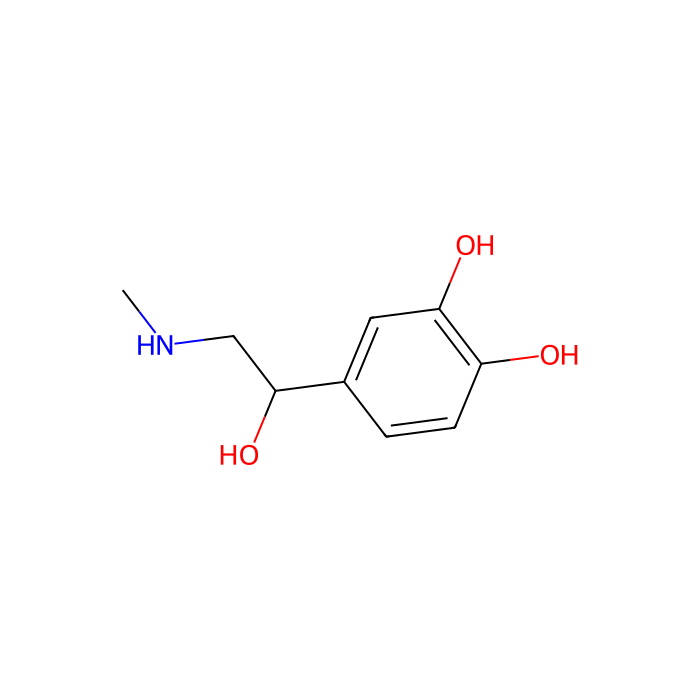
2D description: a benzene ring bearing two adjacent phenolic OH groups (positions 1 and 2), with a –CH(OH)–CH2–NH–CH3 side chain para to one phenol; the β‑carbon (adjacent to ring) is chiral.
Category: Small molecules and compound library (per Category Path: 全部 / 可售 / 小分子和化合物库).
Research use note: For research use only (per Product Data).
Notes: All identifiers labeled “literature” are general reference values; item‑specific identity and stereochemical assignment should be verified against the supplied CoA/Spec Sheet.
Synthetic Utility
L‑Adrenaline is a multifunctional building block combining a catechol ring and a chiral β‑amino alcohol.
Transformations on the nitrogen (literature):
N‑acylation/carbamoylation to modulate basicity and lipophilicity; reductive amination of derivatives to access analogs.
Quaternization to form ammonium salts (phase‑transfer applications in method development).
Transformations on the phenols (literature):
Protection as methyl ethers (COMT‑mimetic O‑methylation) or benzyl ethers; subsequent cross‑coupling via aryl triflates/halides.
Oxidation to o‑quinone enabling conjugate additions/cycloadditions; entry to pigment‑like adrenochrome frameworks.
Side‑chain chemistry (literature):
Inversion/retention strategies at the β‑center via Mitsunobu or activation–substitution (after suitable protection) to diversify stereochemical space.
Formation of cyclic carbamates/oxazolidines as protecting/activating groups.
Ligand/auxiliary roles (by analogy to β‑amino alcohol ligands):
Potential chiral ligand for asymmetric additions or epoxidations; scope requires empirical validation.
Operational guidance:
Implement phenol protection early; conduct transformations under inert atmosphere with metal chelation to suppress catechol oxidation.
For electrophilic aromatic substitution, directivity is dominated by the activated catechol ring; ortho/para selectivity must be managed with protection and sterics.
Target Specificity
This section typically applies to biological antibodies, enzymes, or targeted affinity reagents. L‑Adrenaline is a small molecule and does not have clone/isotype/epitope attributes.
Item-specific target details (clone, isotype, species reactivity): Not applicable.
For receptor studies, consult literature on adrenergic receptor subtypes (α1, α2, β1, β2, β3) and design assays accordingly.
Häufig gestellte Fragen
What is Moligand??
Moligand? is one of Aladdin Scientific's premium product lines, formulated for high-purity applications across multiple workflows. Compared to standard grades in the same workflow, Moligand? products typically offer tighter specifications, more rigorous QC, and stronger lot-to-lot consistency.
How should this product be stored?
Store at ?80 °C. Ultra-low temperature storage is required to maintain the specified shelf life.
How is this product shipped?
This product ships frozen with dry ice and cold packs. Unpack on arrival and transfer it to the storage condition stated above; handle dry ice with insulated gloves in a ventilated area.
What are the CAS number, molecular formula and molecular weight?
The CAS Number is 51-43-4, the molecular formula is C9H13NO3, and the molecular weight is 183.20 g/mol.
What documentation is provided?
Available product documentation, including Certificates of Analysis (COA), Safety Data Sheets (SDS), and specification sheets, is shown in the product document area. Document availability and access follow the current site policy.
Wir verwenden Cookies, um die ordnungsgemäße Funktion der Website sicherzustellen und, soweit zulässig, Ihr Nutzererlebnis zu verbessern. Sie können Ihre Einstellungen jederzeit unter „Einstellungen“ verwalten. Weitere Informationen finden Sie in unserer Cookie-Richtlinie.
Dürfen wir Sie über Rabattaktionen informieren?
Später erinnern
Vielen Dank! Bitte überprüfen Sie Ihren E-Mail-Posteingang, um zu bestätigen.
Products are supplied to verified businesses, institutions, and qualified professionals for research and development use only. Not for use in humans, animals, diagnosis, or therapy.
 K2605162
