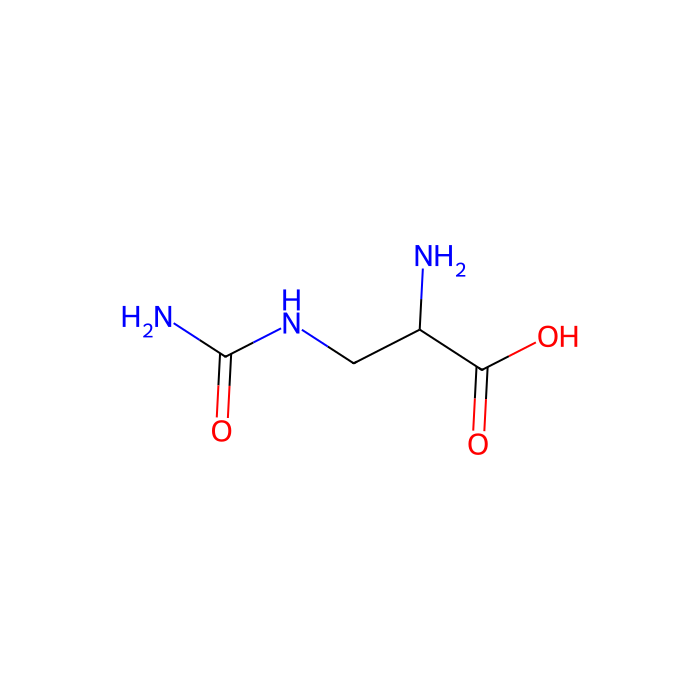
L-Albizziin a glutamase inhibitor, a GlnRS (glutaminyl-tRNA synthetase) inhibitor as well as an intermediate in the synthesis of heterocycles. L-Albizziin is also a potential effector group in affinity chromatography.
This compound belongs to the class of organic compounds known as l-alpha-amino acids. These are alpha amino acids which have the L-configuration of the alpha-carbon atom.
External Descriptors
non-proteinogenic L-alpha-amino acid
1. Djoumbou Feunang Y, Eisner R, Knox C, Chepelev L, Hastings J, Owen G, Fahy E, Steinbeck C, Subramanian S, Bolton E, Greiner R, and Wishart DS. ClassyFire: Automated Chemical Classification With A Comprehensive, Computable Taxonomy. Journal of Cheminformatics, 2016, 8:61.
Determine the necessary mass, volume, or concentration for preparing a solution.
Dilution Calculator
Determine the dilution needed to prepare a stock solution.
Reconstitution Calculator
Bewertungen
Kundenbewertungen
Application Protocols
No tested application protocols (e.g., WB, IHC, IF, FC) or recommended dilutions are provided for this item. As a small-molecule/biochemical reagent, L‑Albizziin is typically deployed in synthetic schemes or biochemical assays rather than as a direct probe in immunoassays.
General preparation guidance (adapt as needed):
Stock solutions: Prepare in water, buffer (pH 7–9), or DMSO/DMF depending on solubility; filter sterilize (0.22 µm) for sensitive biochemical assays.
Working concentrations: Establish empirically via small pilot studies (e.g., 1 µM to 10 mM range depending on assay type and solubility/response); include vehicle controls for organic cosolvents.
Documentation: Record exact batch number and storage history; many amino-acid–like solids can absorb moisture affecting gravimetric dosing.
Please refer to the CoA and SDS and design application-specific SOPs validated for your laboratory setting.
Biological Roles
Item-specific biological roles or targets: Not specified for this item; refer to primary literature for CAS 1483‑07‑4.
General context for L‑configured amino acid analogs (biochemistry; not medical claims):
Enzyme interaction: amino acid analogs frequently mimic natural substrates or transition states, enabling study of enzyme recognition, catalysis, and inhibition in purified systems. Depending on its side chain, L‑Albizziin could interact with amino acid–metabolizing enzymes or transporters; exact interactions must be verified experimentally.
Transport and uptake: in cell-free and vesicle systems, analogs can be used to probe transporter specificity; caution that many analogs require dedicated permeases or show limited membrane permeability.
Structural biology: as ligands or co-crystallography additives, analogs can stabilize specific enzyme conformations, aiding structure determination. Ensure buffer compatibility and solubility.
Analytical standards: stable, non-endogenous analogs are useful as internal standards for LC–MS workflows in metabolomics-like method development.
Experimental considerations:
pH and ionic strength affect zwitterion state and binding thermodynamics; buffer carefully to match physiological pH when appropriate.
Keep DMSO content low in enzyme assays (<1–2% v/v) and include vehicle controls.
Note: Without precise structure and pKa values for L‑Albizziin, experimental design should begin with small screens to identify suitable concentration ranges and detect off-target interactions.
Buffer Applications
L‑Albizziin is not typically used as a primary buffering agent. No item-specific buffer system or pKa set is provided for this product.
Practical guidance (general):
For biochemical assays involving L‑Albizziin, select an appropriate external buffer system (e.g., phosphate, HEPES, MOPS, Tris) based on the assay pH and compatibility with detection methods. Maintain ionic strength consistent with your controls.
Adjust pH after dissolving the compound; amino-acid–like reagents can alter solution pH upon dissolution due to zwitterionic equilibria.
If the compound possesses additional ionizable groups (unknown here), buffering near those pKa values may influence solubility and activity—determine empirically.
Summary: Use standard laboratory buffers for assays or storage solutions; do not rely on L‑Albizziin for buffering capacity without confirmed pKa data.
Green Alternatives
Perspective: As a solid research reagent rather than a bulk solvent, the “green” discussion centers on solvent choice, waste minimization, and protection/coupling strategy rather than replacing the reagent itself.
Greener practice options (general guidance):
Solvent selection: prioritize water or aqueous buffers whenever feasible. When organic co-solvents are required, consider lower-toxicity options such as ethanol or propylene carbonate where chemically compatible. For peptide couplings, dimethyl carbonate and ethyl acetate work in niche cases but often lack the solvating power of DMF/DMSO.
Safer coupling systems: replacing benzotriazole-based additives (e.g., HOBt/HOAt) with OxymaPure (ethyl cyano(hydroxyimino)acetate) reduces explosive risk while maintaining high coupling efficiency (literature).
Process intensification: use micellar catalysis (e.g., TPGS-750-M) to run transformations in water, reducing organic solvent usage when reactions on this substrate are compatible.
Minimizing protecting groups: adopt orthogonal protection to reduce steps and solvent-intensive workups; consider on-resin transformations to decrease isolation cycles.
Trade-offs:
Water-rich media can change ionization and reactivity of amino-acid–like reagents; yields and selectivity may differ from DMF/DMSO systems.
Greener coupling agents may require optimization of base, equivalents, and time to match legacy protocols.
Documentation: Capture solvent and reagent inventories to quantify improvements (e.g., PMI/E-factor). Validate that the greener choices maintain identity and enantiopurity of L‑Albizziin under your conditions.
Pharmaceutical Uses
No pharmacopeial status, excipient role, or formulation use is specified for this item. This product is sold strictly for research use only.
General considerations (non-clinical, formulation science context):
Amino acid–like compounds are sometimes used as excipients or stabilizers in biopharmaceutical formulations due to their osmolyte properties; however, there is no information here indicating that L‑Albizziin is suitable or qualified for such use.
Regulatory grade: In the absence of compendial listing (e.g., USP/EP) or GMP documentation, do not use this material for any clinical manufacturing or diagnostic applications.
If your application involves pre-formulation or stability model systems:
Verify solubility limits in the intended vehicle and assess compatibility with typical tonicity agents, antioxidants, and surfactants.
Evaluate pH stability and potential for Maillard-type reactions if reducing sugars are present, as applicable to amino-containing compounds.
Conclusion: Limit use to research and laboratory method development. Consult the CoA and SDS for any additional quality attributes relevant to non-clinical formulation studies.
Physical Properties
Item-specific physical data from Product Data: Not specified for this item; refer to CoA/Spec Sheet.
General/literature expectations for amino acid–like solids (for planning only; not specifications for this item):
Appearance: typically crystalline or amorphous solid; hygroscopicity varies with side chain functionality.
Melting/decomposition: many nonvolatile amino-acid analogs decompose before boiling; melting points are often >150 °C with decomposition (literature, class behavior).
Solubility: commonly high solubility in water and aqueous buffers at neutral to basic pH; generally sparingly soluble in most nonpolar organic solvents. Zwitterionic forms can reduce solubility in strictly anhydrous organics (literature, class behavior).
pKa values: amino-acid analogs often exhibit pKa1 (carboxyl) ~2–3 and pKa2 (amino) ~9–10; additional ionizable groups shift these values (literature, class behavior). Actual pKa set for L‑Albizziin must be obtained from authoritative sources.
LogP/logD: typically low logP (hydrophilic), with logD strongly pH dependent (literature, class behavior).
Density, refractive index: generally not used analytically for solids in this class; consult CoA if needed.
Practical note:
When preparing analytical methods, determine exact solubility and ionization by small-scale tests and verify with batch documentation to avoid overconcentration or precipitation during LC/MS sample prep.
Quality and Grades
Item-specific grade/purity, stabilizers, and analytical cutoffs: Not specified for this item; refer to CoA/Spec Sheet.
Guidance on grades (general information to help selection):
Research-grade solids (unbuffered): typically suitable for biochemical assays, synthesis, and method development where trace UV-absorbing impurities and water content are controlled within research norms. Actual assay purity and impurity profile should be confirmed on the batch CoA.
Biochemical/≥98% purity offerings (when applicable): favored for enzymology or as standards, improving mass balance and minimizing off-target effects from impurities.
Trace metal specifications: if your application is metal-catalyzed (e.g., Pd-mediated couplings on protected amino acids), consult trace metal data; not specified here.
Analytical verification recommendations:
Confirm identity by NMR/HRMS/elemental analysis as appropriate for your workflow. For chiral materials designated “L-”, validate enantiomeric composition via chiral HPLC or optical rotation against literature or certified reference values.
Water content can strongly affect weighing accuracy and coupling efficiency; use Karl Fischer where critical.
Stabilizers/additives: Not specified for this item; refer to CoA/Spec Sheet.
Bottom line: Use the batch CoA/SDS for definitive grade, purity, water, residual solvent, and stabilizer details prior to regulated or highly sensitive applications.
Reaction and Applications
Manufacturer applications provided: Not specified beyond “For research use only.” The points below summarize typical uses of L‑configured amino acid analogs in research (general guidance; verify suitability for your system).
Potential application areas:
Biochemical probe: amino acid analogs are often used to interrogate enzyme active sites, substrate specificity, or metabolic flux in cell-free systems. Determine exact reactivity/selectivity from primary literature for CAS 1483‑07‑4 before designing assays.
Standards and calibration: can serve as reference materials for chromatographic or mass-spectrometric method development (e.g., retention mapping, ionization efficiency studies) after structural confirmation.
Building block for synthesis: with appropriate protection, amino-acid–like compounds may be incorporated into peptidomimetics or small-molecule libraries. Standard protection (Boc/Fmoc/CBz) and coupling agents (HATU, HBTU, EDCI, DIC) are commonly employed.
Derivatization chemistry: formation of amide/ester derivatives for analytical tagging (e.g., dansylation, Marfey’s reagent for chiral analysis) or for UV/fluorophore introduction.
Practical considerations:
Drying: If water content matters (solid-phase synthesis), dry under high vacuum over P2O5 or in a desiccator; confirm by KF.
Compatibility: Avoid strong oxidants; mind pH to reduce racemization during coupling (use mild bases, low temperature, fast activation-deactivation cycles).
Always consult primary references for CAS 1483‑07‑4 to align experiments with the specific functional profile of L‑Albizziin.
Reaction Conditions
No item-specific reaction parameters are provided. The following general conditions are commonly effective for α‑amino acid–type substrates in solution-phase or solid-phase coupling (literature guidance; adapt after confirming L‑Albizziin’s functional groups):
Solvents: DMF or NMP (anhydrous) for activation/coupling; DCM as co-solvent for Boc chemistry; aqueous-organic mixtures for EDC-mediated couplings of water-soluble partners.
Bases: DIPEA (2–4 equiv) for uronium/phosphonium couplings; NaHCO3 or NMM in aqueous-organic media for EDC/Oxyma.
Additives: OxymaPure (0.5–1.0 equiv) to suppress racemization and improve yields; avoid HOBt dry handling hazards by using wetted or alternative additives.
Temperatures and times: 0–25 °C for activation; coupling 30–120 min at 20–25 °C typically reaches completion for unhindered partners; extend or heat mildly (30–40 °C) for sterically encumbered substrates.
Workup: Dilute with water, extract (if protected hydrophobic products), or precipitate into cold ether. For polar products, direct desalting (SPE or lyophilization) often preferred.
Analytical checkpoints:
Monitor by LC/MS or HPLC; look for epimerization via chiral methods where relevant.
Confirm identity by HRMS and NMR; assess residual coupling reagents and urea byproducts.
Note: Optimize conditions to the confirmed side-chain chemistry and stability of L‑Albizziin.
Safety and Handling
Authoritative safety information must be taken from the SDS. The following item-specific fields are not provided and should be verified in the SDS:
GHS Classification: Not specified for this item; refer to SDS.
Signal word / Pictograms / H-statements: Not specified for this item; refer to SDS.
General laboratory safety guidance for amino acid–like research reagents:
PPE: wear lab coat, safety glasses, and suitable gloves (e.g., nitrile). Handle powders in a fume hood or powder enclosure to minimize inhalation exposure.
Avoid generating dust and avoid contact with eyes/skin. Wash thoroughly after handling.
Storage incompatibilities: segregate from strong oxidizing agents and strong acids/bases that could promote degradation or undesired reactions; keep container tightly closed to minimize moisture uptake.
First aid overview: in case of skin/eye contact, rinse with water for at least 15 minutes; remove contaminated clothing. If inhaled, move to fresh air. If ingested, rinse mouth; do not induce vomiting; seek medical attention. Always follow your institution’s EHS procedures.
Spill response: avoid dust generation; collect mechanically or with damp disposable towels/HEPA vacuum; dispose of in accordance with local regulations.
Thermal stability: many amino-acid analogs decompose on strong heating; avoid unnecessary thermal stress.
Research use only: Not for human or veterinary use. Always defer to the current SDS for authoritative hazard, toxicology, and regulatory details.
Solvent Selection
Applicability: L‑Albizziin is expected to be a polar, amino acid–like solid. Solvent choice should prioritize aqueous media or polar protic/amide solvents.
General guidance (not item specifications):
Primary solvents: water, phosphate or HEPES buffers (pH adjusted), minimal ionic strength necessary for your assay. For peptide coupling or derivatization, DMF, NMP, or DMSO can be used to prepare concentrated stock solutions before dilution into aqueous media.
Miscibility profile: DMSO and DMF are fully miscible with water and can aid dissolution for hydrophilic solids; pre-wet with a small volume of DMSO/DMF, then add buffer to target concentration.
pH leverage: dissolution often improves at slightly basic pH (e.g., pH 8–9) where the carboxyl group is deprotonated; avoid excessive base that may cause side reactions.
Salting-in: modest ionic strength (e.g., 50–150 mM NaCl) can improve behavior in proteins assays; verify compatibility.
Comparison (general):
Water/buffers: best for biochemical assays; minimal matrix effects; pH control required.
DMSO: excellent cosolvent for stock solutions; may affect enzyme activity above ~1–2% v/v—keep consistent across controls.
DMF/NMP: useful for coupling chemistry; less favored in biology-facing assays due to toxicity concerns; remove by dialysis or desalting where applicable.
Practical tip: Filter stock solutions (0.22 µm) to remove particulates prior to cell-free enzymology, kinetics, or LC/MS injections.
Storage and Reconstitution
Item-specific conditions (from Product Data):
Storage: Store at -20°C.
Shipping: Ice chest + ice pads (cold shipment).
General storage guidance for amino acid–like solids:
Keep container tightly closed, protected from moisture and light. Allow vials to equilibrate to room temperature in a desiccator before opening to minimize condensation.
For long-term storage, consider using a desiccant and inert atmosphere if the compound is moisture-sensitive (verify from CoA/SDS).
Reconstitution (general guidance; not specifications for this item):
Solvents: Water or aqueous buffer are preferred; DMSO or DMF can be used to prepare concentrated stocks if needed. Verify compatibility with downstream assays.
pH: Adjust to target pH after dissolution; slight basification (e.g., to pH 8) can aid solubility for carboxylate-containing compounds.
Sterile work: For biochemical assays, prepare solutions using sterile technique and filter through 0.22 µm PES or PTFE filters.
Aliquoting: Prepare single-use aliquots; avoid repeated freeze–thaw cycles. Store frozen aliquots at -20°C (or per any updated CoA guidance).
Stability: Solution stability is assay- and matrix-dependent; perform a small stability study (e.g., 24–72 h at 4°C and room temperature) if solutions will be stored.
Research use note: For research use only. Consult the current CoA and SDS for any additional, lot-specific handling or storage instructions.
Structure and Identity
Brief overview: L-Albizziin (SKU L344148) is supplied for research use only as a specialized amino-acid–like building block/biochemical reagent.
Item-specific identifiers (from Product Data):
CAS: 1483-07-4
PubChem CID: 92891
InChIKey: 115979 (as provided)
SMILES: Not specified for this item; refer to CoA/Spec Sheet.
Molecular formula: Not specified for this item; refer to CoA/Spec Sheet.
Molecular weight: Not specified for this item; refer to CoA/Spec Sheet.
Structural features (general/literature-style context; not item specifications):
The “L-” descriptor typically denotes the L-configuration at the α-carbon under biogenic amino acid stereochemical convention. If L‑Albizziin is an α‑amino acid analog (as naming suggests), it would contain: an α‑amino function, a carboxylate, and a side-chain functionality that differentiates it from proteinogenic amino acids. Exact functional groups and substitution pattern should be confirmed from the CoA/SDS or primary literature for CAS 1483‑07‑4.
Expected 2D depiction (general): α‑amino and α‑carboxyl groups attached to a chiral center (L); the side chain defines the “albizziin” identity. Without an authoritative structure here, users should consult the certificate of analysis before synthesis planning or analytical method setup.
Notes:
Where precise atom connectivity, stereochemistry, or canonical SMILES are required (e.g., for informatics or analytical libraries), use the batch-specific documentation or trusted structure databases for CAS 1483‑07‑4.
Synthetic Utility
Item-specific reactivity data are not provided. The following summarizes general synthetic considerations for L‑configured amino-acid–like building blocks:
Chiral pool starting point: The L‑stereocenter provides an entry to enantioenriched scaffolds. With appropriate protection, the α‑amino/α‑carboxyl handles enable convergent assembly of peptidomimetics and small molecules.
Protection strategies: Common orthogonal schemes include Fmoc (base-labile) or Boc (acid-labile) on the amine, and methyl/benzyl esters or tBu esters on the acid. Adjust to the side chain functionality once confirmed for L‑Albizziin.
Coupling chemistry: Use carbodiimides (EDC/DIC) with additives (Oxyma, HOBt) or uronium/phosphonium reagents (HATU/HBTU/PyBOP). Minimize racemization by using low temperatures, rapid activation, and non-nucleophilic bases (DIPEA/Collidine).
Side-chain diversification: If the side chain bears nucleophilic or electrophilic groups, chemoselective derivatization enables library generation (e.g., acylations, sulfonylations, reductive aminations after appropriate protection/deprotection cycles).
Analytical control: Track enantiopurity via chiral HPLC or Marfey’s derivatization. Monitor coupling efficiency by test cleaves (SPPS) or LC/MS of crude mixtures.
Caveat: Finalize protecting-group choices and conditions only after confirming the exact functional groups and stability profile of L‑Albizziin from the CoA/Literature.
Target Specificity
No target, antigen, enzyme, or receptor specificity is provided for this product. This item is listed as a general research chemical/biochemical reagent rather than a biologic or antibody.
Target/epitope: Not applicable.
Species reactivity/clone/isotype: Not applicable.
Users seeking target-specific information should consult primary literature for CAS 1483‑07‑4 or generate empirical data in their assay system.
Häufig gestellte Fragen
What is the purity of this product?
This product is supplied at ≥98% purity (chemical assay). Lot-specific values are stated on the Certificate of Analysis.
How should this product be stored?
Store at ?20 °C. Freezer storage is required to maintain the specified shelf life.
How is this product shipped?
This product ships in an insulated container with ice pads. Unpack on arrival and transfer it to the storage condition stated above.
What are the CAS number, molecular formula and molecular weight?
The CAS Number is 1483-07-4, the molecular formula is C4H9N3O3, and the molecular weight is 147.13 g/mol. InChIKey GZYFIMLSHBLMKF-REOHCLBHSA-N.
What documentation is provided?
Available product documentation, including Certificates of Analysis (COA), Safety Data Sheets (SDS), and specification sheets, is shown in the product document area. Document availability and access follow the current site policy.
Wir verwenden Cookies, um die ordnungsgemäße Funktion der Website sicherzustellen und, soweit zulässig, Ihr Nutzererlebnis zu verbessern. Sie können Ihre Einstellungen jederzeit unter „Einstellungen“ verwalten. Weitere Informationen finden Sie in unserer Cookie-Richtlinie.
Dürfen wir Sie über Rabattaktionen informieren?
Später erinnern
Vielen Dank! Bitte überprüfen Sie Ihren E-Mail-Posteingang, um zu bestätigen.
Products are supplied to verified businesses, institutions, and qualified professionals for research and development use only. Not for use in humans, animals, diagnosis, or therapy.

 J2514110