This compound belongs to the class of organic compounds known as l-alpha-amino acids. These are alpha amino acids which have the L-configuration of the alpha-carbon atom.
External Descriptors
Not available
1. Djoumbou Feunang Y, Eisner R, Knox C, Chepelev L, Hastings J, Owen G, Fahy E, Steinbeck C, Subramanian S, Bolton E, Greiner R, and Wishart DS. ClassyFire: Automated Chemical Classification With A Comprehensive, Computable Taxonomy. Journal of Cheminformatics, 2016, 8:61.
Determine the necessary mass, volume, or concentration for preparing a solution.
Dilution Calculator
Determine the dilution needed to prepare a stock solution.
Reconstitution Calculator
Bewertungen
Kundenbewertungen
Application Protocols
No manufacturer-validated application protocols are provided for this item; refer to CoA/Spec Sheet.
General laboratory usage examples (for reference only):
Preparation of aqueous stock (e.g., 100 mM):
Weigh 1.872 g (literature MW 187.19 g/mol) into a 100 mL volumetric flask, add ~80 mL water, dissolve with stirring, adjust pH if required, and dilute to volume. Record that concentration refers to the monohydrate.
Amino acid analysis standard:
Oxidative hydrolysate workflows (performic acid pre-oxidation) commonly quantify cysteic acid; prepare standards across 1–100 µM in the instrument’s loading buffer.
Peptide coupling test reaction:
Dissolve L-cysteic acid in water/DMF (2:1), add EDC·HCl and Oxyma, maintain pH 7.5–8.5 with minimal DIPEA, then add amine partner; stir at RT for 1–2 h and analyze by LC-MS.
These examples are illustrative, not validated specifications. Adjust to your instrumentation and SOPs.
Biological Roles
General biochemical context (literature; not medical claims):
Origin and occurrence: L-Cysteic acid is a fully oxidized derivative of L-cysteine, featuring a sulfonic acid in place of a thiol. It is formed in vitro by strong oxidants (e.g., performic acid) and can occur in vivo under oxidative conditions as a terminal oxidation product of cysteine-containing residues.
Functional implications in proteins: Conversion of cysteine/cystine to cysteic acid abolishes redox activity and disulfide formation, introduces a permanent negative charge (sulfonate), and can significantly affect protein folding, stability, and interactions. It is extensively used as a marker of oxidative modification in proteomics and keratin research.
Metabolic relationships: While cysteine metabolism commonly proceeds via cysteinesulfinic acid to hypotaurine/taurine, cysteic acid represents a higher oxidation state; it is not proteinogenic and is generally not reincorporated into primary metabolism, but is of interest as a metabolite or end-product in oxidative stress studies.
Receptor/transport interactions: Structurally, it resembles acidic amino acids and can interact with amino acid transport systems; its strong acidity (sulfonate) alters uptake and partitioning relative to glutamate/aspartate (literature observations), but specific transport kinetics are system-dependent.
Analytical utility: As an authentic standard, it supports quantification of oxidative modifications in biomolecules and calibration in amino acid analysis following oxidative hydrolysis protocols.
Buffer Applications
Not a typical buffering agent. L-Cysteic acid contains both a carboxylic acid and a sulfonic acid (very strong) plus an amino group; however, its primary use is not as a buffer.
General guidance (literature-based):
Potential buffering regions correspond to its pKa values (approx.):
~pH 1–2 (sulfonic/carboxylic acid region) and ~pH 8–9 (ammonium deprotonation). In practice, these ranges are narrow or impractical for routine biochemical buffering.
If used incidentally to adjust ionic strength or pH in method development, confirm buffering capacity empirically and monitor ionic strength, as sulfonates can significantly increase conductivity.
Recommendation:
Prefer established buffers (citrate, acetate, MES, MOPS, Tris) matched to your target pH. Use L-cysteic acid primarily as an analyte/standard or reagent rather than a buffer component.
Green Alternatives
As a naturally inspired, highly water-soluble amino-sulfonic acid, L-cysteic acid can often be used under benign, aqueous conditions.
Greener practice opportunities (general):
Solvent: Favor water as the primary medium; for coupling/derivatization, use water or water/ethanol mixtures. Avoid chlorinated solvents, which offer no solubility benefit here.
Coupling chemistry: Choose water-compatible coupling reagents (e.g., EDC/HOBt alternatives such as EDC/Oxyma, or carbodiimide with NHS) to minimize hazardous byproducts. Consider enzymatic ligations where applicable.
Energy: Reactions and dissolutions typically proceed at ambient temperature; mild heating (≤40 °C) suffices for dissolution.
Waste: Neutral aqueous waste streams can often be treated in-house per local regulations, reducing organic solvent waste.
Comparison to related choices (literature-based, qualitative):
L-Cysteic acid vs. protected thiol amino acids (e.g., Boc-Cys(Trt)-OH):
Advantages: No need for air/moisture control; avoids odor and waste from thiol-protecting group strategies; supports water as solvent.
Trade-offs: The sulfonic acid is strongly acidic and may require corrosion-resistant equipment for concentrated solutions; limited compatibility with nonaqueous peptide coupling platforms.
L-Cysteic acid vs. taurine:
Taurine can sometimes substitute for sulfonate functionality with simpler handling, but lacks the carboxyl group needed for peptide-like coupling and chiral center.
Note: No item-specific green certifications are provided; consult CoA/Spec Sheet for any sustainability statements.
Pharmaceutical Uses
Item-specific pharmacopeial status or excipient role: Not specified for this item; refer to CoA/Spec Sheet.
General formulation/manufacturing context (no therapeutic claims):
As a strongly acidic, highly water-soluble amino-sulfonic acid with a defined chiral center, L-cysteic acid can be employed in process R&D settings as:
A chiral resolving aid or counterion in salt screening for basic APIs (leveraging the sulfonic acid; though more commonly specialized sulfonic acids are used).
A reagent or reference standard for assessing oxidative stability of cysteine-containing peptides/proteins (e.g., stress-testing workflows), without implying any clinical use.
Considerations for use in GMP settings:
Control of hydration state (monohydrate) is critical for accurate stoichiometry.
Trace inorganic content and microbial bioburden may be relevant if used near GMP environments; specify and qualify per internal standards.
Note: No claims are made regarding therapeutic action, dosing, or inclusion in pharmacopeias for this product.
Physical Properties
Item-specific specifications (this lot): Not specified for this item; refer to CoA/Spec Sheet.
Hygroscopicity: The monohydrate form helps stabilize against moisture uptake, but the solid is still water-affinitive (general observation)
Formula and formula mass (monohydrate): C3H9NO6S; ~187.19 g/mol (literature)
Notes:
No UV cutoff, peroxide level, heavy metal limits, or water content are specified for this item; refer to CoA/Spec Sheet if required for your application.
Quality and Grades
Item-specific grade/purity: Not specified for this item; refer to CoA/Spec Sheet.
Research Use Only: Supplied for laboratory research and development. Not for human or veterinary use, drug, or diagnostic applications.
Interpreting common grades for context (general guidance):
Biochemical/bioreagent grade typically emphasizes low inorganic/organic contaminants that can interfere with enzymatic assays or cell-free systems; often provides tight limits on metals and UV-absorbing impurities.
Analytical reagent (AR) grade emphasizes assay purity and defined limits for inorganic residues.
If used for peptide/biopolymer work, additional controls (optical rotation to confirm L-configuration, chiral purity, and inorganic anions) may be relevant; verify via CoA.
Stabilizers/additives:
None specified for this item; refer to CoA/Spec Sheet if stabilizers, counterions, or residual solvents are a concern.
Practical QA tips:
For quantitative work (e.g., amino acid analysis or calibration standards), verify water of hydration and assay on the specific lot. The monohydrate state impacts gravimetric calculations (MW ~187.19 g/mol, literature).
Reaction and Applications
While primarily a biochemical building block/standard, L-cysteic acid monohydrate is useful across several laboratory contexts:
Biopolymer chemistry (literature/practice):
Reference residue for oxidative modification studies: Disulfide/thiol oxidation (e.g., performic acid treatment) converts cysteine/cystine residues to cysteic acid; authentic material is used for method development and standards in peptide mapping and amino acid analysis.
Incorporation into peptides/proteins to introduce a permanent, strongly acidic sulfonate side chain that is inert to redox conditions.
Synthetic building block:
Chiral α-amino acid scaffold enables standard protection (Boc/Fmoc) at the α-amino group and coupling via the carboxyl to form amide/peptide bonds. The sulfonic acid usually remains as a free acid (sulfonate salts can be formed) and is generally not esterified under peptide conditions.
Precursor to zwitterionic/ionic materials or as a hydrophilicity tag in medicinal chemistry leads (for SAR studies; no clinical claims).
Analytical applications:
Calibration standard in amino acid analyzers following oxidative hydrolysis protocols.
Marker for oxidative damage in proteins and for hair/keratin processing studies.
Practical tips:
Use water or water/DMSO as solvent for derivatizations. Maintain pH control: keep below ~pH 9 during couplings to prevent racemization at the α-center (general amino acid guidance). Convert to sodium/potassium salts to increase solubility and modulate pH as needed.
Reaction Conditions
General, literature-based guidance for using L-cysteic acid (monohydrate) in synthesis and analytical prep:
Dissolution/stock solutions:
Water is the solvent of choice. Typical lab stocks: 10–100 mM in deionized water. Adjust pH with dilute NaOH/HCl as needed; record concentration as free acid monohydrate equivalents.
Peptide coupling (solution phase):
Solvent: Water/DMF (1:1 to 3:1) or water/DMSO blends.
Base: Minimal DIPEA or NMM (careful titration; monitor pH 7–9).
Coupling: EDC·HCl with Oxyma or NHS; or HATU/HBTU-type reagents if mixed-organic tolerated.
Temperature: Ambient to 25–40 °C; times from 0.5–4 h typical depending on partners (literature generalizations).
Solid-phase approaches:
Fmoc strategy: Introduce as a pre-protected derivative (not provided here); direct on-resin sulfonic acid-bearing residues require high-ionic-strength washes and careful resin selection (PEGylated resins perform better in aqueous-rich media).
Derivatization for analysis:
For pre-column derivatization (e.g., OPA, FMOC-Cl), ensure matrix pH appropriate for primary amines (pH 8–9) and account for strong acidity lowering buffer capacity.
Salt preparation:
Neutralize with stoichiometric NaOH/KOH to prepare the monosodium/monopotassium salt; isolate by lyophilization from water to retain hydration state control.
Note: Expected yields and exact conditions are substrate-dependent; optimize per system. These are literature-style practices, not item-specific specifications.
Safety and Handling
Item-specific hazard statements and GHS classification: Not specified for this item; refer to the SDS for authoritative safety information.
General safety guidance for amino/sulfonic acid solids (literature/practice):
Expected hazards: Low acute toxicity but may cause eye, skin, and respiratory tract irritation, especially as dust. Strongly acidic functional groups can lower pH of solutions.
Personal protective equipment (PPE): Lab coat, safety glasses or goggles, and appropriate gloves (e.g., nitrile). Use dust control (weighing in a fume hood) to minimize inhalation exposure.
Handling: Avoid creating dust; avoid contact with bases that could generate heat upon neutralization. Prepare aqueous solutions slowly with stirring; exotherm is minor but pH drop can be significant.
Incompatibilities: Strong bases (neutralization heat), reactive acylating/alkylating agents (could react with the amino group), and dehydrating/oxidizing agents at elevated temperature. Metal complexation is minimal but sulfonates can affect ionic strength in solution.
First aid (overview):
Inhalation: Move to fresh air; seek medical advice if symptoms persist.
Skin/eyes: Rinse with water for several minutes; remove contaminated clothing; seek medical attention for persistent irritation.
Ingestion: Rinse mouth; do not induce vomiting; seek medical advice.
Fire and thermal decomposition: Not flammable; in a fire, thermal decomposition may release sulfur oxides and nitrogen oxides. Use water spray, CO2, or dry chemical as appropriate.
Waste: Dispose according to institutional and local regulations; neutral aqueous waste can usually be sewered per local rules.
Solvent Selection
This compound is a highly polar, zwitterionic amino-sulfonic acid; solvent choice is driven by ionic character and hydrogen-bonding capacity.
Polarity/miscibility (literature/general):
Water: Freely soluble; forms strongly acidic solutions at sufficient concentration.
Alcohols (MeOH, EtOH): Limited to modest solubility; may require warming/sonication.
Polar aprotics (DMSO, DMF): Variable solubility; DMSO often dissolves at moderate concentrations; aqueous co-solvent improves handling.
For analytical standards, prepare aqueous stock solutions; adjust pH as needed with dilute NaOH or HCl. Report concentration as free acid monohydrate to avoid ambiguity.
For peptide coupling/protection chemistry, use aqueous buffers or mixed solvent systems (water/DMF or water/DMSO) and water-compatible coupling reagents.
Comparison (general):
vs. L-cysteine: Cysteic acid is more acidic and more water soluble; it lacks thiol reactivity, which can be advantageous where oxidative stability is required.
vs. Taurine: Taurine is neutrally substituted (aminoethyl sulfonic acid) and often more soluble; cysteic acid includes a carboxylate, enabling peptide-like coupling but increasing acidity.
Drying/conditioning:
If exact water content matters, pre-dry gently under vacuum at ambient temperature to constant weight, mindful that the monohydrate may lose lattice water; confirm by TGA or Karl Fischer (method selection per lab SOP).
Storage and Reconstitution
Item-specific storage: Room temperature (per Product Data). Ship under normal conditions.
Stability: As a crystalline monohydrate, the material is generally stable at ambient conditions when kept dry and protected from contamination. Avoid prolonged exposure to high humidity to maintain consistent hydration state.
Container: Store tightly closed in a clean, dry container. Use desiccant if ambient humidity is high. Minimize headspace to reduce moisture exchange.
Reconstitution (aqueous):
Solvent: Deionized water is recommended. The compound dissolves readily; gentle stirring is sufficient. Adjust pH as needed for your application with dilute NaOH/HCl.
Concentrated stocks: For routine lab use, 10–100 mM stocks are common (literature guidance). Filter sterilize (0.22 µm) for microbiological control if storing solutions.
Solution storage: For maximum integrity, store aqueous solutions at 2–8 °C and use within 1–2 weeks; for longer-term storage, aliquot and freeze at −20 °C to limit bioburden. Avoid repeated freeze–thaw cycles.
Specifications such as water content, residual solvents, or metals: Not specified for this item; refer to CoA/Spec Sheet.
Always consult the SDS for detailed safety and handling instructions prior to use.
Structure and Identity
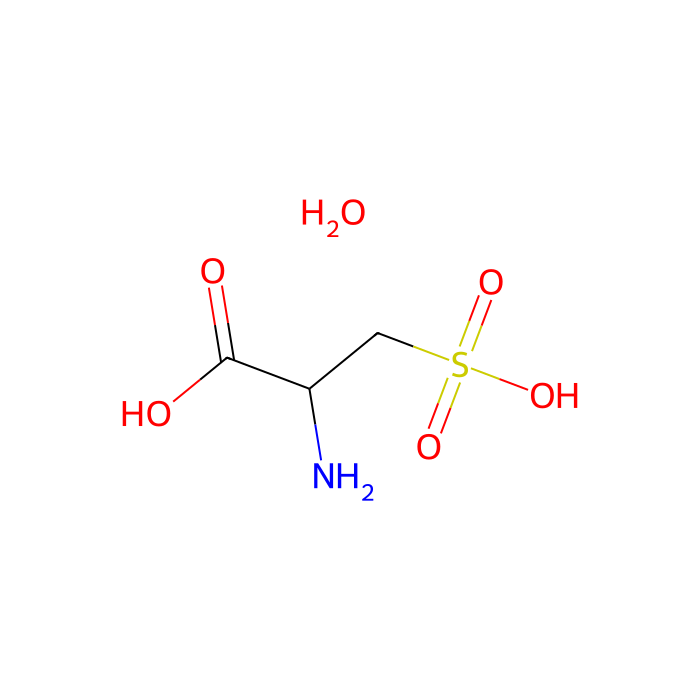
L-Cysteic acid monohydrate is the fully oxidized sulfonic-acid derivative of L-cysteine, supplied as the monohydrate.
Item-specific (from Product Data):
CAS: 23537-25-9
InChIKey (as provided): 273940 (note: atypical format; consult CoA/SDS for the canonical InChIKey)
Storage: Room temperature; Shipped: Normal; Research use only
Literature/Computed identity (non-spec, for reference):
Common name: L-Cysteic acid monohydrate (L-2-amino-3-sulfopropionic acid·H2O)
Core functional groups: α-amino acid (α-NH2 and α-CO2H), sulfonic acid (–SO3H), chiral center at Cα with L configuration (S)
2D structural description (general):
Backbone is a three-carbon amino acid: the α-carbon bears an amino group and a carboxyl group; the side chain is –CH2–SO3H (sulfonic acid). The monohydrate comprises one lattice water per molecule. The α-carbon is stereogenic and configured L (S). The molecule exists as a zwitterion over a broad pH range (protonated ammonium and deprotonated carboxylate/sulfonate depending on pH).
Synthetic Utility
Chemoselective features (general/literature):
Functional groups: α-Amino (nucleophilic), α-carboxyl (electrophilic upon activation), and sulfonic acid (strong acid, typically present as sulfonate; generally not derivatized under mild conditions).
Chirality: Single stereocenter at the α-carbon enables chiral induction/transfer in peptide and amide synthesis.
Representative transformations:
Peptide/amidation: Protect the α-amino group (Boc or Fmoc) and couple via the carboxyl using EDC/Oxyma, HATU, or DIC/HOAt analogs in water/DMF or water/DMSO mixtures. The sulfonic acid remains ionized and inert.
Salt formation/ion pairing: Formation of alkali metal salts (Na+, K+) or pairing with organic cations (e.g., TBA) to tune solubility and phase-transfer properties for specialized applications.
Side-chain stability: The –SO3H is robust to oxidation/reduction and most protecting-group manipulations, making cysteic acid a durable replacement for redox-sensitive cysteine where a permanent negative charge is desired.
Retrosynthetic value:
Serves as a terminally oxidized analogue of L-cysteine, useful in SAR where thiol/disulfide chemistry is undesirable. Incorporation into peptides can mimic acidic side chains with higher acidity than Asp/Glu, altering binding and solubility profiles (no biological efficacy claims).
Workflow notes:
Maintain pH control (≤9) during couplings to minimize racemization.
Employ water-rich solvent systems and consider in situ base (e.g., NMM, DIPEA) sparingly due to strong acidity and high ionic strength.
Target Specificity
Not applicable. This product is a small-molecule amino acid derivative, not an antibody, enzyme, or affinity reagent. No target, epitope, clone, or species reactivity information is associated with this item.
Häufig gestellte Fragen
How should this product be stored?
Store at room temperature.
How is this product shipped?
This product ships under standard ambient conditions. No temperature-controlled packaging is required.
What are the CAS number, molecular formula and molecular weight?
The CAS Number is 23537-25-9, the molecular formula is HO3SCH2CH(NH2)CO2H·H2O, and the molecular weight is 187.17 g/mol. InChIKey PCPIXZZGBZWHJO-DKWTVANSSA-N.
What documentation is provided?
Available product documentation, including Certificates of Analysis (COA), Safety Data Sheets (SDS), and specification sheets, is shown in the product document area. Document availability and access follow the current site policy.
Wir verwenden Cookies, um die ordnungsgemäße Funktion der Website sicherzustellen und, soweit zulässig, Ihr Nutzererlebnis zu verbessern. Sie können Ihre Einstellungen jederzeit unter „Einstellungen“ verwalten. Weitere Informationen finden Sie in unserer Cookie-Richtlinie.
Dürfen wir Sie über Rabattaktionen informieren?
Später erinnern
Vielen Dank! Bitte überprüfen Sie Ihren E-Mail-Posteingang, um zu bestätigen.
Products are supplied to verified businesses, institutions, and qualified professionals for research and development use only. Not for use in humans, animals, diagnosis, or therapy.

 E1821075