QUALITÄT & REINHEITAnimal Free?Animal-free — produced without animal-derived components to reduce contamination risk. Use in biomanufacturing and culture avoiding animal-origin material.BioReagent?BioReagent grade — tested suitable for life-science and molecular-biology use. Use for cell culture, assays, and biochemical work needing biological compatibility.Moligand™?Moligand™ — Aladdin's line of ligands and bioactive small molecules. Use for receptor, pathway, and binding studies needing defined small-molecule tools.for Cell culture?Cell-culture grade — low endotoxin and contaminants to support viable cell growth. Use in mammalian/other cell culture media and supplements.
L-Lysine is an amino acid with a basic side chain and is amphipathic in nature. It has a protonated alkyl amino group and is fully protonated at physiological pH. L-lysine mainly participates in electrostatic interactions in proteins.L-Lysine monohydrate has been used in:SILAC (stable isotope labeling by amino acids in cell culture) methodthe complete synthetic (C) medium for positive selection screening of yeast cellsthe growth medium for cells
L-Lysine is an essential proteinogenic α amino acid used in a wide range of applications including as a non-animal sourced supplement in cell culture media, a substrate of enzymes such as L-lysine oxidase (EC 1.4.3.14), a component of poly-lysine polymers
Storage
Room temperature
Note
Animal Free, BioReagent, für die Zellkultur, Moligand™
This compound belongs to the class of organic compounds known as l-alpha-amino acids. These are alpha amino acids which have the L-configuration of the alpha-carbon atom.
External Descriptors
Not available
1. Djoumbou Feunang Y, Eisner R, Knox C, Chepelev L, Hastings J, Owen G, Fahy E, Steinbeck C, Subramanian S, Bolton E, Greiner R, and Wishart DS. ClassyFire: Automated Chemical Classification With A Comprehensive, Computable Taxonomy. Journal of Cheminformatics, 2016, 8:61.
Determine the necessary mass, volume, or concentration for preparing a solution.
Dilution Calculator
Determine the dilution needed to prepare a stock solution.
Reconstitution Calculator
Bewertungen
Kundenbewertungen
Application Protocols
No manufacturer-validated application protocols were provided for this item.
Item-specific tested applications and recommended conditions: Not specified for this item; refer to your internal SOPs or relevant literature.
General preparation notes (literature-based guidance; not product specifications)
Prepare aqueous stock solutions (e.g., 100–1000 mM) in sterile water; adjust pH as needed with HCl/NaOH.
For sterile applications, filter through 0.22 μm and store refrigerated in aliquots to minimize contamination.
Verify compatibility with amine-reactive assays (NHS esters, aldehydes) before use.
Biological Roles
(Literature/general biochemistry context; research use only.)
Essential amino acid: L-Lysine is one of the 20 proteinogenic amino acids and must be supplied exogenously in many organisms, including mammals.
Structural role: Incorporated into proteins via ribosomal translation; its positively charged side chain promotes interactions with nucleic acids and acidic residues.
Post-translational modifications: ε-amino group is a site for acetylation, methylation, ubiquitination, and sumoylation—key in chromatin regulation and proteostasis.
Metabolism: Catabolized via the saccharopine pathway in most eukaryotes, yielding acetyl‑CoA equivalents; alternative pipecolate pathway exists in certain tissues and microbes.
Biosynthesis (microbial/plants): Produced via the diaminopimelate (DAP) pathway from aspartate semialdehyde.
Cofactor/ligand behaviors: Can coordinate metal ions through ε‑amine and carboxylate, influencing metalloenzyme function in vitro.
pH and charge state: Triprotic acid-base behavior (pKa ~2.2/9.0/10.5, literature) grants a net positive charge near neutral pH, affecting binding and solubility in biological matrices.
No clinical/medical claims are made; this product is for research use only.
Buffer Applications
While not a Good’s buffer, L-lysine can function as a practical buffering component in the alkaline range due to its ε-amine (pKa ~10.5, literature).
Effective buffering window (literature): Approximately pH 9.5–11, centered near the ε-amine pKa. Limited buffering near neutral pH compared to TRIS or HEPES.
Typical use cases
Alkaline enzyme reactions compatible with primary amines (verify enzyme tolerance).
As a co-buffer or pH adjuster in systems where bio-based, animal-component–free materials are preferred.
Preparation guidance (general; adjust to your application)
Prepare 0.1–1.0 M L-lysine solution in water. Adjust pH upward with NaOH or downward with HCl to the target pH (e.g., 50–200 mM working buffer at pH 10.0).
Filter sterilize (0.22 μm) for cell culture or sterile workflows.
Consider ionic strength; add NaCl only if compatible with the system.
Compatibility notes
Primary amines can interfere with NHS-ester labeling or aldehyde-based assays; avoid when such chemistries are planned.
Coordinate with metal-sensitive assays; lysine can weakly chelate metals, subtly altering activity.
Item-specific validated buffer protocols are not specified for this item; consult your assay requirements and perform small-scale optimization.
Green Alternatives
L-Lysine is bio-based, readily biodegradable, and water-soluble, making it a greener choice for several roles traditionally filled by petrochemical amines or chelators.
Potential substitutions (literature/general)
As a benign base/amine donor in aqueous media vs. ethylenediamine (EDA) or triethanolamine (TEA): lower toxicity and better biodegradability, albeit weaker basicity at neutral pH.
As a metal complexant vs. EDTA: more biodegradable but generally weaker, with narrower pH operating range; may be preferred in environmentally conscious processes where strong chelation is unnecessary.
As a buffer component in alkaline range vs. TRIS: lower buffering capacity near pH 8 but fully bio-derived and less temperature-dependent pKa drift near its own pKa values.
Comparison snapshot (general)
L-Lysine: Renewable, aqueous, mild chelation, limited solubility in organics.
EDTA: Strong, persistent chelator; not easily biodegradable.
TRIS: Synthetic buffer with good capacity at pH ~7–9; not bio-based.
Trade-offs: L-lysine’s buffering range is centered higher (pKaε ~10.5), and its zwitterionic nature can interact with biomolecules; validate compatibility in sensitive systems.
Pharmaceutical Uses
(General formulation/manufacturing context; no therapeutic claims.)
Roles in dosage forms (literature/general)
Counterion/base: Forms lysinate salts of acidic APIs to enhance solubility or stability.
Excipient: Functions as pH adjuster, buffering component in the alkaline range, and stabilizer for proteins via ionic interactions.
Tonicity/compatibility: May contribute to ionic strength in parenteral or ophthalmic research formulations when appropriate.
Advantages
Bio-based, biocompatible profile; widely used in bioprocess buffers and protein formulations (research/manufacturing settings).
Multiple protonation states permit fine pH adjustment without introducing non-biological buffers.
Considerations
Primary amine reactivity can lead to unintended conjugation with activated esters or carbonyl-containing excipients; assess excipient–API compatibility.
For regulated applications, pharmacopeial compliance (e.g., compendial monographs) and impurity limits must be verified per lot; item-specific compliance is not specified here.
Item-specific pharmacopeial status, endotoxin/bioburden, and impurity limits: Not specified for this item; refer to CoA/Spec Sheet.
Physical Properties
Item-specific values were not provided in the Product Data. The following are literature/general reference values for L-lysine (monohydrate where available); they are NOT product specifications.
Physical state: White to off-white crystalline solid (literature)
Melting/decomposition: Often reported to decompose >200 °C; L-lysine anhydrous ~215–225 °C dec (literature)
Solubility (literature)
Water: Freely soluble; typical reports > 100 g/L at ambient temperature
Alcohols: Slightly soluble to sparingly soluble (ethanol, methanol)
LogP (neutral form): strongly negative; compound is highly hydrophilic and typically exists as a zwitterion in water
Hygroscopicity: Amino acids can absorb moisture; monohydrate contains lattice water (literature observation)
Optical rotation (literature, aqueous): positive for L-enantiomer; magnitude varies with concentration and wavelength (consult primary sources)
Item-specific numeric specifications (e.g., exact MP, water content, metal limits, UV cutoff) are not specified for this item; refer to CoA/Spec Sheet.
What these mean in practice (general guidance; not product specifications)
Animal Free: Manufactured without animal-derived raw materials, reducing risk of adventitious animal-origin contaminants; suitable for chemically defined or animal-component–free workflows.
BioReagent: Suitable for life-science research applications; typically emphasizes chemical identity and bioresearch utility (e.g., solubility, compatibility). Exact impurity limits are product-specific and should be confirmed on the CoA.
For Cell culture: Appropriate for media preparation or supplementation in research cell culture. Cell-culture–oriented materials commonly consider bioburden and endotoxin, but specific acceptance criteria are item-specific; consult the CoA/Spec Sheet.
Moligand™: Indicates suitability as a ligand/chelating component in biochemical or coordination workflows; practical for metal-ion handling in media or assays.
Not included/Not specified for this item (consult CoA)
Exact assay/purity, bioburden/endotoxin limits, heavy metals, residual solvents, water content, UV absorbance: Not specified for this item; refer to CoA/Spec Sheet.
Practical notes
For cell culture, prepare solutions using sterile, particulate-free water; filter sterilize (e.g., 0.22 μm) if asepsis is required.
Document lot-to-lot traceability and record CoA values in regulated environments.
Reaction and Applications
Biochemical and cell culture applications (aligned with item grade)
Component of chemically defined or animal-component–free media; supports cellular metabolism as an essential amino acid (research use only).
Buffering/co-buffering capacity in alkaline range due to ε-amine (pKa ~10.5, literature); useful for maintaining pH in certain biochemical assays.
Metal ion coordination (Moligand™): ε-amine and carboxylate can chelate transition metals; can serve as a benign complexant in media or analytical workflows.
Organic/analytical chemistry uses (literature)
Chiral auxiliary/resolving agent for acids via salt formation with the ε-amine; exploit diastereomeric salt crystallization.
Schiff-base formation with aldehydes/ketones to prepare imines for further transformations (e.g., reductive amination). Aqueous or mixed aqueous conditions are often viable.
Protecting-group chemistry: Precursor to protected monomers (e.g., Boc‑Lys‑OH, Fmoc‑Lys‑Xxx) for peptide synthesis; side-chain functionalization via the ε-amine.
Crosslinking/derivatization: Reaction with activated esters (NHS esters) or acyl chlorides to form amides on the ε-amine under mild conditions.
Practical tips
Adjust pH to 8–10 to enhance nucleophilicity of the ε-amine for conjugation; for peptide couplings, standard carbodiimide/uronium reagents (EDC/HATU/HBTU) are applicable with appropriate protection strategies (literature guidance).
For metal complexation studies, control ionic strength and pH to avoid precipitation of metal hydroxides; verify complex stoichiometry by titration or spectroscopic methods.
Note: No item-specific application testing data were provided; tailor conditions to your system and consult primary literature.
Reaction Conditions
General literature guidance for transformations involving L-lysine (monohydrate). These are not product specifications.
Reductive amination (ε-amine modification)
Solvent: Water or water/MeOH, pH 7.5–9.5.
Carbonyl partner: Aldehydes preferred; use NaBH3CN (pH-controlled) or NaBH(OAc)3 in mildly acidic to neutral media.
Temperature/time: 20–40 °C, 1–16 h; monitor by LC/MS.
Amide coupling (peptide-type)
Activation: EDC/HOBt or HATU/HBTU with base (DIPEA) in DMF or aqueous-organic mixtures when groups are suitably protected.
Temperature: 0–25 °C for activation; 25–50 °C as needed.
Consider orthogonal protection to direct coupling to ε- vs α-amine.
Conditions: Aqueous buffer pH 8–10, excess carbonyl compound; may require dehydrating cosolvent or aniline catalysis; reduce in situ if stable imine is not desired.
Metal complexation studies
pH: 6–9 to balance amine protonation and metal hydrolysis.
Matrix: Buffered aqueous solutions with controlled ionic strength; characterize stoichiometry via UV–Vis, potentiometry, or NMR.
Maillard-type reactions (with reducing sugars)
Conditions: Aqueous solutions, 50–120 °C; leads to advanced glycation products—useful in model food chemistry studies.
Expected yields and rates are substrate-specific; consult primary literature for optimization in your system.
Safety and Handling
Regulatory/GHS
GHS classification, signal word, H-statements, pictograms: Not specified for this item; refer to the product SDS for authoritative safety information.
General hazards and prudent practices (literature-based, for laboratory settings)
Low inherent hazard profile typical of amino acids; avoid inhalation of dust and contact with eyes/skin.
Not flammable or self-reactive under normal conditions; does not form peroxides.
Use standard laboratory PPE: lab coat, safety glasses, disposable gloves. Handle powders in a fume hood or with local exhaust to minimize dust.
First-aid overview (consult SDS for details)
Inhalation: Move to fresh air; seek medical attention if symptoms persist.
Skin/eye contact: Rinse with water for several minutes; remove contaminated clothing; obtain medical advice if irritation develops.
Ingestion: Rinse mouth; seek medical advice if unwell.
Incompatibilities and stability (general)
Strong oxidizers may react with organic compounds; avoid contact.
Reacts with aldehydes/ketones to form Schiff bases, especially at elevated pH.
Stable at ambient temperature when kept dry and protected from contamination.
Environmental considerations
Readily biodegradable; minimize release of powders to drains or the environment. Dispose of according to institutional and local regulations.
Solvent Selection
L-Lysine monohydrate is a highly polar, zwitterionic solid. Solvent choice primarily revolves around achieving high aqueous solubility and desired protonation state.
Polarity and miscibility (literature)
Water: Freely soluble; ideal solvent for stock solutions and media preparation. Solubility increases with temperature and with acidification (e.g., slight HCl).
Alcohols (MeOH/EtOH): Low solubility; may aid in cosolvent systems but are generally suboptimal.
Aprotic organics (DMF, DMSO): Limited solubility; DMSO can dissolve small quantities but water remains preferred.
Greater solubility in acidic aqueous media (formation of lysinium salts). Near neutral to slightly basic pH, remains highly water soluble due to zwitterionic character.
When to choose water vs alternatives
Choose water or buffered aqueous systems for biological/cell culture use and for peptide-related chemistry.
Use minimal DMSO only when required for compatibility with specific assays; verify biological tolerance.
Comparison (general)
Water (pH-adjusted) vs. saline or PBS: Use simple water or defined buffers to avoid unintended ionic interactions; chloride salts (e.g., lysine·HCl) can shift pH and ionic strength.
Item-specific solvent specifications (e.g., exact solubility values) are not specified for this item; refer to CoA/Spec Sheet.
Storage and Reconstitution
Item-specific storage
Storage Conditions: Room temperature (from Product Data).
Shipped In: Not specified for this item.
Stability and handling (general)
Keep container tightly closed in a dry, well-ventilated place. Protect from moisture to maintain the defined hydration state.
Avoid prolonged exposure to elevated temperatures and humidity.
Reconstitution/preparation (general guidance; not product specifications)
Dissolve in high-purity water to the desired concentration. Gentle warming and pH adjustment (slightly acidic) can accelerate dissolution.
For cell culture or sterile workflows, filter sterilize (0.22 μm) and work aseptically. Consider preparing single-use aliquots to avoid repeated opening.
Typical working concentrations vary by application (e.g., media supplementation in the low mM range), but exact values are application-specific.
Shelf life and specifications
Item-specific shelf life, assay, water content, and impurity limits: Not specified for this item; refer to CoA/Spec Sheet.
Always consult the SDS for safe handling and the CoA for lot-specific quality attributes before use.
Structure and Identity
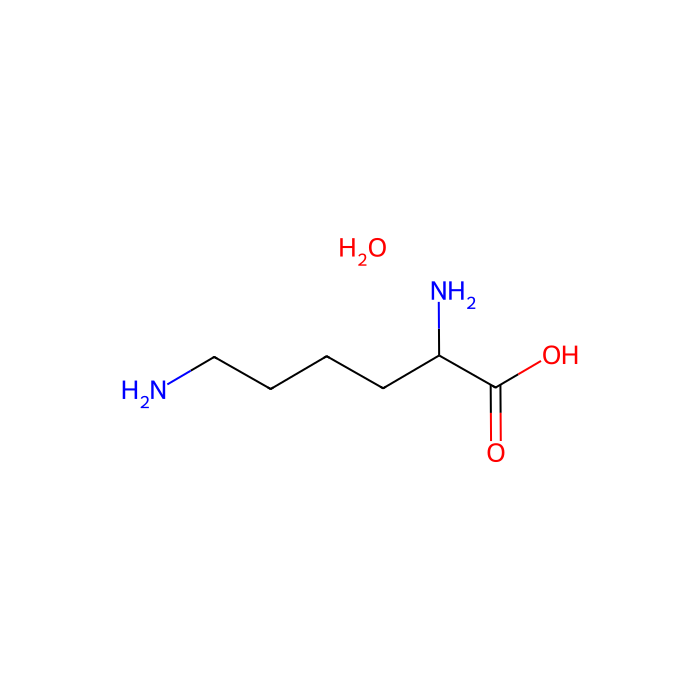
A proteinogenic, bifunctional amino acid supplied as the monohydrate. The molecule contains an α-amino acid core and a primary ε-amine on a four‑carbon side chain.
Item-specific identifiers (from Product Data)
SKU: L478519
Product Name: L-Lysine monohydrate
CAS: 39665-12-8
InChIKey (as provided): 135250
Category Path: 全部 / 可售 / 生命科学
Literature/computed identifiers and composition (for reference; not product specifications)
Common name: L-Lysine (monohydrate)
Molecular formula (monohydrate, literature): C6H14N2O2·H2O
InChIKey (L-lysine base, literature): KDXKERNSBIXSRK-YFKPBYRVSA-N (note: may differ for hydrate)
Structural features of interest
Diamine amino acid with separated nucleophilic sites (α- vs ε-amine)
Zwitterionic behavior near physiological pH due to –NH3+/–COO− pairing
Capable of metal coordination and Schiff-base formation via ε-amine
Synthetic Utility
L-Lysine monohydrate is a versatile chiral building block featuring two amines and one carboxyl group, enabling orthogonal functionalization.
Functional group reactivity (literature)
ε‑Amine: Nucleophilic substitution/acylation to give amides, ureas, carbamates; imine formation with aldehydes (reductive amination).
α‑Amino acid: Peptide coupling to form amide bonds; requires protection (e.g., Boc, Fmoc, Cbz) to control chemoselectivity.
Carboxyl: Esterification or activation (e.g., as NHS ester) for subsequent couplings.
Synthetic roles
Precursor to protected lysine monomers for SPPS (Boc‑Lys‑(Z)‑OH, Fmoc‑Lys(Boc)‑OH, etc.).
Chiral source for derivatization to lactams and heterocycles (e.g., intramolecular cyclization to yield pipecolic derivatives via appropriate protection/activation).
Organocatalytic/ligand uses: Simple diamine-carboxylate scaffold enables hydrogen-bonding/Brønsted base catalysis in water and metal coordination.
Practical guidance
Employ orthogonal protecting groups to differentiate α- vs ε-amine (Boc/Fmoc on one amine, benzyloxycarbonyl on the other); control pH to favor selective acylation.
Use water or mixed aqueous/organic media to exploit zwitterionic solubility; for anhydrous couplings, convert to protected, neutral derivatives to improve solubility in organics.
No item-specific reactivity data are provided; the above reflects literature practices.
Target Specificity
Not applicable to this product type. L-Lysine monohydrate is a small molecule reagent, not an antibody, protein, or targeted probe.
Item-specific target/epitope/clone/isotype data: Not specified for this item.
Häufig gestellte Fragen
What does Animal Free mean?
Animal Free indicates that the material has been processed and tested for specialty industrial processing. Specifications focus on the impurities that affect performance in that application — for example, metal content for electronics, particle size for batteries, refractive index for optics, or moisture content for moisture-sensitive processes.
What does BioReagent mean?
BioReagent indicates that the product has been processed and tested for biological and biochemical applications. Specifications may include endotoxin limits, microbial controls, sterility, low DNase/RNase/protease activity, and verified biological activity where relevant.
How should this product be stored?
Store at room temperature.
What are the CAS number, molecular formula and molecular weight?
The CAS Number is 39665-12-8, the molecular formula is C6H16N2O3, and the molecular weight is 164.2 g/mol. InChIKey HZRUTVAFDWTKGD-JEDNCBNOSA-N.
What documentation is provided?
Available product documentation, including Certificates of Analysis (COA), Safety Data Sheets (SDS), and specification sheets, is shown in the product document area. Document availability and access follow the current site policy.
Wir verwenden Cookies, um die ordnungsgemäße Funktion der Website sicherzustellen und, soweit zulässig, Ihr Nutzererlebnis zu verbessern. Sie können Ihre Einstellungen jederzeit unter „Einstellungen“ verwalten. Weitere Informationen finden Sie in unserer Cookie-Richtlinie.
Dürfen wir Sie über Rabattaktionen informieren?
Später erinnern
Vielen Dank! Bitte überprüfen Sie Ihren E-Mail-Posteingang, um zu bestätigen.
Products are supplied to verified businesses, institutions, and qualified professionals for research and development use only. Not for use in humans, animals, diagnosis, or therapy.

 H2309064