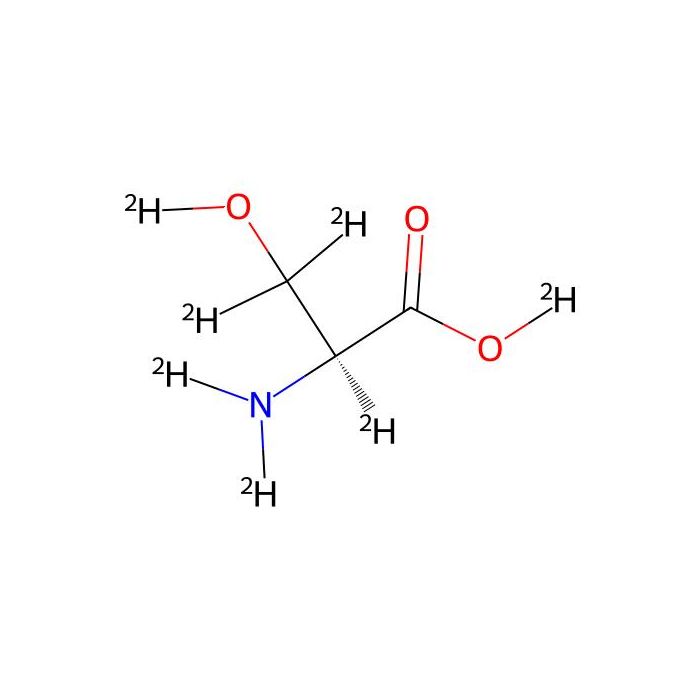
L-Serine-d 7 is the deuterium labeled L-Serine. L-Serine ((-)-Serine; (S)-Serine), one of the so-called non-essential amino acids , plays a central role in cellular proliferation.
In Vitro
Stable heavy isotopes of hydrogen, carbon, and other elements have been incorporated into drug molecules, largely as tracers for quantitation during the drug development process. Deuteration has gained attention because of its potential to affect the pharmacokinetic and metabolic profiles of drugs. MCE has not independently confirmed the accuracy of these methods. They are for reference only.
Form:Solid
Spezifikationen
Biochemische und physiologische Mechanismen
L-Serine-d 7 is the deuterium labeled L-Serine. L-Serine ((-)-Serine; (S)-Serine), one of the so-called non-essential amino acids , plays a central role in cellular proliferation.
Storage
Store at -20°C
Verschickt in
Ice chest + Ice pads
Dieses Produkt erfordert Kühlkettenversand. Grundversand und andere Economy-Optionen sind nicht verfügbar.
Zertifikate (CoA, COO, BSE/TSE und Analyse-Diagramm)
C of A & Other Certificates(BSE/TSE, COO):
Analytical Chart:
Lösungsrechner
Molarity Calculator
Determine the necessary mass, volume, or concentration for preparing a solution.
Dilution Calculator
Determine the dilution needed to prepare a stock solution.
Reconstitution Calculator
Bewertungen
Kundenbewertungen
Application Protocols
Representative research workflows using L-Serine-d7 (general guidance; adapt to your matrices and regulatory requirements):
LC–MS quantitation of serine in plasma (isotope-dilution)
Prepare a 1.00 mM stock of L-Serine-d7 in water (gravimetric; correct for KF water from CoA if available). Store aliquots at −20 °C.
Working IS: 10 µM in 95:5 H2O:MeOH with 0.1% formic acid.
Sample prep: spike 10 µL IS into 90 µL plasma, protein precipitate with 300 µL MeOH (−20 °C), vortex, centrifuge, collect supernatant, dilute 1:1 with water.
LC–MS/MS: HILIC or reversed-phase with ion-pair–free conditions; MRM transitions set for d0 and d7; quantify via peak-area ratios against a 6–8 point calibration (matrix-matched).
Metabolic flux tracing in cell culture (serine–glycine pathway)
Replace media serine with L-Serine-d7 at physiological concentration (e.g., 0.4 mM) while maintaining other nutrients.
Analyze serine/glycine isotopologues; correct for natural abundance and exchangeable deuterons.
GC–MS after derivatization (optional)
Convert to N(O,S)-derivatives (e.g., TBDMS) to enhance volatility; verify that derivatization does not induce H/D back-exchange at non-exchangeable positions.
Note: Parameters above are illustrative literature-style protocols; verify and validate for your instruments and biosafety policies.
Biological Roles
Section provides general biochemistry of serine; no clinical claims are made.
Role of serine (general/literature)
Proteinogenic amino acid incorporated by the universal genetic code (codons UCU, UCC, UCA, UCG, AGU, AGC). Contributes a nucleophilic side-chain hydroxyl to active sites and post-translational modifications (phosphorylation, O-glycosylation).
Central node in metabolism: precursor/interconvertible with glycine via serine hydroxymethyltransferase (SHMT), providing one-carbon units to the folate cycle; contributes to nucleotide biosynthesis and methylation capacity.
Lipid and membrane biology: headgroup donor for phosphatidylserine; precursor to sphingoid bases via serine palmitoyltransferase.
Redox/homeostasis: supports glutathione biosynthesis through the serine→glycine→cysteine pathway.
Relevance of deuterated serine (general)
Isotopic tracing: deuterium labeling patterns report on pathway usage, exchange with solvent, and enzymatic isotope effects.
Minimal perturbation: deuteration preserves charge and functional groups; kinetic isotope effects are small for non-rate-limiting C–H(D)/O–H(D) steps, enabling near-native behavior in many systems.
Experimental considerations
H/D exchange can occur at labile positions (e.g., hydroxyl, ammonium) in protic media; design flux experiments to account for exchangeable deuterons.
Use appropriate controls with unlabeled serine to deconvolute isotope effects from biological regulation.
Buffer Applications
L-Serine (including L-Serine-d7) is not a standard buffering agent because its acid–base functionalities (pKa ≈ 2.2 and 9.2) straddle the neutral pH range and the side-chain OH is weakly acidic (pKa ~13.6).
Applicability
Not typically used as a primary buffer in biochemical assays or chromatography.
Can contribute to overall ionic strength and act as a zwitterionic stabilizer in enzyme assays or formulations, but dedicated buffers (HEPES, Tris, phosphate, MOPS) are preferred.
Practical notes (general)
If included for biological relevance, maintain pH with a true buffer and add serine as an analyte or cosubstrate.
For LC–MS sample preparation, use volatile buffers (ammonium formate/bicarbonate) and spike L-Serine-d7 as an internal standard; do not rely on it for pH control.
Green Alternatives
Deuterated amino acids are specialty materials used when isotopic discrimination is required. “Greener alternatives” are application-dependent and typically mean avoiding isotopic labeling when not necessary, or selecting less resource-intensive solvents and workflows.
When to choose alternatives
Routine calibrations not requiring isotope dilution: unlabeled L-serine (biobased, widely available) is the greener and lower-cost option.
Solvent footprint: dissolve and handle in water or volatile, MS-compatible buffers (ammonium formate/bicarbonate) instead of nonpolar organics.
Comparative overview (general)
| Choice | Environmental/Health profile | Performance tradeoffs |
|---|---|---|
| L-Serine (unlabeled) | Lowest resource intensity; biobased; benign handling | Lacks isotopic mass shift; unsuitable for IDMS and flux tracing |
| L-Serine-d7 | Specialty, higher embodied energy from isotope production | Essential for IDMS accuracy, tracer MFA, and interference-free quantitation |
| Aqueous buffers | Nonflammable, low VOC | May require pH control for full dissolution |
| Alcohol-rich solvents | Higher VOC load | Minor solubility benefit; usually unnecessary |
Greener practice tips
Use minimal effective concentrations for internal standards; consolidate calibration curves across batches.
Favor water-only stocks and volatile buffers; avoid chlorinated solvents.
Design LC methods with shorter gradients and smaller ID columns to reduce solvent use.
Pharmaceutical Uses
For research use only. No medical or clinical uses are claimed or supported here.
General formulation context (literature/general)
Amino acids can serve as stabilizers/tonicity agents in lyophilized or liquid biopharmaceutical formulations; however, serine is less common than glycine, arginine, or histidine for this purpose.
Deuterated amino acids are rarely used as excipients; their primary role is analytical (reference standards, tracers) in development settings.
Process analytics
L-Serine-d7 may be used as an internal standard for in-process controls (IPC) and release testing methods (e.g., quantifying residual serine or monitoring media components) in R&D labs.
Regulatory considerations
For any GMP-related use, rely on the lot-specific CoA for identity, assay, impurities, and isotopic enrichment. Confirm compliance with method validation requirements (specificity, accuracy, precision) using appropriate matrix-matched calibrators.
Practical guidance
Prepare gravimetric stock solutions with correction for water content when performing isotope-dilution assays.
Document isotopic enrichment and isotopologue distribution in method files to ensure traceability across lots.
Physical Properties
Item-specific numerical specifications are not provided in the Product Data and should be taken from the item’s CoA/Spec Sheet when required for regulated workflows.
Item-specific specs
Appearance: Not specified for this item; refer to CoA/Spec Sheet.
Other physicochemical specs (mp, assay, water, metals, UV cutoff): Not specified for this item; refer to CoA/Spec Sheet.
Literature/general data for L-serine (unlabeled; deuteration does not materially change bulk properties)
Physical state: crystalline solid; zwitterionic in the solid state.
Melting point: ~222–230 °C (decomp., literature; varies with heating rate and form).
Solubility: very soluble in water; sparingly soluble in alcohols; practically insoluble in nonpolar solvents (literature).
LogP (octanol/water, literature): ~−3.1 (highly hydrophilic). LogD7.4 strongly negative due to zwitterionic form.
Isoelectric point (pI, literature): ~5.7–5.8.
Hygroscopicity: low-to-moderate tendency to absorb moisture compared with other amino acids (general observation; verify per lot).
Notes
Deuterium substitution slightly increases molar mass but has negligible effect on solubility and acid–base equilibria at typical analytical precision. Always verify lot-specific parameters on the CoA for method validation.
Quality and Grades
Item-specific quality information
Grade/Purity: Not specified for this item; refer to CoA/Spec Sheet.
Isotopic enrichment: Not specified for this item; refer to CoA/Spec Sheet. (Common market offerings for amino acid-d7 standards are often ≥97–98 atom % D, but this must be confirmed per lot.)
Residual solvents, water, metals, and other contaminants: Not specified for this item; refer to CoA/Spec Sheet.
How to interpret typical quality attributes for deuterated amino acids (general guidance)
Isotopic enrichment (atom % D): determines isotopic purity and directly impacts mass-spectrometric resolution, isotope dilution accuracy, and tracer studies. Inspect the isotopologue distribution on the CoA (e.g., d6, d5 contributions).
Chemical purity (HPLC/LC-MS): high purity minimizes background and matrix interferences; low UV background is less relevant than MS cleanliness for this class.
Enantiomeric purity (ee): L-configuration is often specified for biological studies; check optical rotation or chiral HPLC data on the CoA if your application is stereosensitive (enzymology, cell labeling).
Counterions/additives: products are typically supplied as the free acid (neutral amino acid). Any salt form or residual buffer should be disclosed on the CoA.
Water content: Karl Fischer values can influence accurate gravimetric preparation of standards. Use KF value from the CoA to correct concentration when needed.
Stabilizers
Generally none are added for solid amino acids; absence/presence should be confirmed on the CoA to avoid unknown matrix components in quantitative assays.
Reaction and Applications
As a uniformly deuterated, chiral α-amino acid, L-Serine-d7 is leveraged across analytical and mechanistic studies where isotopic discrimination is central.
Analytical and tracer applications (general)
Isotope-dilution LC–MS/LC–MS/MS: internal standard for absolute quantification of endogenous serine in biofluids and tissues; d7 provides a distinct mass shift (Δm ≈ +7 Da) with co-elution for matrix-matched calibration.
Metabolic flux analysis (MFA): tracer for mapping serine–glycine–one-carbon metabolism, de novo sphingolipid headgroup incorporation, and folate-mediated C1 flux. Deuterium retention/loss patterns report on specific enzymatic steps.
NMR: deuterium labeling reduces proton background and can be used in 2H NMR tracing; residual 1H signals enable 1H-observed experiments when mixed-label strategies are used.
Chemical/biochemical transformations (general)
Peptide synthesis: incorporation of L-Ser-d7 residues for site-specific isotope labels in peptides/proteins; useful for MS-based turnover and proteolysis studies.
Derivatization for separations: formation of O-silyl/O-acyl derivatives enhances volatility for GC–MS or improves chromatographic behavior.
Practical tips
Prepare gravimetrically in water or aqueous-organic; correct for measured water content per CoA for quantitative work.
For cell-free enzyme assays, verify that deuterium kinetic isotope effects do not confound turnover rates if the labeled position participates in the rate-limiting step.
Track isotopologue distributions (d0–d7) in data processing to account for natural abundance and any H/D exchange during workup.
Reaction Conditions
General guidance for common manipulations of L-Serine-d7 and its derivatives (literature-based; adapt to your substrate and scale):
Dissolution and stock preparation
Water or aqueous buffer, 1–100 mM typical. Gentle warming (25–40 °C) and sonication speed dissolution. Adjust pH 7.5–9.0 with NH4OH for rapid wetting; avoid strong base if maintaining deuterium at exchangeable sites is critical.
Peptide coupling (solution or SPPS)
Activation: HATU (1.0–1.2 equiv) or EDC·HCl (1.2–1.5 equiv) with HOAt/HOBt (caution per safety) or OxymaPure, in DMF/NMP with DIPEA (2–4 equiv), 0–25 °C, 0.5–4 h.
Protecting groups: Fmoc strategy with side-chain protection (e.g., benzyl ether) to preserve the hydroxyl; tBu-based protection also common. Monitor for H/D exchange under acidic TFA cleavages—exchange is limited primarily to labile sites.
O-Derivatization for GC–MS
Silylation: BSTFA + 1% TMCS, 60–70 °C, 15–60 min, typically after conversion to the methyl ester and N-trifluoroacetylation to improve volatility.
Phosphorylation (model conditions)
POCl3 or phosphoramidite chemistry under base (e.g., pyridine, Et3N) at 0–25 °C, followed by hydrolysis; protect α-amine/carboxylate to avoid side reactions.
Verification of isotopic integrity
Analyze by LC–HRMS to quantify d0–d7 envelopes pre/post reaction. Avoid prolonged exposure to protic acids/bases at elevated temperature to minimize H/D exchange.
Note: The above are literature-style conditions intended as starting points; optimize stoichiometry and timing for your system.
Safety and Handling
Item-specific GHS classification
Signal word: Not specified for this item; refer to SDS.
H-statements: Not specified for this item; refer to SDS.
Pictograms: Not specified for this item; refer to SDS.
General safety guidance for amino acid solids (literature/general)
Expected hazards: low acute toxicity profile typical of amino acids; primary risks are dust generation and nuisance particulates. Avoid inhalation and contact with eyes/skin.
PPE: laboratory coat, safety glasses, appropriate gloves (nitrile recommended). Use a dust mask/respirator if handling large quantities or generating aerosols.
Handling: weigh in a clean, dry area; minimize electrostatic dust. Use dedicated spatulas to prevent cross-contamination when preparing internal standards.
Incompatibilities: strong oxidizers may react with organic materials. Avoid mixing with strong mineral acids/bases in the dry state.
First aid (overview; consult SDS): rinse eyes with water for ≥15 minutes if contacted; wash skin with soap/water; move to fresh air if dust is inhaled; seek medical attention if symptoms persist.
Spills & waste: collect solids by gentle sweeping or HEPA vacuum; avoid water that could create slippery surfaces. Dispose of according to institutional and local regulations for nonhazardous laboratory chemicals unless SDS indicates otherwise.
Storage and stability (item-specific + general)
Store at −20 °C as specified; keep tightly closed in original container. Protect from moisture. Warm to room temperature in a desiccator before opening to prevent condensation.
Shelf life: verify on CoA; isotopic enrichment is typically stable when stored dry and cold.
Solvent Selection
L-Serine-d7 is a highly polar, zwitterionic solid; solvent choice is governed by hydrogen bonding and acid–base speciation.
Polarity and miscibility (general/literature)
Best solvents: water and aqueous buffers across pH 2–10 (high solubility). Heating (25–60 °C) can accelerate dissolution.
Limited solubility: lower alcohols (MeOH, EtOH) — modest to low; may improve with small amounts of water.
LC–MS internal standards: prepare primary stock in water or water:MeOH (≥80:20) to aid wetting; adjust pH slightly basic (pH 8–9 with NH4OH) for rapid dissolution if needed.
Enzymology/cell-free systems: use physiological buffers (e.g., 10–100 mM HEPES, PBS), considering ionic strength and pH near neutrality to maintain the zwitterion.
Derivatization workflows (GC–MS): dissolve in water, then derivatize (e.g., silylation) to increase volatility; extract into organic phase post-derivatization.
Brief comparison (general)
Water vs MeOH: Water gives rapid, complete dissolution and preserves zwitterionic form; MeOH may require sonication and leads to slower dissolution.
Aqueous NH4HCO3 or formate buffers are MS-friendly and volatile for LC–MS assays.
Note: Verify sample compatibility with downstream instrumentation and use LC–MS–grade reagents to minimize background signals.
Storage and Reconstitution
Item-specific storage and shipping
Storage Conditions: Store at −20 °C (per Product Data).
In-use handling (general best practices for amino acids and isotopically labeled standards)
Keep container tightly closed; allow to equilibrate to room temperature in a desiccator before opening to prevent condensation.
Protect from moisture. Reseal promptly after use; consider secondary containment with desiccant.
Reconstitution
Solvent: water or aqueous buffers are preferred. Initial concentration 1–100 mM depending on application.
Technique: add solvent gradually with gentle vortexing/sonication; mild warming (≤40 °C) aids dissolution.
pH: near neutral to slightly basic (pH 7–9) can accelerate dissolution; avoid strong acids/bases if preserving deuterium at exchangeable sites is critical.
Aliquoting and stability
Prepare single-use aliquots to avoid repeated freeze–thaw. Store solutions at −20 °C (short term: 4 °C for several days; verify by LC–MS for critical assays).
Light sensitivity: not notably photosensitive; store protected from light as a general precaution.
Documentation
Record preparation date, exact concentration (gravimetric, KF-corrected if available), and isotopic enrichment from the CoA for traceability.
Always consult the lot-specific CoA and SDS for authoritative guidance on stability and safe handling.
Structure and Identity
A stable-isotope–labeled essential research amino acid standard. L-Serine-d7 is the uniformly deuterated analogue of the proteinogenic amino acid L-serine, used widely as an internal standard and tracer in metabolomics and mechanistic biochemistry.
Item-specific (from Product Data)
SKU: L648350
CAS: 935275-35-7
Storage: Store at -20°C
Shipped in: Ice chest + Ice pads
Research Use: For research use only
Molecular formula: Not specified for this item; refer to CoA/Spec Sheet.
Molecular weight: Not specified for this item; refer to CoA/Spec Sheet.
SMILES: Not specified for this item; refer to CoA/Spec Sheet.
InChIKey: Not specified for this item; refer to CoA/Spec Sheet.
Literature/computed identity (for L-Serine-d7; for reference only)
Isotopic description: L-serine with seven protium atoms replaced by deuterium (d7), retaining L-configuration at Cα.
Approximate average molar mass: ~112.13 g/mol (computed from d7 isotopic substitution)
Core scaffold: α-amino acid backbone — a chiral α-carbon bearing: (i) amino group (–NH2/–ND2 isotopic analogue), (ii) hydroxymethyl side chain (–CH2OH/–CD2OD), and (iii) carboxylate (–CO2H).
2D structural description (general)
Backbone: HOOC–C*(H/D)(NH2/ND2)–CH2OH/CD2OD with defined L stereochemistry at the α-carbon (S configuration by CIP). The side chain is a primary alcohol (serine). The molecule is zwitterionic near neutral pH (–NH3+/–ND3+ and –COO–).
Synthetic Utility
L-Serine-d7 combines the reactivity of a chiral α-amino acid with an embedded isotopic label, enabling synthesis of deuterium-labeled building blocks, peptides, and small molecules.
Functional-group handles (general)
α-Amino and α-carboxyl groups: amenable to peptide coupling (HATU/HBTU/EDC-based activation) to introduce labeled residues into peptides/proteins.
Side-chain hydroxyl (primary alcohol): convertible to halides (e.g., via TsCl then displacement), esters, phosphates, or protected as benzyl/tert-butyl silyl ethers.
Named/typical transformations (general)
Peptide synthesis: Fmoc/tBu or Boc strategies using protected L-Ser(d7) derivatives (e.g., Fmoc-Ser(OBn)-d7-OH) to retain the isotopic label through SPPS.
O-derivatization: phosphorylation to generate labeled phosphoserine analogues; acylation/silylation for GC–MS derivatization.
Chiral pool strategy: exploit the L-configuration for asymmetric induction/transmission of chirality in downstream targets while carrying deuterium labels for mechanistic studies.
Use cases
Synthesis of site-specifically deuterated peptides to probe fragmentation pathways in tandem MS.
Preparation of labeled small molecules where serine serves as a precursor (e.g., β-hydroxy amino derivatives), enabling kinetic isotope effect or tracer analysis.
Practical notes
Protect exchangeable positions when necessary to minimize H/D loss during acidic/basic steps.
Verify isotopic integrity by HRMS and, when relevant, 2H NMR after key steps.
Target Specificity
Not applicable. This product is a small-molecule amino acid standard, not a biologic or affinity reagent. No antigen/epitope/clone/isotype information applies.
Häufig gestellte Fragen
How should this product be stored?
Store at ?20 °C. Freezer storage is required to maintain the specified shelf life.
How is this product shipped?
This product ships in an insulated container with ice pads. Unpack on arrival and transfer it to the storage condition stated above.
What are the CAS number, molecular formula and molecular weight?
The CAS Number is 935275-35-7, the molecular formula is C3D7NO3, and the molecular weight is 112.14 g/mol.
What documentation is provided?
Available product documentation, including Certificates of Analysis (COA), Safety Data Sheets (SDS), and specification sheets, is shown in the product document area. Document availability and access follow the current site policy.
Wir verwenden Cookies, um die ordnungsgemäße Funktion der Website sicherzustellen und, soweit zulässig, Ihr Nutzererlebnis zu verbessern. Sie können Ihre Einstellungen jederzeit unter „Einstellungen“ verwalten. Weitere Informationen finden Sie in unserer Cookie-Richtlinie.
Dürfen wir Sie über Rabattaktionen informieren?
Später erinnern
Vielen Dank! Bitte überprüfen Sie Ihren E-Mail-Posteingang, um zu bestätigen.
Products are supplied to verified businesses, institutions, and qualified professionals for research and development use only. Not for use in humans, animals, diagnosis, or therapy.