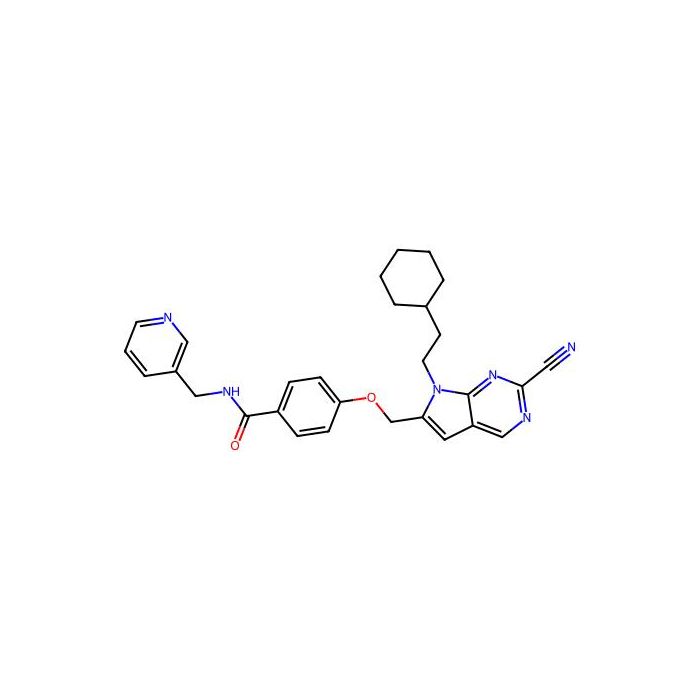
LB-60-OF61 is a NAMPT inhibitor and is a cytotoxic compound with a selectivity towards MYC overexpressing cell lines
In Vitro
LB-60-OF61 is potent against HCT116 cells with an IC 50 around 30 nM as measured in a 384 well format. MCE has not independently confirmed the accuracy of these methods. They are for reference only.
IC50& Target:NAMPT
Spezifikationen
Spezifikationen & Reinheit
10mM in DMSO
Biochemische und physiologische Mechanismen
LB-60-OF61 is a NAMPT inhibitor and is a cytotoxic compound with a selectivity towards MYC overexpressing cell lines.
Storage
Store at -80°C
Verschickt in
Dry ice packs + Cold packs
Dieses Produkt erfordert Kühlkettenversand. Grundversand und andere Economy-Optionen sind nicht verfügbar.
Aktionsart
INHIBITOR
Namen und Kennungen
PubChem CID
134692422
Molekulargewicht
494.59
Erweiterte Daten
Zertifikate (CoA, COO, BSE/TSE und Analyse-Diagramm)
C of A & Other Certificates(BSE/TSE, COO):
Analytical Chart:
Lösungsrechner
Molarity Calculator
Determine the necessary mass, volume, or concentration for preparing a solution.
Dilution Calculator
Determine the dilution needed to prepare a stock solution.
Reconstitution Calculator
Bewertungen
Kundenbewertungen
Application Protocols
No validated application protocols are provided for LB-60-OF61 in the Product Data.
General HTS/assay protocol template (not item-specific)
Prepare a 10–50 mM DMSO stock. Confirm clear solution visually; warm (≤40 °C) and sonicate if needed.
Create serial dilutions in DMSO to achieve desired top concentrations; backfill plate wells with DMSO to maintain uniform vehicle.
Transfer to assay plates (acoustic or pin tools recommended for low volumes). Dilute into assay buffer to reach final test concentrations with consistent DMSO % across all wells.
Include controls: vehicle-only, assay positive controls, and assay-interference controls (detergent sensitivity, redox/fluorescence counterscreens as applicable).
Read endpoints per assay type and analyze with appropriate models (4PL/variable slope). Reconfirm hits in independent runs.
Item-specific parameters (concentration ranges, incubation times, readouts) are not specified for this item and must be defined by the end user.
Biological Roles
No biological function, target, or pathway assignment is provided for LB-60-OF61 in the Product Data. As a small-molecule library member, it is supplied for exploratory research only.
General context (not item-specific)
Library compounds are commonly used to probe biochemical or cellular systems for measurable responses (enzyme inhibition/activation, reporter activity, morphological changes) without prior knowledge of a target.
Any observed biological effect should be validated through orthogonal assays, concentration–response analysis, and counter-screens to rule out assay interference (fluorescence quenching, redox cycling, colloidal aggregation).
Follow-up studies typically include mechanism-of-action workups (thermal shift assays, CETSA, target engagement by MS) and preliminary ADME characterization if progression is intended.
Caution
Do not infer biological roles or activities for LB-60-OF61 without experimental evidence. All use is strictly for research use only.
Buffer Applications
LB-60-OF61 is not a buffering reagent. No pKa or buffering capacity data are provided for this item.
Practical guidance for assay buffers (general; not item-specific)
Prepare primary stocks in DMSO, then dilute into a validated assay buffer (e.g., PBS, HEPES, Tris) compatible with your biological system and readout.
Maintain consistent vehicle concentration (e.g., 0.1–1.0% DMSO) across controls and treated wells.
Consider adding 0.01–0.05% nonionic surfactant for hydrophobic compounds to reduce nonspecific adsorption and aggregation, ensuring no interference with the assay.
Filter buffers (0.22 µm) and degas if required by the readout (e.g., SPR, ITC).
Item-specific buffer parameters
pKa values, optimal pH ranges, buffer recipes: Not applicable/not specified for this item; refer to your assay requirements.
Green Alternatives
While LB-60-OF61 is a discrete small molecule (not a solvent), greener choices can be made in its handling and use, particularly for dissolution, assay preparation, and any synthetic follow-up.
Greener handling choices (general guidance; not item-specific)
Prefer aqueous buffers with minimal organic cosolvent at the point of use; keep final DMSO ≤0.5–1.0% v/v where assay-compatible.
When screening solubility, prioritize ethanol (biobased option) over DMF/DMAC/NMP when performance allows.
Use microscale operations (µL–mL) and sealed plates to reduce solvent consumption and emissions.
Illustrative comparison (general)
DMSO: benchmark solvency, low volatility; not readily biodegradable; minimize volumes and ensure proper waste handling.
PEG-400: low vapor pressure, low flammability; viscous and may impede diffusion in some assays.
Operational sustainability
Consolidate shipping with other cold-chain materials; promptly transfer to −80 °C to avoid waste from temperature excursions.
Adopt just-in-time aliquoting to reduce repeat freeze–thaw cycles and discarded residues.
Note
No item-specific life-cycle or hazard metrics are provided; consult your EHS group for solvent selection policies (CHEM21/ACS GCI guidance).
Pharmaceutical Uses
No pharmacopeial status, excipient role, or formulation utility is provided for LB-60-OF61. This product is supplied strictly for laboratory research use and is not intended for human or veterinary use.
General discovery context (not item-specific)
Small-molecule library members may serve as screening hits or chemical starting points in early-stage discovery workflows. Any transition toward development requires expansive characterization (purity, identity, stability, polymorph/salt form, synthetic route, and comprehensive safety testing).
If progression is contemplated, evaluate solid-state properties (DSC/TGA, XRPD), solution stability, and impurity profiles under ICH-like conditions during feasibility studies.
Item-specific statement
Pharmaceutical/clinical usage: Not specified for this item; none implied. For research use only.
Physical Properties
Item-specific physical constants are not disclosed in this listing. Where quantitative values are required for method development, consult the CoA/Spec Sheet or determine experimentally on a micro-scale.
Item-specific (from Product Data)
Appearance: Not specified for this item; refer to CoA/Spec Sheet.
Molecular Weight: Not specified for this item; refer to CoA/Spec Sheet.
Commonly referenced properties (literature/general guidance; NOT item-specific)
Library members are often provided as solids or viscous oils; actual physical state for LB-60-OF61 is not specified.
Solubility screening approach (general):
Start with anhydrous DMSO to prepare 10–50 mM primary stocks.
If limited solubility is observed, warm gently (≤40 °C), sonicate briefly, or add co-solvents (e.g., DMF, ethanol) before final aqueous dilution.
Keep final assay DMSO ≤0.5–1.0% v/v unless your assay tolerates higher.
Other constants such as bp/mp, logP/logD, pKa, refractive index, density, UV–vis λmax are structure-dependent and not available here.
Recommendations
Verify solubility and stability in your exact assay buffer (pH, salts, cofactors) by a small trial at working concentration.
For analytical characterization, LC–MS (ESI±), 1H NMR, and HPLC/UPLC purity profiling are typical; consult the CoA for any item-specific results.
Quality and Grades
Item-specific grade and purity are not provided in this listing.
Item-specific statement
Grade/Purity: Not specified for this item; refer to CoA/Spec Sheet.
How to interpret grades (general guidance; not item-specific)
Screening/Library grade: Typically suitable for discovery biology and phenotypic/biochemical assays. Purity is often reported by HPLC/UPLC (e.g., area %), with identity by MS and/or NMR; exact thresholds vary by supplier and batch.
Analytical (AR)/HPLC grade (solvents): Low residue and low UV background—relevant when preparing low-µM stocks for optical assays.
What to check on the CoA (recommended)
Purity method and threshold (e.g., UPLC area %, orthogonal methods if available).
Identity confirmation (MS, 1H NMR; sometimes 13C NMR/HRMS).
Water content/residual solvents (KF/GC) if your assay is moisture sensitive.
Salt form and counterions, which can affect solubility and apparent potency.
Stability notes (light/air/moisture) and any added stabilizers.
Practical tips
Upon receipt, record lot/batch, attach CoA to ELN, and, if critical, perform in-house verification (LC–MS purity, concentration by UV/evaporation gravimetry) before large screens.
Reaction and Applications
This item is positioned as a small-molecule library member rather than a synthetic reagent. Accordingly, its most relevant applications are in discovery screening and chemical biology workflows.
Discovery applications (general guidance; not item-specific)
High-throughput screening (HTS)/medium-throughput screens: Prepare plate maps, DMSO stocks (10–50 mM), and serial dilutions for single-point and dose–response testing.
Assay development: Use as part of a chemically diverse panel to probe assay dynamic range and identify potential interferences (fluorescence quenchers, redox activity, aggregation).
Hit triage & SAR-by-catalog: Reconfirm primary hits, perform orthogonal assays, and procure analogs to explore preliminary structure–activity trends.
Chemoproteomics/phenotypic profiling: If activity is observed, follow up with target deconvolution (thermal shift, pull-downs) using derivatized probes of related chemotypes.
Practical considerations
Control for vehicle effects (DMSO %, pH, ionic strength) and colloidal aggregation (0.01–0.05% nonionic surfactant; detergent-sensitive counterscreens).
Assess compound stability (freeze–thaw tolerance, light/air sensitivity) via LC–MS before large screens.
Implement plate handling best practices: backfilling with DMSO to minimize edge effects, humidified incubation to reduce evaporation, and randomized layouts to mitigate positional bias.
Note
No item-specific biological target, activity, or reactivity information is provided for LB-60-OF61 in the Product Data.
Reaction Conditions
This product is not provided as a reagent for performing specific named reactions, and no structure or reactivity information is disclosed.
Item-specific statement
Recommended reaction conditions: Not applicable/not specified for this item; refer to CoA/Spec Sheet if later provided.
General advice (not item-specific)
For any exploratory chemistry involving an unknown scaffold, begin with small-scale (≤10 mg) reactions and comprehensive analytics (LC–MS, NMR) to map stability under basic/acidic, oxidative/reductive, and thermal conditions.
If attaching tags/handles (biotin/alkyne/azide) for chemoproteomics, employ mild conditions first (amide coupling, click chemistry) after confirming the presence of suitable functional groups.
Because no structural details are available here, specific temperatures, catalysts, or yields cannot be recommended.
Safety and Handling
Safety information specific to this item is not included in the listing and may be provided in the SDS. Always treat unknown small molecules as potentially hazardous.
Item-specific data from Product Data
GHS Classification: Not specified for this item; refer to SDS.
Signal Word: Not specified for this item; refer to SDS.
H-Statements/Pictograms: Not specified for this item; refer to SDS.
Storage Conditions: Store at −80 °C.
Shipped In:Dry ice packs + Cold packs.
General laboratory guidance (not item-specific; defer to SDS)
PPE: Lab coat, safety glasses, and disposable nitrile gloves; use additional protection if aerosol or dust generation is possible.
Engineering controls: Handle powders/unknowns in a fume hood or ventilated enclosure. Avoid inhalation, ingestion, or skin contact.
Handling: Minimize freeze–thaw cycles; work from aliquots. Allow vials to equilibrate to room temperature in a desiccator before opening to prevent moisture condensation.
Hygiene: Wash hands after handling. Keep containers tightly closed. Avoid cross-contamination of screening plates.
Incompatibilities: Unknown for this item; as a precaution, segregate from strong oxidizers/reductants and acids/bases until compatibility is known.
First aid (overview): In case of skin/eye contact, rinse with water for ≥15 min; if inhaled, move to fresh air; if ingested, seek medical attention. Provide SDS to responders.
Waste
Dispose of solutions and consumables as organic chemical waste per institutional and local regulations.
Solvent Selection
Because the structure is undisclosed here, select solvents empirically with a preference for assay-compatible, low-toxicity choices.
General strategy for small-molecule library members (not item-specific)
Primary stock solvent: Anhydrous DMSO is the default due to broad solvency, low volatility, and assay compatibility.
Alternative co-solvents:DMF, ethanol, or PEG-400 can assist dissolution; verify assay tolerance.
Aqueous dilution: Dilute DMSO stocks into assay buffer (e.g., PBS, HEPES) to reach the working concentration while keeping final DMSO low (≤0.5–1.0% v/v, assay-dependent).
Surfactants: For hydrophobic compounds, 0.01–0.05% nonionic surfactants (e.g., Tween 20, Pluronic F-68) may help maintain dispersion; confirm no assay interference.
Quick comparison (general; choose per assay)
DMSO: strongest, widely tolerated; hygroscopic.
Ethanol: volatile, often tolerated ≤1–2% v/v; may affect cells.
DMF: strong solvency; use sparingly due to cytotoxicity.
PEG-400: good for very lipophilic compounds; viscous; diffusion-limited in some assays.
Practical tips
Warm (≤40 °C) and sonicate briefly to aid dissolution. Filter through 0.2 µm PTFE if particulates persist.
Document final vehicle composition (DMSO %, surfactant, pH, ionic strength) for reproducibility.
Shipped In:Dry ice packs + Cold packs to maintain the frozen/cold chain.
Additional practical guidance (general; not item-specific)
Upon receipt, verify package integrity and log the temperature if monitored. Transfer immediately to −80 °C.
If supplied as a solid: equilibrate the sealed vial to room temperature in a desiccator, then open to avoid moisture condensation.
If supplied as a solution: keep frozen; thaw on ice, mix gently, and promptly aliquot into single-use portions to minimize freeze–thaw.
Reconstitution (typical for library compounds):
Dissolve in anhydrous DMSO to make a concentrated stock (e.g., 10–50 mM), warming (≤40 °C) and sonicating briefly if necessary.
If aqueous stocks are required, dilute the DMSO solution into buffer immediately before use; avoid prolonged storage of aqueous solutions unless stability is verified.
Light/air sensitivity: Not specified for this item; as a precaution, protect from light and purge headspace with inert gas if long-term storage in solution is necessary.
Stability and documentation
Shelf life and retest date: Not specified for this item; refer to CoA/Spec Sheet.
Record lot number, concentration, and date of preparation on all aliquots for full traceability.
Research Use Note
For research use only. Not for human or veterinary use.
Structure and Identity
Brief overview: LB-60-OF61 (SKU: L655653) is a cataloged small-molecule library member supplied for research screening and discovery workflows.
Product Name: LB-60-OF61
SKU: L655653
CAS: 794461-93-1
PubChem CID: 134692422
Molecular Formula: Not specified for this item; refer to CoA/Spec Sheet.
Molecular Weight: Not specified for this item; refer to CoA/Spec Sheet.
SMILES: Not specified for this item; refer to CoA/Spec Sheet.
InChIKey: Not specified for this item; refer to CoA/Spec Sheet.
Structural description
Item-specific structural features (functional groups, ring systems, stereochemistry) are not disclosed in this listing. Consult the Certificate of Analysis (CoA) or Spec Sheet for definitive identifiers and spectral confirmation (e.g., LC–MS, NMR) if provided.
This positions LB-60-OF61 as a screening entity rather than a purpose-designed reagent or building block. Where structure-dependent guidance is needed (e.g., solubility or pKa), see the item’s CoA/Spec Sheet or perform a small-scale pretest.
Notes
If you maintain internal registration systems, index the compound by CAS 794461-93-1 and your own ELN/batch ID to ensure traceability with plate maps and screening records.
Synthetic Utility
LB-60-OF61 is listed as a screening compound from a small-molecule library; no functional-group description or reactive handles are provided.
Item-specific statement
Synthetic role: Not specified for this item; refer to CoA/Spec Sheet if functional groups are disclosed.
General guidance (not item-specific)
If used as a reference or internal standard, confirm chemical stability in the chosen matrix (organic solvent, buffer) and monitor by LC–MS over time.
If structural information becomes available and derivatization is desired (e.g., for probe synthesis), map potential sites of modification and evaluate protecting group strategies consistent with the core scaffold.
Note
In the absence of structural data, no named-reaction or retrosynthetic guidance can be responsibly provided.
Target Specificity
No target, pathway, or selectivity profile is provided for LB-60-OF61 in the Product Data.
Item-specific statement
Target/epitope/clone/species reactivity: Not applicable to this small-molecule product and not specified.
Guidance (general; not item-specific)
If activity is observed in screening, establish on-target engagement using orthogonal assays (biochemical vs cellular), counter-screens against close homologs, and selectivity panels to quantify specificity and off-targets.
Employ concentration–response testing and include appropriate vehicle and positive controls to contextualize potency and efficacy metrics.
Häufig gestellte Fragen
How should this product be stored?
Store at ?80 °C. Ultra-low temperature storage is required to maintain the specified shelf life.
How is this product shipped?
This product ships frozen with dry ice and cold packs. Unpack on arrival and transfer it to the storage condition stated above; handle dry ice with insulated gloves in a ventilated area.
What are the CAS number, molecular formula and molecular weight?
The CAS Number is 794461-93-1, the molecular formula is C29H30N6O2, and the molecular weight is 494.59 g/mol.
What documentation is provided?
Available product documentation, including Certificates of Analysis (COA), Safety Data Sheets (SDS), and specification sheets, is shown in the product document area. Document availability and access follow the current site policy.
Wir verwenden Cookies, um die ordnungsgemäße Funktion der Website sicherzustellen und, soweit zulässig, Ihr Nutzererlebnis zu verbessern. Sie können Ihre Einstellungen jederzeit unter „Einstellungen“ verwalten. Weitere Informationen finden Sie in unserer Cookie-Richtlinie.
Dürfen wir Sie über Rabattaktionen informieren?
Später erinnern
Vielen Dank! Bitte überprüfen Sie Ihren E-Mail-Posteingang, um zu bestätigen.
Products are supplied to verified businesses, institutions, and qualified professionals for research and development use only. Not for use in humans, animals, diagnosis, or therapy.