LDC4297 hydrochloride - ≥98% , CAS No.2319747-14-1

CAS: 2319747-14-1 Cat. No.: L647740 Summenformel: C23H29ClN8O Molekulargewicht: 468.98
Zu bestellen verfügbar
QUALITÄT & REINHEIT ≥98%
Storage
Store at 2-8°C,Protected from light,Desiccated
Shipped In
Wet ice
★
Größe
Deutschland (EU)
USA*
Preis
Menge
5mg
L647740-5mg
Auf Bestellung · 8–12 Wochen
148,30€
10mg
L647740-10mg
Auf Bestellung · 8–12 Wochen
250,69€
25mg
L647740-25mg
Auf Bestellung · 8–12 Wochen
521,42€
50mg
L647740-50mg
Auf Bestellung · 8–12 Wochen
868,52€
100mg
L647740-100mg
Auf Bestellung · 8–12 Wochen
1.475,94€
Enter a quantity for the sizes you want to add.

Übersicht

LDC4297 hydrochloride is a selective inhibitor of CDK7 with an IC 50 value of 0.13 nM. LDC4297 hydrochloride inhibits human cytomegalovirus (HCMV) replication with an EC 50 value of 24.5 nM. LDC4297 hydrochloride shows broad antiviral activities to Herpesviridae , Adenoviridae , Poxviridae , Retroviridae and Orthomyxoviridae with EC 50 values of 0.02-1.21 μM. LDC4297 hydrochloride can be used for the research of infection

In Vitro

LDC4297 hydrochloride (0-10 μM; 6 d) dose-dependently inhibits HCMV replication with an EC 50 value of 24.5 nM. LDC4297 hydrochloride (0-10 μM; 4 d) shows anti-proliferative activity to primary cultures of fibroblasts derived from human (HFF) with a GI 50 value of 4.5 μM. LDC4297 hydrochloride (20 μM; 12-96 h) shows anti-HCMV activity through a multifaceted mode of action that involves an interference with virus-induced Rb phosphorylation. LDC4297 hydrochloride (0-10 μM; 7 d) shows broad antiviral activities to HCMV, GPCMV, MCMV, HVV-6A, HSV-1, HSV-2, VZV, EBV, HAdV-2, Vaccinia virus, HIV-1 (nl4-3), HIV-1 (4LIG7) and Influenza A virus with EC 50 values of 0.02, 0.05, 0.07, 0.04, 0.02, 0.27, 0.06, 1.21, 0.25, 0.77, 1.04, 1.13 and 0.99 μM, respectively. MCE has not independently confirmed the accuracy of these methods. They are for reference only. Western Blot AnalysisCell Line: Primary cultures of fibroblasts derived from human (HFF) with virus infection Concentration: 20 μM Incubation Time: 12, 24, 48 and 96 hours Result: Showed inhibitory effect towards viral protein synthesis at the stage of immediate early (IE) gene expression and the drug-mediated reduction of IE1p72 levels partially recovered over time. Exerted an inhibitory effect on human cytomegalovirus (HCMV) induced an up-regulation of protein expression or protein phosphorylation, and reduced Rb expression in the uninfected control cells at 24 h.

In Vivo

LDC4297 hydrochloride (100 mg/kg; p.o. once) shows promising pharmacokinetic analyses . MCE has not independently confirmed the accuracy of these methods. They are for reference only. Animal Model: CD1 mice Dosage: 100 mg/kg Administration: Oral gavage; 100 mg/kg once Result: Showed a half-life (t1/2z) of 1.6 h, and the time to a mean peak plasma concentration of 1297.6 ng/mL is reached 0.5 h after administration with a continued presence in plasma for at least 8 h and a bioavailability of 97.7%.

Form:Solid

IC50& Target:CDK7 0.13 nM (IC 50 ) 166v VP22-GFP 0.02 μM (EC 50 ) 01-6332 0.27 μM (EC 50 ) HIV-1 (NL4.3 strain) 1.04 μM (EC 50 ) 4LIG7 1.13 μM (EC 50 )

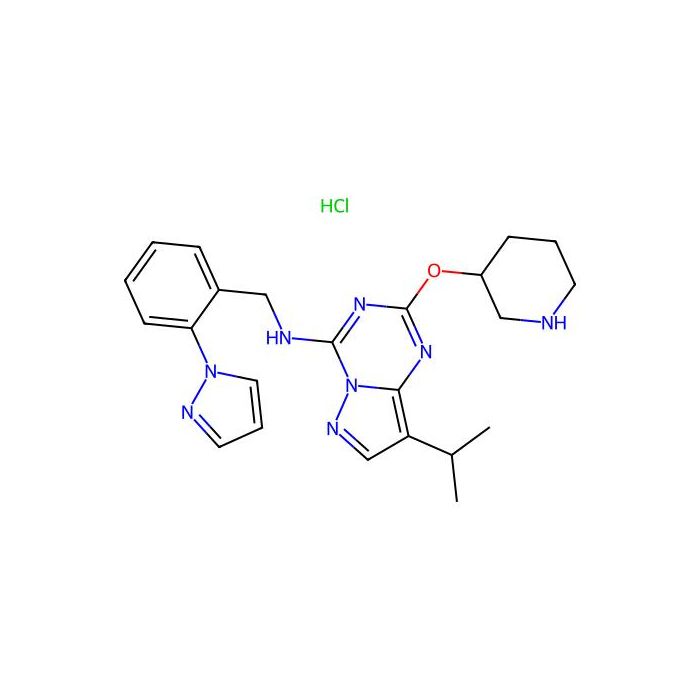
Spezifikationen

Spezifikationen & Reinheit
≥98%
Biochemische und physiologische Mechanismen
LDC4297 hydrochloride is a selective inhibitor of CDK7 with an IC 50 value of 0.13 nM. LDC4297 hydrochloride inhibits human cytomegalovirus (HCMV) replication with an EC 50 value of 24.5 nM. LDC4297 hydrochloride shows broad antiviral activities to Herpes
Storage
Store at 2-8°C,Protected from light,Desiccated
Verschickt in
Wet ice
Dieses Produkt erfordert Kühlkettenversand. Grundversand und andere Economy-Optionen sind nicht verfügbar.
Aktionsart
INHIBITOR
Reinheit
≥98%
Namen und Kennungen
Molekulargewicht
468.98

Erweiterte Daten

Zertifikate (CoA, COO, BSE/TSE und Analyse-Diagramm)
C of A & Other Certificates(BSE/TSE, COO):
Analytical Chart:
Lösungsrechner
Bewertungen

Kundenbewertungen

Application Protocols

Validated application types, recommended dilutions, and positive controls are not provided for this item.

General protocol guidance for small-molecule screening (not item-specific):

  • Stock solution: Prepare 10–20 mM in dry DMSO; aliquot to avoid repeated freeze–thaw.
  • Plate setup: Perform serial half-log or log dilutions (e.g., 10-point curves) maintaining constant DMSO across wells (typically 0.1–0.5% v/v final).
  • Controls: Include vehicle controls, assay-specific positive controls, and orthogonal counterscreens to identify assay interference.
  • Readout integrity: Check for intrinsic fluorescence/absorbance overlap with detection wavelengths; implement parallel reporter-free assays if needed.

For biochemical, cellular, or biophysical protocols specific to LDC4297, consult primary literature or internal SOPs once the compound’s target and properties are confirmed.

Biological Roles

Item-specific biological targets, pathways, or modes of action for LDC4297 hydrochloride are not provided in this listing.

General considerations for small-molecule research compounds (not item-specific):

  • Biochemical interactions: Small molecules may modulate enzymes, receptors, transporters, or protein–protein interactions; binding modes can be reversible or covalent.
  • Cellular disposition: Ionization state (as an HCl salt) can influence aqueous solubility and, indirectly, apparent permeability and uptake. Actual permeability and efflux liability are structure-dependent.
  • ADME in research systems: In vitro stability in microsomes/S9, plasma protein binding, and metabolic soft spots are typically characterized during probe development; no such data are provided here.
  • Off-target profiling: Panels (e.g., kinases, GPCRs, safety counterscreens) help establish selectivity; no panel data are included in this product entry.

This product is provided strictly for laboratory research use; no claims are made regarding physiological roles or therapeutic utility. For mechanistic use, consult primary literature specific to LDC4297 and confirm identity and purity from the CoA.

Buffer Applications

This item is not a buffering reagent and is not typically used to formulate buffers.

Practical guidance (general for handling in buffers):

  • Dissolve in a compatible solvent (e.g., DMSO or water) to make a concentrated stock, then dilute into the working buffer immediately before use.
  • Maintain buffer pH near neutral unless activity assays require otherwise; strong basic conditions may convert the hydrochloride salt to the free base, potentially reducing solubility.
  • Include low levels of nonionic surfactant (e.g., 0.01–0.05% Tween-20) when aggregation is a concern.

For recipes and buffering capacity, refer to standard biological buffers (PBS, HEPES, Tris, MOPS); these are unrelated to the present compound.

Green Alternatives

As a defined screening compound rather than a process solvent or reagent, “green alternatives” focus on the handling workflow, not substitution of the compound itself.

Greener handling strategies (general guidance):

  • Solvent minimization: Use high-concentration DMSO stock solutions and miniaturize assays (384/1536-well) to reduce solvent volumes and chemical consumption.
  • Prefer aqueous systems: When feasible, dissolve directly in water or buffered media to lower DMSO use; validate solubility and stability.
  • Benign co-solvents: If an organic co-solvent is required, consider ethanol as an alternative to DMF/MeCN where assay-tolerant.
  • Waste reduction: Adopt sealed, low-dead-volume dispensing (acoustic or positive-displacement) to minimize rinse waste.
  • Energy use: Follow the specified 2–8 °C storage; avoid unnecessary ultra-cold storage.

Illustrative comparison (general):

  • DMSO (ubiquitous, robust solvation; higher environmental persistence) vs ethanol/water (lower hazard profile; may limit solubility). The optimal choice balances assay performance with solvent footprint.

For scale-up synthesis or route design (outside the scope of this catalog item), apply green chemistry principles (solvent selection guides, reduced protecting groups, catalytic steps).

Pharmaceutical Uses

No pharmacopeial status, excipient role, or formulation use is specified for this item.

Context (general; not item-specific):

  • Hydrochloride salts can enhance aqueous solubility and solid-state stability of basic drug-like molecules; however, this product is supplied strictly for research use and not for human or veterinary applications.
  • If used in pre-formulation research, typical exploratory activities include salt screening, pH–solubility profiling, and stability studies under ICH-like conditions. Any such work must be performed under appropriate research governance with no clinical use implied.

Conclusion: This catalog item is intended for discovery and laboratory research only and is not accompanied by GMP documentation or pharmacopoeial monographs.

Physical Properties
  • Appearance: Not specified for this item; refer to CoA/Spec Sheet.
  • Melting point / decomposition: Not specified for this item; refer to CoA/Spec Sheet.
  • Boiling point: Not applicable for salts in practical terms (typically decompose before boiling; item-specific value not provided).
  • Density, refractive index, pKa, logP/logD: Not specified for this item; refer to CoA/Spec Sheet.
  • Solubility (item-specific): Not specified for this item; refer to CoA/Spec Sheet.

General (literature/typical for organic hydrochloride salts; not item-specific):

  • Physical state: Frequently crystalline solids; hygroscopic tendency can vary by scaffold.
  • Solubility profile: Often more soluble in polar media (water, aqueous buffers, methanol, ethanol) and in polar aprotic solvents (DMSO, DMF). Free-base solubility can differ markedly from the HCl salt.
  • Stability: Hydrochloride salts can offer improved solid-state stability versus free bases but may be moisture-sensitive; avoid prolonged exposure to humid air.

Practical notes for use (general):

  • Prepare concentrated stock solutions in dry DMSO or water/buffer as compatible with assays, then dilute into working media to minimize precipitation.
  • If solubility is limited, gentle warming (≤40 °C) and sonication can assist dissolution; filter sterilize (0.22 μm) for cell-based assays if required.

For definitive numerical specifications and release criteria (e.g., water content, residual solvents), consult the CoA/Spec Sheet.

Quality and Grades
  • Grade/Purity (item-specific): Not specified for this item; refer to CoA/Spec Sheet.
  • Release documentation: CoA will typically report identity (NMR/LC–MS/HRMS), purity by HPLC/UPLC, and key residuals (e.g., solvents, water by KF) when applicable. Absence of an explicit grade in the catalog listing does not imply absence of quality control—refer to the batch CoA.
  • What grade labels mean (general):
    • Research grade: Suitable for discovery chemistry and screening; not qualified for GMP use.
    • HPLC grade (solvents): Low UV absorbance and particulates for chromatography; not applicable to all solids.
    • Analytical reagent (AR): Defined impurity limits for analytical use.
  • Stabilizers: Not specified for this item; refer to CoA/Spec Sheet. If present, stabilizers will be disclosed and may influence analytical baselines or bioassay readouts.
  • Implications for use: For demanding applications (e.g., cell-based assays or biophysical binding), verify purity specification, counterion content (chloride), and salt form via CoA to ensure batch-to-batch reproducibility.

For regulatory or GMP contexts, this product is offered for research use only and is not accompanied by GMP documentation or pharmacopeial compliance statements.

Reaction and Applications

This product is positioned under a small-molecule and compound library category and is intended for research and screening workflows.

Typical research applications (general; not item-specific):

  • Chemical biology screening: Use as a defined small molecule in phenotypic or target-based assays. Establish concentration–response curves (e.g., 10-point, half-log dilutions) from a DMSO stock.
  • Probe development workflows: Benchmark activity profiles, selectivity windows, and cellular permeability when orthogonal assays are available.
  • Assay development/validation: Assess signal window, assay robustness (Z′ factor), interference (autofluorescence/aggregation), and counter-screens.
  • Mechanistic studies: If literature information on LDC4297 becomes available, incorporate orthogonal readouts (biochemical vs cellular) and time-course dependency to differentiate reversible/irreversible or ATP-competitive mechanisms. For the present listing, no target or mechanism is specified.

Practical tips:

  • Solution preparation: Prepare fresh DMSO stocks (e.g., 10–20 mM), store aliquots at 2–8 °C protected from light to reduce freeze–thaw cycles.
  • Adsorption/aggregation checks: Include low nonionic surfactant (e.g., 0.01–0.05% Tween-20) or BSA in assay buffer if colloidal aggregation is suspected; run detergent-sensitive controls.
  • Interference controls: For optical assays, verify compound absorbance/fluorescence in the detection window; include counterscreens (e.g., redox cycling, luciferase interference) as appropriate.

Note: No manufacturer application text or biological target is provided for this item in the current listing.

Reaction Conditions

No item-specific reaction conditions are provided because this product is a finished research compound rather than a reagent.

General handling conditions for solutions (not item-specific):

  • Stock preparation: 10–50 mM in anhydrous DMSO or as high as solubility permits; sonication and mild warming (≤40 °C) can aid dissolution.
  • Aqueous dilution: Add stock slowly to vigorously mixed buffer/media to prevent local supersaturation and precipitation; typical working concentrations in bioassays range from low nM to high μM depending on the assay design.
  • Light and moisture: Protect from light and minimize exposure to atmospheric moisture per storage guidance to maintain integrity.

If you intend to perform chemical reactions on the scaffold (e.g., prodrug derivatization), first convert to the free base under controlled conditions and confirm identity by LC–MS/NMR. Without structure disclosure, specific catalysts, temperatures, or yields cannot be recommended.

Safety and Handling
  • GHS classification, pictograms, H-statements, signal word: Not specified for this item; refer to the SDS for authoritative hazard classification.
  • Primary hazards (general for organic hydrochloride salts): May cause irritation to eyes, skin, and respiratory tract. Dust generation should be minimized. Some research compounds may have unknown toxicological profiles—handle as a substance of unknown toxicity.
  • PPE: Laboratory coat, safety goggles, and chemically resistant gloves (e.g., nitrile). Use in a certified fume hood to avoid inhalation of dust or aerosols.
  • Storage incompatibilities: Avoid strong oxidizers and strong bases (which can liberate the free base). Keep container tightly closed to limit moisture uptake and contamination.
  • Spill/accidental release (general): Avoid breathing dust. Sweep up with minimal dusting; transfer to a suitable waste container. Wash spill area with water and detergent. Dispose of according to institutional and local regulations.
  • First aid (general):
    • Inhalation: Move to fresh air; seek medical attention if symptoms occur.
    • Skin: Wash with soap and water; remove contaminated clothing.
    • Eyes: Rinse cautiously with water for several minutes; remove contact lenses if present and easy to do; continue rinsing.
    • Ingestion: Rinse mouth; seek medical advice.
  • Fire-fighting: Use water spray, CO2, dry chemical, or foam as appropriate for surrounding fire. Combustion may produce COx, NOx, HCl.

Always consult the product’s SDS for definitive hazard, exposure limits, and emergency procedures.

Solvent Selection

LDC4297 hydrochloride is an organic hydrochloride salt; actual solubility is scaffold-dependent. In absence of item-specific solubility data, select solvents strategically and verify experimentally.

  • Primary stock solvents (general best-practice):
    • DMSO (anhydrous): Common for 10–50 mM stocks of small molecules; broad solvating power and assay compatibility at ≤0.5% v/v.
    • Water or aqueous buffers (pH 2–7): Many HCl salts dissolve readily; confirm compatibility with downstream assays.
    • Methanol/ethanol: Useful for intermediate dissolution prior to aqueous dilution if needed.
  • Miscibility & polarity: DMSO is miscible with water and many organics; avoid high final DMSO percentages in biological assays.
  • pH considerations: As a protonated amine salt, maintaining mildly acidic to neutral pH can preserve solubility; strong base may convert to the free base with lower aqueous solubility.
  • Filtration: If particulates persist, pass solution through a 0.22 μm PTFE or PES filter.

Comparison (general guidance):

  • DMSO vs water: DMSO maximizes solubility across diverse scaffolds; water provides clean matrices for bioassays but may limit solubility for hydrophobic cations.
  • DMF/MeCN: Secondary options when DMSO is unsuitable; consider cytotoxicity and volatility.

Always corroborate solvent choice with a small-scale solubility test and consult the CoA for any provided solubility notes.

Storage and Reconstitution
  • Storage conditions (item-specific): Store at 2–8 °C, protected from light, desiccated.
  • Shipping: Shipped on wet ice.
  • Container management: Keep tightly closed in the original amber vial or other light-protective container. Open briefly to minimize moisture uptake; consider handling in a dry box or with desiccant present if ambient humidity is high.
  • Reconstitution (general guidance):
    • For biochemical or cell-based assays, prepare a concentrated stock in anhydrous DMSO (e.g., 10–20 mM) or in water if soluble. Mix gently, sonicate if needed, and filter (0.22 μm) if particulate remains.
    • Aliquot stock solutions into small, single-use vials or plates to avoid multiple freeze–thaw cycles.
  • Working solution stability: Prepare fresh working dilutions immediately before use. Protect solutions from light (foil-wrap tubes/plates) during handling and incubation.
  • Freeze–thaw practices: While this item is stored at 2–8 °C as supplied, DMSO stocks may be kept at 2–8 °C or frozen depending on your workflow; limit freeze–thaw cycles to preserve integrity.

Always consult the batch CoA/Spec Sheet for any additional stability or solubility notes specific to your lot. For long-term projects, verify stability by LC–MS/HPLC after storage.

Structure and Identity

A small-molecule research compound supplied as the hydrochloride salt.

  • Product name (catalog): LDC4297 hydrochloride (SKU: L647740)
  • CAS: 2319747-14-1
  • Molecular formula: Not specified for this item; refer to CoA/Spec Sheet.
  • Molecular weight: Not specified for this item; refer to CoA/Spec Sheet.
  • SMILES / InChI / InChIKey: Not specified for this item; refer to CoA/Spec Sheet.
  • Structural features (general): Hydrochloride salts typically indicate the presence of a basic nitrogen (e.g., amine) protonated as the ammonium chloride. The precise heterocycles, ring systems, and substitution pattern for LDC4297 are not provided in this listing.
  • Stereochemistry: Not specified for this item; refer to CoA/Spec Sheet.

2D structure description (general context): Most amine hydrochlorides present as the protonated amine center paired with chloride; without the exact structure, specific functional groups (aryl, heteroaryl, aliphatic) cannot be detailed here.

Notes:

  • Item-specific identifiers will appear on the Certificate of Analysis (CoA) or Specification Sheet when available.
  • For cheminformatics workflows, obtain the canonical structure file from the CoA/Spec Sheet or request from technical support to ensure unambiguous identity mapping.
Synthetic Utility

As supplied, LDC4297 hydrochloride is a finished small molecule salt intended for screening; it is not positioned as a general synthetic building block. Item-specific functional groups are not disclosed in this listing.

General synthetic considerations for organic amine hydrochlorides (not item-specific):

  • Free-base generation: Basification (e.g., saturated NaHCO3 or Na2CO3) followed by extraction can liberate the free base for synthetic manipulations if permitted by your use case and IP constraints.
  • Salt-switching: Conversion to alternative counterions (e.g., mesylate, sulfate) can be performed to optimize crystallinity or solubility in formulation research.
  • Derivatization: If the scaffold contains modifiable positions (aryl halides, heteroaryl sites, amides), cross-coupling or late-stage functionalization may be feasible; actual reactivity depends on the undisclosed structure.

For route development or SAR expansion, obtain the exact structure from the CoA/Spec Sheet or literature to plan compatible transformations and protecting-group strategies.

Target Specificity

No target, pathway, or selectivity profile is specified for LDC4297 hydrochloride in this product listing.

  • Target name, class, Ki/IC50, and selectivity panel data: Not specified for this item; refer to literature or contact technical support if such data become available.
  • Species selectivity and cellular potency: Not specified for this item; refer to CoA/Spec Sheet or primary references.

Users should establish activity and specificity in their own assay context, employing appropriate positive/negative controls and orthogonal modalities.

Häufig gestellte Fragen

What is the purity of this product?
This product is supplied at ≥98% purity (chemical assay). Lot-specific values are stated on the Certificate of Analysis.
How should this product be stored?
Store at 2–8 °C, protected from light, desiccated. Keep the container tightly closed with desiccant — the material is moisture-sensitive.
How is this product shipped?
This product ships chilled on wet ice. Unpack on arrival and transfer it to the storage condition stated above.
What are the CAS number, molecular formula and molecular weight?
The CAS Number is 2319747-14-1, the molecular formula is C23H29ClN8O, and the molecular weight is 468.98 g/mol.
What documentation is provided?
Available product documentation, including Certificates of Analysis (COA), Safety Data Sheets (SDS), and specification sheets, is shown in the product document area. Document availability and access follow the current site policy.

Dürfen wir Sie über Rabattaktionen informieren?

Später erinnern

Vielen Dank! Bitte überprüfen Sie Ihren E-Mail-Posteingang, um zu bestätigen.

Hoppla! Benachrichtigungen sind deaktiviert.