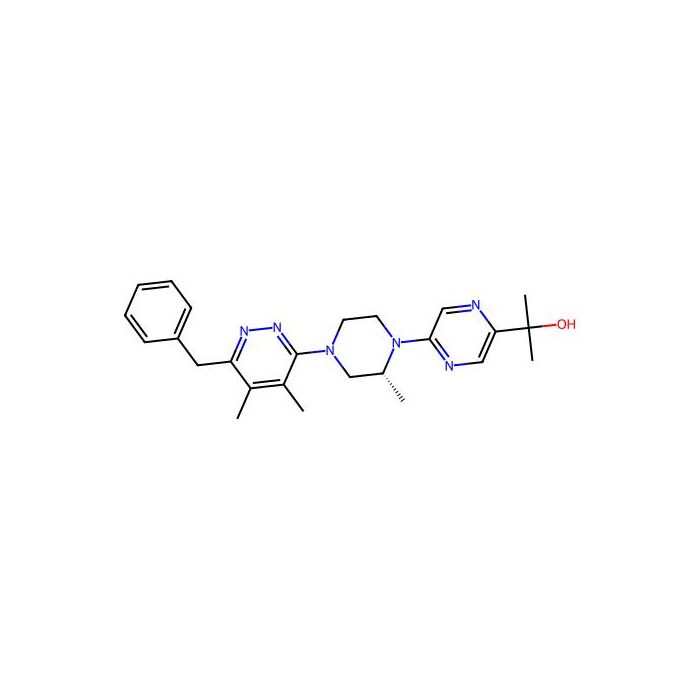
LEQ506 is a second-generation inhibitor of smoothened ( Smo ) with IC 50 s of 2 and 4 nM in human and mouse, respectively.
In Vitro
LEQ506 is a second-generation inhibitor of smoothened (Smo) with IC 50 s of 2 and 4 nM in human and mouse, respectively. LEQ506 inhibits Hedgehog (Hh) signaling in a human cell line (HEPM) as measured by the amount of Gli mRNA with an IC 50 ~6-fold lower than that of Compound 2. LEQ506 is an efficacious compound by consistently decreasing Gli1 mRNA by about 70 to 80%. LEQ506 shows a tendency to preferentially inhibit Gli1 rather than Ptch1 mRNA. LEQ506 (at 1%) is also an efficacious compound with an inhibition of 80 to 90% for Gli1 and of 60 to 70% for Ptch1. MCE has not independently confirmed the accuracy of these methods. They are for reference only.
Cell Assay
DAOY cells are serum starved 16 h before experiments and subsequently incubated for 24 h with sonic Hedgehog (SHH) (50 nM) and LEQ506 at different concentrations . Cells are then washed twice with PBS and stored at -80°C until RNA isolation. Total RNA is isolated using the RNeasy Mini Kit. The amount and quality of extracted RNA are determined using the 2100 Bioanalyzer. MCE has not independently confirmed the accuracy of these methods. They are for reference only.
Zertifikate (CoA, COO, BSE/TSE und Analyse-Diagramm)
C of A & Other Certificates(BSE/TSE, COO):
Analytical Chart:
Lösungsrechner
Molarity Calculator
Determine the necessary mass, volume, or concentration for preparing a solution.
Dilution Calculator
Determine the dilution needed to prepare a stock solution.
Reconstitution Calculator
Bewertungen
Kundenbewertungen
Application Protocols
No tested applications or step‑by‑step protocols are provided in the Product Data for this item.
General, non‑validated guidance (informational only):
Prepare a concentrated DMSO stock (e.g., 10 mM). Store as micro‑aliquots at −80 °C to avoid repeated freeze–thaw.
For cell assays, dilute into pre‑warmed medium to a final DMSO content compatible with your cells (commonly ≤0.1–0.5% v/v). Include vehicle controls.
Generate an 8–12 point concentration–response curve to estimate potency. Confirm effects with orthogonal readouts (e.g., reporter assay plus qPCR of pathway genes).
These notes are provided as general practices for small‑molecule probes and are not product‑validated protocols. Consult primary literature and optimize for your system.
Biological Roles
Research context (literature, general):
Pathway target: LEQ506 is described in the literature as a potent antagonist of Smoothened (SMO), a Class‑F GPCR that transduces Hedgehog (Hh) signaling. By inhibiting SMO, it suppresses downstream GLI transcriptional activity in Hh‑responsive cells.
Use cases: Chemical probe for dissecting Hh pathway dependence, validating SMO as a node in developmental signaling studies, and benchmarking against other SMO modulators (e.g., vismodegib, sonidegib) in comparative pharmacology.
Mechanistic notes: SMO antagonists typically bind within the heptahelical transmembrane pocket, stabilizing an inactive receptor conformation and preventing propagation of the Hh signal from Patched (PTCH1) regulation to GLI transcription (literature, general for the class).
Selectivity considerations: While designed for SMO, comprehensive selectivity panels (GPCR kinome, safety pharmacology) should be consulted in the primary literature for off‑target awareness; verify for your lot and system.
Cellular considerations: Effective concentration windows depend on cell type, expression levels of SMO/GLI, and presence of agonists (e.g., ShhN, SAG). Time‑dependent effects may reflect receptor trafficking and transcriptional feedback.
Important note:
No medical or clinical claims are made. LEQ506 supplied here is for laboratory research use only. Confirm exact identity, purity, and salt form using the CoA/SDS and, if needed, in‑house analytical methods before biological experimentation.
Buffer Applications
This product is a small‑molecule bioactive probe rather than a buffering agent. It is not used to establish or maintain pH.
Practical guidance for assay buffers (general):
Use standard physiological buffers (e.g., HBSS, PBS, or cell culture media) compatible with your biological system.
When diluting DMSO stocks into aqueous buffers, add slowly with mixing to minimize precipitation. Inclusion of 0.1% BSA or 0.01–0.05% nonionic surfactant can reduce nonspecific binding (validate to avoid assay interference).
For pH‑controlled experiments, select an appropriate buffer system (HEPES, MOPS, Tris) based on your assay’s pH and temperature, independent of LEQ506 itself.
Green Alternatives
Context: As a bioactive research probe, the primary environmental considerations relate to solvent choice for stock preparation and assay dilution rather than bulk solvent use or reagent replacement.
Greener handling options (general guidance):
Prefer DMSO over DMF/NMP for stock solutions when feasible; DMSO has a more favorable environmental/health profile and broad solubilizing power.
Minimize solvent volumes: Prepare the highest practical stock concentration to reduce the total DMSO used across assays.
Aqueous compatibility: Where solubility allows, dilute into buffered saline/medium with minimal cosolvent. Employ gentle surfactants (e.g., polysorbates) judiciously to avoid increasing persistent organic load.
Comparison (general; not item‑specific performance claims):
DMSO vs DMF/NMP: DMSO typically offers lower toxicity and better biodegradability; DMF/NMP carry stricter regulatory scrutiny (reprotoxicity concerns).
Ethanol/PEG‑400 cosolvents: Can reduce required DMSO percentage for some assays but may introduce assay interference or viscosity; validate case‑by‑case.
Process suggestions:
Use micro‑aliquoting to limit freeze‑thaw cycles and waste.
Adopt low‑adsorption labware to reduce the need for re‑dosing due to surface losses.
Note: There are no direct “green substitute reagents” for LEQ506 itself; improvements focus on solvent management and operational efficiency.
Pharmaceutical Uses
Scope: Research use only. No therapeutic or clinical claims are made for this catalog item.
Relevant to formulation science (general, literature context for small‑molecule probes):
Preformulation screening: Solubility profiling in DMSO and biorelevant media (FaSSIF/FeSSIF simulants) may be performed during early discovery to understand compound behavior; such studies are research‑focused and not for human use.
Salt/solid‑form considerations: If a defined salt form or polymorph is used, it can influence solubility and stability; specific form for this item is not specified—consult CoA.
Excipient compatibility (in vitro tools): For nonclinical delivery to cells or tissues, vehicles such as DMSO, PEG‑400, or cyclodextrins may be explored to enhance apparent solubility (validate for biological interference).
Regulatory status: Not specified for this item. This material is not certified to pharmacopeial standards (USP/EP/JP) unless explicitly stated on the CoA.
Any in vivo formulation, GLP/GMP manufacturing, or clinical application falls outside the scope of this listing and requires separate sourcing, documentation, and regulatory review.
Physical Properties
Item‑specific properties (from Product Data):
Appearance: Not specified for this item; refer to CoA/Spec Sheet.
Molecular weight: Not specified for this item; refer to CoA/Spec Sheet.
Hazard/physicochemical data in Product Data: Not specified.
Literature/general guidance for compounds of this class (not item‑specific specs):
State: Bioactive library members like LEQ506 are typically supplied as off‑white to light‑colored solids or films, or as DMSO solutions in microplates; verify your lot’s appearance on the CoA.
Solubility practice: Prepare concentrated stocks in anhydrous DMSO (e.g., 10–50 mM), then dilute into aqueous assay buffer with carrier protein (e.g., 0.1% BSA) or surfactant (e.g., 0.01–0.05% Tween‑20) to minimize precipitation (general practice).
Aqueous solubility: Many SMO inhibitors are poorly water‑soluble; expect the need for co‑solvent (DMSO) or limited final DMSO fractions (≤0.1–0.5% v/v in cells, assay‑dependent). Determine exact solubility empirically.
pKa/logP/BP/MP/density/refractive index: Not specified for this item; consult the CoA or primary literature if critical to your workflow.
Notes:
Always confirm working concentrations are below the solubility limit in the chosen assay medium to avoid colloids/aggregate artifacts.
Filter sterilization of final dilutions (0.22 μm) may reduce particulates but review compound stability to avoid adsorption losses.
Quality and Grades
Item‑specific grade/purity (from Product Data):
Grade/Purity: Not specified for this item; refer to CoA/Spec Sheet.
Interpretation and general guidance:
Research‑grade bioactive probe: In the absence of a stated analytical grade (e.g., ≥98% HPLC), assume research‑use only quality intended for screening, target validation, or mechanism studies. Confirm purity by lot on the CoA (typical techniques: HPLC/UPLC with UV or MS detection, 1H NMR, LC‑MS).
Identity assurance: Verify CAS (1204975‑42‑7) and PubChem CID (45100669) alignment with your internal reference before critical studies. Where possible, cross‑check by HRMS exact mass and retention time in your own lab methods.
Stabilizers/solvent content: Not specified for this item; review CoA for any residual solvents, salt form, or stabilizers. These can influence solubility and biological assay performance.
UV background: If planning spectroscopic readouts, examine the CoA or run a quick UV scan of the formulated stock to ensure low background at assay wavelengths.
Documentation to request/consult:
CoA for each lot: purity (%), identification (NMR/LC‑MS), residual solvents, water content if measured, and salt/form information.
SDS: for hazard classification and handling.
Note: Do not equate “library” or “screening” grade with clinical suitability; this material is for research use only.
Reaction and Applications
Not a classical synthetic reagent: LEQ506 is primarily used as a bioactive probe in cell‑based and biochemical assays, not as a substrate, catalyst, or solvent in chemical synthesis.
Research applications (general, literature context):
Hedgehog (Hh) pathway interrogation: Employed to suppress pathway activation in reporter assays (e.g., Gli‑luciferase), to delineate upstream vs downstream signaling dependencies.
Target engagement studies: Useful in binding/competition assays with Smoothened (SMO) to benchmark affinity relative to other ligands (literature, general for SMO antagonists).
Phenotypic screening: Applied in pathway‑relevant phenotypic models to establish pharmacological rescue or inhibition profiles.
Chemical biology controls: Serves as a reference antagonist in panels profiling Hh/SMO tool compounds (when identity is verified by CAS and literature).
Practical assay tips (general):
Titrate across a broad range (e.g., 8–12 points spanning 10 nM to 30 μM) to capture full CRC and estimate IC50; adjust top concentration below the solubility ceiling.
Include vehicle (DMSO) controls matched to the highest solvent content.
Consider pre‑incubation (e.g., 30–60 min) to ensure target engagement before stimulation with pathway agonists (e.g., Shh ligand or SMO agonists) where applicable.
Monitor for off‑target cytotoxicity at higher concentrations with orthogonal viability assays (e.g., resazurin, CellTiter‑Glo), independent of pathway readouts.
Note: For synthetic transformations, refer instead to the “Solvent Selection” and “Storage & Reconstitution” sections for handling in the lab.
Reaction Conditions
This section is not typically applicable. LEQ506 is a bioactive probe used in biochemical and cell‑based assays rather than in chemical transformations.
Assay‑relevant conditions (general guidance):
Stock preparation: Dissolve in anhydrous DMSO (e.g., 10–50 mM). Vortex/sonicate briefly to fully solubilize.
Working concentration ranges: Common screening ranges span low‑nanomolar to tens of micromolar, adjusted for solubility and assay sensitivity. Determine empirically.
Incubation: Pre‑incubate with cells or biochemical components (e.g., 30–60 min) to achieve steady‑state target engagement before stimulation/readout, as appropriate for your assay design.
Temperature: Standard cell culture (37 °C, 5% CO2) or biochemical assay temperatures (room temperature to 37 °C), depending on the system.
These are general research practices and not product‑specific specifications. Always validate conditions for your biological model and readout.
Safety and Handling
Item‑specific safety data (from Product Data):
GHS Classification: Not specified for this item; refer to SDS.
Signal Word: Not specified for this item; refer to SDS.
Hazard (H‑) Statements: Not specified for this item; refer to SDS.
Pictograms: Not specified for this item; refer to SDS.
Storage Conditions: Store at −80 °C.
Shipped In: Dry ice packs + Cold packs.
General laboratory safety guidance (not a substitute for SDS):
PPE: Wear lab coat, safety glasses, and nitrile gloves. Handle powders/aliquots in a fume hood or ventilated enclosure to minimize inhalation/dermal exposure.
Avoid: Ingestion, inhalation of dust/aerosols; contact with skin and eyes. Prevent environmental release.
Incompatibilities: Strong oxidizers and strong acids/bases may cause degradation for many heteroaromatic drug‑like molecules; segregate accordingly (general guidance).
First aid (general): If on skin/eyes, rinse with water for ≥15 minutes. If inhaled, move to fresh air. If ingested, rinse mouth. Seek medical attention for persistent symptoms. Provide SDS to responders.
Spill response: For small spills, absorb with inert material (silica/vermiculite), collect in sealable container, and decontaminate area. Dispose according to institutional and local regulations.
Special risks: Many bioactives exhibit high potency; avoid cross‑contamination of shared equipment. Decontaminate pipettes and bench surfaces after use.
Always defer to the product‑specific SDS and institutional EHS requirements for authoritative safety information.
Solvent Selection
Compound type context: LEQ506 is a lipophilic small molecule used as a pathway probe. Solvent selection focuses on preparing concentrated stocks and ensuring compatibility with biochemical/cellular assays.
Practical guidance (general, not item‑specific specs):
Primary stock solvent: Anhydrous DMSO is the default. Typical stock concentrations: 10–50 mM depending on solubility; verify visually and by LC if needed.
Working solutions: Dilute DMSO stocks into assay buffer or culture medium. Maintain final DMSO at levels tolerated by your system (commonly ≤0.1–0.5% v/v for mammalian cells; some cells tolerate up to 1%, but validate).
Cosolvent systems: For challenging solubility, premix stock with small volumes of PEG‑400 or ethanol before aqueous dilution (e.g., DMSO:PEG‑400:buffer), monitoring for precipitation and biological compatibility.
Surfactants/carriers: 0.01–0.05% Tween‑20 or 0.1% BSA can reduce adsorption/aggregation in biochemical assays (test for assay interference).
Avoid: High ionic strength and low temperature during dilution can reduce solubility; add stock slowly with mixing at room temperature before cooling/incubation.
Comparison (general):
DMSO: best‑in‑class solvating power for drug‑like molecules; potential cytotoxicity at higher %.
NMP/DMF: stronger solvents but greater toxicity and assay interference risk; prefer DMSO where possible.
Aqueous buffers alone: often insufficient for initial dissolution; use only for secondary dilution.
Tip: Use low‑binding plasticware and pre‑wetted tips to minimize compound loss on surfaces.
Storage and Reconstitution
Item‑specific storage and shipping (from Product Data):
Storage Conditions: Store at −80 °C.
Shipped In: Dry ice packs + Cold packs.
Reconstitution guidance (general for small‑molecule bioactives; not item‑specific specs):
Solvent: Reconstitute in anhydrous DMSO to prepare a concentrated stock (e.g., 10–50 mM depending on solubility). Vortex and, if needed, brief sonication to fully dissolve.
Aliquoting: Dispense into single‑use micro‑aliquots (e.g., 10–50 μL) in solvent‑resistant, low‑bind tubes to minimize adsorption and freeze–thaw cycling.
Storage of solutions: Store DMSO stocks at −80 °C in sealed containers (parafilm or crimp) with minimal headspace to reduce moisture ingress. Protect from light if the compound is light‑sensitive (check CoA/SDS or run a quick stability check).
Freeze–thaw: Avoid repeated cycles. Thaw on ice or at room temperature, mix gently, and return unused portion to −80 °C promptly.
Aqueous working solutions: Prepare immediately before use. Filter (0.22 μm) if particulate is observed, being mindful of potential adsorption losses.
Stability notes:
Long‑term stability, hygroscopicity, and light‑sensitivity are not specified for this item; refer to CoA/SDS and verify empirically via LC‑MS/HPLC over the course of your study.
Research Use: For research use only.
Structure and Identity
Brief overview: LEQ506 (also known in the literature as NVP‑LEQ506) is a small‑molecule research compound commonly used as a chemical probe of Hedgehog (Hh) signaling.
Item‑specific identifiers (Product Data):
SKU: L656149
Product Name: LEQ506
CAS: 1204975-42-7
PubChem CID: 45100669
InChIKey: Not specified for this item; refer to CoA/Spec Sheet.
SMILES: Not specified for this item; refer to CoA/Spec Sheet.
Molecular formula: Not specified for this item; refer to CoA/Spec Sheet.
Molecular weight: Not specified for this item; refer to CoA/Spec Sheet.
Structural features (general literature context, not item‑specific specifications):
Compound type: small, lipophilic heteroaromatic scaffold used as a Smoothened (SMO) pathway probe in Hh signaling research (literature).
Functional motif: designed to interact with the 7‑TM GPCR Smoothened; typical scaffolds in this class feature multiple aromatic/heteroaromatic rings and H‑bond acceptors/donors suited for GPCR pocket binding (literature, general).
2D description (general):
Without item‑specific structural strings (SMILES/InChI), a precise atom‑by‑atom 2D description cannot be provided here. Consult the CoA/SDS or primary literature for the exact depiction of LEQ506 used in your lab.
Synthetic Utility
Not a synthetic building block: LEQ506 is supplied as a finished bioactive small molecule and is not typically employed as a reagent, catalyst, or intermediate in organic synthesis.
Context for chemists (general):
If analog synthesis or SAR expansion is of interest, consult primary literature/patents describing SMO antagonist chemotypes related to LEQ506 for retrosynthetic approaches, core modifications, and exit vectors. Such work is outside the scope of this catalog item but may inform in‑house medicinal chemistry.
For analytical characterization in support of biological studies, typical methods include LC‑MS (ESI), HPLC purity, and 1H/13C NMR where sample quantity permits. Establishing a reference standard curve by LC‑MS can aid in stability/assay quantification.
For practical laboratory use of this product, refer to the “Solvent Selection,” “Reaction & Applications,” and “Storage & Reconstitution” sections.
Target Specificity
Not applicable for this listing. Target specificity details (e.g., antigen/epitope, clone, isotype, species reactivity) apply to antibody or protein capture reagents and are not provided in the Product Data for this small‑molecule compound.
For biological background regarding pathway modulation relevant to this molecule class, see the “Biological Roles” section.
Häufig gestellte Fragen
How should this product be stored?
Store at ?80 °C. Ultra-low temperature storage is required to maintain the specified shelf life.
How is this product shipped?
This product ships frozen with dry ice and cold packs. Unpack on arrival and transfer it to the storage condition stated above; handle dry ice with insulated gloves in a ventilated area.
What are the CAS number, molecular formula and molecular weight?
The CAS Number is 1204975-42-7, the molecular formula is C25H32N6O, and the molecular weight is 432.56 g/mol.
What documentation is provided?
Available product documentation, including Certificates of Analysis (COA), Safety Data Sheets (SDS), and specification sheets, is shown in the product document area. Document availability and access follow the current site policy.
Wir verwenden Cookies, um die ordnungsgemäße Funktion der Website sicherzustellen und, soweit zulässig, Ihr Nutzererlebnis zu verbessern. Sie können Ihre Einstellungen jederzeit unter „Einstellungen“ verwalten. Weitere Informationen finden Sie in unserer Cookie-Richtlinie.
Dürfen wir Sie über Rabattaktionen informieren?
Später erinnern
Vielen Dank! Bitte überprüfen Sie Ihren E-Mail-Posteingang, um zu bestätigen.
Products are supplied to verified businesses, institutions, and qualified professionals for research and development use only. Not for use in humans, animals, diagnosis, or therapy.