Determine the necessary mass, volume, or concentration for preparing a solution.
Dilution Calculator
Determine the dilution needed to prepare a stock solution.
Reconstitution Calculator
Bewertungen
Kundenbewertungen
Application Protocols
Not specified for this item; refer to CoA/Spec Sheet.
This listing does not include tested applications or recommended dilutions. Users should follow institutionally validated procedures or peer-reviewed protocols for incorporating leupeptin into lysis buffers, tissue homogenization workflows, or enzyme assays. See Buffer Applications for general considerations.
Biological Roles
Leupeptin functions as a reversible inhibitor of selected protease families and is widely used to dissect proteolytic pathways in cells and tissues (research context only).
Mechanistic features (literature/general):
Target classes: primarily trypsin-like serine proteases (e.g., trypsin, plasmin) and papain/calpain-like cysteine proteases. It is generally ineffective against aspartyl proteases (e.g., pepsin) and metalloproteases.
Mode of inhibition: the C-terminal aldehyde forms a reversible covalent adduct with the active-site nucleophile (serine or cysteine), stabilizing a hemiacetal/hemithioacetal and mimicking the tetrahedral intermediate. The peptide sequence confers substrate-pocket complementarity.
Selectivity: the di-leucyl motif favors binding at hydrophobic S1/S2 subsites; the arginine side chain guides interactions with proteases that accommodate basic residues at P1.
Research uses to probe biology:
Preservation of signaling proteins and post-translationally processed polypeptides during extraction to avoid artifactual degradation.
Assignment of protease involvement by comparing phenotypes/activities with and without inhibitor.
Complementarity with other inhibitors (pepstatin A, bestatin, EDTA, E-64) to map contributions of distinct protease families.
Notes:
The inhibitor is used across cell-free assays, cell lysates, and tissue homogenates. Concentration and exposure time should be empirically optimized to balance inhibition with minimal perturbation of cellular components.
No medical/clinical use is implied; all applications are for research use only.
Buffer Applications
Leupeptin is commonly included in lysis/extraction buffers to suppress proteolysis during protein handling (research use only). While it is not a buffering agent per se, it is compatible with many buffer systems.
Typical use scenarios (literature/general guidance):
Cell lysis buffers: PBS, TBS, Tris–HCl, HEPES, or RIPA-like buffers supplemented with leupeptin immediately before use; keep samples on ice.
Tissue homogenization: add to sucrose or isotonic buffers during mechanical disruption to protect labile proteins.
Enzyme assay buffers: include leupeptin to suppress background proteases that can confound kinetic measurements of unrelated enzymes.
Working concentrations and handling (literature):
Stock solutions: commonly prepared at 1–10 mg/mL in water or DMSO; sterile-filter if sterility is required.
Final concentrations: often 1–100 µg/mL (≈2–200 µM depending on exact salt form). Optimize by titration based on protease burden.
Compatibility: generally compatible with nonionic detergents (e.g., Triton X-100, NP-40), salts (NaCl, KCl), chelators (EDTA), and reducing agents (DTT, βME) at standard levels.
Practical tips:
Add just prior to use; prolonged pre-mixing in basic buffers can reduce potency.
For broad-spectrum protection, use in combination with other class-specific inhibitors (e.g., pepstatin A for aspartyl proteases, EDTA for metalloproteases).
Green Alternatives
Context: In protease inhibition, “greener” often refers to choosing inhibitors with lower acute toxicity and improved handling profiles while achieving equivalent performance.
Comparative considerations (literature/general):
Leupeptin vs PMSF/DFP:
PMSF and DFP are highly reactive organophosphorus serine-protease inhibitors with significant acute toxicity and instability in water. Leupeptin offers effective inhibition of trypsin-like serine proteases and many cysteine proteases with substantially lower volatility and more user-friendly aqueous handling.
Leupeptin vs aprotinin (protein inhibitor):
Aprotinin is a polypeptide; while potent, it is a biologic with potential allergenicity and is less amenable to organic stock solutions. Leupeptin, as a small-molecule peptide aldehyde, dissolves readily in water and common organic co-solvents (e.g., DMSO), facilitating low-waste stock preparation.
Leupeptin + E-64 in place of high loads of PMSF:
A mixed cocktail (e.g., leupeptin for trypsin-like and cysteine proteases, E-64 for cysteine proteases, and lower PMSF/AEBSF levels) can reduce reliance on more hazardous reagents while maintaining broad-spectrum coverage.
Trade-offs:
Peptide aldehydes are susceptible to oxidation/hydrolysis and may require more frequent preparation of fresh solutions.
Specificity profiles differ: leupeptin does not inhibit all protease classes (e.g., aspartyl and metalloproteases are weakly or not affected), so greener substitution may require a complementary inhibitor rather than a 1:1 replacement.
Pharmaceutical Uses
This product is supplied strictly for research use only.
Therapeutic/clinical use: None. No medical or clinical claims are made.
Formulation/excipient status: Not used as a standard pharmaceutical excipient.
Pharmacopoeial listings: Not applicable.
Comment (general): leupeptin is a laboratory protease inhibitor employed in biochemical research and analytical sample preparation. It is not developed or supplied as a drug substance, active ingredient, or dosage-form excipient.
Physical Properties
Item-specific physico-chemical specifications are not provided in the listing and should be confirmed on the product CoA/Spec Sheet.
Appearance: Not specified for this item; refer to CoA/Spec Sheet.
Molecular weight: Not specified for this item; refer to CoA/Spec Sheet.
Molecular formula: Not specified for this item; refer to CoA/Spec Sheet.
Melting point, boiling point, density, refractive index: Not specified for this item; refer to CoA/Spec Sheet.
General/literature characteristics (for context; not item specifications):
Physical form: typically a white to off-white solid (often provided as the free base or as a sulfate/hemisulfate salt).
Solubility: readily soluble in water and aqueous buffers; soluble in polar protic/amide solvents (e.g., methanol, ethanol, DMSO); poorly soluble in nonpolar solvents (e.g., ether, hexanes). Acidified aqueous solutions (e.g., 0.1% acetic acid) can enhance dissolution.
Ionization: multiple basic sites (guanidinium, amide nitrogens) confer strong aqueous solubility; the aldehyde is neutral and reactive toward nucleophiles.
Stability (dry): generally stable as a dry solid protected from moisture and light; the aldehyde functionality can hydrate in water and can undergo slow oxidation—fresh solutions are recommended.
Note: If exact salt form is critical for stoichiometry or activity calculations, confirm by CoA (salt form will affect molecular weight and may modestly influence solubility and pH of solutions).
Quality and Grades
Grade/Purity: Not specified for this item; refer to CoA/Spec Sheet.
Stabilizers/additives: Not specified for this item; refer to CoA/Spec Sheet.
Interpretation and practical considerations (general):
Protease inhibitors such as leupeptin are commonly offered as high-purity biochemical grade solids to minimize background activities and contaminants (salts, residual solvents, microbial bioburden). Inhibitor potency and absence of protease contamination are critical to performance.
If an “assay” or “activity” specification is provided on the CoA (e.g., percent inhibition against trypsin/papain under defined conditions), use that data to set working concentrations. Absence of UV-absorbing impurities (for proteomics) may be noted for some lots.
Salt form matters: free base vs. sulfate/hemisulfate alters molecular weight (for molarity calculations) and can influence pH upon dissolution. Confirm the exact counterion on the CoA.
Endotoxin/bioburden: not typically specified for research-grade small peptides, but may be relevant for sensitive cell-based assays; consult CoA if applicable.
Recommendation: for quantitative workflows (proteomics sample prep, enzyme kinetics), document the lot number and verify critical attributes (identity, purity, salt form, water content if reported) using the Aladdin CoA/Spec Sheet.
Reaction and Applications
As a peptide aldehyde, leupeptin is used as a selective, reversible inhibitor of serine and cysteine proteases rather than as a reagent for synthetic organic transformations.
Key research applications (literature/general):
Proteome/sample preservation: added to cell lysis buffers and extraction solutions to suppress proteolysis of target proteins during homogenization and processing.
Enzyme kinetics/biochemistry: used to define contributions of trypsin-like serine proteases and papain/calpain-like cysteine proteases by observing inhibition profiles in vitro.
Purification workflows: included during affinity or ion-exchange chromatography to maintain integrity of labile proteins and peptides.
Functional assays: stabilizes secreted proteins in conditioned media or tissue lysates during incubation steps.
Protease inhibitor cocktails: commonly combined with other inhibitors (e.g., pepstatin A for aspartyl proteases, PMSF/AEBSF for serine proteases, E-64 for cysteine proteases) to broaden coverage.
Practical notes:
Working concentrations (literature guidance): often 1–100 µM (or 1–100 µg/mL) depending on protease abundance and matrix; titration is recommended for each system.
Order of addition: add to cold buffers immediately before use; keep samples on ice to synergize chemical inhibition with temperature control.
Compatibility: generally compatible with common buffer components (Tris, HEPES, PBS), nonionic detergents, salts, and reducing agents at typical concentrations; avoid prolonged exposure to strong base or oxidants.
Note: No synthetic/stoichiometric reaction use is typical for this compound; its primary value is biochemical inhibition.
Reaction Conditions
This item is not employed as a reagent/catalyst in chemical synthesis; therefore, conventional “reaction conditions” (solvent screens, temperatures, catalysts, yields) are not applicable.
General guidance for biochemical use (literature; not item specifications):
Temperature: keep samples cold (on ice or 4 °C) to complement chemical inhibition.
pH: near neutral (pH 6–8) buffers maintain inhibitor integrity and activity.
Time: add immediately prior to lysis/assay; prolonged pre-incubation in basic media can reduce potency.
Matrix effects: high protease loads (e.g., pancreas, muscle extracts) may require the higher end of typical concentration ranges and/or combination cocktails.
For exact procedural details, consult validated protocols for your specific assay or sample type and adjust concentration empirically.
Safety and Handling
Hazard communication for this specific item is not provided in the listing.
GHS classification (mixture/solid): Not specified for this item; refer to SDS.
Signal word / H-statements / Pictograms: Not specified for this item; refer to SDS.
General laboratory safety guidance (literature/standard practice):
Leupeptin is intended for research use only. Avoid inhalation, ingestion, and skin/eye contact.
PPE: lab coat, safety glasses, and suitable gloves (e.g., nitrile). Handle powders in a fume hood or ventilated enclosure to minimize dust inhalation.
Incompatibilities: strong oxidizers may react with the aldehyde functionality; avoid prolonged exposure to basic solutions which can promote decomposition of peptide aldehydes. Store away from moisture and light.
Special risks: peptide aldehydes can form reversible adducts with nucleophiles; keep solutions capped and prepare fresh aliquots to maintain activity.
First aid (overview; defer to SDS): if on skin/eyes, rinse with water for several minutes; if inhaled, move to fresh air; if ingested, rinse mouth. Seek medical attention in all cases of exposure.
Environmental precautions: prevent release to drains where feasible; collect spills with inert absorbent and dispose of according to institutional and local regulations.
Always consult the product’s SDS for authoritative hazard information, exposure controls, and transport classification before use.
Solvent Selection
Leupeptin is a polar peptide aldehyde and behaves as a water-compatible small biomolecule rather than a hydrophobic organic reagent.
Primary solvents: water and aqueous buffers (near-neutral pH) provide good solubility. Slight acidification (e.g., 0.1% acetic acid) can improve wetting/dissolution.
Organic co-solvents: DMSO, methanol, ethanol are suitable for preparing concentrated stocks; DMF is also compatible. Avoid nonpolar solvents (hexanes, diethyl ether) where solubility is poor.
pH considerations: maintain pH 6–8 for routine use; strong base can accelerate degradation of peptide aldehydes.
Filtration: 0.22 µm sterile filtration is feasible for aqueous working solutions if sterility is required.
When to choose water vs DMSO stocks:
Water/buffer stocks: preferred for immediate use in enzyme assays or lysis buffers; minimal organic carryover.
DMSO stocks: preferred for longer-term frozen aliquots at higher concentration and enhanced chemical stability; dilute into aqueous media just before use to ≤1% v/v DMSO to minimize biological effects.
Practical tip: confirm the exact salt form on the CoA to compute molar concentrations correctly (counterion changes formula weight). Prepare fresh or thaw single-use aliquots to preserve inhibitor activity.
Storage and Reconstitution
Item-specific storage (as supplied):
Storage conditions: Room temperature (per product data). Protect from moisture and light. Keep container tightly closed.
Shipped in: Not specified for this item; refer to CoA/Spec Sheet.
Reconstitution and use (general literature guidance; not item specifications):
Solvents: dissolve in water, buffer (near neutral pH), or DMSO to prepare stocks (commonly 1–10 mg/mL). Gentle vortexing and brief sonication can aid dissolution. If needed, acidify aqueous solvent slightly (e.g., 0.1% acetic acid) to improve wetting.
Filtration: 0.22 µm sterile filtration is suitable for cell-based work.
Aliquoting: prepare single-use aliquots to avoid repeated freeze–thaw and to minimize exposure to air and moisture.
Storage of reconstituted solutions: for best stability, store aliquots at −20 °C or below and use thawed aliquots immediately. Avoid prolonged storage at room temperature once in solution.
Stability notes: peptide aldehydes can hydrate/oxidize in aqueous media; prepare fresh solutions shortly before use for critical assays.
Always consult the Aladdin CoA/SDS for lot-specific guidance, and follow institutional SOPs for handling, labeling, and disposal. For research use only.
Structure and Identity
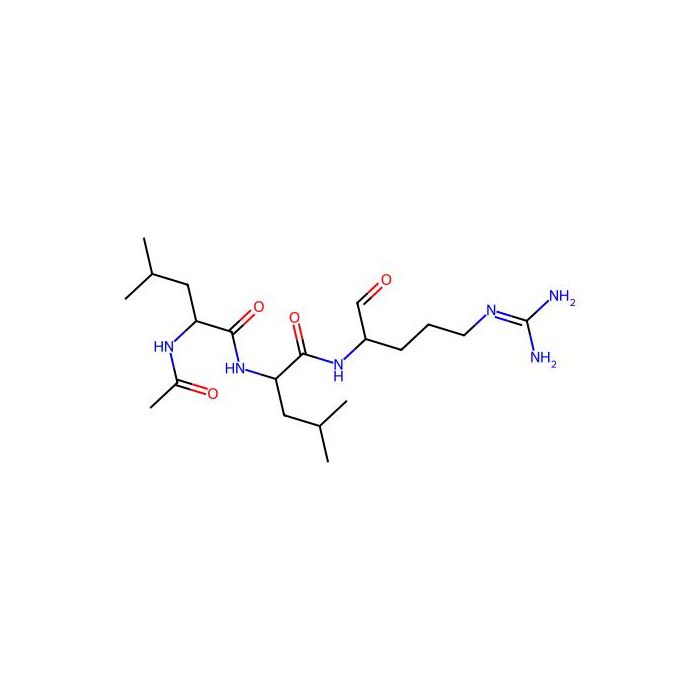
Leupeptin is a small peptide aldehyde protease inhibitor commonly described as Ac-Leu-Leu-Arginal (tri-peptide bearing a C-terminal aldehyde). It is widely used to inhibit serine and cysteine proteases in biochemical workflows.
SKU: L693345
Product name: Leupeptin
CAS: 24365-47-7 (leupeptin, commonly supplied as various salts; verify exact form on CoA)
PubChem CID: 5284408 (literature identifier for leupeptin)
InChIKey: 98853 (as provided in catalog entry; note: standard InChIKeys are typically 27 characters; consult CoA/SDS for the canonical identifier)
SMILES: Not specified for this item; refer to CoA/Spec Sheet.
Molecular formula: Not specified for this item; refer to CoA/Spec Sheet.
Molecular weight: Not specified for this item; refer to CoA/Spec Sheet.
Structural features (general/literature):
Tripeptidic backbone with N-terminal acetyl group, two consecutive L-leucines, and an L-arginine residue whose carboxyl terminus is present as an aldehyde (–CHO) rather than –CO2H.
Stereochemistry: typically all-L configuration in natural/synthetic material (literature).
2D structure in words (general): an N-acetylated di-leucyl segment linked to L-arginine; the side chain of arginine carries a guanidinium, and the C-terminus is truncated to an aldehyde, enabling reversible covalent binding (hemiacetal/hemithioacetal) in serine/cysteine protease active sites.
Synthetic Utility
Leupeptin is not typically used as a building block or reagent in synthetic organic chemistry. Its primary value is as a biochemical tool compound.
General notes for chemists (literature/context):
Functional group profile: peptide amides, guanidinium (basic), and an aldehyde “warhead.” The aldehyde is moisture-sensitive and can hydrate or oxidize; this reactivity underlies enzyme inhibition rather than serving as a general synthetic handle.
Derivatization: in method development or probe design, leupeptin-like peptide aldehydes can be derivatized (e.g., oxime formation, reductive amination) for immobilization or reporter conjugation, but such modifications typically diminish or alter protease selectivity.
Retrosynthetic perspective: where a peptide aldehyde motif is desired, chemists generally prepare it de novo from protected peptides via selective C-terminal reduction/oxidation steps rather than employing leupeptin as a precursor.
Conclusion: For synthetic applications (couplings, catalysis, materials), alternative reagents are more suitable. Use leupeptin where biochemical protease inhibition is the goal.
Target Specificity
Not specified for this item; refer to CoA/Spec Sheet.
Note: Detailed target specificity data (e.g., percent inhibition against named proteases under defined assay conditions) is lot- and protocol-dependent and is not provided in this product listing. For general background on leupeptin’s inhibitor class and typical protease families, see the Biological Roles section.
Häufig gestellte Fragen
What is the purity of this product?
This product is supplied at ≥98% purity (chemical assay). Lot-specific values are stated on the Certificate of Analysis.
How should this product be stored?
Store at room temperature.
What are the CAS number, molecular formula and molecular weight?
The CAS Number is 24365-47-7. InChIKey GDBQQVLCIARPGH-BSOSBYQFSA-N.
What documentation is provided?
Available product documentation, including Certificates of Analysis (COA), Safety Data Sheets (SDS), and specification sheets, is shown in the product document area. Document availability and access follow the current site policy.
Wir verwenden Cookies, um die ordnungsgemäße Funktion der Website sicherzustellen und, soweit zulässig, Ihr Nutzererlebnis zu verbessern. Sie können Ihre Einstellungen jederzeit unter „Einstellungen“ verwalten. Weitere Informationen finden Sie in unserer Cookie-Richtlinie.
Dürfen wir Sie über Rabattaktionen informieren?
Später erinnern
Vielen Dank! Bitte überprüfen Sie Ihren E-Mail-Posteingang, um zu bestätigen.
Products are supplied to verified businesses, institutions, and qualified professionals for research and development use only. Not for use in humans, animals, diagnosis, or therapy.