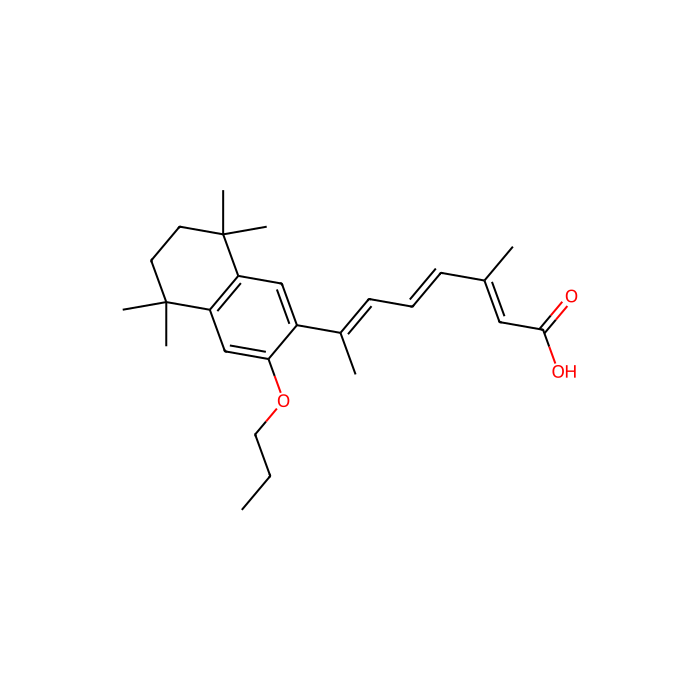
LG 100754 - Moligand™, ≥98% , Agonist of Peroxisome proliferator-activated receptor-γ;Antagonist of Retinoid X receptor-α;Antagonist of Retinoid X receptor-β;Antagonist of Retinoid X receptor-γ, CAS No.180713-37-5, Agonist of Peroxisome proliferator-activated receptor-γ;Antagonist of Retinoid X receptor-α;Antagonist of Retinoid X receptor-β;Antagonist of Retinoid X receptor-γ

CAS: 180713-37-5 Cat. No.: L286924 Summenformel: C26H36O3 Molekulargewicht: 396.56
Zu bestellen verfügbar
QUALITÄT & REINHEIT Moligand™ ? Moligand™ — Aladdin's line of ligands and bioactive small molecules. Use for receptor, pathway, and binding studies needing defined small-molecule tools. ≥98%
Synonyms
LGD 100754|LG 100754|(2E,4E,6Z)-3-Methyl-7-(5,5,8,8-tetramethyl-3-propoxy-5,6,7,8-tetrahydro-naphthalen-2-yl)-octa-2,4,6-trienoic acid|(2e,4e,6z)-3-Methyl-7-(5,5,8,8-Tetramethyl-3-Propoxy-5,6,7,8-Tetrahydronaphthalen-2-Yl)octa-2,4,6-Trienoic Acid|CD 3159|2,4,6-Octatrienoic acid, 3-methyl-7-(5,6,7,8-tetrahydro-5,5,8,8-tetramethyl-3-propoxy-2-naphthalenyl)-, (2E,4E,6Z)-|(2E,4E,6Z)-3-Methyl-7-(5,6,7,8-tetrahydro-5,5,8,8-tetramethyl-3-propoxy-3-naphthalenyl)-2,4,6-octatrienoic acid|(2E,4E,6Z)-3-methyl-7-(5,5,8,8-tetramethyl-3-propoxy-6, 7-dihydronaphthalen-2-yl)octa-2,4,6-trienoic acid|LG754|(2E,4E,6Z)-3-Methyl-7-(5,6,7,8-tetrahydro-5,5,8,8-tetramethyl-3-propoxy-3-naphthalenyl)-2,4,6-octatrienoicacid|LG100754|(2E,4E,6Z)-3-methyl-7-(5,5,8,8-tetramethyl-3-propoxy-6,7-dihydronaphthalen-2-yl)octa-2,4,6-trienoic acid
Storage
Lagerung bei -20°C
Shipped In
Eistruhe + Eispads
★
Größe
Deutschland (EU)
USA*
Preis
Menge
1mg
L286924-1mg
Auf Bestellung · 8–12 Wochen

106,65€

124,87€
Speichern 18,22 € (14.59%)
5mg
L286924-5mg
Auf Bestellung · 8–12 Wochen

229,86€

343,54€
Speichern 113,67 € (33.09%)
10mg
L286924-10mg
Auf Bestellung · 8–12 Wochen

413,82€

540,51€
Speichern 126,69 € (23.44%)
25mg
L286924-25mg
Auf Bestellung · 8–12 Wochen

930,13€

1.216,48€
Speichern 286,35 € (23.54%)
50mg
L286924-50mg
Auf Bestellung · 8–12 Wochen
1.348,38€
100mg
L286924-100mg
Auf Bestellung · 8–12 Wochen
2.427,85€
Enter a quantity for the sizes you want to add.

Übersicht

Anwendung:

LG100754 (UVI 2112) ist ein Modulator von RXR-Dimeren. LG100754 wirkt als Antagonist des homodimeren RXR:RXR, aber als Agonist der heterodimeren RXR:PPARα und RXR:PPARγ. LG100754 ist ein Insulinsensibilisator, der über RXR wirkt.

Spezifikationen

Synonyme
LGD 100754 | LG 100754 | (2E,4E,6Z)-3-Methyl-7-(5,5,8,8-tetramethyl-3-propoxy-5,6,7,8-tetrahydro-naphthalen-2-yl)-octa-2,4,6-trienoic acid | (2e,4e,6z)-3-Methyl-7-(5,5,8,8-Tetramethyl-3-Propoxy-5,6,7,8-Tetrahydronaphthalen-2-Yl)octa-2,4,6-Trienoic Acid | CD 3159 | 2,4,6-Octatrienoic acid, 3-methyl-7-(5,6,7,8-tetrahydro-5,5,8,8-tetramethyl Show more
Spezifikationen & Reinheit
Moligand™, ≥98%
Biochemische und physiologische Mechanismen
LG100754 is a unique RXR ligand that acts as an antagonist against RXR homodimers, but is a strong agonist for RXR:PPARα and RXR:PPARγ heterodimers. The compound does not have agonist activities for other RXR heterodimers containing LXR or GAR/FXR receptors. LG100754 initiates adipocyte differentiation, inhibits TNFα-induced insulin receptor hypophosphorylation and improves insulin resistance in db/db mice.
Storage
Lagerung bei -20°C
Verschickt in
Eistruhe + Eispads
Note
Moligand™
Aktionsart
AGONIST, ANTAGONIST
Mechanismus der Wirkung
Agonist of Peroxisome proliferator-activated receptor-γ;Antagonist of Retinoid X receptor-α;Antagonist of Retinoid X receptor-β;Antagonist of Retinoid X receptor-γ
Reinheit
≥98%
Namen und Kennungen
SMILES
CCCOC1=CC2=C(C=C1C(=CC=CC(=CC(=O)O)C)C)C(CCC2(C)C)(C)C
IUPAC Name
(2E,4E,6Z)-3-methyl-7-(5,5,8,8-tetramethyl-3-propoxy-6,7-dihydronaphthalen-2-yl)octa-2,4,6-trienoic acid
InChIKey
HNODNXQAYXJFMQ-LQUSFLDPSA-N
InChI
1S/C26H36O3/c1-8-14-29-23-17-22-21(25(4,5)12-13-26(22,6)7)16-20(23)19(3)11-9-10-18(2)15-24(27)28/h9-11,15-17H,8,12-14H2,1-7H3,(H,27,28)/b10-9+,18-15+,19-11-
Isomere SMILES
CCCOC1=CC2=C(C=C1/C(=C\C=C\C(=C\C(=O)O)\C)/C)C(CCC2(C)C)(C)C
Molekulargewicht
396.56
Reaxys
35598042
Reaxys-RN_link_address
https://www.reaxys.com/reaxys/secured/hopinto.do?context=S&query=IDE.XRN=35598042&ln=

Erweiterte Daten

Taxonomic Classification

Taxonomy Tree

KingdomOrganic compounds
SuperclassLipids and lipid-like molecules
KlassePrenol lipids
SubclassRetinoids
Intermediate Tree Nodes Not available
Direct ParentRetinoids
Alternative Parents Tetralins  Bicyclic monoterpenoids  Aromatic monoterpenoids  Styrenes  Phenol ethers  Medium-chain fatty acids  Methyl-branched fatty acids  Alkyl aryl ethers  Unsaturated fatty acids  Monocarboxylic acids and derivatives  Carboxylic acids  Organic oxides  Hydrocarbon derivatives  Carbonyl compounds  
Molecular FrameworkAromatic homopolycyclic compounds
Substituents Retinoid skeleton - Aromatic monoterpenoid - Bicyclic monoterpenoid - Monoterpenoid - Tetralin - Phenol ether - Styrene - Medium-chain fatty acid - Alkyl aryl ether - Branched fatty acid - Methyl-branched fatty acid - Fatty acid - Fatty acyl - Benzenoid - Unsaturated fatty acid - Monocarboxylic acid or derivatives - Ether - Carboxylic acid - Carboxylic acid derivative - Organooxygen compound - Hydrocarbon derivative - Carbonyl group - Organic oxide - Organic oxygen compound - Aromatic homopolycyclic compound
BeschreibungThis compound belongs to the class of organic compounds known as retinoids. These are oxygenated derivatives of 3,7-dimethyl-1-(2,6,6-trimethylcyclohex-1-enyl)nona-1,3,5,7-tetraene and derivatives thereof.
External Descriptors Not available
3D-Struktur
Interaktives chemisches Strukturmodell


Zugehörige Ziele (menschlich)
RXRG Tclin Retinoic acid receptor RXR-gamma (2 Activities)
Activity TypeActivity Value -log(M)Mechanism of ActionActivity ReferencePublications (PubMed IDs)
RXRB Tclin Retinoic acid receptor RXR-beta (3 Activities)
Activity TypeActivity Value -log(M)Mechanism of ActionActivity ReferencePublications (PubMed IDs)
RXRA Tclin Retinoic acid receptor RXR-alpha (3 Activities)
Activity TypeActivity Value -log(M)Mechanism of ActionActivity ReferencePublications (PubMed IDs)
RARB Tclin Retinoic acid receptor beta (1 Activities)
Activity TypeActivity Value -log(M)Mechanism of ActionActivity ReferencePublications (PubMed IDs)
RARA Tclin Retinoic acid receptor alpha (1 Activities)
Activity TypeActivity Value -log(M)Mechanism of ActionActivity ReferencePublications (PubMed IDs)
PPARG Tclin Peroxisome proliferator-activated receptor gamma (0 Activities)
Activity TypeActivity Value -log(M)Mechanism of ActionActivity ReferencePublications (PubMed IDs)
RARA Tclin Retinoic acid receptor alpha (1324 Activities)
Activity TypeRelationActivity valueUnitsAction TypeJournalPubMed IddoiAssay Aladdin ID
RARG Tclin Retinoic acid receptor gamma (1154 Activities)
Activity TypeRelationActivity valueUnitsAction TypeJournalPubMed IddoiAssay Aladdin ID
RXRG Tclin Retinoid X receptor gamma (646 Activities)
Activity TypeRelationActivity valueUnitsAction TypeJournalPubMed IddoiAssay Aladdin ID
RARB Tclin Retinoic acid receptor beta (1232 Activities)
Activity TypeRelationActivity valueUnitsAction TypeJournalPubMed IddoiAssay Aladdin ID
RXRA Tclin Retinoid X receptor alpha (3637 Activities)
Activity TypeRelationActivity valueUnitsAction TypeJournalPubMed IddoiAssay Aladdin ID
Wirkungsmechanismen
Zertifikate (CoA, COO, BSE/TSE und Analyse-Diagramm)
C of A & Other Certificates(BSE/TSE, COO):
Analytical Chart:
Chemische und physikalische Eigenschaften
LöslichkeitSolvent:DMSO, Max Conc. mg/mL: 39.66, Max Conc. mM: 100; Solvent:ethanol, Max Conc. mg/mL: 19.83, Max Conc. mM: 50
Molekulargewicht396.6
XLogP38.400
Hydrogen Bond Donor Count1
Hydrogen Bond Acceptor Count3
Rotatable Bond Count7
Exact Mass396.266 Da
Monoisotopic Mass396.266 Da
Topological Polar Surface Area46.500 Ų
Heavy Atom Count29
Formal Charge0
Complexity665.000
Isotope Atom Count0
Defined Atom Stereocenter Count0
Undefined Atom Stereocenter Count0
Defined Bond Stereocenter Count3
Undefined Bond Stereocenter Count0
The total count of all stereochemical bonds3
Covalently-Bonded Unit Count1
Sicherheit und Gefahren (GHS)
Sicherheitshinweise

P264:Wash hands [and …] thoroughly after handling.

Reaxys
35598042
Reaxys-RN_link_address
https://www.reaxys.com/reaxys/secured/hopinto.do?context=S&query=IDE.XRN=35598042&ln=
Lösungsrechner
Bewertungen

Kundenbewertungen

Application Protocols

Only protocols explicitly validated for this catalog item may be listed here; none are provided in the Product Data.

  • Tested applications: Not specified for this item; refer to CoA/Spec Sheet.
  • Recommended working ranges/dilutions: Not specified for this item; refer to CoA/Spec Sheet.
  • Positive controls: Not specified for this item; refer to CoA/Spec Sheet.

For general guidance on using small-molecule ligands in biochemical or cell-based assays, please refer to the Reaction & Applications and Reaction Conditions sections, and adapt to your system with appropriate controls and pilot experiments.

Biological Roles

General/literature context (not item-specific claims):

  • LG 100754 is widely referenced as a rexinoid-class probe that modulates Retinoid X Receptors (RXRs), nuclear receptors that heterodimerize with partners (e.g., RAR, PPAR, LXR, FXR) to control gene expression. Publications frequently describe LG 100754 as an RXR antagonist or inverse agonist in RXR homodimer settings, enabling dissection of RXR-dependent transcription independent of partner receptors.

Pathways influenced via RXR biology (literature):

  • Lipid and glucose metabolism (through PPAR/LXR partnerships), bile acid homeostasis (FXR/RXR), and retinoid signaling (RAR/RXR). By selectively influencing RXR function, the compound serves as a mechanistic tool to parse cistromes, coactivator/corepressor dynamics, and target gene networks in different cell types.

Experimental considerations:

  • Use matched controls (e.g., 9-cis-retinoic acid as an RXR agonist comparator) to benchmark pathway directionality and potency.
  • Verify on-target effects by genetic perturbation (RXR knockdown/knockout) and orthogonal readouts (transcripts, protein markers, ChIP-seq where relevant).
  • Assess off-target liabilities with broad profiling (e.g., receptor panel, thermal proteome profiling) if leveraging the compound as a selectivity discriminator in complex systems.

Note: The above describes literature-reported biological roles of the LG 100754 chemotype. This product is supplied strictly for research use only and is not intended for diagnostic, therapeutic, or other clinical applications.

Buffer Applications

This item is a hydrophobic small-molecule research ligand and is not a buffering agent. It does not define or maintain pH ranges and is not used to prepare classical biological buffers.

Practical guidance:

  • When introducing the compound into buffered systems (e.g., PBS, HEPES, Tris), first dissolve in a suitable organic solvent (commonly DMSO) and add to the buffer under vigorous mixing to avoid precipitation.
  • Maintain constant final organic solvent percentage across samples and controls to prevent solvent-driven artifacts in assays.

For buffer selection relevant to your assay target (e.g., nuclear receptor coregulator recruitment assays), choose buffer components based on protein stability and biophysical compatibility rather than any property of the ligand.

Green Alternatives

Greener practice with this product centers on solvent and workflow choices rather than substituting the ligand itself.

  • Solvent minimization: Use high-concentration DMSO stocks to reduce total solvent volume. Target ≤0.1% v/v DMSO in biological assays where compatible to lessen solvent burden and downstream aqueous waste.
  • Aqueous formulation aids: Consider hydroxypropyl-β-cyclodextrin (HP-β-CD) inclusion complexes or small amounts of PEG400 to deliver the compound in predominantly aqueous buffers, reducing reliance on organic co-solvents (balance with assay interferences).
  • Micro-scale experimentation: Adopt miniaturized plate formats (384/1536-well) to cut reagent and solvent use. Employ acoustic dispensing to limit DMSO tips and plastic waste.
  • Energy/light management: Store and handle at low temperature as specified (−20°C) and protect from unnecessary light exposure to avoid degradation and repeat syntheses.
  • Waste handling: Segregate DMSO-rich streams for appropriate disposal; consolidate rinse steps to minimize total waste volume.

Comparison of delivery strategies (general):

  • DMSO-only dosing: Simple, robust solubilization; higher organic content in assay.
  • Ethanol co-solvent: Evaporates readily, but may perturb membranes at modest %.
  • HP-β-CD complexation: Lower organic %; potential assay background—requires controls.

These measures preserve data quality while reducing environmental footprint, consistent with green chemistry principles applied to screening campaigns.

Pharmaceutical Uses

No pharmacopeial status or excipient role is provided for this item. This product is sold exclusively for research use and is not intended for human or veterinary use.

Context (general/literature):

  • LG 100754 is commonly cited as a nuclear receptor tool compound for discovery research. In pharmaceutical R&D settings, such ligands can be employed as reference standards in ADME method development, receptor selectivity panels, or as control articles in cell-based pathway assays.
  • Formulation screening for in vivo or preclinical work is outside the scope of this listing. If you are developing formulations for non-clinical studies, verify compound identity, purity, and stability with your lot-specific CoA and perform full stability-indicating analytics under ICH-like conditions.

Compliance note:

  • Not a GMP material. Not for use as an API, excipient, or in clinical diagnostics. For any regulated application, source a suitable grade and supporting documentation specific to that use case.
Physical Properties

Item-specific specifications are not provided in the Product Data.

  • Appearance: Not specified for this item; refer to CoA/Spec Sheet.
  • Melting point (MP): Not specified for this item; refer to CoA/Spec Sheet.
  • Boiling point (BP): Not specified for this item; refer to CoA/Spec Sheet.
  • Density: Not specified for this item; refer to CoA/Spec Sheet.
  • Refractive index: Not applicable for a solid; if supplied as a solution, refer to CoA/Spec Sheet.
  • Solubility: Not specified for this item; refer to CoA/Spec Sheet.
  • LogP, pKa: Not specified for this item; refer to CoA/Spec Sheet.

General/literature guidance (not item-specific):

  • Many RXR-directed small molecules are hydrophobic solids with poor aqueous solubility and are commonly prepared as DMSO stock solutions for bioassays (literature). Co-solvents such as ethanol or PEG400, or complexation (e.g., with cyclodextrins), are sometimes used to improve aqueous delivery.
  • If your workflow requires a defined aqueous concentration, pre-wet with DMSO (≤0.1–0.5% v/v final in cell assays, as tolerated) and add to buffer under vigorous mixing to prevent local supersaturation and precipitation.

Practical notes:

  • Verify solubility and concentration by UV–Vis or LC methods appropriate to your assay matrix.
  • For crystallinity-sensitive dosing, consider low-bind plastics and inline filtration (0.2 µm PTFE/RC) to remove microprecipitates before cell or enzyme exposure.
Quality and Grades
  • Grade/Purity: Moligand™ (as listed). This designation indicates suitability for ligand screening, target engagement studies, and chemical biology applications where identity and assay-ready handling are priorities. It does not, by itself, specify a numeric purity or chromatography grade.

What Moligand™ typically entails (general guidance; verify per CoA):

  • Identity verification by orthogonal analytical methods (e.g., NMR/HRMS/LC). Exact methods and acceptance criteria are lot-specific.
  • Purity suitable for research assay use. Numeric purity, residual solvent content, water content, or metal content are Not specified for this item; refer to CoA/Spec Sheet.
  • Packaging intended to minimize adsorption and moisture/oxygen/light ingress, with clear labeling for cold-chain handling.

Implications for experimental use:

  • For biochemical or cell-based assays, Moligand™ grade material is intended to be dissolved in DMSO or other appropriate solvent to produce accurate stock solutions. Confirm concentration by weight/volume and, when needed, by LC-UV/LC–MS against an external standard.
  • If your application is particularly purity-sensitive (e.g., mechanistic enzymology, biophysical KD determination), we recommend reviewing the lot CoA and, if necessary, performing a brief in-house polish (e.g., prep HPLC) and re-characterization.

Documentation:

  • CoA, SDS, and lot traceability are available upon request. When publishing, cite: supplier (Aladdin Scientific), product name (LG 100754), SKU (L286924), CAS (180713-37-5), and lot number.
Reaction and Applications

This product is a research ligand, not a general synthetic reagent. Its most relevant applications are in chemical biology and pharmacology workflows rather than in preparative organic reactions.

Assay-oriented applications (general/literature):

  • Nuclear receptor modulation: LG 100754 is widely cited as a tool compound for studying Retinoid X Receptor (RXR) signaling, often characterized as an RXR antagonist/inverse agonist in RXR homodimer contexts (literature). It is used in cell-based reporter assays, coactivator recruitment TR-FRET/AlphaScreen assays, and in vitro binding/thermal shift studies to dissect RXR-dependent transcriptional programs.
  • Target engagement: Employed in SPR/ITC and DSF to quantify ligand binding. For cellular target engagement, CETSA/BRET/NanoBRET approaches can be adapted with appropriate controls.
  • Pathway mapping: Utilized to differentiate RXR homodimer activity from RAR/RXR heterodimer pathways in gene reporter systems (literature). Serves as a counter-screen tool to validate selectivity windows of novel rexinoids.

Practical tips:

  • Prepare concentrated DMSO stocks (e.g., 10–50 mM) and perform serial dilutions to minimize precipitation. Keep final DMSO constant across wells.
  • Include positive/negative controls (e.g., 9-cis-retinoic acid or bexarotene as comparators; literature) and assess cytotoxicity separately from pathway readouts.
  • Protect from excessive light and heat; retinoid-like chemotypes can isomerize or degrade under harsh conditions (literature). Confirm integrity by LC–MS after prolonged incubations.
Reaction Conditions

This product is not typically used as a reagent or catalyst in synthetic reactions; there are no canonical “reaction conditions” in the preparative chemistry sense for LG 100754.

Assay-condition guidance (general/literature) for small-molecule ligands in RXR studies:

  • Stock solutions: Prepare at high concentration in DMSO (e.g., 10–50 mM) to minimize solvent carryover. Verify concentration gravimetrically and/or by LC–UV with an extinction coefficient where available.
  • Working concentrations: Many nuclear receptor assays explore 0.001–10 µM ranges; exact windows should be empirically determined for your assay format and cell line (not item-specific).
  • Incubation: 2–24 h for cell-based reporter assays is common; shorter times (minutes to hours) for biophysical/coactivator recruitment assays. Maintain temperature/CO2 per cell-line requirements and protect plates from bright light.
  • Controls: Include vehicle-only and known agonist/antagonist comparators; maintain constant final DMSO.
  • Stability: Monitor for precipitation or degradation over assay duration via LC–MS sampling of assay supernatant where feasible. Use amberware or foil wrapping to reduce photodegradation risk.

Note: The above parameters are general literature practices and should be optimized per system. They are not item-specific specifications for this product.

Safety and Handling

Hazard communication provided in Product Data is incomplete for this item.

  • Signal word (GHS): Not specified for this item; refer to SDS.
  • Hazard statements (H-codes): Not specified for this item; refer to SDS.
  • GHS classification/pictograms: Not specified for this item; refer to SDS.

General laboratory safety guidance (not item-specific; defer to SDS for authoritative information):

  • Handle in a fume hood with standard PPE: lab coat, safety glasses, and appropriate chemically resistant gloves (e.g., disposable nitrile). Avoid inhalation of dust or aerosols and prevent skin/eye contact.
  • Many hydrophobic bioactive ligands are harmful if swallowed and may cause irritation; treat as potentially harmful. Avoid generating dust; use antistatic measures when weighing fine powders.
  • Incompatibilities: Strong oxidizers and strong acids/bases may degrade organic ligands; segregate accordingly. Avoid exposure to intense light and elevated temperatures if the chemotype is photosensitive (common for retinoid-like scaffolds; literature guidance).
  • First aid (high-level): If on skin/eyes, rinse with water for at least 15 minutes and remove contaminated clothing; if inhaled, move to fresh air; if ingested, rinse mouth. Seek medical attention in all cases of significant exposure. Show the SDS to medical personnel.
  • Spill/accidental release: Avoid dust. Absorb with inert material, collect in chemical waste. Decontaminate area and ventilate.
  • Waste disposal: Dispose of contents/container in accordance with institutional and local regulations for organic laboratory waste.

Always consult the product’s SDS and your institution’s EHS policies before use.

Solvent Selection

Item-specific solubility data are not provided; select solvents based on general behavior of hydrophobic small-molecule ligands and your assay constraints.

  • Primary stock solvent (typical/literature): DMSO is the most common choice for preparing concentrated stocks of hydrophobic nuclear receptor ligands. Ethanol (absolute) can be used where DMSO is undesirable, noting different cell tolerability profiles.
  • Aqueous delivery: Use serial dilution into assay buffer with vigorous mixing to keep final DMSO/EtOH ≤0.1–0.5% v/v in cell assays (as your system tolerates). Consider co-solvents (≤10% PEG400) or carriers (HP-β-CD) to enhance apparent solubility.
  • Adsorption mitigation: For low-nanomolar work, use low-bind polypropylene plates and tips; pre-rinse vessels with dilute dosing solution to passivate surfaces.

When to choose alternatives:

  • If UV readouts <300 nm are essential and your ligand absorbs strongly, consider matching blanks and verifying solvent/background absorbance. For fluorescence assays, check solvent effects on quantum yield and inner-filtering.
  • For crystallography/biophysics: Compatible volatile co-solvents (MeOH, isopropanol) may be preferable during soaking/co-crystallization; optimize empirically and validate ligand integrity by LC–MS.

Comparison (general):

  • DMSO: maximal solvating power; widely biocompatible at low %; higher viscosity.
  • Ethanol: good solvency; easily evaporated; stricter limits in some cell systems.
  • PEG400/cyclodextrins: formulation aids; can alter assay baselines—validate controls.
Storage and Reconstitution

Storage conditions (item-specific from Product Data):

  • Store at −20°C.
  • Shipped on ice chest + ice pads to maintain cold chain integrity.

General handling and reconstitution guidance (not item-specific specifications):

  • Allow the sealed container to equilibrate to room temperature before opening to prevent moisture condensation. If supplied as a solid, quickly subdivide into single-use aliquots in amber vials or low-bind tubes; if supplied as a solution, keep tightly capped and minimize headspace.
  • Reconstitution: Dissolve in anhydrous DMSO to prepare a concentrated stock (e.g., 10–50 mM, as solubility permits). Mix thoroughly (gentle vortex/sonication) until fully dissolved. If necessary, warm mildly to room temperature; avoid prolonged heating.
  • Aliquoting: Dispense small, single-use volumes to avoid repeated freeze–thaw cycles. Store aliquots at −20°C or below, protected from light.
  • Use: Thaw aliquots just before use. After dilution into aqueous buffers/media, use promptly to minimize precipitation or degradation. Maintain constant final DMSO across controls and treated samples.
  • Stability: Lot-specific stability data, water/peroxide/metal limits, and UV cutoff are Not specified for this item; refer to CoA/Spec Sheet. If experiments span multiple days, confirm integrity by LC–MS/LC–UV.

Research use only: Not for human or veterinary use.

Structure and Identity

Brief overview: LG 100754 (SKU L286924) is listed in our small-molecule/compound library category (Moligand™ grade) for research screening and mechanistic studies.

  • CAS: 180713-37-5
  • PubChem CID: 6442223 (literature identifier)
  • SKU: L286924; Product name: LG 100754
  • InChIKey: Not specified for this item; refer to CoA/Spec Sheet.
  • SMILES: Not specified for this item; refer to CoA/Spec Sheet.
  • Molecular formula: Not specified for this item; refer to CoA/Spec Sheet.
  • Molecular weight: Not specified for this item; refer to CoA/Spec Sheet.

Structural features (general/literature context):

  • LG 100754 is widely cited as a retinoid-inspired “rexinoid” chemotype developed for probing nuclear receptor pharmacology (literature). The scaffold class is designed to engage the hydrophobic ligand-binding pocket of Retinoid X Receptors (RXRs). Exact atom connectivity and stereochemistry for this catalog item are not specified here; please refer to the item’s CoA/SDS for definitive identifiers.

2D description (general):

  • Typical rexinoids feature a polyaromatic/hydrophobic core with carboxylate, amide, or related polar handles to tune potency and selectivity (literature). Because the precise structure for this listing is not provided in the Product Data, a textual description of ring systems, substituents, or stereocenters is not included to avoid misrepresentation.

Notes:

  • For unambiguous identification in manuscripts or databases, cite the CAS (180713-37-5) and your lot-specific CoA identifiers. Always reconcile any external database record with the lot-specific CoA from Aladdin Scientific.
Synthetic Utility

This product is intended as a bioactive reference ligand rather than as a versatile synthetic building block.

  • Functional group reactivity: Without disclosing a definitive structure for this catalog entry, meaningful predictions about chemoselectivity or derivatization scope cannot be made here without risk of misrepresentation. Refer to the CoA/structure if you plan to derivatize the compound (e.g., to prepare photoaffinity or biotinylated analogs).
  • Role in synthesis: Commonly used as a reference standard or control compound when preparing structure–activity relationship (SAR) libraries around RXR-directed scaffolds (literature). It provides a benchmark for potency/selectivity against which new analogs are compared.
  • Analog generation (general): Researchers often modify rexinoid cores by varying aryl substituents, linkers, and polar headgroups to tune RXR isoform selectivity and pharmacokinetics. If adapting LG 100754 for probe development, consider installing minimal handles (alkynes/azides/anilides) away from known SAR hotspots and confirm retained activity.
  • Analytics: For synthetic and medicinal chemistry workflows, establish rapid LC–MS and qNMR methods to quantify purity and track isomerization/degradation that can occur in polyene/aromatic retinoid-like systems (literature guidance).

Conclusion: Treat LG 100754 primarily as a standard/control in discovery chemistry; consult the definitive structure on the lot CoA before any derivatization campaigns.

Target Specificity

Only information from Product Data may appear in this section.

  • Target, epitope, clone/isotype, species reactivity: Not specified for this item; refer to CoA/Spec Sheet.

Note: Although LG 100754 is frequently discussed in the literature as a tool compound in nuclear receptor research, no target specificity is provided in the Product Data for this listing. Please consult the lot-specific documentation if available, or contact Aladdin Scientific for technical support.

Häufig gestellte Fragen

What is the purity of this product?
This product is supplied at ≥98% purity (chemical assay). Lot-specific values are stated on the Certificate of Analysis.
What is Moligand??
Moligand? is one of Aladdin Scientific's premium product lines, formulated for high-purity applications across multiple workflows. Compared to standard grades in the same workflow, Moligand? products typically offer tighter specifications, more rigorous QC, and stronger lot-to-lot consistency.
How should this product be stored?
Store at ?20 °C. Freezer storage is required to maintain the specified shelf life.
How is this product shipped?
This product ships in an insulated container with ice pads. Unpack on arrival and transfer it to the storage condition stated above.
What are the CAS number, molecular formula and molecular weight?
The CAS Number is 180713-37-5, the molecular formula is C26H36O3, and the molecular weight is 396.56 g/mol. InChIKey HNODNXQAYXJFMQ-LQUSFLDPSA-N.
What documentation is provided?
Available product documentation, including Certificates of Analysis (COA), Safety Data Sheets (SDS), and specification sheets, is shown in the product document area. Document availability and access follow the current site policy.

Dürfen wir Sie über Rabattaktionen informieren?

Später erinnern

Vielen Dank! Bitte überprüfen Sie Ihren E-Mail-Posteingang, um zu bestätigen.

Hoppla! Benachrichtigungen sind deaktiviert.