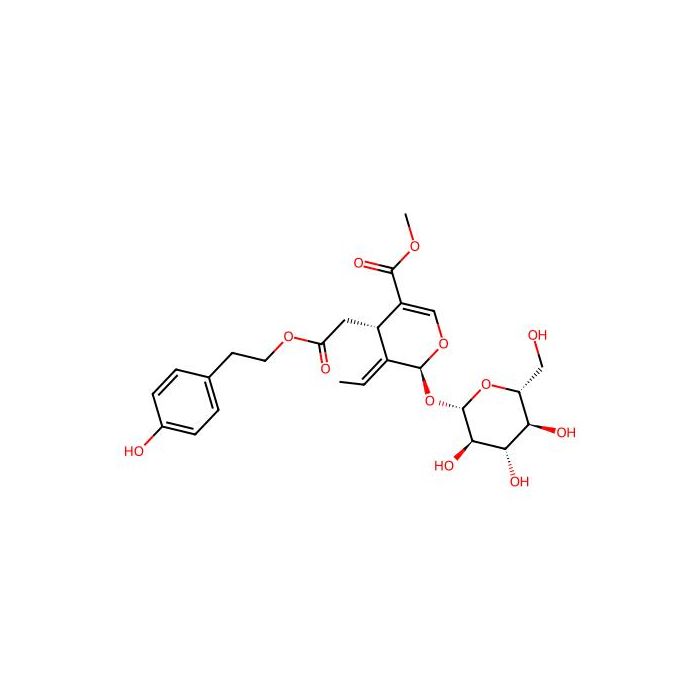
Ligustroside (Ligstroside), a secoiridoid derivative, has outstanding performance on mitochondrial bioenergetics in models of early Alzheimer's disease (AD) and brain ageing by mechanisms that may not interfere with Aβ production. Ligustroside significantly inhibits nitric oxide production in lipopolysaccharide-activated RAW264.7 macrophages.
In Vitro
Ligstroside increases mRNA expression of SIRT1, CREB1, complex I, and GPx1 in SH-SY5Y-APP 695 cells. MCE has not independently confirmed the accuracy of these methods. They are for reference only.
In Vivo
Ligstroside (50 mg/kg; a supplemented diet for 6 months) protects against mitochondrial dysfunction in models of early Alzheimer's disease and brain ageing . MCE has not independently confirmed the accuracy of these methods. They are for reference only. Animal Model: Female NMRI mice, aged 12 months Dosage: 50 mg/kg Administration: Received a supplemented diet for 6 months (equivalent to 6.25 mg/kg b.w.) Result: Showed improved spatial working memory; Restored brain ATP levels in aged mice and led to a significant life extension compared to aged control animals.
Ligustroside (Ligstroside), a secoiridoid derivative, has outstanding performance on mitochondrial bioenergetics in models of early Alzheimer's disease (AD) and brain ageing by mechanisms that may not interfere with Aβ production. Ligustroside significant
Storage
Store at 2-8°C,Protected from light,Desiccated
Verschickt in
Wet ice
Dieses Produkt erfordert Kühlkettenversand. Grundversand und andere Economy-Optionen sind nicht verfügbar.
This compound belongs to the class of organic compounds known as terpene glycosides. These are prenol lipids containing a carbohydrate moiety glycosidically bound to a terpene backbone.
External Descriptors
Not available
1. Djoumbou Feunang Y, Eisner R, Knox C, Chepelev L, Hastings J, Owen G, Fahy E, Steinbeck C, Subramanian S, Bolton E, Greiner R, and Wishart DS. ClassyFire: Automated Chemical Classification With A Comprehensive, Computable Taxonomy. Journal of Cheminformatics, 2016, 8:61.
Determine the necessary mass, volume, or concentration for preparing a solution.
Dilution Calculator
Determine the dilution needed to prepare a stock solution.
Reconstitution Calculator
Bewertungen
Kundenbewertungen
Application Protocols
No item-specific, validated application protocols are provided for this product; refer to CoA/Spec Sheet.
General example procedures (research context; adjust to your system):
HPLC reference standard preparation
Accurately weigh ~5.0 mg of ligustroside into a volumetric flask.
Dissolve in methanol (or ethanol) and bring to volume for 1.0 mg/mL stock.
Store at 2–8 °C, protected from light. Prepare working standards by aqueous dilution immediately before use.
Analyze by RP-UHPLC (C18, water–MeOH or water–ACN gradient, PDA at 235–280 nm). Confirm identity with MS if available.
Enzymatic hydrolysis assay (β-glucosidase)
Prepare 1–2 mM ligustroside in phosphate buffer (50 mM, pH 6.8) with ≤2% DMSO if needed.
Add β-glucosidase at desired activity; incubate 30 °C, 1–4 h.
Quench with MeOH (1:1), centrifuge, and analyze supernatant by LC–MS to monitor aglycone/tyrosol formation.
Antioxidant assay setup (DPPH)
Prepare serial dilutions in ethanol or ethanol/water.
Mix with DPPH solution; incubate in the dark; read at 517 nm and calculate activity relative to controls.
These are illustrative starting points only; optimize conditions for your instruments and materials.
Biological Roles
General, literature-based overview (no clinical claims):
Natural origin: Ligustroside is a secoiridoid glycoside predominantly found in plants of the Oleaceae family (e.g., Olea europaea). It is biosynthetically related to oleuropein and derives from iridoid pathways intersecting with phenylpropanoid metabolism (tyrosol incorporation).
Plant function: Proposed roles include chemical defense, antioxidant protection, and contribution to organoleptic properties of plant tissues. Its concentration varies with cultivar, developmental stage, and processing (e.g., fermentation of olives can enzymatically hydrolyze glycosides).
Biotransformation: In plant and microbial systems, β-glucosidases and esterases can convert ligustroside to tyrosol and corresponding secoiridoid aglycones; oxidation and glycosylation further diversify the metabolite pool.
Analytical biomarker: Used as a chemotaxonomic marker and quality indicator in olive leaves, fruits, and derived botanical materials; helpful in assessing processing effects and varietal differences.
Physicochemical behavior in biological media: High polarity and multiple hydrogen-bonding sites suggest limited passive diffusion across lipid membranes; in vitro work often requires cosolvents or transport facilitators. Hydrolysis can occur under acidic or enzymatic conditions, leading to changes in activity in biochemical assays.
Note: Any discussion of physiological effects should be confined to controlled research settings. This product is supplied strictly for laboratory research use.
Buffer Applications
Ligustroside is not a buffering agent and is not typically used to prepare defined pH buffer systems.
Practical note: When used in biochemical assays, dissolve ligustroside in a small volume of DMSO or ethanol and dilute into a pre-made buffer (e.g., phosphate, HEPES, or acetate) at the desired pH. Maintain organic cosolvent at low percentages to avoid precipitation and assay interference.
Stability: Avoid strongly acidic or basic buffers that can hydrolyze glycosidic and ester linkages. Near-neutral buffers (pH ~6.5–7.5) and protection from light generally support better short-term stability.
For actual buffer formulations and pH control, use established buffering agents (e.g., phosphate, HEPES, acetate, citrate) rather than ligustroside.
Green Alternatives
While ligustroside is an analyte/standard rather than a process solvent, greener choices can be made for its dissolution, extraction, and analysis.
Greener solvent choices for working with ligustroside (general guidance):
Favorable options
Water or aqueous ethanol: renewable, low-toxicity; effective for dissolution and sample preparation for RP-HPLC.
Ethanol (EtOH): bio-based and less toxic than methanol; good solubility for ligustroside and compatibility with UV/LC–MS.
Use with caution
Methanol: effective and LC-friendly but toxic; consider replacing with ethanol where feasible.
DMSO: excellent solubilizer but high E-factor in waste and potential bioassay interference; minimize volumes and dilute promptly.
Comparison (literature-informed, qualitative):
Water–EtOH (50:50): greener, adequate solubility, compatible with most reversed-phase methods; slightly reduced elution strength vs. MeOH.
Reference standard: Employed as a system suitability/calibration standard in QC of botanical raw materials and extracts where ligustroside is a declared marker.
Process development: Serves as a model compound for studying extraction, purification (e.g., RP flash/SFC), and stability of secoiridoid glycosides in botanical ingredient manufacturing.
Formulation research: Used to study solubility, degradation kinetics, and matrix effects in complex mixtures (tinctures, ethanolic extracts), informing selection of stabilizers and packaging to mitigate light/hydrolysis.
No therapeutic or clinical claims are made or implied. This product is provided strictly for research use only (from Product Data).
Physical Properties
Item-specific appearance/specs: Not specified for this item; refer to CoA/Spec Sheet.
Storage conditions (from Product Data): Store at 2–8 °C, protected from light, desiccated. Shipped on wet ice.
Literature/general values and behavior (for context; not item specifications):
Physical state: typically an off-white to pale solid (amorphous or microcrystalline) for purified standards (literature).
Thermal behavior: charring/decomposition on strong heating; well-defined melting points are often not reported for secoiridoid glycosides due to decomposition (literature).
Solubility profile (qualitative, literature):
High: water (especially warm), methanol, ethanol.
Moderate: aqueous buffers (pH-dependent), DMSO.
Low: nonpolar solvents (hexanes, toluene, CPME) due to multiple hydrogen-bond donors/acceptors.
Partitioning: highly polar; expected negative to very low logP and high topological polar surface area consistent with glycosides (computed trends; literature class behavior).
UV–Vis: conjugation within the phenethyl phenol gives absorption in the UV; typical quantitation for secoiridoid/phenolics is at 230–280 nm, with secondary bands at ~320 nm depending on substitution (literature; verify method-specific λmax).
Optical rotation: secoiridoid glycosides are optically active; sign/magnitude are structure- and solvent-dependent (literature; verify on CoA for this lot).
Note: For definitive numerical values (mp, [α]D, UV cutoff, water content, and assay purity), consult the CoA/Spec Sheet.
Quality and Grades
Grade/purity for this item: Not specified for this item; refer to CoA/Spec Sheet.
How to interpret typical grades for phytochemical standards (general guidance):
Analytical/Reference Standard Grade: Tight control of identity (NMR, HRMS), purity (HPLC area %), and residual solvents; intended for method development, system suitability, and quantitative assays in botanicals or foods.
Research/Biochemical Grade: Suitable for discovery biology and organic synthesis; may have broader specs for assay purity and residuals.
HPLC Grade (for solvents) is not applicable here; for analytes, “HPLC ≥98%” typically refers to chromatographic purity by a defined method.
Characterization best practices (recommended for ligustroside lots):
Identity: 1H/13C NMR in DMSO-d6 or CD3OD; diagnostic signals for iridoid protons, anomeric proton (β-Glc ~4.3–4.6 ppm, J ~7–8 Hz), aromatic protons of the p-hydroxyphenethyl group.
Purity: Reversed-phase HPLC or UHPLC with PDA at ~235–280 nm; consider secondary detection (MS) to resolve co-eluting secoiridoids (e.g., oleuropein, demethyloleuropein).
Water and ash content, residual solvents, heavy metals: Not specified for this item; refer to CoA/Spec Sheet.
Documentation: CoA should state assay method, chromatographic conditions (column, gradient, λ), and reference spectra/chromatograms to support traceability.
Reaction and Applications
Ligustroside is primarily used as a reference standard and as a substrate/precursor in natural products and carbohydrate chemistry.
Analytical/standards work:
System suitability and calibration for quantifying secoiridoids in olive-derived matrices by HPLC/UHPLC–PDA or LC–MS.
Fingerprinting and chemometric profiling of botanical materials (e.g., differentiating ligustroside vs. oleuropein content).
Biotransformation and enzymology (literature):
Substrate for β-glucosidase- or esterase-mediated hydrolysis to release tyrosol and secoiridoid aglycones; used to study glycosidase selectivity and kinetics.
Oxidative or enzymatic conversions to related secoiridoids for pathway elucidation.
Synthetic manipulations (general):
Selective acylation/benzoylation of hydroxyls for protecting-group studies.
Transesterification or mild saponification to access aglycone derivatives.
Periodate-mediated sugar cleavage followed by reductive workups to probe connectivity (structural elucidation workflows).
Materials/antioxidant chemistry (in vitro research):
Model phenolic for radical scavenging assays (DPPH, ABTS) and ORAC benchmarking; compare activity of ligustroside vs. catechol-containing analogs (e.g., oleuropein).
Notes:
Avoid strong mineral acids/bases that can cause rapid degradation (glycosidic and ester cleavage).
For kinetic or stability studies, maintain controlled pH (near-neutral) and exclude light and metal contaminants.
Reaction Conditions
General literature-guided conditions for common manipulations of ligustroside (for planning; verify and optimize experimentally):
Glycosidic hydrolysis (enzymatic):
Reagents: β-glucosidase (almond or microbial).
Solvent: phosphate buffer pH 6.0–7.0; 25–40 °C.
Time: 1–24 h depending on enzyme load and substrate concentration.
Reagents: Na2CO3 or NaHCO3 (aqueous), or catalytic NaOMe in MeOH at 0–25 °C.
Considerations: Avoid strong base and prolonged exposure to prevent sugar degradation; quench promptly and neutralize.
Protection (acetylation):
Reagents: Ac2O/pyridine or DMAP in anhydrous CH2Cl2 or MeCN at 0–25 °C.
Outcome: Peracetates of sugar and phenolic OH; selectivity achievable via stepwise or enzymatic strategies.
Analytical prep (stock solutions):
1–10 mg/mL in MeOH, EtOH, or DMSO; store cold, protected from light; dilute into aqueous media before injection or assay.
Purification:
RP flash or preparative HPLC with water–MeOH/ACN gradients; acidic modifiers (e.g., 0.1% formic acid) can sharpen peaks but may accelerate hydrolysis over long exposures.
These conditions are representative literature practices, not item-specific specifications.
Safety and Handling
Research use: For research use only (from Product Data). Not for human or animal diagnostic or therapeutic use.
GHS information for this item: Not specified for this item; refer to SDS.
Signal word: Not specified for this item; refer to SDS.
Hazard statements (H-phrases): Not specified for this item; refer to SDS.
Pictograms: Not specified for this item; refer to SDS.
General laboratory safety (good practice for polyphenolic glycosides; not a substitute for SDS):
PPE: lab coat, safety glasses, disposable nitrile gloves. Avoid inhalation of powders and contact with eyes/skin.
Handling: Work away from strong light to minimize photo-induced degradation. Use clean, dry tools; minimize exposure to ambient humidity due to hygroscopic tendencies of sugar-rich compounds.
Incompatibilities: Strong oxidizers; strong acids/bases (can hydrolyze glycosidic/ester bonds). Avoid elevated temperatures that may accelerate hydrolysis or decomposition.
First aid (general):
Skin/eye contact: Rinse with water for several minutes; remove contaminated clothing; seek medical attention if irritation persists.
Inhalation: Move to fresh air; seek attention if symptoms occur.
Ingestion: Rinse mouth; do not induce vomiting; seek medical advice.
Spill/leak: Avoid dust formation. Collect solids by gentle sweeping or HEPA vacuum; wipe residues with alcohol–water solution.
Waste: Dispose of according to institutional and local regulations for organic laboratory chemicals.
Always defer to the product-specific SDS for authoritative safety and regulatory information.
Solvent Selection
Ligustroside is a highly polar, multi-hydroxylated glycoside. Selecting the right solvent is crucial for dissolution, stability, and method compatibility.
Polarity/miscibility (general):
Best solvents: water, methanol, ethanol, aqueous methanol/ethanol, and DMSO.
Limited solubility: acetone, acetonitrile (improves with water content), ethyl acetate.
Poor solvents: nonpolar media (hexane, heptane, toluene).
Practical recommendations:
Analytical stock solutions: prepare 1–10 mg/mL in methanol, ethanol, or DMSO; dilute into aqueous mobile phases for HPLC/LC–MS. Filter (0.22 µm PTFE or PVDF) if needed.
Bioassays: prefer aqueous buffer with a small cosolvent fraction (≤5–10% DMSO or ≤20–30% ethanol) to avoid precipitation on dilution.
Stability: protect from light; avoid strong acid/base; chilled, neutral aqueous–alcoholic media generally preserve integrity during short analyses.
Comparison (use case oriented):
Water–MeOH (50:50): balanced elution strength for RP-HPLC injections and good solubility.
DMSO: maximal solubilizing power; may be undesirable for some enzymes/cells; dilute immediately before use.
Ethanol: greener alternative to MeOH/DMSO; broad compatibility for spectrophotometry and extractions.
Always verify solvent compatibility with your analytical or biological system and confirm absence of precipitation upon dilution.
Storage and Reconstitution
Storage (from Product Data): Store at 2–8 °C, protected from light, desiccated. Shipments are on wet ice.
Container handling: Keep tightly closed in a dry, light-protective container. Minimize headspace exchanges to limit moisture uptake and oxidation.
Reconstitution (general guidance; not item-specific specs):
Solvents: methanol, ethanol, water, or DMSO. Begin with a small volume of solvent, sonicate gently if needed, then bring to final volume.
Concentration: Choose based on application (e.g., 1–10 mg/mL for analytical stocks). Verify complete dissolution and filter (0.22 µm) if particulates are present.
Working solutions: Prepare freshly in aqueous media; avoid prolonged exposure to strong acids/bases and light.
Aliquoting: Divide stock into single-use portions to avoid repeated freeze–thaw or light exposure.
Stability considerations (general):
Hygroscopic materials may pick up moisture; open only at ambient RH <50% or under dry gas if feasible.
Protect from light to minimize photooxidation of phenolic and iridoid functionalities.
If more detailed stability data (e.g., shelf life, impurity limits, or assay over time) are required, consult the product CoA/Spec Sheet and perform in-house verification under your storage conditions.
Structure and Identity
Ligustroside is a plant-derived secoiridoid glycoside commonly encountered as a reference phytochemical in Oleaceae matrices (e.g., olive leaf/fruit). It features an esterified secoiridoid core glycosidically linked to glucose and bearing a para-hydroxyphenethyl (tyrosol) moiety.
Item-specific identifiers (from Product Data)
SKU: L648524
CAS: 35897-92-8
InChIKey: 106042 (as provided)
SMILES: Not specified for this item; refer to CoA/Spec Sheet.
Molecular formula: Not specified for this item; refer to CoA/Spec Sheet.
Molecular weight: Not specified for this item; refer to CoA/Spec Sheet.
Structural features (general chemistry knowledge)
Iridoid/secoiridoid framework with a hemiacetal/lactol functionality embedded in the bicyclic system.
β-D-glucopyranosyl glycosidic linkage at C-1 of the iridoid core (typical for this class).
Ester linkage connecting the secoiridoid acid fragment to a p-hydroxyphenethyl (tyrosol) alcohol.
Functional groups: phenol (p–OH), primary alcohol (in sugar), multiple secondary alcohols, ester, acetal, and ether linkages.
Stereochemistry: multiple defined stereocenters on the iridoid ring system and at the anomeric carbon (typically β-configuration); exact configuration should be verified against the CoA or primary literature for the supplied lot.
2D structure in words (general description)
A glucose unit attached to a bicyclic, oxygen-rich iridoid skeleton that is opened (seco) and further esterified to a para-hydroxylated phenethyl group.
Synthetic Utility
Ligustroside’s dense functionality and defined stereochemistry make it a useful scaffold in synthesis and reactivity studies.
Functional group handles:
Phenolic p–OH (on the phenethyl unit): amenable to etherification/esterification; radical coupling studies.
Ester linkage: can be transesterified or hydrolyzed (acid/base or enzymatic) to access aglycone/tyrosol fragments.
Acetal/hemiacetal moiety in the iridoid: sensitive to strong acids; can engage in rearrangements or opening under controlled conditions.
Transformations (literature precedents):
Enzymatic hydrolysis with β-glucosidase to remove glucose; esterase-catalyzed cleavage to release tyrosol.
Oxidation of the phenolic moiety and comparative antioxidant/radical-trapping studies vs. catechol analogs.
Derivatization for MS: formation of dansyl/acetyl/benzoyl derivatives to improve chromatographic behavior and detection.
Retrosynthetic value:
Provides access to tyrosol-based esters and iridoid aglycones for SAR studies within secoiridoid families.
Caveats: Protect groups judiciously to avoid over-acylation of sugar hydroxyls; maintain neutral to mildly basic conditions for steps requiring the intact glycosidic linkage.
Target Specificity
This product is a small-molecule natural product standard (secoiridoid glycoside), not an antibody, enzyme, or affinity reagent.
Target specificity data (clone, isotype, antigen, species reactivity, etc.): Not applicable.
In biochemical studies, ligustroside may be used as a substrate or probe for general classes of enzymes (e.g., β-glucosidases, esterases) to study catalytic preferences; however, no target-binding specificity is designated for this catalog item.
Häufig gestellte Fragen
What is the purity of this product?
This product is supplied at ≥98% purity (chemical assay). Lot-specific values are stated on the Certificate of Analysis.
How should this product be stored?
Store at 2–8 °C, protected from light, desiccated. Keep the container tightly closed with desiccant — the material is moisture-sensitive.
How is this product shipped?
This product ships chilled on wet ice. Unpack on arrival and transfer it to the storage condition stated above.
What are the CAS number, molecular formula and molecular weight?
The CAS Number is 35897-92-8, the molecular formula is C25H32O12, and the molecular weight is 524.51 g/mol. InChIKey GMQXOLRKJQWPNB-MVVLSVRYSA-N.
What documentation is provided?
Available product documentation, including Certificates of Analysis (COA), Safety Data Sheets (SDS), and specification sheets, is shown in the product document area. Document availability and access follow the current site policy.
Wir verwenden Cookies, um die ordnungsgemäße Funktion der Website sicherzustellen und, soweit zulässig, Ihr Nutzererlebnis zu verbessern. Sie können Ihre Einstellungen jederzeit unter „Einstellungen“ verwalten. Weitere Informationen finden Sie in unserer Cookie-Richtlinie.
Dürfen wir Sie über Rabattaktionen informieren?
Später erinnern
Vielen Dank! Bitte überprüfen Sie Ihren E-Mail-Posteingang, um zu bestätigen.
Products are supplied to verified businesses, institutions, and qualified professionals for research and development use only. Not for use in humans, animals, diagnosis, or therapy.