Long-chain fatty acid - Carboxylic acid salt - Organic lithium salt - Organic alkali metal salt - Monocarboxylic acid or derivatives - Carboxylic acid - Carboxylic acid derivative - Organic oxygen compound - Organic oxide - Hydrocarbon derivative - Organic salt - Organooxygen compound - Carbonyl group - Aliphatic acyclic compound
Beschreibung
This compound belongs to the class of organic compounds known as long-chain fatty acids. These are fatty acids with an aliphatic tail that contains between 13 and 21 carbon atoms.
External Descriptors
Not available
1. Djoumbou Feunang Y, Eisner R, Knox C, Chepelev L, Hastings J, Owen G, Fahy E, Steinbeck C, Subramanian S, Bolton E, Greiner R, and Wishart DS. ClassyFire: Automated Chemical Classification With A Comprehensive, Computable Taxonomy. Journal of Cheminformatics, 2016, 8:61.
Determine the necessary mass, volume, or concentration for preparing a solution.
Dilution Calculator
Determine the dilution needed to prepare a stock solution.
Reconstitution Calculator
Bewertungen
Kundenbewertungen
Application Protocols
Item-specific (from Product Data)
Tested applications and recommended conditions: Not specified for this item; refer to CoA/Spec Sheet.
General practice examples (literature; for research use only)
Lubricant gel preparation: 10 wt% lithium stearate in mineral oil; heat to ~190 °C under stirring until transparent; cool while shearing to achieve uniform gel. Verify consistency (e.g., cone penetration) per ASTM methods.
Metal stearate exchange: Combine lithium stearate (1.0 equiv) with anhydrous CaCl2 (0.5 equiv) in hot ethanol; reflux 2 h; filter and wash to isolate calcium stearate; dry under vacuum at 80 °C.
Note: These are general examples and not validated protocols for this SKU. Optimize and validate conditions for your system.
Biological Roles
Applicability
Lithium stearate itself is not a biological metabolite and is intended for research and materials use. No clinical/therapeutic claims are made.
Literature/General context
Stearate (octadecanoate) is a common saturated fatty acid anion derived from stearic acid, widely found in lipids and biological membranes. In biology, stearic acid participates in lipid biosynthesis, beta-oxidation, and membrane structure when esterified to glycerol backbones.
Lithium is a small alkali metal cation with no essential biological role; free lithium salts can influence ionic balances, but lithium stearate’s hydrophobic anion limits aqueous bioavailability.
Implications for lab work
In aqueous biological systems, lithium stearate has very low solubility and is not typically used. If introduced, it may form micelles/aggregates only above high loading in specialized nonaqueous or emulsified environments.
For model membrane or surfactant studies in nonaqueous media, long-chain carboxylates (including lithium stearate) can be used to probe self-assembly and interfacial behavior.
Summary
Biological relevance pertains to the stearate moiety’s role in lipid chemistry; lithium stearate is primarily a materials/industrial reagent rather than a biochemical tool.
Buffer Applications
Not typically applicable.
Lithium stearate is an insoluble fatty acid salt and is not used to prepare aqueous buffer systems. For aqueous work involving stearate, sodium or potassium stearate soaps are more common due to better water dispersibility.
See the Solvent Selection and Reaction & Applications tabs for guidance on dispersion and nonaqueous processing.
Green Alternatives
Context (literature)
Lithium stearate is valued for high-performance greases and as a lubricant/additive. Sustainability considerations include lithium criticality, sourcing of stearic acid (renewable fats vs petrochemical), and processing temperatures.
Potential alternatives and trade-offs
Sodium or potassium stearate: Renewable carbon content; better aqueous processing. Trade-off: poorer high-temperature grease properties; higher water sensitivity.
Calcium stearate: Abundant, lower criticality metal; common as a polymer lubricant. Trade-off: grease thickening and mechanical stability typically inferior to lithium systems at high temperatures.
Aluminum stearate: Strong gelling and thickening in nonpolar media at lower loadings. Trade-off: different shear stability; may require aromatic solvents and can complicate recycling.
Lithium 12-hydroxystearate: Often more efficient than lithium stearate for greases (lower treat rate, better dropping point). Trade-off: still lithium-based; similar criticality concerns.
Bio-based thickeners (e.g., cellulose derivatives, oleogelators): Renewable and metal-free. Trade-off: Limited temperature range and load-carrying capability vs lithium soaps.
Mini-comparison (literature)
Criterion | Li stearate | Ca stearate | Al stearate
Grease high-temp performance | High | Moderate | High (aromatics)
Water resistance | Good | Moderate | Moderate
Cost | Moderate–High | Low | Moderate
Greener practice tips
Use bio-derived stearic acid feedstocks.
Optimize formulations to lower thickener loading.
Implement energy-efficient heating/mixing profiles during gel formation.
Pharmaceutical Uses
Item-specific (from Product Data)
No pharmacopeial status or excipient grade indicated. Grade/Purity: Not specified for this item; refer to CoA/Spec Sheet.
Literature/General context
Metal stearates are widely used as excipients (e.g., magnesium stearate, calcium stearate) for lubrication and mold release in solid dosage manufacturing. Lithium stearate, however, is not commonly used in pharmaceutical formulations because the lithium ion is generally avoided in excipients unless specifically justified.
Potential roles in non-pharmaceutical materials: internal/external lubricant in polymeric medical device processing (non-contact components), release agent for molded parts, pending material compatibility and regulatory review.
Compliance note
Any use in drug products would require verification of excipient status, impurity limits (e.g., heavy metals, free stearic acid), and lithium-specific toxicology. This product is for research use only (per Product Data).
Physical Properties
Item-specific (from Product Data)
Appearance: Not specified for this item; refer to CoA/Spec Sheet.
Literature/General values (non-specification; typical for lithium stearate)
Physical state: white/off-white, waxy to powdery solid (literature)
Melting point: often reported ~220–225 °C (may soften and decompose; literature)
Density: typically ~1.02–1.05 g/cm³ at 25 °C (literature)
Solubility: insoluble in water; limited solubility in lower alcohols; soluble/dispersible in hot nonpolar oils and aliphatic hydrocarbons; forms gels in mineral/PAO oils (literature)
Partitioning: classical logP not meaningful due to ionic character; behaves amphiphilically (literature)
pKa: not applicable (salt of a strong carboxylic acid in this context); stearic acid pKa ~10.1 (water/ethanol; literature)
Hygroscopicity: low to moderate; may absorb moisture/oil film (literature)
Thermal behavior: can form lithium carbonate/oxide on strong heating in air with organic decomposition (literature)
Notes
All numeric values above are for general reference only and are not specifications for this SKU.
Quality and Grades
Item-specific (from Product Data)
Grade/Purity: Not specified for this item; refer to CoA/Spec Sheet.
Stabilizers/Additives: Not specified for this item; refer to CoA/Spec Sheet.
General guidance on grades for metal stearates (literature/industry context)
Technical/industrial grade: Common for lubricant and polymer-additive use; controls on ash content, free fatty acid, moisture, and particle size are typical. May not be suitable for analytical applications.
Analytical/reagent grade: Tighter control of inorganic impurities (e.g., Na, K, Ca, Fe) and free acid; useful when catalytic or spectroscopic sensitivity to trace metals matters.
Low free acid/low moisture specs: Important for moisture-sensitive compounding and for reproducible rheology in grease formulation.
Oil content/particle size: Impacts dispersion quality and thickening efficiency in lubricants; microfine powders disperse more uniformly.
Recommendation
Review the CoA/Spec Sheet for this SKU for exact assay, loss on drying, free stearic acid, heavy metals, and any additive information. Select grade according to application (tribology, polymer processing, or materials synthesis).
Reaction and Applications
Item-specific (from Product Data)
Manufacturer Applications: Not specified for this item; refer to CoA/Spec Sheet.
Literature/General applications
Lubricating greases: Primary thickener for multi-purpose lithium greases; lithium 12-hydroxystearate is most common, while lithium stearate is used for specific rheology/compatibility profiles. Provides good mechanical stability and water resistance.
Polymer processing: Internal/external lubricant and mold-release aid in polyolefins and engineering plastics; improves flow, reduces die buildup, and enhances surface finish.
Rubber compounding: Processing aid and anti-tack agent; can influence filler dispersion.
Pigments/fillers surface treatment: Carboxylate anchoring to inorganic surfaces (e.g., CaCO3, metal oxides) to improve hydrophobicity and dispersion in nonpolar matrices.
Materials synthesis: Precursor for generating lithium-containing oxides/carbonates via thermal decomposition; metathesis route to other metal stearates by exchange with soluble metal salts (e.g., MClx).
Colloids/supramolecular: Amphiphilic lithium carboxylate can participate in lamellar/gel phases in hydrocarbons; useful for model systems of surfactant self-assembly in nonaqueous media.
Practical tips (literature)
Drying: If low moisture is required, dry under vacuum at 60–80 °C to constant weight to remove adsorbed water/oils.
Dispersion: Pre-wet with a small portion of hot oil or solvent to minimize agglomeration; apply high-shear mixing for uniform gels.
Reactivity: Acid addition regenerates stearic acid; use in non-aqueous metathesis to avoid competitive hydrolysis.
Metathesis to other metal stearates: Suspend lithium stearate in hot ethanol/toluene mixtures (60–90 °C). Add a solution of the target metal salt (e.g., MClx) under stirring. Reaction times 1–4 h are typical. The desired metal stearate often precipitates or can be isolated after solvent removal and washing. Maintain anhydrous or low-water conditions to limit back-formation of stearic acid.
Surface modification: Disperse nanoparticles (e.g., metal oxides) in hot nonpolar solvent (toluene, xylene) and add lithium stearate (0.1–10 wt% vs solids). Heat 80–130 °C with vigorous stirring for 1–6 h to achieve carboxylate binding; wash by centrifugation/redispersion.
Grease gel formation (materials prep): Charge base oil and lithium stearate (typically 5–15 wt%) into a reactor with agitation. Heat to 180–200 °C until clarity; then controlled cooling with shear to target NLGI grade. Incorporate performance additives below 120 °C (literature practice; exact temperatures and times depend on formulation and equipment).
Acid regeneration of stearic acid: Treat a suspension of lithium stearate with a slight excess of a mineral or carboxylic acid in an organic/water biphasic system. Separate the organic phase containing stearic acid; wash and dry.
Notes
Monitor by FTIR (carboxylate νas(COO–) ~1540–1560 cm⁻¹; νs(COO–) ~1400–1420 cm⁻¹) to confirm binding vs free acid (C=O ~1700–1715 cm⁻¹).
No catalytic activity is inherent; the salt primarily acts as ligand/thickener/precursor.
Safety and Handling
Item-specific (from Product Data)
GHS classification, signal word, pictograms, H-statements: Not specified for this item; refer to SDS.
Storage conditions: Room temperature (per Product Data).
General safety guidance (consult the product SDS for authoritative information)
Expected hazards: Generally considered low acute toxicity for metal stearates; dust may cause mechanical irritation to eyes/respiratory tract. Avoid inhalation of dusts and prolonged skin contact.
PPE: Use lab coat, safety glasses or goggles, and appropriate gloves (e.g., nitrile). Employ dust control (local exhaust) when handling powders.
Incompatibilities: Strong oxidizers (risk of exotherm); strong acids (will liberate stearic acid); strong bases at high temperature may promote decomposition.
Thermal hazards: Organic component may smolder/burn; decomposition at elevated temperatures can generate irritating fumes and lithium-containing inorganic residues (e.g., Li2CO3) in air.
Spill/cleanup: Avoid dust generation. Sweep or HEPA vacuum into suitable container. Wash area with mild detergent.
First aid overview: Eye—rinse with water for several minutes; Skin—wash with soap and water; Inhalation—move to fresh air; Ingestion—rinse mouth. Seek medical attention if symptoms persist.
Firefighting: Use CO2, dry chemical, or foam for surrounding materials. Fire residues may contain lithium salts; avoid water jets that may spread burning oils if greases are present.
For research use only (per Product Data).
Solvent Selection
Applicability
Lithium stearate is a solid additive/thickener, not used as a solvent. Solvent selection is therefore about dispersing or dissolving it for processing.
Literature/General guidance
Polarity: Amphiphilic salt with a long hydrophobic tail; does not dissolve in water but can disperse in nonpolar media and certain polar organics with heating.
Miscibility/dispersion profile:
Water: Insoluble; may form scums/films.
Hydrocarbon/mineral/PAO oils: Dispersible; forms gels on heating with shear—basis of lithium grease thickeners.
Alcohols (EtOH, i-PrOH): Low solubility at RT; improved on heating.
Aromatics (toluene, xylene): Dispersible with heat.
Polar aprotics (THF, DMF): Limited solubility; can aid in metathesis or surface treatments.
Processing tips:
For lubricant gels: Charge lithium stearate into base oil (e.g., mineral or PAO), heat to ~180–200 °C with agitation until clarity/gelation, then cool under shear to target NLGI grade (literature; adjust per formulation).
For polymer additives: Pre-blend with carrier resin or masterbatch for uniform distribution.
Comparison (literature)
Sodium/calcium stearates: Better water dispersibility (soap formation), but inferior high-temperature grease performance vs lithium stearate.
Aluminum stearate: Strong gelling in aromatics; different rheology vs lithium stearate.
Storage and Reconstitution
Item-specific (from Product Data)
Storage conditions: Room temperature.
Shipped in: Not specified for this item; refer to CoA/Spec Sheet.
General guidance (literature/best practice)
Container: Store in tightly closed, clean, inert container to prevent uptake of moisture, dust, or oils. Use a wide-mouth bottle if frequent scooping is expected.
Environment: Ambient dry place, away from strong oxidizers and acids. Avoid sources of ignition when handling powders near flammable oils/solvents.
Shelf life: Stable under recommended conditions; check periodically for caking or contamination. Refer to CoA for retest date.
Reconstitution/dispersion: For preparing concentrates or gels, add to preheated solvent/oil with stirring. For analytical work, dry at 60–80 °C under vacuum to constant mass before use.
Handling: Minimize dust formation; use clean, dry tools. Reseal promptly after use to maintain consistent moisture content.
For research use only (per Product Data).
Structure and Identity
Item-specific (from Product Data)
Product name: Lithium stearate (SKU: L283258)
CAS: 4485-12-5
PubChem CID: 517357
InChIKey: 120997 (as provided)
SMILES: Not specified for this item; refer to CoA/Spec Sheet.
Molecular formula: Not specified for this item; refer to CoA/Spec Sheet.
Molecular weight: Not specified for this item; refer to CoA/Spec Sheet.
Literature/General identity (for reference only)
Synonyms: Lithium octadecanoate; lithium salt of stearic acid
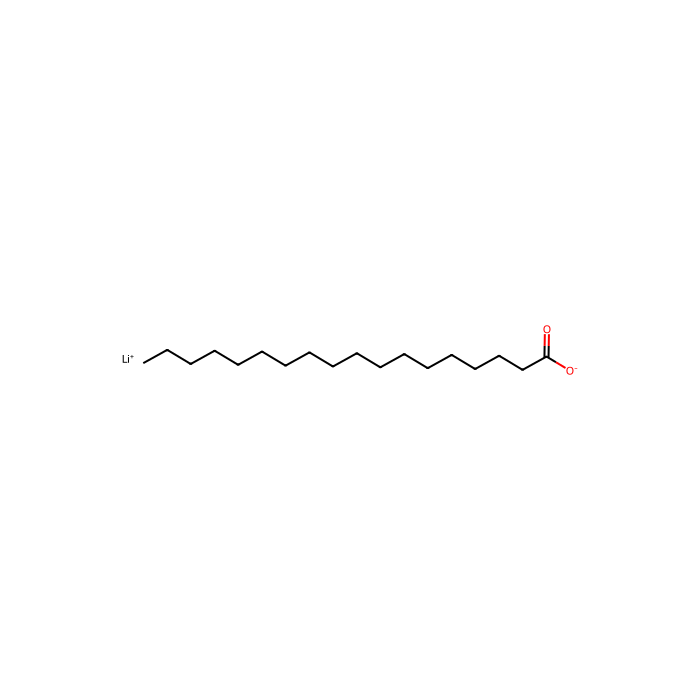
Typical molecular formula (literature): C18H35LiO2
Structural features: a single long, saturated C18 alkyl chain (stearate, CH3–(CH2)16–) terminating in a carboxylate group bound to Li+. No rings, no heteroatoms beyond the carboxylate oxygens; fully saturated hydrocarbon tail; ionic carboxylate headgroup.
2D description: a linear C18 hydrocarbon chain attached to a carboxylate (–COO–) with lithium as the counter-cation; amphiphilic (hydrophobic tail, polar ionic head).
Synthetic Utility
Literature/General synthetic roles
Carboxylate source: Lithium stearate serves as a readily handled solid source of stearate anion. It can be used to introduce hydrophobic C18 chains onto inorganic or organometallic surfaces through ligand exchange.
Metathesis to other metal stearates: Reaction with soluble metal salts (e.g., CaCl2, Zn(OAc)2, FeCl3) in suitable media yields the corresponding metal stearates (precipitation-driven or phase-transfer assisted). Useful for preparing tailored surface treatments or catalyst supports.
Hydrophobic capping ligand: Long-chain carboxylates cap nanocrystal surfaces (e.g., metal oxides), modulating growth and dispersibility in nonpolar solvents.
Phase-transfer and ion-pairing: In nonaqueous systems, lithium carboxylates can act as counterions to generate ion pairs that alter solubility and reactivity of organic cations.
Thermal precursor: On calcination, the organic portion combusts leaving lithium-containing inorganic residues (e.g., Li2CO3, Li2O), enabling routes to Li-doped oxides or carbonates for materials research.
Practical considerations
Choose solvent systems that promote either dissolution (hot alcohols/aromatics) or effective dispersion (oils) depending on the transformation.
Avoid excess water during metathesis if free stearic acid formation is undesirable; a slight excess of base (e.g., Li2CO3) can drive full neutralization when generating stearates in situ.
Target Specificity
Not applicable.
This product is a small-molecule inorganic-organic salt, not a biological affinity reagent or antibody. No antigen/epitope/clone/isotype information applies.
Häufig gestellte Fragen
How should this product be stored?
Store at room temperature.
What are the CAS number, molecular formula and molecular weight?
The CAS Number is 4485-12-5, the molecular formula is C18H35LiO2, and the molecular weight is 290.41 g/mol. InChIKey HGPXWXLYXNVULB-UHFFFAOYSA-M.
What documentation is provided?
Available product documentation, including Certificates of Analysis (COA), Safety Data Sheets (SDS), and specification sheets, is shown in the product document area. Document availability and access follow the current site policy.
Wir verwenden Cookies, um die ordnungsgemäße Funktion der Website sicherzustellen und, soweit zulässig, Ihr Nutzererlebnis zu verbessern. Sie können Ihre Einstellungen jederzeit unter „Einstellungen“ verwalten. Weitere Informationen finden Sie in unserer Cookie-Richtlinie.
Dürfen wir Sie über Rabattaktionen informieren?
Später erinnern
Vielen Dank! Bitte überprüfen Sie Ihren E-Mail-Posteingang, um zu bestätigen.
Products are supplied to verified businesses, institutions, and qualified professionals for research and development use only. Not for use in humans, animals, diagnosis, or therapy.

 J2627052