Store at Room Temperature. Store under desiccating conditions. The product can be stored for up to 12 months.
Spezifikationen
Synonyme
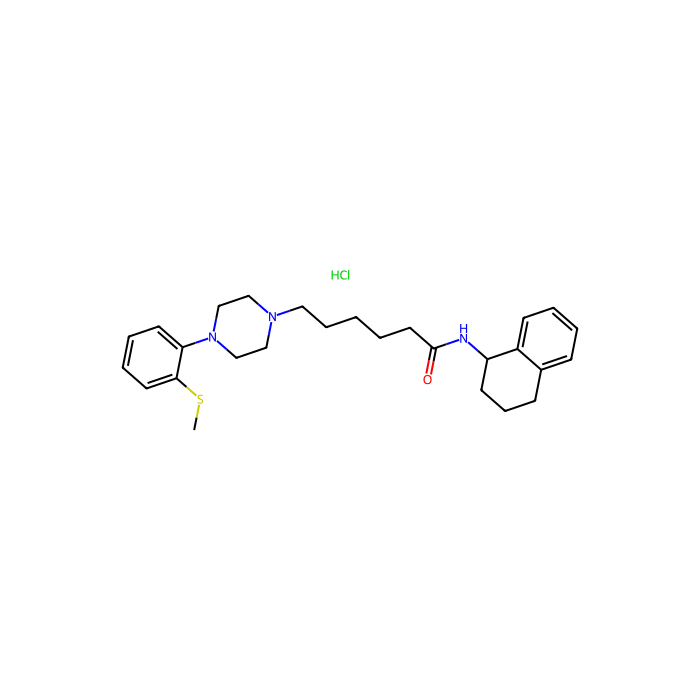
4-[2-(Methylthio)phenyl]-N-(1,2,3,4-tetrahydro-1-naphth alenyl)-1-piperazinehexanamide hydrochloride | LP44 | 6-(4-(2-(Methylthio)phenyl)piperazin-1-yl)-N-(1,2,3,4-tetrahydronaphthalen-1-yl)hexanamide hydrochloride | 1-Piperazinehexanamide, 4-(2-(methylthio)phenyl)-N-(1,2,3,4-tetrahydro-1-naphthalenyl)-, hydrochloride (1:1) | 1-Piperazine Show more
Spezifikationen & Reinheit
≥99%
Biochemische und physiologische Mechanismen
Highly potent, selective 5-HT 7 agonist (K i = 0.22 nM). Shows >200 and >1000-fold selectivity over 5-HT 1A and 5-HT 2A receptors, respectively. Supresses REM sleep.
Storage
Room temperature,Desiccated
Verschickt in
Normal
Aktionsart
AGONIST
Hinweis
Wherever possible, you should prepare and use solutions on the same day. However, if you need to make up stock solutions in advance, we recommend that you store the solution as aliquots in tightly sealed vials at -20°C. Generally, these will be useable for up to one month. Before use, and prior to opening the vial we recommend that you allow your product to equilibrate to room temperature for at least 1 hour. Need more advice on solubility, usage and handling? Please visit our frequently asked questions (FAQ) page for more details.
This compound belongs to the class of organic compounds known as phenylpiperazines. These are compounds containing a phenylpiperazine skeleton, which consists of a piperazine bound to a phenyl group.
External Descriptors
Not available
1. Djoumbou Feunang Y, Eisner R, Knox C, Chepelev L, Hastings J, Owen G, Fahy E, Steinbeck C, Subramanian S, Bolton E, Greiner R, and Wishart DS. ClassyFire: Automated Chemical Classification With A Comprehensive, Computable Taxonomy. Journal of Cheminformatics, 2016, 8:61.
Zertifikate (CoA, COO, BSE/TSE und Analyse-Diagramm)
C of A & Other Certificates(BSE/TSE, COO):
Analytical Chart:
Chemische und physikalische Eigenschaften
Löslichkeit
Soluble in DMSO to 100 mM and in ethanol to 100 mM
Molekulargewicht
488.100 g/mol
XLogP3
Hydrogen Bond Donor Count
2
Hydrogen Bond Acceptor Count
4
Rotatable Bond Count
9
Exact Mass
487.242 Da
Monoisotopic Mass
487.242 Da
Topological Polar Surface Area
60.900 Ų
Heavy Atom Count
33
Formal Charge
0
Complexity
565.000
Isotope Atom Count
0
Defined Atom Stereocenter Count
0
Undefined Atom Stereocenter Count
1
Defined Bond Stereocenter Count
0
Undefined Bond Stereocenter Count
0
The total count of all stereochemical bonds
0
Covalently-Bonded Unit Count
2
Lösungsrechner
Molarity Calculator
Determine the necessary mass, volume, or concentration for preparing a solution.
Dilution Calculator
Determine the dilution needed to prepare a stock solution.
Reconstitution Calculator
Bewertungen
Kundenbewertungen
Application Protocols
The Product Data do not list validated protocols for LP-44. Use standard small-molecule handling practices and develop assay-specific procedures.
General protocol outline for in vitro assays (not item-specific)
Prepare a 10–50 mM stock in anhydrous DMSO. Confirm concentration by UV or qNMR if needed.
Serially dilute in DMSO or aqueous buffer to the desired working range. Keep final DMSO ≤0.5–1% v/v in the assay.
Include vehicle controls, positive/negative controls as appropriate, and assess compound stability over the assay timeframe (e.g., LC–MS at 0 and end point).
Check for precipitation visually and by light scattering; adjust solvent/cosolvent accordingly.
If using in biochemical binding/enzymatic assays, incorporate counter-screens to exclude assay interference (fluorescence quenching/enhancement, redox activity, aggregation). Lot-specific recommendations, if any, will be found on the CoA/Spec Sheet.
Biological Roles
No biological target, pathway, or mode-of-action annotations are provided in the Product Data for LP-44. Without a verified structure and curated bioactivity record, no item-specific biological roles can be stated.
General considerations for screening compounds (not item-specific)
Putative roles are typically inferred from target-based or phenotypic screening; any preliminary annotations must be verified across orthogonal assays and counter-screens to exclude assay interference compounds (PAINS) and nonspecific mechanisms (e.g., redox cycling, aggregation).
Establish a reference quality control package: identity (HRMS, NMR), purity (orthogonal HPLC), stability (thermal, photolytic, hydrolytic), and solubility/logD as a function of pH to contextualize observed bioactivity.
Evaluate potential liabilities early: chemical reactivity with thiols/amines, fluorescence overlap with assay readouts, and colloidal aggregation (use detergents or DLS where appropriate).
If literature suggests a known target for a same-named compound, confirm CAS/CID congruence before transferring any claims to this catalog item. Use the CAS (824958-12-5) and CID (11225543) to retrieve authoritative records prior to making mechanistic conclusions.
Buffer Applications
Buffer-forming properties are not applicable to LP-44 as presented; no acid/base characteristics or pKa data are provided in the Product Data.
Practical guidance for assay buffers (general, not item-specific)
Stock solutions: Prepare in anhydrous DMSO, then dilute into the assay buffer immediately before use. Keep final solvent ≤0.5–1% v/v to minimize effects on pH, ionic strength, and biological activity.
Adsorption mitigation: Include a small amount of nonionic detergent (e.g., 0.01–0.05% Tween-20) when permissible to limit compound binding to plastics.
pH stability checks: If the compound exhibits pH-dependent solubility or stability (to be determined experimentally), evaluate in representative buffers (PBS pH 7.4, HEPES pH 7.4, Tris pH 8.0) before high-throughput use.
Item-specific buffer recipes are not applicable; consult the CoA/Spec Sheet for any provided solubility notes.
Green Alternatives
Specific process chemistry for LP-44 is not defined in the Product Data. The guidance below addresses greener handling strategies for general small-molecule use, especially in screening and analytical workflows.
Greener solvent choices (general)
Prefer 2-MeTHF or CPME over dichloromethane/THF for many extraction and reaction scenarios where applicable (check solubility/compatibility first).
Use ethanol or isopropanol in place of acetonitrile/methanol for certain sample preparations when assay tolerance allows.
Consider water-rich cosolvent systems (e.g., EtOH/water) for cleanup where compound stability permits.
Operational improvements
Minimize DMSO volume in assay plates (≤0.5–1% v/v final) and consolidate stock solutions to reduce solvent waste.
Employ microscale reaction technologies and 96/384-well plate formats with automated liquid handling to cut solvent consumption.
Choose energy-efficient evaporation (speed-vac with heat control) and reuse clean glassware to limit disposables.
Illustrative comparison (general, not item-specific)
DCM vs CPME: CPME offers lower peroxide formation tendency and improved safety profile; DCM has higher volatility and environmental concern.
THF vs 2-MeTHF: 2-MeTHF is bio-derived and less miscible with water, often simplifying workups; THF forms peroxides readily and may require inhibitor management.
Note: Always confirm compound stability and assay performance when changing solvents or process conditions.
Pharmaceutical Uses
No pharmacopeial status, excipient role, or formulation guidance is provided for LP-44 in the Product Data. This product is supplied strictly for research use only and is not intended for human or veterinary use.
General R&D formulation context (not item-specific)
Preformulation screening may include solubility in biorelevant media, stability to light/oxidation, and compatibility with common excipients; these studies are exploratory and not indicative of clinical suitability.
For in vitro research, DMSO stock solutions are commonly used and diluted into aqueous buffers; confirm absence of precipitation or adsorption in the presence of serum proteins if using cell-based assays.
If in vivo exploratory research is contemplated within institutional guidelines, develop vehicle systems with appropriate co-solvents/surfactants only after confirming safety protocols; no such use is endorsed by this listing.
No medical, diagnostic, or therapeutic claims are made for this catalog item.
Physical Properties
Item-specific physicochemical data were not provided. Do not assume values—consult the lot-specific CoA/SDS.
Appearance: Not specified for this item; refer to CoA/Spec Sheet.
Melting point (MP): Not specified for this item; refer to CoA/Spec Sheet.
Boiling point (BP): Not specified for this item; refer to CoA/Spec Sheet.
Density: Not specified for this item; refer to CoA/Spec Sheet.
Refractive index: Not applicable if solid; otherwise not specified for this item; refer to CoA/Spec Sheet.
Solubility: Not specified for this item; refer to CoA/Spec Sheet.
logP/logD: Not specified for this item; refer to CoA/Spec Sheet.
pKa: Not specified for this item; refer to CoA/Spec Sheet.
General laboratory guidance (literature/practice, not item-specific)
For small-molecule screening compounds, initial dissolution in anhydrous DMSO at 10–50 mM is commonly practical, followed by dilution into assay buffers (final DMSO ≤0.5–1% v/v).
Empirically determine solubility by incremental solvent addition with vortex/sonication and visual clarity checks; confirm concentration by UV or quantitative NMR where appropriate.
If hygroscopic, weigh rapidly in a dry box or desiccator; the Product Data specifies storage at room temperature, desiccated, which suggests sensitivity to moisture for stability/handling.
Quality and Grades
Grade and purity were not specified in the Product Data.
Grade/Purity: Not specified for this item; refer to CoA/Spec Sheet.
Interpretation and best practices (general)
If supplied as “screening compound” or “compound library” grade, typical expectations include identity confirmation by MS and purity by HPLC (often ≥95% by area), but always verify the actual lot specification on the CoA.
UV/Vis chromatographic suitability (e.g., “HPLC grade” solvents) does not apply to discrete solids; for analytical work, request UV cutoff or impurity profile only if relevant to detection method.
Stabilizers: Not specified for this item; refer to CoA/Spec Sheet. If present (e.g., small amounts of acid/base or antioxidant), consider their impact on bioassays and remove by preparative purification if necessary.
Lot-to-lot traceability: Ensure the lot number on the label matches the CoA. Archive the CoA with your ELN/LIMS for method validation and regulatory traceability.
If conducting SAR or high-content screening, independently confirm purity and identity (orthogonal techniques: qNMR, HRMS, and HPLC with orthogonal stationary phase) prior to hit progression.
Reaction and Applications
No manufacturer application notes were provided for LP-44, and the chemical structure is not specified in the Product Data. As listed in the “small molecules and compound libraries” category, typical uses include exploratory screening, probe development, or as a reference compound within internal libraries. Avoid inferring any biological mechanism or target without verified structural/annotation data.
General laboratory applications for small molecules (not item-specific)
Hit identification: Evaluate activity in biochemical/biophysical assays; confirm with orthogonal readouts. Track lot identity/purity meticulously.
Analytical characterization: LC–MS method development for retention and mass confirmation; stability-indicating methods for degradation profiling under heat/light/humidity.
Formulation for assays: Prepare concentrated DMSO stocks; conduct solubility, stability (freeze–thaw, room-temperature bench), and adsorption-to-plastic studies.
If synthetic transformations are intended
Without structural information, no reaction family recommendations can be made for this item. Obtain the structure from the CoA/Spec Sheet and consult reaction-specific literature (e.g., functional-group tolerant couplings, protection strategies) appropriate to the confirmed scaffold.
Practical tips
Begin with micro-scale assays and stability screens to conserve material.
Document exact solvent history and storage conditions; these often explain variability in screening results.
Reaction Conditions
No reaction condition guidance can be given for LP-44 without item-specific structural information. The following notes are generic and intended for method development once the compound’s functional groups are confirmed from the CoA/Spec Sheet.
General method-development framework (not item-specific)
Solvent: Start with polar aprotic media (DMSO, DMF, NMP, acetonitrile) for heteroatom-rich substrates; switch to alcohols or ethers if solubility dictates.
Temperature: Screen 20–80 °C in sealed vials; monitor by LC–MS to establish stability windows and conversion.
Catalysis: Choose catalysts based on verified functional handles (e.g., Pd cross-coupling for aryl halides; CuAAC for terminal alkynes/azides; EDCI/HATU for carboxylate/amine couplings).
Time: 0.5–24 h typical; confirm by time-course sampling.
Atmosphere: Use inert gas (N2/Ar) if the compound is air/moisture sensitive; confirm via preliminary stability testing.
Expected yields and specific conditions are inherently structure-dependent and cannot be stated for this item.
Safety and Handling
Safety information in Product Data is incomplete. Always consult the SDS for authoritative guidance.
GHS classification: Not specified for this item; refer to SDS.
Pictograms / Signal word / H-statements: Not specified for this item; refer to SDS.
Research use: For research use only (Product Data). Not for diagnostic or therapeutic use.
General laboratory precautions (good practice)
PPE: lab coat, safety glasses, and appropriate chemical-resistant gloves. Handle powders in a fume hood or ventilated enclosure to minimize inhalation of particulates.
Avoid contact with skin/eyes; prevent aerosol/dust generation. Use micro-spatulas and antistatic measures for fine powders.
Incompatibilities: Unknown for this item; segregate from strong oxidizers/acids/bases until specific data are confirmed from SDS.
First aid (overview; defer to SDS): rinse eyes/skin with water for ≥15 minutes upon contact; move to fresh air if inhaled; seek medical attention if adverse symptoms persist.
Spill response: Gently cover with inert absorbent (e.g., vermiculite), avoid dusting, collect in sealed container for disposal per institutional and local regulations.
Waste: Dispose as organic laboratory chemical waste; do not release to drains.
Storage and shipping
Storage: Room temperature, desiccated (Product Data). Maintain in original, tightly closed container with desiccant.
Shipping: Normal (Product Data). Protect from excessive humidity and temperature extremes during transit.
Solvent Selection
No structure or solubility profile is provided for LP-44 in the Product Data. The following guidance reflects general best practices for unknown small-molecule solubility and handling.
Recommended approach (general)
Primary stock: Attempt dissolution in anhydrous DMSO (10–50 mM). If solubility is limited, warm gently (≤40 °C) and sonicate; avoid prolonged heating.
Alternative cosolvents: DMF or NMP can increase solubility for polar/aprotic-insoluble compounds; ethanol or isopropanol may be suitable for moderately lipophilic compounds. Confirm compatibility with downstream assays.
Aqueous use: Dilute DMSO stocks into buffer immediately before use to a final DMSO fraction ≤0.5–1% v/v to minimize solvent effects on cells/enzymes.
Nonpolar matrices: For synthetic manipulations, if applicable, consider acetonitrile, ethyl acetate, or methanol as workup solvents; select based on TLC/LC behavior.
Selection considerations
Polarity class, dielectric constant, and partitioning behavior: Not specified for this item; infer only after obtaining the structure from CoA/Spec Sheet or measuring solubility empirically.
Solvent purity: Use anhydrous, inhibitor-free grades as appropriate. Filter stocks (0.2 µm PTFE) for sensitive assays.
Small comparison (general, not item-specific)
DMSO: maximal solvency for many heteroaromatic/amine-containing molecules; broad assay compatibility at low %.
DMF/NMP: stronger solvency but greater toxicity and assay interference risk—use sparingly.
EtOH: biocompatible at ≤1–2% v/v but lower solvency for highly lipophilic solids.
Storage and Reconstitution
Item-specific conditions provided:
Storage: Room temperature, desiccated (Product Data). Keep tightly closed in a dry environment; consider a desiccator cabinet with indicating desiccant.
Shipped in: Normal (Product Data).
Additional guidance (general, not item-specific)
Light/moisture protection: Store in amber vials if the compound is light sensitive (verify via CoA/SDS). Keep headspace dry; optional: add inert gas blanket (N2/Ar) for hygroscopic/air-sensitive materials.
Reconstitution: For solid materials, equilibrate to room temperature in a desiccator before opening to prevent condensation. Prepare concentrated stocks in anhydrous DMSO; filter (0.2 µm PTFE) if needed for sterile or particle-free applications.
Aliquoting: Divide DMSO stocks into single-use aliquots to minimize freeze–thaw (−20 to −80 °C for long-term DMSO stock stability, if compatible). Record exact solvent, concentration, and date.
Stability: Not specified for this item; refer to CoA/Spec Sheet. Perform periodic LC–MS/HPLC checks for long-term projects.
Handling note: If the compound is hygroscopic, rapidly weigh in a low-humidity environment and recap immediately after dispensing.
Always defer to the lot-specific CoA/SDS for authoritative storage, stability, and reconstitution instructions.
Structure and Identity
Overview for LP-44 (SKU L274948). Item-specific structural identifiers are largely not provided in the Product Data; definitive identity should be confirmed via the item’s CoA/Spec Sheet.
Product name: LP-44 (catalog designation)
CAS: 824958-12-5 (Product Data)
PubChem CID: 11225543 (Product Data)
InChIKey: 74462 (Product Data; appears truncated—verify against CoA/Spec Sheet/SDS)
SMILES: Not specified for this item; refer to CoA/Spec Sheet.
Molecular formula: Not specified for this item; refer to CoA/Spec Sheet.
Molecular weight: Not specified for this item; refer to CoA/Spec Sheet.
Structural description
Functional groups, ring systems, and stereochemistry: Not specified for this item; refer to CoA/Spec Sheet.
Identification guidance (general)
For unambiguous confirmation, request and review: NMR (1H/13C), HRMS/ESI, HPLC/UPLC chromatogram, and, if applicable, chiral purity data.
Cross-verify registry numbers (CAS, CID) and vendor lot numbers with the CoA before use in critical experiments.
If an InChIKey appears non-standard or truncated, retrieve the authoritative structure record from PubChem (CID above) and confirm the computed InChIKey against the supplied documentation.
Synthetic Utility
The Product Data do not provide a structure for LP-44; therefore, item-specific synthetic reactivity, protecting-group strategies, or named-reaction compatibility cannot be described.
General guidance for using catalog small molecules in synthesis (not item-specific)
Before employing as a synthon or scaffold, obtain the full structural specification (CoA, spectral package) and assess functional groups for compatibility with intended conditions (e.g., base/acid sensitivity, redox liability, halide availability for cross-coupling).
If the compound contains basic heteroatoms (common in screening libraries), evaluate salt formation or free-base conversion for improved handling and reactivity.
For late-stage diversification, consider C–H functionalization, SNAr (if activated aryl systems are present), or amide coupling onto pendant amines/acids—only after confirming such moieties exist in the verified structure.
Document any derivatization and retain an aliquot of the original material for back-comparison (LC–MS, NMR) to ensure integrity of reference stocks.
Without structure, do not assume participation in specific named reactions; consult literature once the exact scaffold is confirmed.
Target Specificity
No target specificity data are provided for LP-44 in the Product Data.
Target/Pathway: Not specified for this item; refer to CoA/Spec Sheet or curated databases linked to CAS 824958-12-5 / CID 11225543 for literature context.
Species reactivity / selectivity profile / binding constants: Not specified for this item; refer to CoA/Spec Sheet.
Note: Do not transfer literature claims associated with similarly named compounds unless the CAS/CID and structural identity match exactly.
Häufig gestellte Fragen
What is the purity of this product?
This product is supplied at ≥99% purity (chemical assay). Lot-specific values are stated on the Certificate of Analysis.
How should this product be stored?
Store at room temperature, desiccated. Keep the container tightly closed with desiccant — the material is moisture-sensitive.
How is this product shipped?
This product ships under standard ambient conditions. No temperature-controlled packaging is required.
What are the CAS number, molecular formula and molecular weight?
The CAS Number is 824958-12-5, the molecular formula is C27H38ClN3OS, and the molecular weight is 488.13 g/mol. InChIKey DWGKCWWWKHCVDH-UHFFFAOYSA-N.
What documentation is provided?
Available product documentation, including Certificates of Analysis (COA), Safety Data Sheets (SDS), and specification sheets, is shown in the product document area. Document availability and access follow the current site policy.
Wir verwenden Cookies, um die ordnungsgemäße Funktion der Website sicherzustellen und, soweit zulässig, Ihr Nutzererlebnis zu verbessern. Sie können Ihre Einstellungen jederzeit unter „Einstellungen“ verwalten. Weitere Informationen finden Sie in unserer Cookie-Richtlinie.
Dürfen wir Sie über Rabattaktionen informieren?
Später erinnern
Vielen Dank! Bitte überprüfen Sie Ihren E-Mail-Posteingang, um zu bestätigen.
Products are supplied to verified businesses, institutions, and qualified professionals for research and development use only. Not for use in humans, animals, diagnosis, or therapy.