QUALITÄT & REINHEITMoligand™?Moligand™ — Aladdin's line of ligands and bioactive small molecules. Use for receptor, pathway, and binding studies needing defined small-molecule tools.≥98%
LY293111 is a leukotriene receptor antagonist and protect neurons from the sPLA2-IB-induced neuronal cell death independently of blocking their receptors.
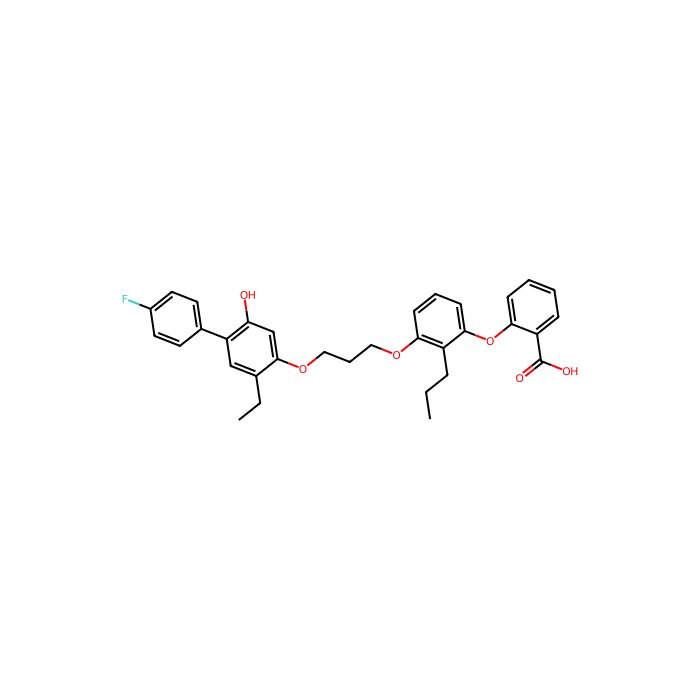
Etalocib (LY293111), an orally active leukotriene B4 receptor antagonist, inhibits the binding of [3H]LTB4, with a Ki of 25 nM. Etalocib (LY293111) prevents LTB4-induced calcium mobilization with an lC50 of 20 nM. Etalocib (LY293111) induces apoptosis.
Storage
Store at -20°C
Verschickt in
Ice chest + Ice pads
Dieses Produkt erfordert Kühlkettenversand. Grundversand und andere Economy-Optionen sind nicht verfügbar.
This compound belongs to the class of organic compounds known as diphenylethers. These are aromatic compounds containing two benzene rings linked to each other through an ether group.
External Descriptors
Not available
1. Djoumbou Feunang Y, Eisner R, Knox C, Chepelev L, Hastings J, Owen G, Fahy E, Steinbeck C, Subramanian S, Bolton E, Greiner R, and Wishart DS. ClassyFire: Automated Chemical Classification With A Comprehensive, Computable Taxonomy. Journal of Cheminformatics, 2016, 8:61.
Determine the necessary mass, volume, or concentration for preparing a solution.
Dilution Calculator
Determine the dilution needed to prepare a stock solution.
Reconstitution Calculator
Bewertungen
Kundenbewertungen
Application Protocols
Validated application protocols specific to this SKU are not listed on this page.
Suggested general workflow for small-molecule ligands in screening:
Prepare a 10–50 mM DMSO master stock under low light; vortex/sonicate as needed.
Aliquot into low-bind tubes; store at −20°C (see Storage tab). Avoid repeated freeze–thaw.
Prepare serial dilutions in assay buffer with matched vehicle controls (constant DMSO %).
Confirm absence of precipitation visually and/or by light scattering; if needed, adjust dilution scheme or add a small amount of surfactant (e.g., 0.01% Tween-20) compatible with the assay.
Verify stability over the assay window by LC–MS or activity recovery.
Tested applications, recommended concentrations, positive controls: Not specified for this item; refer to CoA/Spec Sheet.
For detailed, target-specific protocols, consult the primary literature corresponding to your assay system.
Biological Roles
Note: The following describes typical roles of small-molecule ligands in research. Item-specific biological targets or mechanisms are not provided on this page; consult primary literature by CAS or CID and verify against your experimental aims.
Role in discovery
Functions as a small-molecule modulator for exploring biochemical pathways, receptor/enzymatic function, and cellular phenotypes.
Useful as a reference compound in assay development, enabling benchmarking of assay windows, Z′ factors, and detection limits.
Serves as a tool for microsomal/hepatocyte stability, permeability (Caco-2/MDCK), and plasma protein binding studies, supporting medicinal chemistry decisions.
Selectivity profiling
Chemical biology workflows may survey selectivity across related protein families using panel screens to contextualize potency vs. off-target activity.
Critical caveats
Biological effects are assay- and context-dependent. Validate concentration ranges and exposure times to avoid nonspecific or cytotoxic effects.
Where specific target interactions are claimed, corroborate with orthogonal methods and, when possible, structure confirmation of the batch in use.
This product is for research use only; no medical or clinical claims are made or implied.
Buffer Applications
This item is a small-molecule ligand rather than a buffering agent. It does not serve as a pH buffer or classical buffer component.
For working solutions in biological assays, select buffers based on the biology (e.g., PBS, HEPES, TRIS) and compound stability. Maintain consistent cosolvent content (e.g., 0.1–1.0% DMSO) across controls and treatments.
If compound ionization influences solubility, adjust buffer pH within physiologically acceptable ranges for the assay system and evaluate precipitation over time.
For buffer composition and pH control, refer to standard buffer preparation protocols; item-specific pKa data are not provided on this page.
Green Alternatives
Green chemistry considerations for this product focus more on solvent and workflow choices than on replacing the molecule itself (which is supplied as a defined screening ligand).
Prefer water/biological buffers when feasible (subject to solubility and stability) to reduce organic solvent use.
Use DMSO judiciously—although not classed as a “green solvent,” it is relatively low volatility and reusable; minimize volumes and consolidate stocks.
Analytical and workup
For HPLC/UPLC, choose water–acetonitrile over water–methanol when appropriate balances exist between performance and environmental profile; both are widely used, with acetonitrile often providing lower backpressure.
Implement miniaturized assays (96/384/1536-well) to cut solvent consumption per data point.
Waste minimization
Plan aliquots to avoid repeated thawing and disposal of degraded material.
Use greener cleaning protocols (e.g., aqueous surfactants) where compatible with the compound’s stability and your instrumentation.
Comparison snapshot (general)
Traditional approach: large-volume organic dilutions and repeated preps → higher waste.
No alternative chemical entity is proposed here because the item’s utility is target- and SAR-specific; substitution would change experimental outcomes.
Pharmaceutical Uses
No therapeutic or clinical claims are made for this material. In pharmaceutical research settings, compounds of this type are used as reference ligands and tools.
Preformulation/tool compound roles
Evaluate solubility enhancement strategies (salt screening, co-solvents, cyclodextrins) using a known small-molecule tool.
Assess chemical stability (pH, oxidative, photolytic) and develop indicative stability-indicating LC methods.
Generate calibration standards for bioanalytical LC–MS/MS method development (matrix effects, recovery).
Discovery support
Use as a control in target-based and phenotypic assays to benchmark assay performance.
Investigate permeability and efflux behavior (e.g., Caco-2, MDCK-MDR1) for method readiness.
Regulatory status
Grade: Moligand™; this is a research-grade material and is not produced to pharmacopeial monographs.
Endotoxin, sterility, residual solvent, and elemental impurity profiles: Not specified for this item; refer to CoA/Spec Sheet if needed for specific workflows.
Any use in formulation studies is for laboratory research only and not for human or veterinary administration.
Physical Properties
Item-specific physico-chemical specifications are not listed on this page. Where required for experimental design, consult the batch CoA/Spec Sheet.
Appearance: Not specified for this item; refer to CoA/Spec Sheet.
Molecular weight (item-specific): Not specified for this item; refer to CoA/Spec Sheet.
Molecular formula (item-specific): Not specified for this item; refer to CoA/Spec Sheet.
Melting point / Boiling point: Not specified for this item; refer to CoA/Spec Sheet.
Density / Refractive index: Not applicable for typical solid screening compounds; specific values not specified for this item.
Solubility guidance (general, literature-style)
Small-molecule ligands for screening are commonly prepared as 10–50 mM DMSO stocks; aqueous solubility can vary widely and may require co-solvents (DMSO ≤1% v/v final, where compatible) or surfactants (e.g., 0.01–0.1% Tween-20) in biological buffers.
pKa/logP/logD values are often used to predict buffer compatibility and permeability; request these if needed for modeling.
Hygroscopicity/photostability (general)
Many bioactive small molecules show sensitivity to moisture, heat, and light. Minimize exposure and handle quickly when outside cold storage.
For authoritative, lot-specific values (e.g., mp, purity method, residual solvents), please refer to the CoA/SDS for this SKU.
Quality and Grades
Grade/Purity: Moligand™ (Aladdin Scientific). This designation indicates a screening-grade small molecule intended for use in discovery workflows such as target engagement assays, biochemical inhibition/activation assays, phenotypic screens, and method development.
What Moligand™ generally entails
Prioritizes identity confirmation (e.g., LC–MS, 1H NMR, and/or HRMS as appropriate) to ensure the correct molecular entity for screening.
Emphasizes assay suitability over regulatory compliance; materials are for research use only and not intended for human or veterinary use.
UV/LC baselines aligned to typical discovery analytics (HPLC/UPLC); low non-volatile residue is targeted for analytical cleanliness. Specific numeric thresholds are not listed here.
Item-specific specifications
Reported purity, residual solvent limits, water content, and stabilizers: Not specified for this item; refer to CoA/Spec Sheet.
Implications for researchers
Suitable for hit validation, SAR, and reference control roles in biochemical/cellular assays.
For quantitative bioanalysis (e.g., LC–MS calibration), verify lot-specific purity/assay and consider internal standards.
If you require enhanced trace metal, endotoxin, or pharmacopoeial conformity, contact Technical Support for availability; Moligand™ is not a pharmacopeial grade.
Documentation
Each lot ships with or has available a CoA detailing analytical methods and acceptance criteria used for that batch.
Reaction and Applications
This product is supplied as a ready-to-use screening ligand rather than as a general-purpose synthetic reagent. Consequently, classical organic “reaction applications” (e.g., cross-couplings, additions) are typically not relevant to its primary use. Instead, the emphasis is on discovery workflows:
Primary research applications (general for Moligand-grade ligands)
Prepare concentrated DMSO stocks and aliquot to avoid freeze–thaw cycles (see Storage tab).
Assess compound stability in assay buffer by pre-incubation and LC–MS check, especially for long assay windows.
Include vehicle controls (matched DMSO %) and, where appropriate, positive/negative reference controls.
Orthogonal confirmation
Where binding or activity is measured, confirm hits via orthogonal assays (e.g., biochemical vs. biophysical such as DSF, MST, SPR) to reduce assay artifact risk.
If you intend to repurpose this molecule as a building block or engage in derivatization chemistry, consult its structure on the CoA/SDF to evaluate functional handles and protective group strategies.
Reaction Conditions
Classical reaction conditions (temperatures, catalysts, yields) are not typically applicable because this product is distributed as a finished screening ligand rather than a reagent for carrying out organic reactions.
If you plan to derivatize or formulate the compound, consider the following general laboratory practices:
For salt formation or pH-adjusted solubilization, explore buffered aqueous systems and mild bases/acids (e.g., NaHCO3, citrate, acetate) while monitoring integrity by LC–MS.
For analytical method development, typical mobile phases are water/acetonitrile (0.1% formic acid) or water/methanol with gradients optimized to the compound’s retention.
Conduct any stress testing (acid/base/oxidative/thermal/light) under ICH Q1A(R2)-style conditions to map degradation pathways for stability-indicating methods.
Expected yields, catalysts, and step conditions for synthesis are not provided here because no item-specific synthetic route is described. Consult primary literature for this CAS if you intend to synthesize or modify the compound.
Safety and Handling
Safety information specific to this SKU is limited on this page; always consult the SDS for authoritative guidance.
GHS/CLP
Signal word: Not specified for this item; refer to SDS.
Hazard statements (H-phrases): Not specified for this item; refer to SDS.
Pictograms / Classification: Not specified for this item; refer to SDS.
General laboratory precautions (small-molecule ligands)
Use in a chemical fume hood; avoid inhalation and skin/eye contact.
Wear appropriate PPE: lab coat, nitrile gloves, safety glasses; upgrade PPE if aerosol or dust may form.
Prevent dust generation; handle with tools/spatulas rather than by hand.
First aid (overview; defer to SDS)
Inhalation: move to fresh air; seek medical attention if symptoms occur.
Skin/eyes: rinse with water for ≥15 minutes; remove contaminated clothing; seek medical advice if irritation persists.
Ingestion: rinse mouth; do not induce vomiting; seek medical attention.
Stability & incompatibilities (general)
Store as directed (see Storage tab). Avoid oxidizers, strong acids/bases, and prolonged exposure to light/heat.
Many bioactive organics can adsorb to plastics at low concentrations; use low-bind plastics or glass for analytical dilutions.
Waste
Dispose according to institutional and local regulations for organic laboratory chemicals.
For complete hazard, toxicology, and transport details, consult the SDS for L294138.
Solvent Selection
Because this product is provided as a bioactive small molecule for screening, solvent choice is driven by stock preparation and assay compatibility.
Primary stock solvent (general best practice)
Dimethyl sulfoxide (DMSO) is the standard for preparing 10–50 mM master stocks due to broad solubilizing power and compatibility with many biochemical and cell-based assays. Filter-sterilize if required for sterile workflows.
Assay dilution co-solvents (general)
Maintain final DMSO ≤0.1–1.0% v/v in biological assays to limit solvent effects; verify tolerance for your assay system.
For challenging solubility, consider co-solvent blends (e.g., DMSO:water, DMSO:buffer, or DMSO:ethanol → buffer) and gentle warming/sonication.
Solvent selection table (general guidance)
DMSO: high solvency; widely compatible; may affect some enzymes at >1%.
DMF/NMP: strong solvency; use cautiously in biological systems; prioritize DMSO first.
Ethanol/MeOH: useful for analytical standards; biological tolerance varies.
Aqueous buffers: feasibility depends on compound ionization state and pKa; may require pH adjustment.
Analytical solvents
For LC–MS: water/acetonitrile (0.1% formic acid) or water/methanol systems are typical. Confirm compound ionization behavior prior to MS method finalization.
Item-specific solubility, pKa, or logP are not listed here; consult the CoA or request additional data from Technical Support.
Storage and Reconstitution
Storage conditions (item-specific)
Store at −20°C.
Shipped in an ice chest with ice pads to maintain cold chain during transit.
Handling
Allow the container to equilibrate to room temperature in a desiccated environment before opening to minimize moisture condensation.
Reseal promptly; purge with dry inert gas if available for hygroscopic/light-sensitive materials (general best practice for small molecules).
Reconstitution (general guidance for screening ligands)
Prepare concentrated stocks in anhydrous DMSO (e.g., 10–50 mM) unless your internal data indicate superior solubility in another solvent.
If aqueous use is required, dilute the DMSO stock into buffer with gentle mixing; keep final DMSO ≤0.1–1.0% v/v as assay permits.
For sterile applications, filter-sterilize the working solution through a 0.22 μm PTFE/RC filter if compatible.
Aliquoting and stability
Divide into single-use aliquots to avoid repeated freeze–thaw cycles.
Protect from light and minimize time at room temperature. Track on-bench exposure and number of freeze–thaw events in your ELN.
Shelf life
Item-specific expiry and retest period: Not specified for this item; refer to CoA/Spec Sheet.
For any deviations (e.g., long-term storage at different temperatures), generate internal stability data to justify conditions.
Structure and Identity
Brief overview: LY293111 is supplied as a Moligand-grade small-molecule research ligand intended for screening and discovery workflows.
Product identifiers
SKU: L294138
Product name: LY293111 (research small molecule)
CAS: 161172-51-6
PubChem CID: 177941 (catalog cross-reference)
InChIKey (as provided): 435889
SMILES: Not specified for this item; refer to CoA/Spec Sheet.
Molecular details (item-specific)
Molecular formula: Not specified for this item; refer to CoA/Spec Sheet.
Molecular weight: Not specified for this item; refer to CoA/Spec Sheet.
Structural description (general guidance)
This product is supplied as a defined small-molecule entity intended for biochemical and cell-based assays. In the absence of an item-specific structural string (SMILES/InChI) on this page, please consult the accompanying CoA/SDS or request the structure file (SDF/MOL) from Technical Support for cheminformatics use (QSAR, docking, substructure search).
Notes on identifiers
External identifiers (CAS, CID) are provided for literature/database navigation and do not replace the Certificate of Analysis for identity confirmation. Always verify batch identity by the methods described on the CoA (e.g., LC–MS, HPLC, NMR) prior to critical studies.
Synthetic Utility
This product is supplied as a finished small-molecule ligand for screening and is not primarily intended as a synthetic building block.
When synthetic derivatization is considered
Obtain the structure file (SDF/MOL) from Technical Support or CoA to identify functional handles compatible with derivatization (e.g., carboxylic acids, amines, aryl halides), if present.
Evaluate potential protecting group needs, chemoselectivity issues, and stability of heteroaromatic motifs before planning analog synthesis.
Analytical readiness
For any modification campaign, establish robust HPLC/UPLC purity methods and LC–MS identity confirmation to parallel the Moligand™ lot characterization.
Alternative approach
If your goal is SAR exploration rather than using this exact scaffold, consider commercial analog sets or virtual enumeration followed by prioritized synthesis.
Given the absence of item-specific structural features on this page, detailed synthetic schemes cannot be recommended. Refer to the CoA and primary literature (by CAS 161172-51-6 or CID 177941) to assess feasibility.
Target Specificity
Item-specific biological target, binding constants, and selectivity data are not provided on this page.
Target, mechanism of action, Kd/IC50/EC50, and panel selectivity: Not specified for this item; refer to CoA/Spec Sheet or primary literature by CAS 161172-51-6 / CID 177941.
Species selectivity and off-target profile: Not specified for this item; refer to CoA/Spec Sheet.
Researchers should independently verify target engagement and specificity under their assay conditions using appropriate positive/negative controls and orthogonal methods.
Häufig gestellte Fragen
What is the purity of this product?
This product is supplied at ≥98% purity (chemical assay). Lot-specific values are stated on the Certificate of Analysis.
How should this product be stored?
Store at ?20 °C. Freezer storage is required to maintain the specified shelf life.
What is Moligand??
Moligand? is one of Aladdin Scientific's premium product lines, formulated for high-purity applications across multiple workflows. Compared to standard grades in the same workflow, Moligand? products typically offer tighter specifications, more rigorous QC, and stronger lot-to-lot consistency.
How is this product shipped?
This product ships in an insulated container with ice pads. Unpack on arrival and transfer it to the storage condition stated above.
What are the CAS number, molecular formula and molecular weight?
The CAS Number is 161172-51-6, the molecular formula is C33H33FO6, and the molecular weight is 544.6 g/mol. InChIKey YFIZRWPXUYFCSN-UHFFFAOYSA-N.
What documentation is provided?
Available product documentation, including Certificates of Analysis (COA), Safety Data Sheets (SDS), and specification sheets, is shown in the product document area. Document availability and access follow the current site policy.
Benötigen Sie Hilfe bei der Auswahl der Qualität?
Unser Leitfaden zur Qualitätsauswahl behandelt Reinheit, Stabilisatorstatus und Anwendungseignung für alle Varianten in unserem Katalog.
Wir verwenden Cookies, um die ordnungsgemäße Funktion der Website sicherzustellen und, soweit zulässig, Ihr Nutzererlebnis zu verbessern. Sie können Ihre Einstellungen jederzeit unter „Einstellungen“ verwalten. Weitere Informationen finden Sie in unserer Cookie-Richtlinie.
Dürfen wir Sie über Rabattaktionen informieren?
Später erinnern
Vielen Dank! Bitte überprüfen Sie Ihren E-Mail-Posteingang, um zu bestätigen.
Products are supplied to verified businesses, institutions, and qualified professionals for research and development use only. Not for use in humans, animals, diagnosis, or therapy.

 I2523103