QUALITÄT & REINHEITUltraBio™?UltraBio™ — Aladdin's line for molecular-biology applications. Use for nuclease-free, high-consistency reagents across molecular workflows.Suitable for molecular biology?Molecular-biology grade — free of nucleases and contaminants that degrade DNA/RNA. Use in cloning, PCR, and nucleic-acid work needing clean reagents.Ultra pure?Ultra-pure grade with very low impurity content across the board. Use for trace analysis, electronics, or processes intolerant of contamination.
· Optimization in vinasse processing: Magnesium sulfate plays a role in optimizing the electrodialysis and nanofiltration process of vinasse, enhancing environmental sustainability and efficiency in waste management practices, which are crucial for industrial applications including the production of IVD reagents. · Screening of flame retardant residues: In analytical methodologies like QuEChERS-gas chromatography, magnesium sulfate is employed for its efficacy in the extraction and cleanup steps, underscoring its importance in ensuring high-purity standards required for accurate and reliable diagnostic assays.
Spezifikationen
Synonyme
Arrosalt 2327 | Magnesiumsulfate | USEPA/OPP Pesticide Code: 050503 | Sal De sedlitz | Sulfato de magnesio | MAGNESIUM (AS SULFATE) | OT-S | magnesium;sulfate | MAGNESIUM SULFATE | Magnesium sulfate, anhydrous | Magnesium(II) sulfate | Sulfuric acid magnesium salt (VAN) | Sulfuric acid magnesiumsalt (1:1), hydrate (8CI,9CI) | OT-S (drying Show more
Spezifikationen & Reinheit
UltraBio™, Suitable for molecular biology, Ultra pure
Biochemische und physiologische Mechanismen
Magnesium sulphate can be used to treat acute severe asthma. It is mainly considered as a neuroprotective agent.
Storage
Room temperature
Verschickt in
Normal
Note
Suitable for molecular biology, Ultra pure, UltraBio™
Alkaline earth metal sulfate - Inorganic oxide - Inorganic salt
Beschreibung
This compound belongs to the class of inorganic compounds known as alkaline earth metal sulfates. These are inorganic compounds in which the largest oxoanion is sulfate, and in which the heaviest atom not in an oxoanion is an alkaline earth metal.
External Descriptors
magnesium salt - metal sulfate
1. Djoumbou Feunang Y, Eisner R, Knox C, Chepelev L, Hastings J, Owen G, Fahy E, Steinbeck C, Subramanian S, Bolton E, Greiner R, and Wishart DS. ClassyFire: Automated Chemical Classification With A Comprehensive, Computable Taxonomy. Journal of Cheminformatics, 2016, 8:61.
Determine the necessary mass, volume, or concentration for preparing a solution.
Dilution Calculator
Determine the dilution needed to prepare a stock solution.
Reconstitution Calculator
Bewertungen
Kundenbewertungen
Application Protocols
The following are general, literature-based protocols illustrating common uses of MgSO4 solution in molecular biology. Adjust volumes for your stock concentration (Not specified for this item; refer to CoA/Spec Sheet) and assay requirements.
PCR Mg2+ titration
Prepare a master mix lacking Mg2+. 2) Aliquot into tubes. 3) Add MgSO4 stock to achieve 1.0, 1.5, 2.0, 2.5, 3.0 mM Mg2+. 4) Run identical PCR cycles. 5) Assess yield/specificity; choose the minimal Mg2+ giving specific product.
Restriction digest setup (example)
DNA: 1 µg; 10× buffer: 5 µL; Enzyme: 10 U; Add MgSO4 if buffer lacks Mg2+ to reach 10 mM final; Water to 50 µL. Incubate at 37 °C for 1 h. Verify on agarose gel.
Ligation reaction (T4 DNA ligase)
Vector/insert mix in 1× ligase buffer. If preparing custom buffer, include 10 mM Mg2+ (from MgSO4), 1 mM ATP, 10 mM DTT; 16 °C overnight or RT 1–2 h.
Kinase assay (generic)
Buffer: 50 mM Tris-HCl pH 7.5, 5–10 mM Mg2+, 1–5 mM ATP, substrate and enzyme as required. Incubate at 30 °C; quench and analyze.
RNA refolding (avoid degradation)
Heat RNA at 70 °C 2 min in low-salt buffer; snap-cool. Add MgSO4 to 1–5 mM, adjust pH 7.0–7.5 (HEPES). Incubate at 25–37 °C to allow folding; keep pH near neutral to limit Mg2+-promoted cleavage.
Notes
Prepare matched blanks for spectrophotometry since ionic strength alters baselines.
Validate absence of precipitates when using phosphate/carbonate buffers.
Biological Roles
Magnesium ion (Mg2+) roles (literature)
Universal enzymatic cofactor: Stabilizes negative charges in active sites and coordinates to substrates; required by DNA/RNA polymerases, kinases, ATPases, many endonucleases/exonucleases, and ribozymes.
Nucleotide complexation: Forms MgATP/MgGTP complexes, the true substrates for many enzymes. Free vs bound Mg2+ balance modulates reaction rates.
Membrane/ion homeostasis: Competes with Ca2+ for binding sites; affects channel activity and signaling cascades indirectly.
Sulfate (SO4 2−) roles (literature)
Generally metabolically inert counterion in vitro; contributes to ionic strength and kosmotropic effects in protein stability and precipitation.
Practical implications for laboratory use
Fine control of free Mg2+ is critical: chelators (EDTA/EGTA, citrate), dNTPs, and phosphate reduce free Mg2+. Use calculators or empirical titration in PCR/enzymatic assays.
For RNA work, Mg2+ is both essential for folding and a promoter of RNA cleavage at high pH—optimize concentration and pH to balance activity vs stability.
Note: Biological roles are provided for research context only; this product is for research use only (per Product Data).
Buffer Applications
General use
Magnesium sulfate solution is commonly used to supplement Mg2+ in biological buffers without introducing chloride. It adjusts ionic strength and provides Mg2+ required by nucleic acid-processing enzymes.
Typical buffer systems and ranges (literature; adjust per enzyme/vendor guidance)
PCR buffers: 10 mM Tris-HCl, 50 mM KCl, 1.5–3.0 mM Mg2+ (from MgSO4 or MgCl2), 200 µM each dNTP. Start at 1.5 mM Mg2+ and titrate in 0.5 mM steps.
Restriction digest buffers: Commonly 10–20 mM Tris-HCl, 50–100 mM NaCl/KCl, 5–10 mM Mg2+; verify specific requirements.
Ligation buffers: ~50 mM Tris-HCl, 10 mM Mg2+, 10 mM DTT, 1 mM ATP (supplied separately).
Reverse transcription: Often 3–6 mM Mg2+; some RTs tolerate Mn2+ but Mg2+ is standard.
RNA folding/cleavage studies: Use 1–10 mM Mg2+ while controlling pH (HEPES/MOPS) to mitigate nonspecific cleavage.
Practical buffer preparation tips
Add MgSO4 last to a cooled buffer to minimize precipitation in phosphate- or carbonate-containing systems; verify clarity.
Filter-sterilize (0.2 µm) if needed for cell-free enzymology; autoclaving is generally acceptable for plain sulfate solutions but confirm container compatibility.
Prepare concentrated MgSO4 stocks (e.g., 100 mM or 1 M) to allow precise titration; store aliquots to avoid contamination. Concentration for this item is Not specified for this item; refer to CoA/Spec Sheet.
Green Alternatives
Magnesium sulfate solution is already a water-based, inorganic salt solution with low environmental and safety concerns. Selection of Mg2+ source can still consider green chemistry trade-offs.
Comparative considerations (literature)
Solvent system: Water is a preferred green solvent. No VOCs; low flammability and toxicity.
Counterion choice: Sulfate vs chloride vs acetate—sulfate is non-volatile, non-halogenated, and generally benign. Chloride introduces halides (corrosion concerns); acetate is biodegradable but can affect pH.
Process impacts: High ionic strength effluents may require dilution or treatment; sulfate discharge limits vary by locale.
Example comparison (general)
MgSO4(aq): Non-volatile, low hazard, kosmotropic; may precipitate with phosphate/carbonate.
MgCl2(aq): Similar utility; chloride can be corrosive to stainless steel at high concentrations.
Mg(OAc)2(aq): Adds organic anion; can buffer mildly; may support microbial growth more readily than sulfate.
Greener practice tips
Use the minimum Mg2+ concentration required for assay performance.
Reuse/rationalize buffer stocks to reduce waste; prepare modular concentrates (e.g., separate Mg2+ stock) to extend shelf life and reduce disposal.
Collect salt solutions separately if local regulations limit sulfate discharge.
Pharmaceutical Uses
This product is designated “For research use only” and “Suitable for molecular biology”; it is not supplied as a pharmacopeial/clinical grade material.
Item-specific regulatory status
Research use only (per Product Data). No USP/EP/JP compliance is stated. Any use in manufacturing or clinical settings requires independent qualification.
General formulation context (literature; not specific to this item)
Magnesium salts (including MgSO4) are used industrially as electrolyte components in certain aqueous systems and as processing aids, but their suitability depends on grade (endotoxin/bioburden, particulates, elemental impurities) and on validated supply chains.
Sulfate counterion is generally inert and non-volatile, with low UV absorbance—attributes valued in some aqueous formulations.
Practical guidance
For any translational or GMP-adjacent work, source pharmacopeial grades and confirm specifications such as elemental impurities (ICH Q3D), endotoxin/bioburden, particulates, and conductivity.
For analytical development, the research-grade MgSO4 solution may serve in method development or bench-scale studies, with subsequent bridging to GMP-qualified materials.
No therapeutic or clinical claims are made or implied for this product.
Physical Properties
Item-specific properties for the supplied solution (concentration, density, pH, conductivity, osmolarity, refractive index) are Not specified for this item; refer to CoA/Spec Sheet.
Literature properties (magnesium sulfate, salt form; values depend on hydrate and temperature)
Melting/decomposition (anhydrous): decomposes at elevated temperature (>1100 °C) to MgO + SO3 (literature)
Heptahydrate (MgSO4·7H2O) loses water at ~48–150 °C, then decomposes upon further heating (literature)
Solubility in water: strong; increases with temperature (e.g., MgSO4 total ~35–36 g per 100 g H2O at 20 °C for anhydrous basis; heptahydrate ~71 g/100 g H2O at 20 °C) (literature)
Solubility in organic solvents: negligible in common organic solvents (alcohols, ethers, hydrocarbons) (literature)
pH of aqueous solutions: near-neutral to slightly acidic depending on concentration and CO2 uptake (literature)
Hygroscopicity: anhydrous salt is hygroscopic; readily forms hydrates (literature)
Notes
The physical behavior of the product as supplied will be governed by its actual concentration and hydration state in water; consult the product CoA for item-specific solution parameters.
Quality and Grades
Item-specific grade (from Product Data)
UltraBio™, Suitable for molecular biology, Ultra pure.
What this typically implies (general guidance; not item specifications)
Molecular biology/UltraBio grades are intended for workflows requiring low nuclease (DNase/RNase) and protease activity, low bioburden/endotoxin, and high ionic purity to avoid inhibiting enzyme systems (PCR, RT, ligation, restriction digestion).
Ultra pure indicates stringent control of common inorganic/organic contaminants and particulates, with filtration under clean conditions. UV-absorbing impurities are typically minimized, benefitting spectrophotometric assays.
Practical implications for this product
Consistent Mg2+ activity is critical for polymerases, ligases, kinases, and ribozymes; ionic contaminants (e.g., heavy metals, transition metals) can inhibit enzymes or catalyze nucleic acid degradation. UltraBio-grade processing is chosen to minimize such risks.
If you require certificates of analysis (e.g., bioburden, endotoxin/LAL, nuclease testing, conductivity, ICP trace metals), these are Not specified for this item; refer to CoA/Spec Sheet.
Stabilizers/preservatives
No stabilizers or preservatives are listed in the Product Data. If your application is sensitive to antimicrobial agents, confirm absence/presence on the CoA before use.
Fit-for-use reminders
For critical molecular biology, consider lot qualification in your assay (e.g., PCR titration curves). Maintain sterility during handling to preserve grade attributes.
Reaction and Applications
Given its UltraBio, molecular biology suitability, the most relevant applications exploit Mg2+ as an essential enzymatic cofactor.
Enzymology and nucleic acid workflows (literature)
PCR/RT-PCR/qPCR: Mg2+ is required for DNA/RNA polymerase catalysis and primer-template duplex stabilization. Typical working free Mg2+ is ~1.5–3.0 mM; optimal concentration depends on dNTPs (which chelate Mg2+) and template complexity.
Restriction digestion: Many restriction endonucleases require 5–10 mM Mg2+; confirm buffer recommendations.
Ligation: T4 DNA ligase buffers include ~10 mM Mg2+ for optimal adenylate transfer.
Kinase/phosphatase assays: Mg2+ stabilizes ATP/ADP (MgATP complex) and participates in catalysis.
Ribozyme and reverse transcriptase reactions: Mg2+ shapes RNA folding and catalysis, though excess can promote nonspecific cleavage—titrate carefully.
Biophysical/protein work
Protein stabilization and salting effects: Sulfate is kosmotropic (Hofmeister series), often promoting protein stabilization and precipitation at high concentrations—useful in crystallization screens.
Inorganic/analytical chemistry
Precipitation/gravimetry: MgSO4 can supply Mg2+ for forming defined precipitates (e.g., MgNH4PO4) in classical analyses.
Practical tips
Pre-filter through 0.2 µm if sterility/clarity is required.
Account for chelators (EDTA/EGTA, citrate, phosphate, dNTPs) that reduce free Mg2+; calculate free Mg2+ or empirically titrate.
Avoid phosphate/carbonate buffers at elevated pH to prevent Mg-salt precipitation.
Reaction Conditions
Because this product is primarily used to supply Mg2+ in aqueous systems, “reaction conditions” focus on enzymatic and aqueous assay contexts.
General enzymatic ranges (literature guidance; optimize empirically)
DNA polymerases (PCR): 1.5–3.0 mM free Mg2+ at pH 8.3–8.8 (25 °C), 0.2 mM each dNTP; adjust Mg2+ upwards for high dNTP or GC-rich templates.
Restriction endonucleases: 5–10 mM Mg2+; some enzymes require additional salts (NaCl/KCl) and specific pH (7.4–8.0).
T4 DNA ligase: ~10 mM Mg2+, 1 mM ATP, pH 7.5–8.0, 16 °C to room temperature; overnight incubations common.
Kinase assays: 5–20 mM Mg2+ depending on enzyme and ATP concentration; maintain chelator-free conditions.
Temperature and time
Governed by the enzyme/system; Mg2+ remains stable across typical lab temperatures (0–95 °C) and assay durations.
Matrix compatibility
Avoid high-phosphate/high-carbonate at alkaline pH to prevent Mg-precipitation. Check clarity after mixing.
If EDTA or citrate is present, calculate free Mg2+ (using speciation calculators) or perform titration series.
Analytical control
Use conductivity or ion-selective/ICP methods to verify Mg2+ concentration for critical work. Ensure stock concentration of this item from CoA, as it is Not specified for this item; refer to CoA/Spec Sheet.
Safety and Handling
Item-specific hazard data (GHS classification, pictograms, H-statements): Not specified for this item; refer to SDS.
General safety (literature; defer to SDS for authoritative guidance)
Classification: Magnesium sulfate is generally regarded as low hazard and often not classified as dangerous under GHS at typical concentrations; however, solution hazards depend on concentration and additives.
Primary risks: Eye irritation on contact; may cause mild skin irritation. Ingestion of concentrated solutions may cause gastrointestinal upset. No flammability or peroxide-formation hazards.
Incompatibilities: Avoid mixing concentrated solutions with strong oxidizers only insofar as general chemical hygiene. Precipitates may form with solutions containing carbonates, phosphates, or hydroxides (forms MgCO3/Mg3(PO4)2/Mg(OH)2). Avoid contamination with strong bases if clarity/sterility is required.
PPE: Laboratory coat, safety glasses, and appropriate gloves (e.g., nitrile). Use splash protection when handling larger volumes.
First aid overview: Rinse eyes/skin with water for several minutes if contacted. If inhaled as mist/aerosol, move to fresh air. If ingested, rinse mouth; seek medical advice if symptoms persist. Always follow the SDS.
Spills: Wipe or absorb with inert material; rinse area with water. Solutions are non-volatile and generally non-flammable.
Storage
Follow item-specific instruction: Store at room temperature. Keep container tightly closed to prevent evaporation/contamination. For molecular biology use, maintain aseptic technique to avoid microbial growth.
Solvent Selection
This product is an aqueous inorganic salt solution rather than an organic solvent; typical solvent-selection criteria (polarity index, UV cutoff) do not apply.
General attributes (literature)
Medium: Water (high dielectric constant ~78 at 25 °C) with dissolved MgSO4.
Ionic strength contributions: Both Mg2+ and SO4 2− increase ionic strength; Mg2+ additionally coordinates to biomolecules and affects enzyme catalysis.
Miscibility: Fully miscible with water and aqueous buffers; not miscible with hydrophobic organic solvents. Will salt-out some organics at high concentrations (salting-out effect).
When to choose MgSO4 solution vs alternatives
Choose MgSO4 when you need Mg2+ without introducing chloride (vs MgCl2) or when sulfate’s weakly coordinating, kosmotropic nature is preferred for protein stability studies.
Prefer MgCl2 when chloride is already a buffer component or when higher Mg2+ activities at comparable osmolality are desired (due to differing anion interactions).
Compatibility notes
May precipitate with buffers containing phosphate, carbonate, or borate at higher pH due to insoluble magnesium salts. Validate clarity when combining with such buffers.
For spectroscopic work, sulfate has low UV absorbance; however, high ionic strength can shift baselines—run matched blanks.
Storage and Reconstitution
Item-specific storage (from Product Data)
Store at room temperature. Shipped under normal conditions.
Container handling
Keep tightly closed to prevent evaporation and contamination. For molecular biology applications, use aseptic technique; consider aliquoting into sterile, nuclease-free tubes to minimize repeated opening.
Stability considerations (general)
Aqueous MgSO4 is chemically stable; microbial contamination is the primary risk in molecular biology use. If sterility is not guaranteed, filter-sterilize (0.2 µm) on receipt.
Precipitation can occur if the solution is cooled or mixed with incompatible buffers; warming to room temperature and gentle mixing often redissolves salts.
Reconstitution
Not applicable: the product is supplied as a solution. If concentration adjustment or custom dilutions are required, use high-purity, nuclease-free water. The supplied concentration is Not specified for this item; refer to CoA/Spec Sheet.
Freeze–thaw guidance
Freezing is generally unnecessary and may cause crystallization/volume changes; store at ambient as directed. If frozen accidentally, allow to thaw completely and ensure complete dissolution before use.
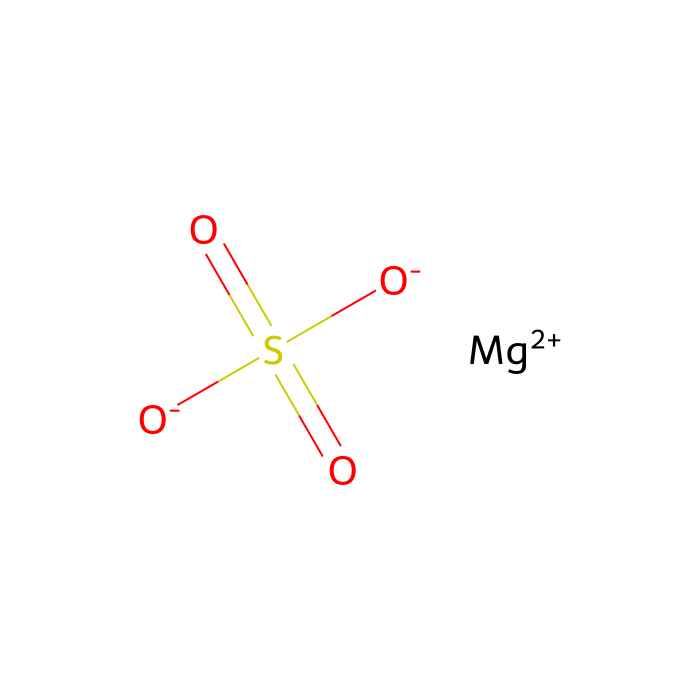
Structure and Identity
Brief description: Magnesium sulfate solution is an aqueous inorganic salt solution supplying Mg2+ and SO4 2− ions; exact concentration is not specified for this item.
InChIKey (common, literature): NBIIXXVUZAFLBC-UHFFFAOYSA-L (may differ from item listing)
Structural features (general)
Ionic compound composed of a divalent magnesium cation and a tetrahedral sulfate anion.
No stereocenters; no covalent C–based framework. In aqueous solution, Mg2+ is hexahydrated [Mg(H2O)6]2+ and sulfate remains tetrahedral SO4 2−.
Synthetic Utility
Not a typical synthetic reagent in solution form
While anhydrous MgSO4 is widely used as a drying agent in organic synthesis, the solution form supplied here is not suited to drying and is instead used to deliver Mg2+ in aqueous systems.
Utility in aqueous/inorganic chemistry (literature)
Precipitation/ion exchange: Source of Mg2+ for forming insoluble magnesium salts (e.g., Mg(OH)2 with base; Mg3(PO4)2 with phosphate) for separations or analytical procedures.
Salting-out and crystallization: Sulfate’s kosmotropic properties can modulate protein and small-molecule solubility, aiding crystallization screens.
Essential cofactor in kinase-mediated phosphorylations, polymerase-driven DNA synthesis, and ATP-dependent ligations. Mg2+ availability directly impacts catalytic turnover and fidelity.
Retrosynthetic/value notes
As an inorganic salt stock, MgSO4 is a modular component in buffer recipes and assay cocktails rather than a transform reagent. Its role is enabling catalysis and controlling medium properties.
Target Specificity
Not applicable. This product is an inorganic salt solution (not an antibody/oligonucleotide/biologic) and has no antigen/epitope specificity. For specificity in use, see “Reaction & Applications” and “Buffer Applications” regarding enzyme cofactor roles.
Wir verwenden Cookies, um die ordnungsgemäße Funktion der Website sicherzustellen und, soweit zulässig, Ihr Nutzererlebnis zu verbessern. Sie können Ihre Einstellungen jederzeit unter „Einstellungen“ verwalten. Weitere Informationen finden Sie in unserer Cookie-Richtlinie.
Dürfen wir Sie über Rabattaktionen informieren?
Später erinnern
Vielen Dank! Bitte überprüfen Sie Ihren E-Mail-Posteingang, um zu bestätigen.
Products are supplied to verified businesses, institutions, and qualified professionals for research and development use only. Not for use in humans, animals, diagnosis, or therapy.