QUALITÄT & REINHEITCarrier Free?Carrier-free — supplied without added carrier protein/stabilizer. Use when carriers (e.g. BSA) would interfere with conjugation or sensitive assays.ExactAb™?ExactAb™ — Aladdin's antibody line emphasizing precision and validated quality. Use for reliable, specificity-validated antibody applications.Validated?Validated grade — performance confirmed in defined applications before release. Use when you want documented assurance the reagent works as stated.1.0 mg/mL
Rabbit anti Human MDM2 Antibody, Polyclonal, could be used for WB, IHC, IF/ICC and so on.
Spezifikationen
Product Name
MDM2 Antibody - Primärer Antikörper, specific to MDM2
Synonyme
ACTFS|HDM2|HDMX|MDM2 oncogene, E3 ubiquitin protein ligase|MDM2|ACTFS antibody|Double minute 2 protein antibody|E3 ubiquitin-protein ligase Mdm2 antibody|Hdm 2 antibody|Hdm2 antibody|HDMX antibody|MDM 2 antibody|DM2 antibody|MDM2 oncogene E3 ubiquitin protein ligase antibody|Mdm2 p53 E3 ubiquitin protein ligase homolog antibody|Mdm2 transformed 3T3 cell double minute 2 p53 binding protein (mouse) binding protein 104kDa antibody|MDM2BP antibody|Mouse Double Minute 2 antibody|MTBP antibody|Murine Double Minute Chromosome 2 antibody|Oncoprotein Mdm2 antibody|p53 Binding Protein Mdm2 antibody|p53-binding protein Mdm2 antibody|Ubiquitin protein ligase E3 Mdm2 antibody
Spezifikationen & Reinheit
ExactAb™, Validated, Carrier Free, 1.0 mg/mL
Biochemische und physiologische Mechanismen
E3 ubiquitin-protein ligase that mediates ubiquitination of p53/TP53, leading to its degradation by the proteasome. Inhibits p53/TP53- and p73/TP73-mediated cell cycle arrest and apoptosis by binding its transcriptional activation domain. Also acts as an ubiquitin ligase E3 toward itself and ARRB1. Permits the nuclear export of p53/TP53. Promotes proteasome-dependent ubiquitin-independent degradation of retinoblastoma RB1 protein. Inhibits DAXX-mediated apoptosis by inducing its ubiquitination and degradation. Component of the TRIM28/KAP1-MDM2-p53/TP53 complex involved in stabilizing p53/TP53. Also component of the TRIM28/KAP1-ERBB4-MDM2 complex which links growth factor and DNA damage response pathways.
Wirtsspezies
Kaninchen
Spezifität
MDM2
Immunogen
KLH-conjugated synthetic peptide encompassing a sequence within the C-term region of human MDM2.
Positive Kontrolle
WB: SK-OV-3 cell lysate. IHC: Human lung cancer tissue. IF/ICC: Jurkat cells.
Konjugation
Unconjugated
Note
Carrier Free, ExactAb™, Validated
SDS-PAGE
150 kDa
Verfahren zur Reinigung
Immunogen affinity purified
Konzentration
1.0 mg/mL
Product Line
Biologische Produkte
Lagerung und Versand
Form
Liquid
Storage
Store at -20°C,Avoid repeated freezing and thawing
Verschickt in
Ice chest + Ice pads
Stabilität und Lagerung
Store at 4℃ short term (1-2 weeks). Store at -20℃ long term (12 months). Upon receipt, it is recommended to aliquot. Avoid freeze/thaw cycle.
Bilder
MDM2 Antibody(Ab114718) - Western Blot All lanes: MDM2 Antibody(Ab114718) at 1/1000 dilution Samples: Lysates at 20 µg per lane Secondary: Goat Anti-Rabbit IgG H&L (HRP) (Ab170144) at 1/20000 dilution Predicted band size: 55 kDa Observed band size: 53 kDa Exposure time: 100.0 s
MDM2 Antibody(Ab114718) - IHC Immunohistochemical analysis of MDM2 staining in human lung cancer formalin fixed paraffin embedded tissue section. The section was pre-treated using heat mediated antigen retrieval with sodium citrate buffer (pH 6.0). The section was then incubated with MDM2 Antibody(Ab114718) at room temperature and detected using an HRP conjugated compact polymer system. DAB was used as the chromogen. The section was then counterstained with haematoxylin and mounted with DPX.
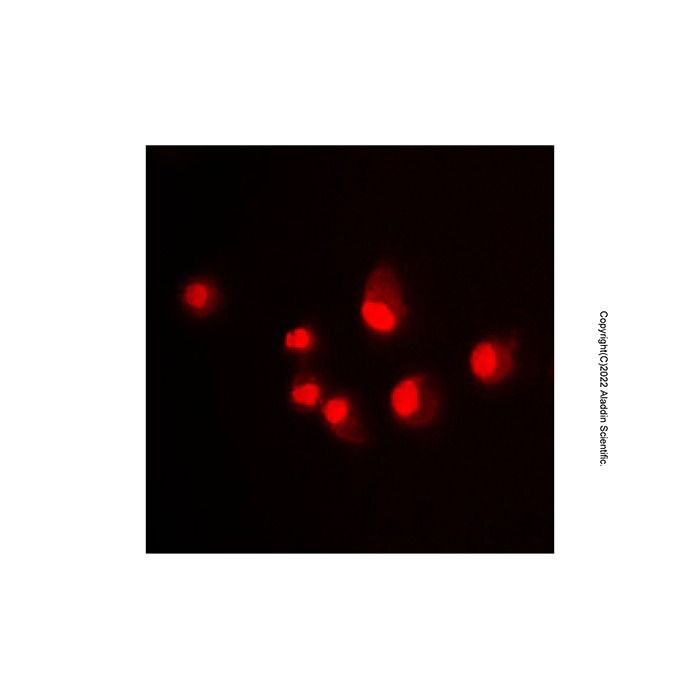
MDM2 Antibody(Ab114718) - IF/ICC Immunofluorescent analysis of MDM2 staining in Jurkat cells. Formalin-fixed cells were permeabilized with 0.1% Triton X-100 in TBS for 5-10 minutes and blocked with 3% BSA-PBS for 30 minutes at room temperature. Cells were probed with MDM2 Antibody(Ab114718) in 3% BSA-PBS and incubated overnight at 4 °C in a humidified chamber. Cells were washed with PBST and incubated with a DyLight 594-conjugated secondary antibody (red) in PBS at room temperature in the dark.
Determine the necessary mass, volume, or concentration for preparing a solution.
Dilution Calculator
Determine the dilution needed to prepare a stock solution.
Reconstitution Calculator
Bewertungen
Kundenbewertungen
Application Protocols
Tested applications, recommended dilutions, and positive control tissues/cell lines are not provided in the Product Data for SKU Ab114718.
Per the non-negotiable rules, only product data may be used here. Therefore:
Tested applications: Not specified for this item; refer to CoA/Spec Sheet.
Recommended dilutions: Not specified for this item; refer to CoA/Spec Sheet.
Positive control suggestions: Not specified for this item; refer to CoA/Spec Sheet.
Antigen retrieval/pretreatment: Not specified for this item; refer to CoA/Spec Sheet.
Please consult the product CoA/Spec Sheet or contact technical support with your intended application, species, and sample type for lot-specific guidance.
Biological Roles
About the target MDM2 (literature/general knowledge; not product claims):
MDM2 (mouse double minute 2 homolog) is an E3 ubiquitin ligase that negatively regulates the tumor suppressor p53 by promoting its ubiquitination and proteasomal degradation. It also inhibits p53 transcriptional activity by direct binding.
Regulation: MDM2 itself is a transcriptional target of p53, forming an autoregulatory feedback loop. Post‑translational modifications (phosphorylation, sumoylation) modulate its activity and localization.
Interactions: MDM2 interacts with MDM4/MDMX, ribosomal proteins (e.g., RPL11), and various signaling proteins, integrating stress responses (DNA damage, ribosomal stress) with cell cycle control.
Cellular localization: Predominantly nuclear, but shuttles between nucleus and cytoplasm depending on cellular context and modifications.
Isoforms and expression: Alternative splicing and SNPs can influence activity and stability. Expression levels vary by tissue and condition.
Relevance to research workflows:
An anti‑MDM2 antibody enables detection/quantification of MDM2, mapping of its localization dynamics, and interrogation of MDM2‑containing complexes.
Note: The above describes the biology of MDM2, not specific performance characteristics of SKU Ab114718.
Buffer Applications
Antibody-centric buffer usage (general guidance; item-specific composition not provided):
Storage buffer: Not specified for this item; refer to CoA/Spec Sheet. For carrier-free antibodies, users often reconstitute in sterile PBS or other assay-matched buffer, optionally adding 0.02–0.05% non-interfering stabilizers only if compatible with downstream uses.
Working buffers: PBS or TBS at pH ~7.2–7.6 with 0.05–0.1% Tween‑20 for washes in immunoassays. Blocking buffers vary by assay (e.g., 5% nonfat dry milk or BSA for WB; serum/protein-free blockers for IF/IHC as needed). Ensure blockers do not introduce carriers if carrier-free status must be preserved.
Compatibility notes: Avoid sodium azide in buffers when using HRP-based detection (inhibits peroxidase) or when cells/enzymes are present. For live-cell applications, use sterile, endotoxin-controlled buffers.
Because item-specific buffer composition and recommended dilutions are not provided in the Product Data, consult the CoA/Spec Sheet and optimize buffer components empirically for your assay.
Green Alternatives
Green chemistry considerations are limited for antibody reagents, but sustainable handling can still reduce environmental impact:
Buffer systems: Prefer phosphate- or Tris-based aqueous buffers prepared with high-purity water; avoid unnecessary organic additives. Carrier-free format already minimizes additives (BSA/azide/glycerol), reducing bioburden and disposal concerns; however, this shifts stability considerations to cold-chain management.
Packaging and waste: Use the smallest practical aliquots to prevent waste from spoilage. Choose recyclable secondary packaging and consolidate shipments when possible.
Cold chain optimization: The product ships on ice. Coordinate delivery to minimize re-icing events and reduce dry ice/ice pack waste.
Process alternatives: For blocking and washing, select biodegradable detergents at minimal effective concentrations, and implement closed-loop rinse systems where allowed.
Comparison (general; not product-specific):
Conventional antibody with azide/glycerol: Higher bench-stability; hazardous waste classification may increase; azide incompatible with copper plumbing.
Carrier-free antibody (this item): Improved compatibility with conjugation/cell assays; requires more stringent cold storage and aliquoting to prevent loss and repeat orders.
Adopt institutional green lab practices (energy-efficient freezers, inventory management) to further reduce the footprint of protein reagent use.
Pharmaceutical Uses
This product is labeled: For research use only. It is not intended for diagnostic, therapeutic, or other clinical applications.
Formulation/excipient context (general information for protein reagents):
Carrier-free antibodies are commonly used as starting materials for custom conjugates (e.g., fluorophores, enzymes, drug-linkers) in research workflows. Any such use remains non-clinical unless produced under appropriate quality systems and regulatory oversight.
No pharmacopeial monograph or clinical-grade designation is provided for this SKU. There is no GMP/GxP claim.
If your project involves translational studies, obtain appropriate clinical-grade materials and follow regulatory guidelines; do not substitute research-grade reagents in clinical manufacturing.
Physical Properties
Item-specific physical data (from Product Data):
Appearance: Not specified for this item; refer to CoA/Spec Sheet.
Molecular Weight: Not specified for this item; refer to CoA/Spec Sheet.
General/literature characteristics for antibodies (for planning only; not item specifications):
Typical IgG molecular mass: ~150 kDa for intact IgG; Fab fragments ~50 kDa; scFv ~25–30 kDa. Actual format for this item is not specified.
Solubility: Antibodies are water-soluble in physiological buffers (e.g., PBS, TBS). Solubility depends on isotype and buffer composition (pH, ionic strength) and on presence/absence of carrier proteins.
Isoelectric point (pI): Often in the ~6–9 range for IgG; exact value is sequence- and glycoform-dependent.
Stability modifiers: Carrier-free formulations lack BSA/glycerol/azide; while advantageous for conjugation or cell-based assays, they generally reduce freeze–thaw tolerance and may require more careful handling.
Optical properties: Proteins typically measured at A280; ε (extinction coefficient) depends on sequence (Trp/Tyr/Cys content). Without sequence, ε cannot be calculated for this item.
Do not treat the above as product specifications. For exact concentration, buffer composition, and any excipients, consult the CoA/Spec Sheet.
What these designations generally imply (explanatory, not additional specifications):
Carrier Free: The antibody is supplied without stabilizing carriers such as BSA, gelatin, glycerol, or sodium azide. Advantages include compatibility with conjugation chemistries (e.g., NHS ester labeling) and cell-based assays sensitive to carriers. Tradeoff: increased sensitivity to adsorption and freeze–thaw; handle gently and aliquot.
ExactAb™: Branded quality indicator denoting advanced production/control for lot-to-lot consistency and defined composition. Specific attributes (e.g., recombinant origin, sequence definition, endotoxin limits) are not specified for this item; refer to CoA/Spec Sheet for confirmations.
Validated: Indicates the antibody has undergone performance verification by the manufacturer. However, the specific tested applications, species reactivity, and validation data are not listed in the provided Product Data and should be reviewed on the CoA/Spec Sheet or datasheet.
Quality control considerations a professional user should confirm pre-experiment:
Concentration (mg/mL), purity profile (SDS-PAGE), aggregation (SEC), endotoxin level (if applicable), buffer composition, and residual host cell proteins/DNA if recombinant.
Performance metadata: application-specific validation (WB/IHC/IF/IP/ChIP/ELISA), linearity and dynamic range, background in negative controls, and lot-to-lot comparability.
For regulatory or publication needs, request the CoA/Spec Sheet for explicit test metrics.
Reaction and Applications
Manufacturer-stated applications: Not specified for this item; refer to CoA/Spec Sheet.
General research applications for an anti-MDM2 antibody (literature/general knowledge; verify suitability for your lot):
Western blot (WB): Detection of MDM2 isoforms in cell/tissue lysates; note that MDM2 undergoes post-translational modifications that may shift apparent molecular weight.
Immunoprecipitation (IP) and Co-IP: Enrichment of MDM2 and associated complexes (e.g., p53–MDM2) prior to proteomic analysis.
Immunofluorescence (IF)/Immunocytochemistry (ICC): Cellular localization studies (nuclear/cytoplasmic distribution) under stress or cell cycle conditions.
Immunohistochemistry (IHC): Assessment of MDM2 protein levels in fixed tissues; epitope retrieval conditions are epitope-dependent and must be optimized per clone/lot.
ELISA and sandwich assays: Quantitative detection when capture/detection pairings are available.
ChIP/ChIP‑seq (if epitope and fixation compatibility permit): Interrogation of chromatin-associated MDM2 complexes.
Practical tips (general):
Validate species cross-reactivity with positive controls known to express MDM2 (e.g., specific human/mouse cell lines) and include knockout/siRNA controls where possible.
Titrate primary antibody carefully, especially for carrier-free formulations that may adsorb to plastics; pre-block tubes with inert protein when compatible with your assay.
For IP, use low-protein-binding plastics and pre-clear lysates to reduce nonspecific binding.
Because specific validated applications are not provided in the Product Data, confirm method suitability on the CoA/Spec Sheet for this SKU.
Reaction Conditions
Small-molecule reaction conditions do not apply to antibody use. For immunoassays, incubation conditions vary by application and clone. Because the Product Data does not specify tested applications for SKU Ab114718, no item-specific conditions can be recommended.
WB: Block membranes 30–60 min; primary incubation 1–16 h at 4–25°C; optimize antibody concentration empirically; use appropriate species-specific secondary.
IF/ICC: Fixation (e.g., 4% PFA) and permeabilization (e.g., 0.1–0.3% Triton X‑100) as required; primary incubation 1–16 h; validate antigen retrieval/permeabilization to preserve MDM2 epitope.
IHC: Antigen retrieval (citrate pH 6 or Tris‑EDTA pH 9) depends on epitope and fixation; apply primary 1–16 h; detect with HRP/AP or fluorescence.
IP: Use 1–5 µg antibody per mg lysate protein as a starting point; incubate 1–4 h at 4°C; capture on Protein A/G resin appropriate to isotype.
These are general starting frameworks and must be adapted to the specific antibody lot/format; consult the CoA/Spec Sheet for product-validated conditions when available.
Safety and Handling
GHS/SDS information (item-specific):
Signal Word: Not specified for this item; refer to SDS.
Hazard Statements (H‑statements): Not specified for this item; refer to SDS.
GHS Classification/Pictograms: Not specified for this item; refer to SDS.
General laboratory safety guidance for antibodies and protein reagents (literature/general knowledge):
Handle using good laboratory practices in a biosafety cabinet if sterility must be maintained. Wear appropriate PPE: lab coat, nitrile gloves, and safety glasses.
Avoid ingestion, inhalation of aerosols, and contact with skin/eyes. Wash thoroughly after handling.
Storage incompatibilities: Do not mix with oxidizing agents, proteases, or microbial contaminants. Use sterile, low-protein-binding plastics to minimize adsorption.
Freeze–thaw caution: The Product Data instructs “Avoid repeated freezing and thawing.” Aliquot upon first thaw to single-use volumes to maintain performance.
First-aid (overview; defer to SDS): In case of skin/eye contact, rinse with water. If inhaled as aerosol, move to fresh air. If swallowed, rinse mouth. Seek medical attention if adverse effects occur.
Spill/cleanup: Absorb with lint-free wipes; decontaminate surfaces with appropriate disinfectant (e.g., 70% ethanol) while preserving sterility where required.
Waste: Dispose of according to institutional and local regulations for biological/chemical waste.
Always consult the product-specific SDS for authoritative hazard and response information.
Solvent Selection
This product is a protein antibody reagent, not a small-molecule solute. Conventional organic solvent selection is not typically applicable.
Practical notes (general/literature):
Use aqueous biological buffers (e.g., PBS, TBS) appropriate for your downstream assay. Maintain isotonicity and pH stability around neutral pH unless your protocol dictates otherwise.
Avoid organic solvents (acetone, acetonitrile, DMSO) as bulk media; even small percentages can denature antibodies. If conjugation requires organic co-solvents, keep below denaturing thresholds and validate empirically.
Refer instead to Storage & Reconstitution and Application Protocols (when available) for buffer guidance.
Storage and Reconstitution
Item-specific instructions (from Product Data):
Storage Conditions: Store at -20°C; Avoid repeated freezing and thawing.
Shipped In: Ice chest + Ice pads.
Additional practical guidance (general; not item specifications):
Upon receipt: Verify the product is cold. If frozen, thaw gently on ice. Briefly spin down to collect contents.
Aliquoting: Because repeated freeze–thaw is discouraged, divide into single-use aliquots in sterile, low-protein-binding tubes. Freeze promptly at −20°C (short term) or consider −80°C for extended storage if compatible.
Reconstitution: Not specified for this item; refer to CoA/Spec Sheet. If lyophilized, reconstitute with sterile, nuclease/protease-free buffer (commonly PBS) to the desired concentration. For carrier-free formats, avoid introducing amines/thiols if subsequent conjugation is planned.
Handling: Keep on ice during use. Avoid vigorous vortexing/foaming; mix by gentle inversion. Use sterile technique to maintain sample integrity.
Freeze–thaw mitigation: Add compatible cryoprotectants only if permitted by your downstream application. Alternatively, store at working concentration in aliquots to eliminate refreezing.
Stability/expiry: Not specified for this item; refer to CoA/Spec Sheet. Monitor performance over time using control samples.
For any uncertainties and definitive storage buffer/composition details, consult the CoA/Spec Sheet and the product SDS.
Structure and Identity
Item-specific identifiers from Product Data:
SKU: Ab114718
Product Name: MDM2 Antibody
CAS: Not specified for this item; refer to CoA/Spec Sheet.
CID: Not specified for this item; refer to CoA/Spec Sheet.
InChIKey: Not applicable to proteins/antibodies.
SMILES: Not applicable to proteins/antibodies.
Molecular Formula: Not specified for this item; refer to CoA/Spec Sheet.
Molecular Weight: Not specified for this item; refer to CoA/Spec Sheet.
General structural description (literature/general knowledge):
Antibodies are Y‑shaped immunoglobulin proteins composed of two heavy chains and two light chains joined by disulfide bonds, featuring variable domains (VH/VL) that define antigen specificity and constant domains (CH/CL).
Typical recombinant or monoclonal IgG subclasses (e.g., IgG1, IgG2a) have glycosylation at Asn297 in the Fc region; the exact isotype/subclass for this item is not specified.
The antigen for this product is MDM2 (mouse double minute 2 homolog, also known as E3 ubiquitin‑protein ligase Mdm2), a cellular protein; exact epitope mapping for this antibody is not specified.
2D conceptual description: an antibody comprises an Fc stem (constant region dimer) and two Fab arms, each containing a paratope (CDR loops) that binds a specific MDM2 epitope. No stereochemistry/SMILES is applicable due to macromolecular nature.
Important note: Sequence, clonality (monoclonal vs polyclonal), host species, isotype, and epitope are not provided in the Product Data and should be confirmed from the CoA/Spec Sheet before experimental planning.
Synthetic Utility
Not typically applicable. This product is a biologic antibody reagent rather than a small-molecule building block or catalyst.
Related practical note (general): Carrier-free antibodies are suitable substrates for chemical bioconjugation (e.g., NHS-ester labeling of lysines, maleimide coupling to reduced cysteines, enzymatic Fc glycan remodeling). If pursuing conjugation, verify buffer is free of primary amines (for NHS chemistry) and thiols (for maleimide chemistry), and confirm sequence/accessibility constraints. These are general considerations and not item-specific specifications.
Target Specificity
Item-specific targeting details are not provided in the Product Data for SKU Ab114718.
From Product Data:
Antigen/Target: Not specified for this item; refer to CoA/Spec Sheet. (Product name indicates MDM2 as the intended target.)
Clone/Isotype/Host species: Not specified for this item; refer to CoA/Spec Sheet.
Species reactivity (human/mouse/rat/etc.): Not specified for this item; refer to CoA/Spec Sheet.
Epitope/Domain: Not specified for this item; refer to CoA/Spec Sheet.
Cross-reactivity: Not specified for this item; refer to CoA/Spec Sheet.
Until these details are confirmed on the CoA/Spec Sheet, validate experimentally with appropriate positive and negative controls.
Häufig gestellte Fragen
What does ExactAb? mean?
ExactAb? indicates the product has been validated for use in rigorous antibody validation workflows. Validation may include positive/negative control samples, signal-to-noise testing, and protocol-specific QC. Lot-specific test data is published on the Certificate of Analysis where available.
What does Carrier Free mean?
Carrier Free indicates that the material has been processed and tested for specialty industrial processing. Specifications focus on the impurities that affect performance in that application — for example, metal content for electronics, particle size for batteries, refractive index for optics, or moisture content for moisture-sensitive processes.
How should this product be stored?
Store at ?20 °C. Avoid repeated freeze–thaw cycles. Aliquot into single-use volumes before freezing.
How is this product shipped?
This product ships in an insulated container with ice pads. Unpack on arrival and transfer it to the storage condition stated above.
What documentation is provided?
Available product documentation, including Certificates of Analysis (COA), Safety Data Sheets (SDS), and specification sheets, is shown in the product document area. Document availability and access follow the current site policy.
Which species reactivity has this antibody been validated against?
Validated reactivity is listed on the PDP and on each lot's datasheet. We validate against the most commonly tested species for the target (MDM2 Antibody); cross-reactivity in untested species may exist but is not guaranteed. Contact technical support for specific species inquiries.
Benötigen Sie Hilfe bei der Auswahl der Qualität?
Unser Leitfaden zur Qualitätsauswahl behandelt Reinheit, Stabilisatorstatus und Anwendungseignung für alle Varianten in unserem Katalog.
Wir verwenden Cookies, um die ordnungsgemäße Funktion der Website sicherzustellen und, soweit zulässig, Ihr Nutzererlebnis zu verbessern. Sie können Ihre Einstellungen jederzeit unter „Einstellungen“ verwalten. Weitere Informationen finden Sie in unserer Cookie-Richtlinie.
Dürfen wir Sie über Rabattaktionen informieren?
Später erinnern
Vielen Dank! Bitte überprüfen Sie Ihren E-Mail-Posteingang, um zu bestätigen.
Products are supplied to verified businesses, institutions, and qualified professionals for research and development use only. Not for use in humans, animals, diagnosis, or therapy.

 ZJ25F0319249