Meglumine - 10mM in DMSO , CAS No.6284-40-8

CAS: 6284-40-8 Cat. No.: M408251 Summenformel: C7H17NO5 Molekulargewicht: 195.21 Beilstein Registry Number: 385906 EG-Nummer: 228-506-9
Zu bestellen verfügbar
GRADE & PURITY 10mM in DMSO
Synonyms
1-​deoxy-​1-​(methylamino)​-D-​glucitol
Storage
Store at -80°C
Shipped In
Dry ice packs + Cold packs
★
Size
Deutschland (EU)
USA*
Price
Qty
1ml
M408251-1ml
—
2 Auf Lager
45,90€
Enter a quantity for the sizes you want to add.
🧪
Why this grade

10mM in DMSO for sensitive chromatographic and analytical workflows requiring minimal baseline interference.

🌡

Storage & shipping

Store at -80°C Ships Dry ice packs + Cold packs Check lot-specific COA for exact specifications.

📋

Quality documents

SDS, COA, datasheet, and spec sheet available for download. Lot-specific COA accessible via lot number lookup.

📚

Literature proof

Cited in 22 peer-reviewed publications across chromatography, organic synthesis, and cross-coupling reactions.

Übersicht

Information

Meglumine is an amino sugar derived from sorbitol for THP-1 cells with IC50 of 22 μg/mL.
In vitro


In vivo


Cell Data

cell lines:

Concentrations:

Incubation Time:

Powder Purity:≥100%

Specifications

Synonyme
1-​deoxy-​1-​(methylamino)​-D-​glucitol
Spezifikationen & Reinheit
10mM in DMSO
Biochemische und physiologische Mechanismen
Meglumine is an amino sugar derived from sorbitol for THP-1 cells with IC50 of 22 μg/mL.
Storage
Store at -80°C
Verschickt in
Dry ice packs + Cold packs
Dieses Produkt erfordert Kühlkettenversand. Grundversand und andere Economy-Optionen sind nicht verfügbar.
Namen und Kennungen
Isomere SMILES
CNC[C@@H]([C@H]([C@@H]([C@@H](CO)O)O)O)O
WGK Deutschland
3
Alternative CAS-Nummer
90191-92-7
Molekulargewicht
195.21
Beilstein
385906
Reaxy-Rn
2324336
Reaxys-RN_link_address
https://www.reaxys.com/reaxys/secured/hopinto.do?context=S&query=IDE.XRN=2324336&ln=

Documentation

📋 Safety Data Sheet (SDS)

Comprehensive hazard, handling, storage, and regulatory compliance document.

Download SDS →

✅ Certificate of Analysis (COA)

Lot-specific quality data. Enter your lot number to retrieve the exact COA.

Look up COA →

📊 Datasheet

Quick-reference summary of product specifications and applications.

View datasheet →

🔬 Specification Sheet

Full quality attributes and acceptance criteria for this grade.

View spec sheet →

Advanced Data

Zertifikate (CoA, COO, BSE/TSE und Analyse-Diagramm)
C of A & Other Certificates(BSE/TSE, COO):
Analytical Chart:
Chemische und physikalische Eigenschaften
Spezifische Drehung [α]-16.5 ° (C=2, H2O)
Siedepunkt (°C)210 °C/1013 hPa
Schmelzpunkt (°C)129-131.5 °C (lit.)
Citations of This Product
Lösungsrechner
Bewertungen

Kundenbewertungen

Application Protocols

No item-specific, validated application protocols are provided in the Product Data. For general laboratory use:

  • Stock solution preparation:

    • Dissolve meglumine in deionized water to desired concentration (e.g., 0.5–2.0 M for process use). Filter-sterilize (0.22 µm) if required.
    • For salt formation, prepare equimolar solutions of acid and meglumine; mix at ambient temperature and monitor pH.
  • HPLC additive screening:

    • Prepare 10 mM meglumine in water; adjust pH if necessary. Blend with organic modifier to target mobile-phase composition; verify column compatibility.

These are general, literature-informed suggestions. For specific, validated protocols, consult primary literature or develop application-specific SOPs.

Biological Roles
  • Scope: This research listing is for laboratory use; no medical or clinical claims are made. The notes below summarize general biochemical context for this chemical class.

  • General biochemical context (literature):

    • Meglumine (N-methyl-D-glucamine) is a synthetic amino sugar derivative, structurally related to glucitol/sorbitol with a terminal N-methyl primary amine. It is not a naturally occurring metabolite but resembles polyols and amino sugars present in carbohydrate metabolism.
    • The protonated amine forms strong ionic interactions with carboxylates and phosphate groups, contributing to its utility as a counterion and solubilizer in aqueous biological media.
    • High hydrogen-bonding capacity can modulate osmolarity; concentrated solutions behave as osmolytes, affecting protein stability and solution viscosity in a manner similar to polyhydroxy compounds.
    • As a weak base (pKa of conjugate acid ~9.5–10, literature), it can modestly buffer near mildly basic pH when paired with its conjugate acid; however, it lacks a classical buffer pair with high capacity like Tris or phosphate.
  • Protein/biomolecule interactions (general):

    • Cationic at neutral to slightly alkaline pH when partially protonated, it can engage in electrostatic and H-bond interactions with acidic biomolecules. Such interactions may influence solubility and aggregation state of some analytes in formulation or analytical contexts.

Use in biological experiments should consider osmolarity, ionic strength, and compatibility with downstream assays and detection methods.

Buffer Applications

Meglumine is not a conventional Good’s buffer, but its primary amine enables limited buffering and pH adjustment in the alkaline range.

  • Applicability: Useful as an alkalizing component or counterion rather than a primary buffer. For robust buffering, consider Tris, borate, or phosphate depending on pH.

  • Preparation guidance (general; literature-based):

    • Meglumine solution (e.g., 0.05–0.5 M) in deionized water can be titrated with HCl to a target pH of ~8.5–10.0. The resulting solution contains a mixture of free base and protonated ammonium, providing modest buffering capacity around the amine’s pKa.
    • Ionic strength/osmolarity: calculate total osmoles (approximately equals total molarity of species in simple systems) to ensure compatibility with cells/biomolecules if applicable.
    • Filtration: sterilize by 0.22 µm filtration if required for sensitive assays.
  • Compatibility notes:

    • Works well as a counterion for acidic analytes in electrophoresis or chromatography buffers where increased solubility and minimized tailing are desired; verify with your detection method (UV cutoff generally not limiting for carbohydrate-like compounds, but confirm baseline behavior empirically).
    • Avoid use as the sole buffer when tight pH control is required across temperature swings, as temperature coefficients and buffering capacity are less documented than for standard buffers.

Item-specific buffer specs and UV cutoff: Not specified for this item; refer to CoA/Spec Sheet.

Green Alternatives

Meglumine itself is often considered a greener alternative to more volatile, odorous organic bases due to its high aqueous solubility, low volatility, and carbohydrate-derived structure.

  • Comparative perspective (general; not item-specific):

| Application | Conventional choice | Greener alternative/role of meglumine | Trade-offs | |---|---|---|---| | pH adjustment in water-rich systems | Triethylamine, ammonia | Meglumine as a nonvolatile, low-odor base | Higher molecular weight → more mass per mole of basicity; can increase solution viscosity | | Salt formation with acids for solubility | Sodium/potassium salts | Meglumine salts can improve solubility and reduce hygroscopic caking vs. Na/K salts in some cases | Organic counterion introduces organic load; may alter crystallization behavior | | Ion-pairing in LC | TBA salts (ion-pairing) | Meglumine as milder, more aqueous-compatible modifier | Different selectivity; may require method re-optimization |

  • Process considerations:
    • Aqueous processing with meglumine can reduce VOC emissions compared with volatile amines.
    • Its biodegradability potential is supported by sugar-like structure, but verify via LCA or regulatory dossiers for your process.

Selection should balance green metrics (E-factor, VOCs) with performance (pH control, solubilization, chromatographic selectivity).

Pharmaceutical Uses

For research and development context only; no therapeutic claims.

  • General excipient roles (literature):

    • Counterion for acidic drugs: formation of meglumine salts to enhance aqueous solubility, dissolution rate, and sometimes solid-state properties of carboxylic acid-containing APIs.
    • Alkalizing agent: pH adjustment in aqueous formulations where a nonvolatile organic base is preferred.
    • Solubilizer/co-solvent contributor: multiple hydroxyls and cationic amine improve interaction with polar excipients and APIs.
  • Development considerations:

    • Hygroscopicity and glass transition behavior of salt forms can influence stability and processing (granulation, drying). Solid-state screening (XRPD/DSC/TGA) is recommended for candidate megumine salts.
    • Compatibility: typically compatible with common hydrophilic excipients; assess Maillard reactivity with reducing sugars or carbonyl-containing excipients under heat/humidity.
    • Regulatory: Meglumine appears in pharmacopeial monographs (e.g., USP/Ph. Eur.) as an excipient; for regulated use, select material that explicitly meets the appropriate pharmacopeial grade and impurity limits. This item is designated for research use only unless otherwise specified.
  • Analytics:

    • Quantify by titration (acid-base), HPLC with ELSD/RI, or LC–MS for formulations. Monitor residual solvents and water content in salt forms as part of ICH stability studies.

Item-specific compliance/grade: Not specified for this item; refer to CoA/Spec Sheet.

Physical Properties
  • Item-specific specifications: Not specified for this item; refer to CoA/Spec Sheet.

  • Literature/general properties (for reference; not item specs):

    • Appearance (typical): white to off-white crystalline solid
    • Molecular weight: ~195.21 g/mol (C7H17NO5)
    • Melting point: literature reports ~128–132 °C (may soften/hygroscopic behavior possible)
    • Solubility: very soluble in water; soluble in lower alcohols (methanol, ethanol); limited solubility in nonpolar solvents
    • pKa (conjugate acid of the primary amine): ~9.5–10 (literature), enabling buffering/neutralization in mildly basic range
    • LogP (estimated): strongly negative; effectively non-lipophilic due to multiple hydroxyls (high HBD/HBA count)
    • Hygroscopicity: can absorb moisture due to polyol functionality (literature observation)
  • Practical notes (general chemistry knowledge):

    • Highly hydrophilic; solutions exhibit high viscosity at elevated concentrations due to extensive hydrogen bonding.
    • The multiple hydroxyls can engage in intramolecular and intermolecular H-bonding, influencing crystallization and solvation behavior.

Always consult the item-specific CoA for definitive physico-chemical specifications relevant to your lot and application.

Quality and Grades
  • Item-specific grade/purity: Not specified for this item; refer to CoA/Spec Sheet.

  • General notes on grades (context for this compound):

    • Research grade: typical for synthetic and analytical applications where pharmacopeial compliance is not required. Suitable for salt formation studies, solubility screening, and as a mobile-phase/modifier in chromatographic methods.
    • Excipient/pharmacopeial grades (general info): Meglumine is known in literature and pharmacopeial monographs (e.g., USP/Ph. Eur.) as an excipient used to form water-soluble salts of acidic APIs and as an alkalizing agent. Such grades emphasize low bioburden/endotoxin and tight impurity controls, including residual metals and related substances. These requirements do not apply unless explicitly stated for this item.
  • Stabilizers/antioxidants: none typically used for this compound; any use would be stated on the CoA. Not specified for this item; refer to CoA/Spec Sheet.

  • What to check on receipt:

    • Lot-specific assay, water content (e.g., KF), residue on ignition, heavy metals, and chromatographic purity if your application is sensitive.
    • Verify optical rotation or specific stereochemical tests if chirality is critical to your process.

This catalog listing is for research use only; select pharmacopeial/excipient grade material only when explicitly required and documented.

Reaction and Applications
  • Salt formation and solubility enhancement (general/literature):

    • Widely used to form salts with carboxylic acids (meglumine salts) to improve aqueous solubility and processability of acidic compounds (e.g., during API candidate screening and formulation development).
    • Procedure: dissolve the acidic substrate in minimal alcohol or water/alcohol; neutralize with equimolar meglumine (aqueous or alcoholic solution) at room temperature; isolate the salt by crystallization, precipitation, or solvent removal. Control stoichiometry (1:1 or higher) based on acid pKa and polyacid functionality.
  • Basifying/alkalizing agent:

    • Acts as a mild, water-compatible organic base for pH adjustment in analytical and preparative processes. Its high solubility and low volatility minimize off-gassing compared with ammonia/TEA.
  • Chromatography additive (method development):

    • As an ion-pairing or competing base additive to suppress tailing of acidic analytes on silica-based HPLC columns in aqueous-rich mobile phases. Typical screening levels: 1–20 mM in water or buffer; confirm compatibility with detectors and column stability.
  • Derivatization/Conjugation chemistry:

    • The primary amine can be acylated or carbamylated (e.g., with activated esters or isocyanates) to create sugar-amine derivatives, polymer linkers, and ionic liquids. Hydroxyls can be selectively protected (e.g., acetonide, silyl) for stepwise functionalization.
  • Phase behavior/process tips:

    • Hygroscopic powders benefit from rapid transfer in low-humidity conditions. For salt screens, use automated liquid handlers with aqueous stocks to ensure accurate dosing and minimize static/dusting.
Reaction Conditions

General literature guidance for common operations involving meglumine (not item-specific specifications):

  • Salt formation with carboxylic acids:

    • Solvent: water, ethanol, isopropanol, or water/alcohol mixtures.
    • Temperature: 20–60 °C for dissolution; crystallization on cooling or by antisolvent addition (e.g., acetone/ether for precipitation).
    • Stoichiometry: typically 1:1 molar ratio base:acid; adjust for di-/polyacids.
    • Workup: concentrate under reduced pressure or filter precipitated salt; dry under vacuum at ambient to 50 °C, protecting from moisture.
  • Amide formation (N-acylation):

    • Aqueous EDC/NHS coupling: pH 7.5–8.5 (phosphate or bicarbonate buffer); 1–2 h to overnight at 20–25 °C.
    • Organic-phase acylation: DMF, DMSO, or alcohols with base (mild) and activated esters/acid chlorides at 0–25 °C; protect hydroxyls if N-selectivity is required.
  • HPLC/mobile-phase additive use:

    • Concentration: screening at 1–20 mM in aqueous phase; adjust pH to 8–10 if desired for deprotonation of acidic analytes.
    • Compatibility: check with column manufacturer; avoid high organic fractions that may reduce solubility of the additive.
  • Drying and handling:

    • Being hygroscopic, dry under high vacuum with mild heat (e.g., 30–40 °C) over P2O5 or in a desiccator to constant weight before precise stoichiometric use.

Expected yields and times vary with substrate; pilot experiments are recommended to optimize for your system.

Safety and Handling
  • Item-specific hazard statements, GHS classification, pictograms, and signal word: Not specified for this item; refer to SDS.

  • General safety guidance (literature/general):

    • Meglumine is a polyhydroxy primary amine; handle as a laboratory chemical. Avoid inhalation of dust and contact with eyes/skin. Use appropriate PPE: lab coat, nitrile gloves, and safety glasses.
    • Engineering controls: handle powders in a fume hood or ventilated enclosure to limit dust exposure.
    • Storage incompatibilities: avoid strong oxidizers and strong acids/bases when not intended for neutralization; amine functionality may engage in Maillard-type browning with carbonyl compounds upon heating.
    • First aid (overview; defer to SDS): in case of eye/skin contact, rinse with water for several minutes; remove contaminated clothing. If inhaled, move to fresh air. If ingested, rinse mouth with water. Seek medical attention if symptoms persist.
    • Fire safety: organic solid; use water spray, CO2, dry chemical, or foam. Combustion may produce nitrogen oxides and carbon oxides.
    • Environmental: prevent large releases to waterways; compound is highly water soluble.

Always rely on the official Safety Data Sheet for authoritative, current hazard and first-aid information for your specific lot.

Solvent Selection

Meglumine is not used as a reaction solvent; this section addresses solvent choice for dissolving and processing meglumine.

  • Polarity and miscibility (general):

    • Extremely polar, highly hydrophilic; freely miscible/soluble in water at typical working concentrations.
    • Readily soluble in lower alcohols (methanol, ethanol) and water–alcohol mixtures; poorly soluble in aprotic nonpolar media (e.g., MTBE, toluene).
  • Practical selection guidance:

    • Aqueous systems: choose deionized water or buffered aqueous media for stock solutions. Adjust pH with HCl or acid salts to form the ammonium species if higher concentrations are needed.
    • Mixed solvents: for co-dissolution with hydrophobic acids (e.g., forming meglumine salts), use water/ethanol or water/IPA blends to balance solubility of both partners.
    • Anhydrous handling: if water-sensitive downstream steps are planned, use dry alcohols (MeOH/EtOH) for initial dissolution, followed by solvent exchange or lyophilization.
  • Small comparison (general):

    • Triethanolamine vs. meglumine: both are basic solubilizers; meglumine offers carbohydrate-like hydrogen bonding and often improved aqueous compatibility but higher viscosity at equal molarity.
    • Tris base vs. meglumine: Tris provides a well-defined buffer system near pH 7–9; meglumine provides basicity and counterion properties without a classic conjugate-acid buffer pair.

Choose water or water/alcohol mixtures to leverage meglumine’s strong hydrogen-bonding and ionic interactions.

Storage and Reconstitution
  • Storage conditions (item-specific from Product Data): Store at -80 °C.

  • Shipping (item-specific from Product Data): Shipped on dry ice packs + cold packs.

  • Research use note: For research use only.

  • General handling guidance:

    • Upon receipt, keep container tightly closed to minimize moisture uptake. Allow to equilibrate to room temperature in sealed packaging before opening to prevent condensation.
    • For long-term storage, maintain at the specified -80 °C. For working aliquots, consider transferring small portions to desiccated containers to reduce freeze–thaw and humidity exposure.
  • Reconstitution (general):

    • Solvent: deionized water is recommended; compound is highly soluble. Typical lab stocks: 0.5–2.0 M. Adjust pH with HCl if needed.
    • Sterilization: filter through 0.22 µm membrane for sensitive applications. Store aqueous stocks refrigerated (2–8 °C) for short term; for extended storage, freeze in aliquots. Avoid repeated freeze–thaw cycles.
  • Stability notes:

    • Hygroscopicity may lead to mass variability; dry under vacuum if accurate weighing is required.
    • Avoid prolonged exposure to elevated temperatures and strong oxidants.

Any item-specific shelf-life, impurity limits, or water content: Not specified for this item; refer to CoA/Spec Sheet.

Structure and Identity

Meglumine (N-methyl-D-glucamine) is a sugar-derived primary amine commonly used as a basic counterion and solubilizer.

  • Item-specific identifiers from Product Data:

    • CAS: 6284-40-8
    • SKU: M408251
    • Category: Small molecule/compound library (research use)
    • SMILES: Not specified for this item; refer to CoA/Spec Sheet.
    • InChIKey: Not specified for this item; refer to CoA/Spec Sheet.
  • Computed/Literature identity (for reference; not item specifications):

    • Synonyms: N-methylglucamine; NMG
    • Molecular formula (literature): C7H17NO5
    • Molecular weight (literature): ~195.21 g/mol
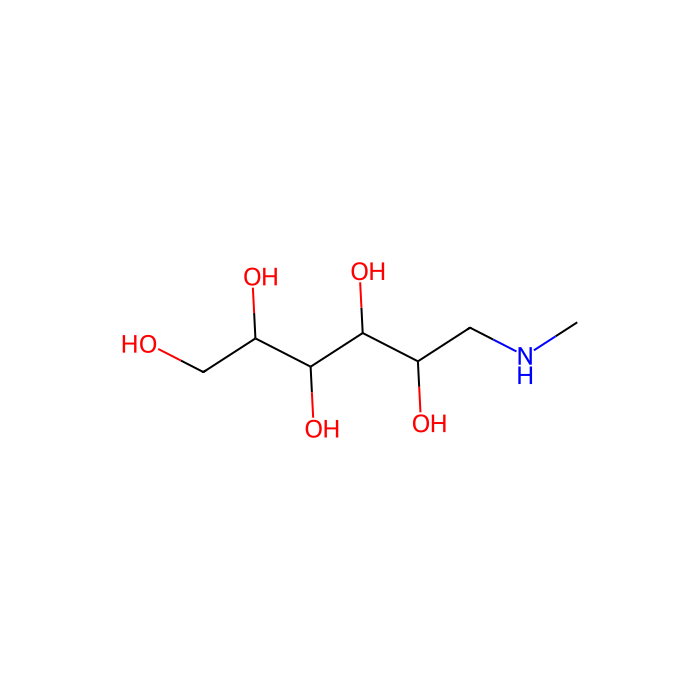
    • Structural features: a D-glucose backbone reduced to a sorbitol-like polyol bearing multiple secondary alcohols (–CHOH–) and a terminal primary alcohol (–CH2OH), with the anomeric carbon substituted by a –CH2–NH–CH3 functionality. Stereochemistry corresponds to D-series carbohydrate configuration (multiple defined stereocenters on the hexitol chain).
    • Functional groups: primary amine (basic), five alcohols (hydrogen-bond donors/acceptors), aliphatic methyl substituent on nitrogen.
  • 2D description in words: a linear hexitol chain with alternating hydroxyl-bearing stereocenters; at one end a primary alcohol (–CH2OH), and near the other end a methylene-linked N-methyl primary amine (–CH2–NHCH3), producing a highly polar, polyfunctional scaffold.

Note: Structural identifiers (SMILES, InChIKey) specific to this item are not provided in the Product Data; consult the CoA/Spec Sheet for item-verified identifiers.

Synthetic Utility
  • Functional group platform:

    • Primary amine (nucleophilic) enables formation of amides, ureas, carbamates, sulfonamides with activated carboxylic acids, isocyanates, sulfonyl chlorides, and NHS esters.
    • Polyol framework (five hydroxyls) allows selective protection and diversification (acetonides, benzyl/allyl ethers, silyl ethers) to craft multifunctional chiral scaffolds and ligands.
  • Applications (literature/general):

    • Counterion-driven crystallization: preparation of crystalline or amorphous salts with carboxylic acids to tune solubility and dissolution for screening libraries.
    • Polymer/conjugate synthesis: serves as a hydrophilic amine initiator for polymer grafting (e.g., PEGylation via NHS esters) or as a pendant cationic handle on carbohydrate-like linkers.
    • Ionic liquids/deep eutectic mixtures: forms eutectics with certain acids, offering low-volatility media for synthesis or extraction.
  • Retrosynthetic value:

    • Chiral pool derivatization from the D-glucose configuration provides access to densely functionalized chiral aminoalditols and sugar-based organocatalysts/ligands.
  • Practical tips:

    • For acylations in water, activate carboxylic acids as NHS or use water-compatible coupling agents (e.g., EDC) at pH 7.5–8.5 to favor amide over ester formation; control stoichiometry due to multiple competing hydroxyls.
    • Protect hydroxyls when chemoselectivity is required at nitrogen; in neat or alcoholic solvents, transesterification/ester formation at hydroxyls may compete under strong activation.
Target Specificity

Not applicable. This product is a small-molecule reagent (meglumine) and is not an antibody, probe, or biomolecular ligand with defined antigen/epitope specificity. For functional usage, refer to Reaction & Applications and Synthetic Utility sections.

Shall we send you a message when we have discounts available?

Remind me later

Thank you! Please check your email inbox to confirm.

Oops! Notifications are disabled.