QUALITÄT & REINHEITMoligand™?Moligand™ — Aladdin's line of ligands and bioactive small molecules. Use for receptor, pathway, and binding studies needing defined small-molecule tools.≥98%
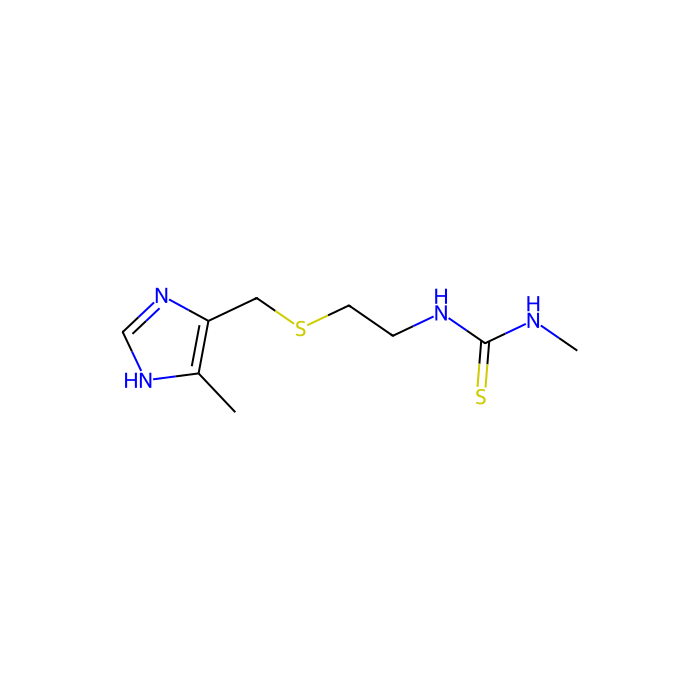
Metiamide (SK&F 92058) is a histamine H2-receptor antagonist.
Spezifikationen
Spezifikationen & Reinheit
Moligand™, ≥98%
Biochemische und physiologische Mechanismen
Description: IC50 Value: 0.92uM(Ki with glycolaldehyde as the varied substrate for E3) Metiamide is a histamine H2-receptor antagonist developed from another H2 antagonist, burimamide. It was an intermediate compound in the development of the successful anti-ulcer drug cimetidine. in vitro: Metiamide is a competitive with aldehyde substrates and noncompetitive with the Human E3 Aldehyde Dehydrogenase coenzyme, binding to both the free E3 isozyme and the enzyme·coenzyme binary complex withK i values of 0.92 μM glycolaldehyde as the varied substrate[1]. Data was got as percentage change in GTPase activity induced by metiamide compared with the GTPase activity stimulated by HA (100 μM)[2]. in vivo: Metiamide is a histamine H2-receptor antagonist. It reduces basal and nocturnal gastric acid secretion and a reduction in gastric volume, acidity, and amount of gastric acid released in response to stimuli including food, caffeine, insulin, betazole, or pentagastrin. Metiamide inhibits many of the isoenzymes of the hepatic CYP450 enzyme system. Other actions of Metiamide include an increase in gastric bacterial flora such as nitrate-reducing organisms. Clinical trail:
Storage
Store at -20°C
Verschickt in
Ice chest + Ice pads
Dieses Produkt erfordert Kühlkettenversand. Grundversand und andere Economy-Optionen sind nicht verfügbar.
This compound belongs to the class of organic compounds known as imidazoles. These are compounds containing an imidazole ring, which is an aromatic five-member ring with two nitrogen atoms at positions 1 and 3, and three carbon atoms.
External Descriptors
imidazoles
1. Djoumbou Feunang Y, Eisner R, Knox C, Chepelev L, Hastings J, Owen G, Fahy E, Steinbeck C, Subramanian S, Bolton E, Greiner R, and Wishart DS. ClassyFire: Automated Chemical Classification With A Comprehensive, Computable Taxonomy. Journal of Cheminformatics, 2016, 8:61.
Wir verwenden Cookies, um die ordnungsgemäße Funktion der Website sicherzustellen und, soweit zulässig, Ihr Nutzererlebnis zu verbessern. Sie können Ihre Einstellungen jederzeit unter „Einstellungen“ verwalten. Weitere Informationen finden Sie in unserer Cookie-Richtlinie.
Dürfen wir Sie über Rabattaktionen informieren?
Später erinnern
Vielen Dank! Bitte überprüfen Sie Ihren E-Mail-Posteingang, um zu bestätigen.
Products are supplied to verified businesses, institutions, and qualified professionals for research and development use only. Not for use in humans, animals, diagnosis, or therapy.

 F2426103