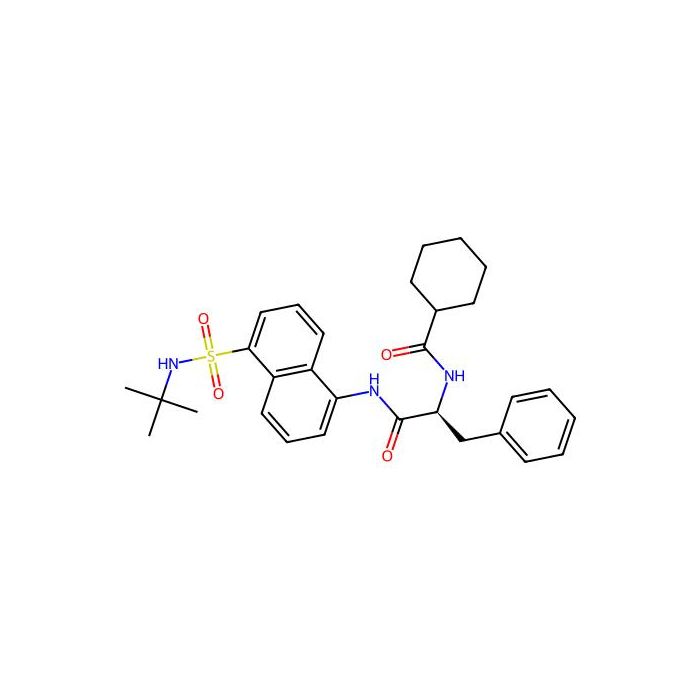
MF-094 is a potent and selective USP30 inhibitor with an IC 50 of 120 nM. MF-094 increases protein ubiquitination and accelerates mitophagy
In Vitro
MF-094 has <30% inhibitory activity for a panel of 22 USPs assays at 10 uM. MCE has not independently confirmed the accuracy of these methods. They are for reference only.
Form:Solid
IC50& Target:IC50: 120 nM (USP30)
Spezifikationen
Spezifikationen & Reinheit
≥99%
Biochemische und physiologische Mechanismen
MF-094 is a potent and selective USP30 inhibitor with an IC 50 of 120 nM. MF-094 increases protein ubiquitination and accelerates mitophagy.
Storage
Store at -20°C
Verschickt in
Ice chest + Ice pads
Dieses Produkt erfordert Kühlkettenversand. Grundversand und andere Economy-Optionen sind nicht verfügbar.
This compound belongs to the class of organic compounds known as phenylalanine and derivatives. These are compounds containing phenylalanine or a derivative thereof resulting from reaction of phenylalanine at the amino group or the carboxy group, or from the replacement of any hydrogen of glycine by a heteroatom.
External Descriptors
Not available
1. Djoumbou Feunang Y, Eisner R, Knox C, Chepelev L, Hastings J, Owen G, Fahy E, Steinbeck C, Subramanian S, Bolton E, Greiner R, and Wishart DS. ClassyFire: Automated Chemical Classification With A Comprehensive, Computable Taxonomy. Journal of Cheminformatics, 2016, 8:61.
Zertifikate (CoA, COO, BSE/TSE und Analyse-Diagramm)
C of A & Other Certificates(BSE/TSE, COO):
Analytical Chart:
Chemische und physikalische Eigenschaften
Löslichkeit
DMSO : 125 mg/mL (233.34 mM; Need ultrasonic)
Molekulargewicht
535.7
XLogP3
5.700
Hydrogen Bond Donor Count
3
Hydrogen Bond Acceptor Count
5
Rotatable Bond Count
9
Exact Mass
535.25 Da
Monoisotopic Mass
535.25 Da
Topological Polar Surface Area
113.000 Ų
Heavy Atom Count
38
Formal Charge
0
Complexity
897.000
Isotope Atom Count
0
Defined Atom Stereocenter Count
1
Undefined Atom Stereocenter Count
0
Defined Bond Stereocenter Count
0
Undefined Bond Stereocenter Count
0
The total count of all stereochemical bonds
0
Covalently-Bonded Unit Count
1
Lösungsrechner
Molarity Calculator
Determine the necessary mass, volume, or concentration for preparing a solution.
Dilution Calculator
Determine the dilution needed to prepare a stock solution.
Reconstitution Calculator
Bewertungen
Kundenbewertungen
Application Protocols
No tested application protocols, recommended dilutions, or platform-specific settings are provided for MF-094 in the product data.
General practices for small-molecule screening stocks:
Stock preparation: Dissolve in anhydrous DMSO to 10–50 mM. Sonication and gentle warming (≤40°C) may assist dissolution; avoid prolonged heating.
Aliquoting: Dispense into amber vials or 96/384-well source plates under dry conditions; cap tightly to minimize water uptake.
Storage of stocks: −20°C per product storage guidance; minimize freeze–thaw by using single-use aliquots.
Assay setup: Thaw on ice, vortex, and centrifuge briefly to collect condensate. Dilute into assay buffer or media to the desired final concentration, maintaining consistent vehicle percentage across controls and treatments.
Controls: Include vehicle-only controls, and if available, a positive control compound for the target/assay class.
Documentation:
Record lot number, stock concentration, solvent, and preparation date in ELN or LIMS. Attach CoA and SDS for traceability.
These are general recommendations; tailor to your assay modality and institutional SOPs.
Biological Roles
No biological function, target, or pathway annotation is provided for MF-094 in the product data. Without structural and mechanistic information, specific biological roles cannot be ascribed.
General considerations for small-molecule library members (research use only):
Screening compounds may exhibit activity across diverse biochemical targets. Initial profiling often includes broad panels (e.g., enzymatic assays, receptor binding, phenotypic readouts) to identify potential hit activity and selectivity windows.
Physicochemical properties (pKa, logD, polar surface area) strongly influence cell permeability and nonspecific binding; these parameters should be computed once a structure is available.
Aggregation and fluorescence interference are common assay artifacts. Employ counter-screens (e.g., detergent-sensitive assays, redox interference panels) and orthogonal readouts to confirm true activity.
Metabolic stability and protein binding (e.g., microsomes, serum) affect apparent potency in cellular systems; establish these profiles only after confirming structural identity and purity.
Important scope note:
This product is supplied strictly for laboratory research use. No clinical, diagnostic, or therapeutic claims are made or implied. Any biological insights must be developed through appropriate in vitro/in vivo research following institutional approvals and ethical guidelines.
Next steps for annotating MF-094 in your pipeline:
Upon receipt of structural data, compute ADME-relevant descriptors, run PAINS/REOS filters, and design confirmatory assays to de-risk artifacts before resource-intensive studies.
Buffer Applications
This product is a discrete small organic compound rather than a buffer component. Consequently, classical buffer system guidance (e.g., pKa-based recipes, buffering ranges, osmolarity) does not apply to MF-094.
Practical notes relevant to buffer use during handling (general):
If diluting DMSO stock into aqueous buffer, add slowly with vortexing to prevent precipitation. Maintain final DMSO at the minimal level compatible with solubility (commonly ≤0.1–1% v/v in biochemical assays).
Choose assay buffers (e.g., PBS, HEPES, Tris) based on biological system requirements, not on the compound. Verify compound stability at the selected pH and ionic strength.
Include a nonionic surfactant (e.g., 0.01–0.05% Tween-20) to mitigate aggregation or adsorption if observed.
For detailed buffer recipes and pH ranges, refer to dedicated buffer reagents; MF-094 itself does not function as a buffering agent.
Green Alternatives
As MF-094 is a discrete small molecule rather than a process solvent, the concept of “green alternatives” pertains primarily to the choice of solvents and handling during its use, not substitution of the compound itself. Optimize your workflows to minimize environmental impact while preserving data integrity.
Greener solvent strategies (general):
Prefer aqueous buffers with minimal organic cosolvent where feasible, provided the compound remains fully dissolved and stable.
When organic stock solutions are needed, use ethanol or isopropanol as assay-compatible and lower-toxicity options relative to DMF or NMP, subject to solubility.
DMSO is widely used; manage through closed systems to limit worker exposure and waste.
Comparison of common vehicles (general guidance):
Ethanol: Lower toxicity; may perturb membrane assays at >1–2% v/v.
Isopropanol: Similar to ethanol, slightly less volatile; assay compatibility comparable.
Acetonitrile: Volatile, good for analytics; handle vapors with care; waste is manageable.
DMF/NMP: High solvency but more hazardous; avoid for routine bioassays if alternatives suffice.
Operational green chemistry tips:
Prepare concentrated stocks to reduce solvent volumes; aliquot to extend shelf life and reduce waste from freeze–thaw cycles.
Use microscale assays and miniaturized plate formats (384/1536 well) to reduce material and solvent consumption.
Implement solvent recycling where compatible with analytical workflows.
Note: No item-specific environmental data (biodegradability, E-factor contribution, etc.) are available for MF-094.
Pharmaceutical Uses
No pharmacopeial status, excipient role, or formulation guidance is provided for MF-094, and it is offered strictly for research use only. Without structural and safety dossiers, this compound is not intended for use in human or veterinary medicinal products.
General, non-clinical formulation considerations for research materials:
For in vitro applications, prepare DMSO stocks and dilute into assay media within solvent tolerance limits.
For exploratory in vivo research in laboratory animals (if permitted by your institution and applicable regulations), thorough pre-formulation screening is essential: solubility across vehicles (e.g., PEG400, Captisol, lipid-based systems), stability, and tolerability must be evaluated de novo. Note that Aladdin Scientific does not provide use directions for in vivo administration.
Avoid assuming GRAS or compendial compliance; no USP/EP monograph or excipient listing is implied.
Documentation:
Rely on the batch-specific CoA and SDS for identity, purity, and hazard assessment. Additional data packages (e.g., elemental impurities, residual solvents per ICH Q3C, stereochemical purity) are not specified for this item; request if required for your internal qualification processes.
Physical Properties
Item-specific physicochemical data are not provided in the product data. For definitive values, consult the CoA/Spec Sheet.
Provided/Item-specific:
Appearance: Not specified for this item; refer to CoA/Spec Sheet.
Molecular formula: Not specified for this item; refer to CoA/Spec Sheet.
Molecular weight: Not specified for this item; refer to CoA/Spec Sheet.
Melting point (MP): Not specified for this item; refer to CoA/Spec Sheet.
Boiling point (BP): Not specified for this item; refer to CoA/Spec Sheet.
Density: Not specified for this item; refer to CoA/Spec Sheet.
Solubility: Not specified for this item; refer to CoA/Spec Sheet.
LogP/logD: Not specified for this item; refer to CoA/Spec Sheet.
pKa: Not specified for this item; refer to CoA/Spec Sheet.
Refractive index: Not applicable/unknown for solids; otherwise not specified.
General guidance for small-molecule library members (literature/general):
Many screening compounds are supplied as amorphous or microcrystalline solids, often soluble in polar aprotic solvents such as DMSO, DMF, or NMP. Always verify with a small-scale solubility test.
If the compound contains ionizable groups, pH-adjusted aqueous cosolvents (e.g., DMSO:buffer mixtures) may improve solubility. Avoid prolonged exposure to basic media if ester/amide hydrolysis is a concern.
Hygroscopicity/photosensitivity are structure-dependent; in the absence of data, minimize exposure to ambient moisture and light until properties are confirmed.
Note: Do not treat generalized statements as specifications. For experimental planning and stock solution preparation, rely on the actual CoA and in-house verification (LC-MS, DSC/TGA for stability, and a tiered solubility screen).
Quality and Grades
Grade/purity and detailed quality attributes are not specified in the provided product data; consult the CoA/Spec Sheet for assay, related substances, residual solvents, and analytical methods.
What to expect and verify for a small-molecule library item:
Identity: Typically supported by LC-MS and/or 1H NMR. Confirm retention time, mass accuracy, and isotopic pattern. If provided, compare to a reference spectrum.
Purity: Screening compounds are commonly supplied at ≥90–95% purity by LC/UV or LC/MS TIC; confirm the exact threshold on the CoA.
Water and residual solvents: Not specified for this item; refer to CoA/Spec Sheet. If critical for your assays, perform KF titration and GC headspace in-house.
Salts and solvate form: Confirm whether delivered as free base/acid or salt (e.g., HCl, TFA). Salt form impacts solubility and molecular weight for dosing calculations.
Stabilizers: Not specified for this item; refer to CoA/Spec Sheet. If none are listed, assume neat compound and protect from moisture/light by default.
Context on grade terminology (general):
“Screening grade/bioactive library grade” prioritizes identity and purity for biochemical/cellular assays rather than trace-metal or UV cutoff specs.
If you require analytical reagent grade, HPLC grade, or GMP-like documentation, contact us for availability. We can often provide enhanced QC (e.g., qNMR purity, chiral purity, ion content) on request.
Bottom line: Use the batch-specific CoA as the authoritative quality document for your lot of MF-094.
Reaction and Applications
This product is cataloged within a small-molecule/compound library category and is primarily intended as a research screening compound. No specific synthetic or application notes are provided for MF-094 in the product data.
Potential research applications (general, non-clinical):
Biochemical or cell-based assay screening as a test article in target validation or SAR exploration pipelines.
Reference standard in LC/MS method development after identity confirmation.
Control or counter-screen compound in phenotypic assays to benchmark assay performance.
If you intend to use MF-094 as a synthetic intermediate:
Absent structural information, no reaction class recommendations can be provided. If a structure is supplied on the CoA, review functional groups for compatibility (e.g., avoid strong base with labile heterocycles; protect nucleophilic sites during acylations).
Practical guidance:
Dissolve in DMSO to prepare a primary stock solution; maintain at low temperature during handling to minimize degradation.
For plate-based screening, pre-dilute into assay-compatible solvent and confirm absence of precipitate at working concentration by visual inspection or nephelometry.
Confirm stability under assay conditions (temperature, light exposure, pH). Utilize LC/MS time-course to monitor degradation or adsorption losses.
Note: Manufacturer Applications field is not provided for this SKU; therefore, no item-specific application claims are made here.
Reaction Conditions
No item-specific reaction conditions are available for MF-094 in the product data. If used as a screening ligand, probe, or synthetic intermediate, conditions should be selected based on its confirmed functional groups and stability profile.
General guidance (literature-based best practices, not item-specific):
Amide coupling: DMF/DCM/MeCN; EDC/HOBt, HATU, or CDI; 0–25°C; 1–12 h. Monitor by LC/MS; quench with aqueous base and extract.
Suzuki–Miyaura coupling (if aryl/hetaryl B/Br/I present): dioxane/water, K2CO3 or Cs2CO3; Pd(PPh3)4 or Pd2(dba)3/XPhos; 60–100°C; 2–16 h.
Buchwald–Hartwig amination: toluene/dioxane; Pd2(dba)3 + BrettPhos/XPhos; NaOtBu or Cs2CO3; 60–110°C; 4–20 h.
Reductive amination: MeOH/THF; NaBH3CN or BH3•THF; 0–25°C; 1–6 h with pH control.
Hydrogenation: EtOH/EtOAc; Pd/C (5–10%); 1–5 bar H2; RT–50°C; monitor for over-reduction.
Stability considerations:
Moisture/air sensitivity is unknown; default to inert atmosphere for moisture-sensitive steps until verified.
Photosensitivity unknown; protect from light during extended reactions if chromophores are suspected.
Important: Treat these as general methods. Select actual conditions only after structural confirmation of MF-094 and small-scale feasibility tests.
Safety and Handling
Authoritative safety information must be taken from the product SDS. The following fields were not specified in the product data and should be confirmed before use:
GHS classification: Not specified for this item; refer to SDS.
Signal word: Not specified for this item; refer to SDS.
Hazard statements (H-codes): Not specified for this item; refer to SDS.
Pictograms: Not specified for this item; refer to SDS.
General laboratory precautions for small organic compounds:
PPE: Use lab coat, safety glasses or goggles, and appropriate chemical-resistant gloves (e.g., nitrile). Employ splash protection when handling stock solutions.
Engineering controls: Work in a certified fume hood to avoid inhalation of dusts/aerosols and solvent vapors.
Avoid contact with skin, eyes, and clothing. Prevent ingestion and inhalation. Handle powders gently to minimize airborne particulates.
Incompatibilities (general): Strong oxidizers and strong acids/bases may be incompatible depending on functional groups; confirm via SDS once structure is verified.
First aid (overview; defer to SDS): In case of skin contact, wash with soap and water. For eye contact, rinse with water for several minutes and seek medical attention. If inhaled, move to fresh air. If swallowed, rinse mouth; do not induce vomiting unless directed by medical personnel.
Spill response: Absorb small liquid spills with inert material; for solids, carefully sweep to avoid dust. Dispose of waste in accordance with institutional and local regulations.
Note: Until hazard data are confirmed, adopt a precautionary approach and treat as potentially harmful. For transport/receipt, this product is shipped in an ice chest with ice pads; inspect for container integrity upon arrival.
Solvent Selection
Item-specific solubility data are not provided; consult the CoA/Spec Sheet and perform a tiered solubility screen. The following guidance applies generally to small-molecule library compounds.
Primary stock solvent: DMSO is typically preferred for screening stocks due to broad solvency and assay compatibility at ≤0.1–1% v/v in final wells.
Secondary solvents/cosolvents: DMF, acetonitrile, ethanol, or isopropanol may be used depending on functionality; follow with aqueous dilution containing surfactants (e.g., 0.01–0.05% Tween-20) if needed.
Aqueous media: Use buffer with physiological pH (e.g., PBS, HEPES) only after achieving a homogeneous organic concentrate. Avoid direct weighing into water for poorly soluble neutrals.
Weak acids/bases: pH adjustment can enable dissolution; ensure compound stability under selected pH. Prepare fresh if hydrolysis-prone motifs (esters, lactams) are suspected.
Quick comparison (general):
DMSO: Maximum solvency, low volatility; can affect sensitive assays at higher %.
DMF: Good solvency, higher toxicity; less favored for biological assays.
Acetonitrile: Volatile, good for LC; limited solvency for nonpolar solids.
Ethanol/IPA: Assay-friendly; limited for highly lipophilic molecules.
Practical tips:
Start with 10 mM in DMSO and escalate to 50–100 mM only if fully dissolved and stable.
Filter (0.22 µm PTFE) if particulate persists; avoid adsorption-prone membranes for lipophilic compounds.
Record exact solvent lot and preparation date to support reproducibility.
Note: Do not treat the above as specifications for MF-094; they are general best practices pending item-specific solubility data.
Storage and Reconstitution
Item-specific handling details provided:
Storage Conditions: Store at −20°C (as provided).
Shipped In: Ice chest + ice pads (as provided). Inspect upon receipt and allow to equilibrate to room temperature in sealed packaging before opening to prevent condensation.
Reconstitution (general guidance for small-molecule library compounds):
Solvent choice: If no solubility data exist, begin with anhydrous DMSO for primary stocks. Alternative solvents (DMF, ethanol, acetonitrile) may be evaluated as needed.
Concentration: Common working stocks are 10–50 mM. Confirm complete dissolution visually; if needed, brief sonication or warming (≤40°C) can assist.
Filtration: If particulates persist, filter through a 0.22 µm PTFE membrane. Avoid cellulose ester membranes for DMSO-rich solutions.
Aliquoting: Prepare single-use aliquots in amber vials or well plates under dry conditions to limit freeze–thaw cycles and moisture uptake.
In-use stability (not item-specific):
Avoid repeated freeze–thaw cycles. Thaw on ice and return unused material to −20°C promptly.
Protect from light until photosensitivity is assessed. Limit exposure to ambient humidity.
Unspecified parameters:
Appearance, stabilizers, and aqueous solubility: Not specified for this item; refer to CoA/Spec Sheet.
For authoritative stability and reconstitution instructions specific to your lot, always consult the batch CoA and SDS.
Structure and Identity
Brief overview: MF-094 (SKU: M647943) is listed in our small-molecule and compound library category. Item-specific structural identifiers are limited in the provided product data.
Chemical name: Not specified for this item; refer to CoA/Spec Sheet.
CAS: 2241025-68-1 (as provided)
PubChem CID: 138319686 (as provided)
InChIKey: 70520 (as provided; note this is not in the conventional 27-character InChIKey format. Verify against CoA/SDS.)
SMILES: Not specified for this item; refer to CoA/Spec Sheet.
Molecular formula: Not specified for this item; refer to CoA/Spec Sheet.
Molecular weight: Not specified for this item; refer to CoA/Spec Sheet.
Structural features (general guidance):
Without a confirmed structure, specific functional groups, ring systems, and stereochemical information cannot be stated for this item.
If a structural file (SMILES/SDF/MOL) is supplied with your batch, review it to identify heteroatoms (N, O, S, halogens), ring count, and stereocenters, which will guide solubility, ionization, and storage decisions.
2D structure description (general):
Not specified for this item; refer to CoA/Spec Sheet.
Identification best practices:
Cross-verify the batch with supplied CoA using CAS, lot number, and any NMR/LC-MS data.
For internal databases, populate structure fields upon receipt of the SDF/SMILES from the CoA to enable computational predictions (pKa/logP) and screening annotations.
Synthetic Utility
MF-094 is listed as a small-molecule library member, and its use is primarily as a test article in screening rather than as a general synthetic building block. Because structural information is not provided, no functional-group-specific reactivity guidance can be offered.
General considerations if employing MF-094 in synthesis (contingent on structure):
Identify reactive handles (e.g., aryl halides for cross-coupling, amines for acylation/urea formation, acids for amide coupling). Select conditions compatible with any sensitive motifs (nitroarenes, benzylic heterocycles, enolizable carbonyls).
Protect labile groups when necessary (Boc/CBz for amines; TBDMS/TBS for alcohols) and stage deprotections under the mildest conditions feasible.
For heteroaromatic systems, consider conditions that mitigate protodehalogenation and over-reduction; use ligand/catalyst sets tuned for heteroaryl coupling (e.g., Buchwald-type ligands).
If chirality is present, plan for enantiospecific routes or chiral separations; confirm ee/er by chiral HPLC or SFC.
Analytical control:
Monitor reactions by LC/MS to track starting material consumption and product profile; collect spectra for target verification.
Assess stability toward silica and base/acid prior to chromatographic purification to avoid degradation.
Note: Without a disclosed structure, the above remains general methodology guidance and must not be interpreted as specific to MF-094.
Target Specificity
Target information is not provided for MF-094. No validated biological target, binding epitope, or selectivity profile is available in the product data.
What you can do to establish specificity (general research guidance):
Perform primary screening followed by orthogonal confirmation (biochemical vs cellular) to rule out assay artifacts.
Build structure–activity relationships (SAR) from analogs, if available, to triangulate on potential targets.
Use counter-screens against frequent hitters and pan-assay interference compounds (PAINS) to de-risk nonspecific mechanisms.
Apply chemoproteomics or thermal shift profiling when feasible to identify on-target interactions in complex systems.
Note: In the absence of item-specific data, no claims are made regarding selectivity or mechanism for MF-094.
Häufig gestellte Fragen
What is the purity of this product?
This product is supplied at ≥99% purity (chemical assay). Lot-specific values are stated on the Certificate of Analysis.
How should this product be stored?
Store at ?20 °C. Freezer storage is required to maintain the specified shelf life.
How is this product shipped?
This product ships in an insulated container with ice pads. Unpack on arrival and transfer it to the storage condition stated above.
What are the CAS number, molecular formula and molecular weight?
The CAS Number is 2241025-68-1, the molecular formula is C30H37N3O4S, and the molecular weight is 535.70 g/mol. InChIKey DQXORJHBZHLLTE-SANMLTNESA-N.
What documentation is provided?
Available product documentation, including Certificates of Analysis (COA), Safety Data Sheets (SDS), and specification sheets, is shown in the product document area. Document availability and access follow the current site policy.
Wir verwenden Cookies, um die ordnungsgemäße Funktion der Website sicherzustellen und, soweit zulässig, Ihr Nutzererlebnis zu verbessern. Sie können Ihre Einstellungen jederzeit unter „Einstellungen“ verwalten. Weitere Informationen finden Sie in unserer Cookie-Richtlinie.
Dürfen wir Sie über Rabattaktionen informieren?
Später erinnern
Vielen Dank! Bitte überprüfen Sie Ihren E-Mail-Posteingang, um zu bestätigen.
Products are supplied to verified businesses, institutions, and qualified professionals for research and development use only. Not for use in humans, animals, diagnosis, or therapy.