Mito-TEMPO is a mitochondria-targeted antioxidant that helps protect against oxidative damage to the mitochondria. It has superoxide and alkyl radical scavenging properties. Mito-TEMPO has been shown to facilitate in the release of proapoptotic proteins from the mitochondria, attenuating ATP-depletion recovery-mediated necrosis and apoptosis. It has been shown to help block negative effects on the cardiac Na|+|channel in cardiomyocytes.
Spezifikationen
Synonyme
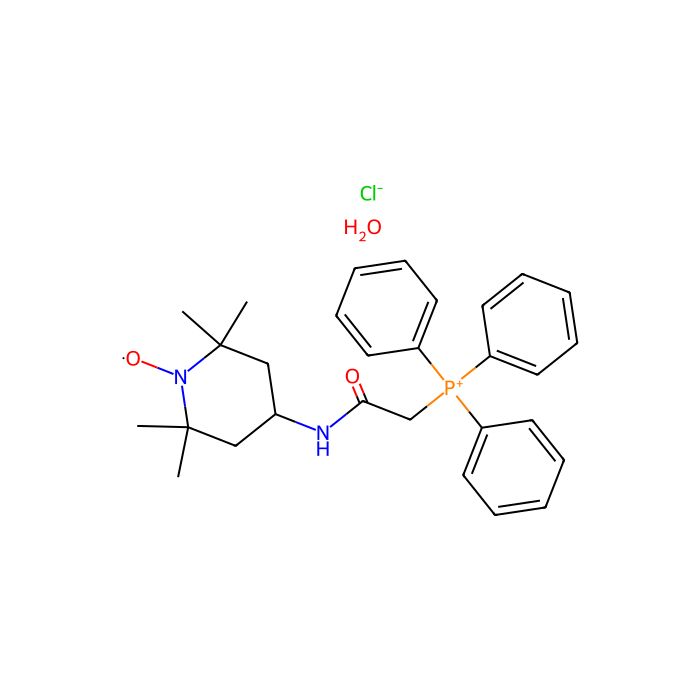
Mito-TEMPO is known as a combination of TEMPO and triphenylphosphonium.
Spezifikationen & Reinheit
≥95%
Storage
Store at -20°C
Verschickt in
Ice chest + Ice pads
Dieses Produkt erfordert Kühlkettenversand. Grundversand und andere Economy-Optionen sind nicht verfügbar.
Aktionsart
MODULATOR
Hinweis
Solutions in water, saline, ethanol or DMSO are stable at +4°C for 1-2 weeks. DMSO stock solution can be stored also at -20°C.
Determine the necessary mass, volume, or concentration for preparing a solution.
Dilution Calculator
Determine the dilution needed to prepare a stock solution.
Reconstitution Calculator
Bewertungen
Kundenbewertungen
Application Protocols
No item-specific, validated application protocols are provided for this SKU in the Product Data.
General/literature practices for using mitochondria-targeted nitroxides (for planning only; not product-validated):
Stock preparation: Dissolve in anhydrous DMSO to 10–50 mM; vortex and, if needed, gently warm to aid dissolution. Filter-sterilize through 0.22 µm PTFE if sterility is required.
Working solutions: Dilute into pre-warmed culture medium or buffer immediately before use, targeting final DMSO ≤0.1–0.2% v/v. Inspect for precipitation.
Dosing: Begin with a conservative range (e.g., 0.05–5 µM) and adjust based on cell tolerance and assay response. Include vehicle and control compounds (TEMPO, TPP+ analogs).
Timing: Allow 15–60 min pre-incubation for mitochondrial accumulation before applying ROS stressors or readouts, as appropriate to the model.
Stability: Protect from strong light and avoid prolonged room-temperature exposure. Prepare fresh dilutions for each experiment.
These points are provided as literature-based planning guidance. Users should verify conditions empirically and consult the primary literature most relevant to their assay system. For any critical application, generate internal SOPs and risk assessments.
Biological Roles
MitoTEMPO hydrate belongs to a class of mitochondria-targeted nitroxide radicals designed to modulate and probe mitochondrial redox biology. The nitroxide moiety (TEMPO) behaves as a persistent radical that can undergo reversible one-electron redox cycling with superoxide and related reactive oxygen species (ROS), while the triphenylphosphonium (TPP+) cation drives mitochondrial accumulation via the inner membrane potential.
General/literature roles in biochemical research:
Superoxide modulation: Acts as a superoxide dismutase (SOD)-mimetic scavenger, facilitating disproportionation of O2•− and buffering localized oxidative stress in the mitochondrial matrix.
Redox probe behavior: Nitroxides exhibit EPR-detectable signals, enabling monitoring of intracellular reduction to hydroxylamine and re-oxidation, which can report on cellular redox status.
Mitochondrial targeting: The TPP+ unit exploits the Nernstian distribution across polarized membranes, leading to several-hundred-fold enrichment within energized mitochondria relative to cytosol (qualitative literature principle; actual accumulation depends on potential, concentration, and time).
Pathway interrogation: Used to dissect roles of mitochondrial ROS in signaling, metabolism, and stress responses by comparing phenotypes with and without targeted ROS buffering (no clinical claims; research context only).
Notes and cautions (general):
Off-target effects can arise from phosphonium-driven membrane interactions at higher concentrations; include TPP+-only controls when possible.
Intracellular reduction can silence the nitroxide signal; time courses and dosing should account for cellular reductive capacity and oxygenation.
No item-specific biological activity data, EC50/IC50 values, or validated assay conditions are provided in the Product Data; consult primary literature for system-specific parameters.
Buffer Applications
This compound is not a buffering agent and is not used to set or maintain pH. Accordingly, conventional buffer recipes (phosphate, HEPES, Tris, etc.) do not apply.
Practical notes (general/literature) for use in buffered systems:
Stock preparation: Prepare a concentrated stock in DMSO or ethanol, then dilute into the desired physiological buffer or culture medium immediately before use, mixing thoroughly to avoid localized precipitation.
Compatible buffers: Common biological buffers (HEPES, PBS, HBSS, carbonate) are generally compatible at typical assay concentrations; verify solubility and absence of precipitation visually.
pH sensitivity: Nitroxide stability is generally acceptable over neutral physiological pH ranges; avoid strongly acidic/basic conditions that could hydrolyze linkers (general caution).
For exact compatibility limits, maximum aqueous concentrations, or recommended vehicles for this SKU, refer to the CoA/Spec Sheet or perform a small solubility/stability screen.
Green Alternatives
Green chemistry considerations for this product focus on solvent choice, waste minimization, and experimental design, as the compound itself is a specialized probe rather than a commodity solvent or reagent.
Solvent selection: Prefer greener solvents where compatible with solubility and biology. Ethanol and water (with minimal DMSO cosolvent) are greener alternatives to DMF or high DMSO fractions, provided the compound remains soluble and stable for the assay window (literature guidance).
Comparison (general/literature; qualitative):
DMSO: Excellent solubilizer, relatively low volatility, but not renewable; downstream waste treatment needed.
Ethanol: Renewable, low toxicity profile; may limit achievable stock concentration and can affect membrane properties in cell assays at higher %.
Water/buffer with minimal cosolvent: Greenest option; may risk precipitation or adsorption losses; confirm by visual inspection and test recovery.
Operational green practices:
Prepare small, concentrated stocks to reduce solvent volumes and storage footprint.
Use amber vials and minimize freeze–thaw cycles to extend shelf life and reduce waste.
Scale assays to the minimum volume that yields robust analytical signal.
There are no direct “green” drop-in replacements for mitochondria-targeted nitroxide probes; selection is driven by the biological question. Where feasible, consider non-chemical alternatives (genetic reporters of redox status) to reduce chemical use and waste (strategy-level green consideration).
Pharmaceutical Uses
This product is supplied strictly for research use only and is not approved for human or veterinary use, diagnostic procedures, or as a drug substance/excipient.
General context (literature/industry background, non-clinical):
Triphenylphosphonium-conjugated small molecules such as MitoTEMPO are studied as chemical tools for investigating mitochondrial redox biology and for formulation research aimed at targeting mitochondrial compartments. These activities occur at the research stage and do not imply suitability for therapeutic applications.
Excipient status: There is no pharmacopeial monograph for MitoTEMPO; it is not recognized as a standard excipient. Any formulation work would be exploratory and limited to preclinical research.
Developability considerations (research-only): Phosphonium salts tend to be hygroscopic and highly lipophilic; solubilization often relies on co-solvents, cyclodextrins, or lipid-based vehicles in formulation studies. Stability-indicating assays should monitor potential redox interconversion between nitroxide and hydroxylamine forms.
Item-specific regulatory grade, residual solvent limits, or compendial compliance are not provided in the Product Data. For any GLP-related exploratory work, obtain a detailed CoA and SDS, and establish internal specifications appropriate to the intended research application.
Physical Properties
Only limited item-specific physical data are provided for this catalog entry. The following notes distinguish item-specific information from general/literature values.
Item-specific (from Product Data):
Appearance: Not specified for this item; refer to CoA/Spec Sheet.
Molecular weight: Not specified for this item; refer to CoA/Spec Sheet.
Molecular formula: Not specified for this item; refer to CoA/Spec Sheet.
General/literature characteristics for MitoTEMPO (anhydrous salt; hydrate properties may differ):
Physical state: typically an orange to red-orange solid due to the nitroxide chromophore (literature, may vary by lot and hydration).
Solubility: high solubility in polar aprotic organic solvents (e.g., DMSO, DMF, acetonitrile); moderate solubility in alcohols (ethanol, methanol); limited solubility in pure water unless aided by the phosphonium salt form and ionic strength (literature). Stock solutions are commonly prepared at 10–50 mM in anhydrous DMSO (literature practice).
Partitioning: the TPP+ cation confers high lipophilicity; logP (TPP conjugates) is typically elevated, supporting membrane permeability (qualitative literature note; specific logP for this item not determined here).
Thermal properties: melting behavior can be broadened by hydration and polymorphism; specific MP/BP for this item are not established here.
Important: For exact numerical values (melting point, water content, counterion identity, hydrate stoichiometry, solubility, UV cutoff, refractive index), consult the item’s CoA/Spec Sheet. Do not treat literature descriptions above as specifications.
Quality and Grades
Item-specific grade/purity are not provided for this listing.
Grade/purity: Not specified for this item; refer to CoA/Spec Sheet for assay, residual solvents, and counterion/water content.
General guidance on quality parameters relevant to MitoTEMPO-type research reagents:
Research grade vs. bioactivity-screening grade: For cell-based ROS studies, low levels of inorganic impurities, residual metals, and peroxides are preferred to minimize off-target oxidative effects. If a bioactivity or screening grade is offered, it typically emphasizes tighter controls on impurities that affect cell health and signal readouts (literature/general practice).
Counterion/hydrate content: For phosphonium salts, chloride vs. bromide and hydration state can influence mass calculations and solubility; verify exact stoichiometry on the CoA before preparing stock solutions.
Spectral identity: 1H/13C NMR (phosphonium center evident by 31P NMR), HRMS, and elemental analysis (adjusted for hydrate) are commonly used to confirm identity and stoichiometry (general practice). Note that the persistent radical may broaden NMR resonances; reduction to the hydroxylamine for characterization is a known approach in the literature.
Residual solvents/water: Karl Fischer and GC headspace values, if present on the CoA, should be used for accurate molarity calculations in sensitive experiments.
For chromatographic use or in vitro work, consult the CoA for UV background and any stabilizers. In the absence of specified grade, treat as research-use only.
Reaction and Applications
This compound is primarily used as a mitochondria-targeted nitroxide probe rather than as a stoichiometric reagent in synthetic chemistry. Accordingly, its most relevant applications are in redox biology and mitochondrial ROS modulation rather than classical organic transformations.
Research applications (literature/general):
Superoxide and ROS modulation: The TEMPO nitroxide functions as a persistent radical and superoxide dismutase (SOD)-mimetic scavenger, commonly employed to attenuate mitochondrial superoxide levels in cell and biochemical studies.
Mitochondrial targeting: The triphenylphosphonium (TPP+) moiety leverages the negative membrane potential of mitochondria to concentrate the compound within the matrix, enabling selective manipulation of mitochondrial redox status.
Control experiments: Paired use with non-targeted TEMPO or TPP+-only analogs helps deconvolute mitochondrial targeting from intrinsic nitroxide activity (good experimental practice).
Analytical readouts: Changes in cellular/mitochondrial ROS are typically measured using fluorescent probes (e.g., MitoSOX Red for superoxide, H2DCFDA for general ROS), EPR spectroscopy for nitroxide signals, or respirometry for functional responses (literature practices; not product-validated).
Not typically used for:
Organometallic or cross-coupling chemistry as a reagent.
Polymerizations, oxidations, or living radical processes where TEMPO is sometimes used, because the TPP+ substituent alters reactivity and handling.
Note: Specific validated applications for this SKU are not provided in the Product Data; users should design dose/response conditions empirically and consult primary literature for assay-specific parameters.
Reaction Conditions
Classical reaction condition guidance (solvent, catalyst, temperature, yield) is not directly applicable because MitoTEMPO hydrate is used as a biological probe rather than a reagent for chemical transformations.
General/literature guidance for experimental deployment in biological systems (non-binding, not product-validated):
Stock solutions: Commonly prepared at 10–50 mM in anhydrous DMSO, stored at low temperature and protected from light; working concentrations in cell systems often range from low nanomolar to low micromolar depending on assay sensitivity and cell type. Exact ranges are system-dependent and should be determined empirically.
Incubation: Pre-equilibrate in complete medium; typical incubation times span 15 min to several hours to allow mitochondrial accumulation (qualitative literature practice).
Controls: Include vehicle controls (DMSO <0.2% v/v), non-targeted TEMPO, and TPP+-only analogs to parse targeting vs. redox effects.
Readouts: Pair with orthogonal ROS assays (e.g., EPR, fluorescent ROS probes) and mitochondrial function measurements (membrane potential dyes, respirometry) to corroborate mechanism.
Important: The Product Data do not provide validated application parameters for this SKU. Users should consult primary literature and perform pilot titrations to establish safe, effective, and artifact-free conditions for their specific system.
Safety and Handling
Authoritative safety guidance must come from the product SDS. The following are general laboratory precautions for nitroxide/ phosphonium salts and do not supersede the SDS.
Item-specific hazard data (from Product Data):
Signal word: Not specified; consult SDS.
H-statements: Not specified; consult SDS.
GHS classification: Not specified; consult SDS.
Pictograms: Not specified; consult SDS.
General handling recommendations (literature/best practice):
PPE: lab coat, safety glasses, and appropriate chemically resistant gloves (e.g., nitrile). Handle powders in a fume hood to minimize dust inhalation.
Incompatibilities: strong oxidizers or reducing agents may alter the nitroxide/TPP+; avoid strong bases/acids that could hydrolyze amide linkers. Avoid reactive metals that can be corroded by halide counterions if present (general precaution).
Stability: nitroxides are generally persistent radicals but may be reduced to hydroxylamines by strong reductants or biological matrices; limit exposure to excessive heat and light.
First aid (overview; consult SDS):
Inhalation: move to fresh air; seek medical advice if symptoms persist.
Skin/eye contact: rinse cautiously with water for several minutes; remove contaminated clothing; obtain medical attention if irritation persists.
Ingestion: rinse mouth; do not induce vomiting; seek medical advice.
Environmental: prevent release to drains in large quantities; collect spills with inert absorbent.
Fire: use CO2, dry chemical, or foam. Combustion may generate phosphorus oxides and aromatic fumes.
Always consult the specific SDS for this SKU for definitive hazard, exposure limits, and emergency measures.
Solvent Selection
This product is a small-molecule probe, not a laboratory solvent. Solvent selection here refers to dissolving the compound for stock solutions and experimental dosing.
General/literature guidance for MitoTEMPO-type salts:
Primary solvents: DMSO is widely used to prepare concentrated stocks (e.g., 10–50 mM) due to strong solvating power for phosphonium salts and nitroxides.
Alternative solvents: DMF and ethanol can be used when DMSO is undesirable; methanol is also feasible but may affect certain assays. Solubility in pure water can be limited; gentle warming and sonication may help, but DMSO cosolvent (0.1–1% v/v in final media) is common in cell studies (literature practice).
Aqueous media: For cell culture, pre-dilute DMSO stocks into buffered media to the desired final concentration, keeping DMSO typically ≤0.1–0.2% v/v to minimize cytotoxic solvent effects (general practice).
Polarity/miscibility profile (qualitative): Highly polar aprotic solvents (DMSO, DMF) — good; lower alcohols — moderate; nonpolar solvents (hexanes, toluene) — poor. Water — variable, often limited without cosolvent.
Comparison (literature, qualitative):
DMSO: maximal solubility, biologically tolerated at low %.
Ethanol: acceptable in many biochemical assays; watch for precipitation upon aqueous dilution.
Aqueous buffers: use only for immediate use after dilution from a concentrated organic stock to avoid slow precipitation.
Always confirm actual solubility and stability with small-scale tests; defer to the item’s CoA for any solvent-specific notes.
Storage and Reconstitution
Item-specific conditions:
Storage: Store at -20°C (from Product Data). Protect from light and moisture; keep container tightly closed.
Additional handling guidance (general best practice for nitroxide/TPP+ salts; not a specification):
Upon receipt: Allow the sealed container to equilibrate to room temperature before opening to prevent moisture condensation, especially for hydrate forms.
Aliquoting: If preparing solutions, make small single-use aliquots to avoid repeated freeze–thaw cycles that can impact stability and concentration.
Reconstitution: Solvent and concentration are application-dependent. Commonly, dissolve in anhydrous DMSO to prepare 10–50 mM stocks (literature). If aqueous working solutions are required, dilute the organic stock into buffer/media immediately before use, mixing thoroughly.
Light/moisture: Store solids and solutions in amber vials with desiccant when feasible. Minimize headspace for solution stocks to reduce oxidative changes.
Stability: The nitroxide can be reduced to hydroxylamine under strongly reducing conditions; check activity periodically if stored for extended periods (e.g., by EPR or functional assay), and discard if discoloration or precipitation occurs.
For definitive shelf life, allowable freeze–thaw cycles, and solution stability for this SKU, consult the item’s CoA and SDS.
Structure and Identity
MitoTEMPO hydrate is a mitochondria-targeted nitroxide radical derived from TEMPO, conjugated through an amide-containing alkyl linker to a lipophilic triphenylphosphonium (TPP+) cation. The hydrate form contains crystallization water.
SKU: M342668
Product name: MitoTEMPO hydrate
CAS: 1569257-94-8
PubChem CID: 73504624 (literature identifier)
InChIKey: 6072 (as provided; truncated/atypical — consult CoA/SDS for full identifier)
SMILES: Not specified for this item; refer to CoA/Spec Sheet.
Molecular formula: Not specified for this item; refer to CoA/Spec Sheet.
Molecular weight: Not specified for this item; refer to CoA/Spec Sheet.
Structural features (general/literature description):
Core nitroxide: a 2,2,6,6‑tetramethylpiperidin-1-oxyl (TEMPO) ring bearing a persistent N–O• radical.
Linker: typically a short amide/alkyl tether that connects TEMPO to the phosphonium center; length varies by supplier/variant (literature).
Mitochondrial targeting moiety: a triphenylphosphonium cation (TPP+), conferring high lipophilicity and membrane potential–driven mitochondrial accumulation (literature generality for TPP+ conjugates).
Hydrate: contains water of hydration; exact stoichiometry not specified for this item.
2D description in words:
A six‑membered piperidine ring bearing four methyl substituents (TEMPO) with an N–O• nitroxide, attached via a carbonyl/alkyl chain to a tetra‑coordinate phosphorus bonded to three phenyl rings (triphenylphosphonium). Counterion commonly chloride in commercial materials (literature), but the specific counterion for this item is not specified; refer to CoA/Spec Sheet.
Synthetic Utility
MitoTEMPO hydrate is not typically employed as a synthetic building block due to its specialized structure combining a persistent nitroxide with a bulky triphenylphosphonium cation. Nevertheless, understanding its functional groups informs handling and potential derivatization in a research context.
Functional features and reactivity (general/literature):
Nitroxide (TEMPO): Persistent radical capable of reversible redox cycling (nitroxide ↔ hydroxylamine). Under strong reducing conditions, it is converted to the corresponding hydroxylamine, which can be re-oxidized by mild oxidants.
Amide linker: Generally stable under neutral conditions; susceptible to hydrolysis under strong acid/base or with activating reagents.
Phosphonium: The TPP+ center is stable toward many conditions but can engage in ion-pairing and phase-transfer–like interactions.
Potential derivatization routes (specialist use):
Isotopic or fluorescent tagging at the linker (if functional handles are present in a given analog) to create dual-modality probes (requires custom synthesis; not specific to this item).
Redox calibration: Chemical reduction to the hydroxylamine for EPR calibration standards and re-oxidation studies.
Not commonly used for:
Radical-mediated polymerizations or alcohol oxidations typical of TEMPO catalysis; the TPP+ substituent hinders process applicability and recovery.
Overall, its value is as a finished probe for mitochondrial redox studies rather than as a precursor in multi-step synthesis.
Target Specificity
This product is not an antibody, enzyme, or nucleic acid with defined biomolecular target specificity parameters. No antigen/epitope, clone, isotype, or species reactivity data apply.
General/literature note: MitoTEMPO-type probes exhibit physicochemical targeting to mitochondria via the triphenylphosphonium cation and membrane potential. This is not a receptor–ligand specificity but a distribution-driven accumulation mechanism. Actual intracellular distribution can vary with cell type, mitochondrial polarization, and dosing.
Item-specific target-binding data are not provided in the Product Data.
Wir verwenden Cookies, um die ordnungsgemäße Funktion der Website sicherzustellen und, soweit zulässig, Ihr Nutzererlebnis zu verbessern. Sie können Ihre Einstellungen jederzeit unter „Einstellungen“ verwalten. Weitere Informationen finden Sie in unserer Cookie-Richtlinie.
Dürfen wir Sie über Rabattaktionen informieren?
Später erinnern
Vielen Dank! Bitte überprüfen Sie Ihren E-Mail-Posteingang, um zu bestätigen.
Products are supplied to verified businesses, institutions, and qualified professionals for research and development use only. Not for use in humans, animals, diagnosis, or therapy.

 H2621018