GRADE & PURITYMoligand™?Moligand™ — Aladdin's line of ligands and bioactive small molecules. Use for receptor, pathway, and binding studies needing defined small-molecule tools.10 mM in DMSO
1.Junming Huang, Genzheng Sha, Minghui Cui, Mengqiu Quan, Yuqing Wang, Yao Lu, Jin Zhu, Jing Chen. (2024) A highly reactive soybean oil-based superhydrophobic polyurethane film with long-lasting antifouling and abrasion resistance. Nanoscale Advances, [PMID:39309514][10.1039/D4NA00674G]
Lösungsrechner
Molarity Calculator
Determine the necessary mass, volume, or concentration for preparing a solution.
Dilution Calculator
Determine the dilution needed to prepare a stock solution.
Reconstitution Calculator
Bewertungen
Kundenbewertungen
Application Protocols
No tested application protocols or validated use-cases are provided in the Product Data for this SKU. The following general guidance is offered for typical laboratory handling of small-molecule electrophiles; adjust to your system and consult the literature.
Stock solution preparation (research use only):
Prepare 100–500 mM stocks in dry DMSO or ethanol. Filter (0.22 µm) if particulate is present. Store aliquots at ≤ –20 °C for short term; at –80 °C per item-specific storage guidance for long term.
In vitro chemical reactions:
For Michael additions to thiols, combine substrate (1.0 equiv) with monoethyl itaconate (1.1–1.5 equiv) in MeOH/ACN with 0.1 equiv base at 0–25 °C. Monitor by LC–MS.
Conduct at pH 7.5–8.3 in buffered aqueous-organic media (≤10–20% DMSO). Include appropriate controls to assess non-specific reactions. Remove excess reagent by gel filtration or dialysis.
These are non-validated, literature-style suggestions. Optimize empirically. For any assay-specific parameters (e.g., concentrations, incubation times), consult primary literature relevant to your system.
Biological Roles
This section provides general literature context; it does not describe clinical use. Item-specific bioactivity data are not provided for this SKU.
Itaconate background (literature):
Itaconate (2-methylidenesuccinate) is an endogenous metabolite generated by decarboxylation of cis-aconitate via the enzyme ACOD1/IRG1 in activated macrophages. It participates in innate immune metabolism and can act as an electrophilic modifier of cysteine residues in proteins.
Monoethyl itaconate in research (literature):
Monoesterification yields a more membrane-permeable derivative while retaining a free acid; it remains an electrophile capable of Michael addition to thiols. Researchers have used monoethyl or dimethyl esters of itaconate as chemical probes to study protein modification and redox-sensitive signaling in cell-based experiments (research use only).
Chemical biology considerations:
The free carboxyl group can engage in ionic interactions or be converted to amides, enabling targeted probe design. The α,β-unsaturated system provides a tunable warhead with reactivity positioned between acrylates and maleimides (qualitative, literature-based).
Selectivity and reactivity:
Preference for cysteinyl thiolates is pH-dependent; higher pH increases thiolate concentration and thus conjugation rate. Competing off-target reactions include addition to amines under more forcing conditions.
Important caveats:
Cellular effects reported in literature are model- and context-dependent; rigorous controls (vehicle, inactive analogs) are essential.
Any biological experimentation must adhere to institutional safety and ethical guidelines. This product is for research use only and not for diagnostic or therapeutic applications.
Buffer Applications
Monoethyl itaconate is not a conventional buffering agent. It lacks a well-defined, narrow pH buffering window suitable for common biological buffers, and its electrophilic double bond can react with nucleophiles present in buffer components.
Practical guidance:
Do not use as a primary buffer. Instead, dissolve in an appropriate organic solvent (e.g., DMSO, ethanol) and dilute into a pre-selected buffer (e.g., phosphate, HEPES) compatible with your assay.
Be mindful that at higher pH, the carboxylic acid will ionize, improving aqueous solubility but also increasing the likelihood of Michael addition with nucleophilic buffer components (amines, thiols).
If pH control is needed:
Choose established buffers with minimal nucleophilicity in the operating pH range (e.g., phosphate, MES, HEPES), and minimize free thiols/amines where electrophile stability is required.
Item-specific buffer specifications: Not applicable; none provided.
Green Alternatives
Greenness considerations for working with monoethyl itaconate center on solvent choice, energy input, and feedstock origin.
Feedstock note (general): Itaconic acid is biosourced (fermentative production from carbohydrates), and its esters inherit this renewable origin. Monoethyl itaconate can thus be part of a bio-based chemistry platform (literature perspective; not item-specific certification).
Greener solvent options (literature/general):
For Michael additions and ester transformations, consider bio-derived or low-toxicity solvents:
2-Methyltetrahydrofuran (2-MeTHF): renewable, good solvating power; check solubility and stability vs. base/acid.
Ethyl acetate: low toxicity, easy recovery; suitable for coupling and extraction.
Dimethyl carbonate (DMC): green polar aprotic alternative for some transesterifications; reactive under base/acid.
Cyrene (dihydrolevoglucosenone): high-boiling dipolar aprotic alternative to DMF/DMSO in some couplings; assess substrate stability.
Comparison (general):
DMF/DMSO vs. EtOAc/2-MeTHF: DMF/DMSO maximize solubility but pose EHS and workup burdens; EtOAc/2-MeTHF improve safety and ease of removal.
ACN vs. EtOH: ACN is petrochemical with toxicity concerns; ethanol is a greener protic solvent when compatible with reactivity.
Process considerations:
Run at ambient temperature where feasible (exocyclic Michael acceptor is reactive), reducing energy consumption.
Use catalytic rather than stoichiometric bases (e.g., DBU, tertiary amines) and minimize excess nucleophile to reduce waste.
Implement solvent recycling and inhibitor-free processing only immediately before use to limit waste from degradation.
Pharmaceutical Uses
No pharmacopeial monograph or excipient designation is provided for this product. The following notes are general, research-oriented and not clinical claims.
Status:
For research use only (as provided). Not for human or veterinary use, not for clinical or diagnostic applications.
As a small-molecule electrophile with one free carboxyl and one ester, monoethyl itaconate is occasionally explored in pre-formulation research as a reactive handle for pro-moiety strategies or to prepare functional polymers for drug delivery in model studies. These are investigational uses in laboratory settings only.
Solubility enhancement can be attempted via salt formation of the free acid (e.g., sodium salt) or through co-solvents (DMSO, ethanol) for in vitro assays.
Compatibility:
Reactive towards thiols and amines; excipient selection in any research formulation should avoid nucleophilic components if preservation of the Michael acceptor is desired.
Sensitive to hydrolysis under strong acid/base; maintain neutral to slightly acidic pH if ester integrity is required during short-term handling.
Regulatory:
This material is not produced under GMP, and no pharmacopoeial compliance is claimed in the Product Data.
Documentation: Consult SDS for handling and CoA for identity/purity when designing research formulations.
Physical Properties
Item-specific physicochemical specifications (grade-specific limits, exact constants) are not provided in the Product Data and should be verified on the CoA/SDS for the supplied lot.
Appearance (item-specific): Not specified for this item; refer to CoA/Spec Sheet.
Boiling point: Not specified for this item; refer to CoA/Spec Sheet. (For related itaconate monoesters, literature reports moderate boiling points with potential for thermal polymerization; vacuum handling is recommended.)
Melting point: Not specified for this item; refer to CoA/Spec Sheet. (Monoesters of itaconic acid are often low-melting solids or liquids at ambient conditions; literature, not item-specific.)
Density (20–25 °C): Not specified for this item; refer to CoA/Spec Sheet.
Refractive index: Not specified for this item; refer to CoA/Spec Sheet.
Solubility (general/literature):
Miscible with polar aprotic organic solvents (DMSO, DMF, acetone, acetonitrile); good solubility in alcohols (MeOH, EtOH).
Limited solubility in nonpolar hydrocarbons; partial solubility in water due to the free carboxylic acid (pH-dependent; higher at basic pH via carboxylate formation).
pKa (general/literature): Carboxylic acid expected in the typical range for α,β-unsaturated monoacids; actual numeric value not specified for this item.
LogP (general/literature): Expected to be modestly polar due to one –CO2H and one –CO2Et; numeric value not specified for this item.
Volatility: The activated double bond can undergo polymerization upon heating; avoid prolonged elevated temperatures. Use reduced pressure for removal of volatile solvents.
Hygroscopicity: The free acid may engage in hydrogen bonding; store dry to avoid hydrolysis of the ester (general guidance).
Quality and Grades
Item-specific grade: Moligand™ (as provided).
What this means: Moligand™ is an Aladdin product line designation. Specific analytical specifications (purity, stabilizers, residual solvents, inhibitor content, metal analysis, water/peroxide levels, UV cutoffs) are not listed in the Product Data for this SKU.
Item-specific numeric specifications: Not specified for this item; refer to CoA/Spec Sheet.
Practical implications for users:
For applications leveraging the electrophilic (Michael acceptor) functionality—e.g., covalent probe synthesis, chemoproteomics labeling, or fragment screening—trace nucleophiles, acids/bases, and polymerization inhibitors can influence performance. Verify inhibitor content and purity on the CoA when available.
If intended for polymerization studies, confirm the absence/presence of radical inhibitors and consider purification (e.g., short-path distillation under high vacuum) immediately prior to use.
For biological research (non-clinical), endotoxin/bioburden are generally not controlled in standard chemical grades; if such controls are required, contact Technical Support for available testing or consider sterile filtration of solutions.
Documentation and lot traceability:
Request the lot-specific Certificate of Analysis (CoA) for assay method, purity, and any stabilizers.
SDS provides hazard classification and handling recommendations for the exact material supplied.
Comparing grades (general guidance):
Analytical reagent (AR) or ≥99% grades prioritize low inorganic/organic impurities.
“Biology-oriented” research-use materials may emphasize identity/purity but are not GMP and not for human/animal administration.
Compliance: For research use only (as stated). Not for diagnostic, clinical, or therapeutic use.
Reaction and Applications
Monoethyl itaconate is a versatile electrophilic building block that combines an α,β-unsaturated carbonyl system with a latent carboxylate function, enabling diverse transformations:
Thiols (soft nucleophiles) add efficiently at the β-carbon under mild basic conditions—useful for preparing thioether-linked conjugates and for modeling cysteine-reactive warheads.
Amines undergo aza-Michael addition; secondary amines typically add faster than primary. Control over addition vs. subsequent cyclization can be achieved via solvent and temperature.
Functional group interconversions:
Selective hydrolysis of the ethyl ester affords itaconic acid; conversely, coupling of the free acid yields amides (itaconamides) retaining the Michael acceptor.
Transesterification enables installation of other alcohols; keep temperatures low to avoid polymerization.
Polymer and materials chemistry:
The itaconate double bond supports radical polymerization (e.g., with AIBN) to yield poly(itaconates) and copolymers; the residual carboxylate provides post-polymer modification handles.
Bioconjugation/chemical biology (research use only):
As a soft electrophile, the itaconate motif can modify cysteine residues in peptides/proteins in vitro, enabling probe design and target engagement studies. Control selectivity by pH (thiolate formation) and stoichiometry.
Strategy notes:
The exocyclic methylene is more reactive than internal acrylates; reactions are often feasible at ambient temperature.
Competing pathways include 1,2-addition to the carbonyl (under strong basic/nucleophilic conditions) and double addition with excess nucleophile—monitor by LC–MS.
Practical tips:
Degas and cool during radical processes; include inhibitors only when desired. For small-molecule synthesis, work under inert atmosphere to limit adventitious polymerization.
Reaction Conditions
The following are general, literature-based guidelines for typical transformations of monoethyl itaconate. Adjust conditions based on substrate sensitivity and scale. These are not item-specific specifications.
Michael addition (thiols):
Solvent: MeOH, EtOH, ACN, DMF, or buffered aqueous-organic.
Base: Triethylamine (0.1–0.5 equiv) or catalytic DBU; pH 7.5–8.5 for aqueous systems to generate thiolate.
Temperature: 0–25 °C; often complete within 0.5–4 h.
Notes: Use 1.0–1.2 equiv electrophile to limit double addition; monitor by LC–MS.
Aza-Michael (amines):
Solvent: ACN or MeOH; optional Lewis acid catalysis for less nucleophilic amines.
Conditions: Room temperature to 50 °C, 2–16 h; suppress polymerization with inhibitor-free, oxygen-lean conditions.
Amide coupling at the free acid:
Reagents: HATU/DIPEA in DMF or EDCI/HOBt (or Oxyma) in DMF/DCM.
Temperature: 0–25 °C; 1–4 h for activation, then 2–12 h coupling.
Notes: Protect amine nucleophiles if aza-Michael is undesired; maintain mild basicity.
Transesterification:
Catalysts: Acid (p-TsOH) or base (NaOMe) with the chosen alcohol (R′OH) as solvent or co-solvent.
Temperature: 25–60 °C; remove EtOH to drive equilibrium. Avoid prolonged heating to limit polymerization/isomerization.
Radical polymerization (monomer use):
Initiator: AIBN (0.5–2 mol%).
Solvent: Toluene, EtOAc, MEK, or bulk.
Temperature: 60–80 °C; inert atmosphere; time 2–24 h depending on conversion.
Hydrogenation of the double bond (for saturation):
Catalyst: Pd/C (5–10 wt%).
Solvent: EtOH or EtOAc.
Conditions: 1–3 bar H2, 25–40 °C, 1–6 h.
Always perform small-scale trials and confirm conversions by NMR/LC–MS.
Safety and Handling
Authoritative safety information must be taken from the product SDS. The following are general laboratory precautions for unsaturated carboxylic acid monoesters and Michael acceptors.
GHS classification (item-specific): Not specified for this item; refer to SDS.
Signal word: Not specified for this item; refer to SDS.
H-statements/Pictograms: Not specified for this item; refer to SDS.
Likely hazards (general):
Irritation: Carboxylic acids/esters may cause skin/eye/respiratory irritation.
Sensitization/cytotoxicity potential: The α,β-unsaturated system is a soft electrophile (Michael acceptor) and can alkylate thiols; avoid skin contact and inhalation of aerosols.
Polymerization: Uncontrolled polymerization may occur under heat or in the presence of radical initiators; keep away from peroxides and elevated temperatures.
PPE recommendations (general best practice):
Chemical-resistant gloves (e.g., nitrile), lab coat, safety goggles; work in a fume hood.
Handling/storage incompatibilities (general):
Avoid strong bases/acids for extended periods (can hydrolyze the ester or isomerize the double bond).
Avoid strong nucleophiles (amines, thiols) unless in controlled reactions; can undergo Michael addition.
Separate from oxidizers and radical initiators.
First aid overview (general):
Skin/eye contact: Rinse with water for ≥15 minutes; remove contaminated clothing; seek medical attention if irritation persists.
Inhalation: Move to fresh air; seek medical attention if symptoms occur.
Ingestion: Rinse mouth; do not induce vomiting; seek medical advice.
Waste: Collect as halogen-free organic waste unless neutralized/consumed; follow institutional and local regulations.
Solvent Selection
Monoethyl itaconate is a moderately polar, bifunctional small molecule (one –CO2H, one –CO2Et, one activated C=C). Solvent choice depends on whether you target nucleophilic addition, ester transformations, or polymerization.
Polarity/miscibility (general/literature):
High solubility: DMSO, DMF, acetone, acetonitrile, methanol, ethanol.
Moderate solubility: Ethyl acetate, THF, dioxane.
Limited solubility: Alkanes and other apolar media; solubility increases upon deprotonation (to carboxylate) in aqueous-organic mixtures.
Aqueous work:
Stock solutions can be prepared in DMSO, MeOH, or EtOH and diluted into buffered aqueous systems; maintain pH to control ionization of the acid (pH > pKa to increase aqueous solubility via carboxylate formation).
Reaction-dependent choices:
Michael additions with thiols/amines: polar protic (MeOH, EtOH) or polar aprotic (ACN, DMF, DMSO) with mild base.
Ester hydrolysis or amidation: alcoholic solvents for transesterification; mixed aqueous-organic for saponification; amide couplings in DMF/DCM with coupling reagents.
Radical polymerization: bulk, solution in toluene/ethyl acetate/MEK; control viscosity and heat removal.
Comparison (general):
DMSO vs MeOH: DMSO maximizes solubility and minimizes side ester exchange; MeOH can promote transesterification under base/acid.
ACN vs DMF: ACN is lower boiling and easier to remove; DMF enhances solubility of bases and coupling reagents.
Practical tips:
Dry solvents to limit ester hydrolysis.
Avoid strong nucleophiles in storage solutions; prepare fresh stocks to minimize Michael adduct formation.
Storage and Reconstitution
Item-specific storage conditions: Store at –80 °C (as provided in Product Data).
Shipping: Shipped on dry ice packs + cold packs to maintain low temperature and minimize degradation/polymerization during transit.
General storage guidance for this chemical class:
Protect from light and moisture; store in airtight, chemically resistant containers. Consider using amber vials.
Under inert gas (argon/nitrogen) to limit oxidation and radical initiation. Avoid repeated freeze–thaw by aliquoting upon receipt.
Do not store solutions for extended periods unless conditions are validated; ester hydrolysis and Michael self-reactions can occur.
Reconstitution/solution preparation:
Solvents: Dry DMSO, DMF, ethanol, or acetonitrile are recommended for concentrated stocks. For aqueous applications, dilute freshly into buffer, adjusting pH to control solubility (higher at pH > pKa due to carboxylate formation).
Working solutions: Prepare immediately prior to use. Filter through 0.22 µm if needed.
Compatibility: Avoid strong bases/acids and nucleophile-rich matrices when the intact Michael acceptor is required.
Stability notes:
Elevated temperature can promote polymerization and degradation; keep cold whenever feasible.
If polymerization inhibitors are present (not specified for this item), they may impact sensitive downstream reactions; consider removal just before use.
Documentation: For shelf-life and lot-specific stability, consult the CoA/Spec Sheet and SDS. Research use only.
Structure and Identity
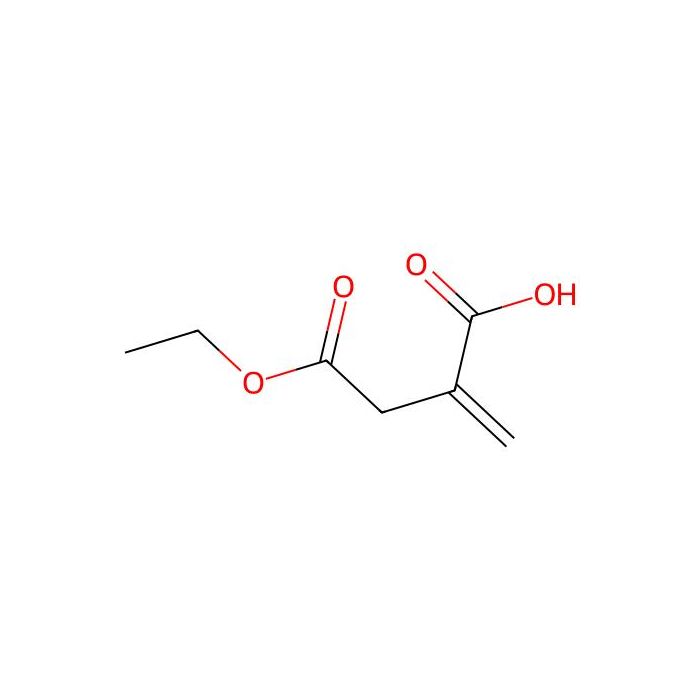
Monoethyl itaconate is the monoester of itaconic acid, containing one free carboxylic acid and one ethyl ester on a methylene-substituted alkene (methylidene succinate skeleton). It combines an electron-deficient double bond (Michael acceptor) with a carboxylate/ester handle useful for further derivatization.
Item-specific IDs (from Product Data):
CAS: 57718-07-7
PubChem CID: 533740
SKU: M1500799
Item-specific fields not provided:
Molecular formula: Not specified for this item; refer to CoA/Spec Sheet.
Molecular weight: Not specified for this item; refer to CoA/Spec Sheet.
SMILES: Not specified for this item; refer to CoA/Spec Sheet.
InChIKey: Not specified for this item; refer to CoA/Spec Sheet.
Structural features (general chemistry/literature):
Functional groups: one α,β-unsaturated carboxylate (Michael acceptor), one ethyl ester, one carboxylic acid (acidic proton), conjugated to a methylene (exocyclic) C=C.
2D description: an itaconate backbone (CH2=C–(COOR)–CH2–COOH) where R = ethyl for one carboxyl, and the second carboxyl remains as –COOH; the exocyclic methylene is geminal to the ester-bearing carbonyl.
No stereogenic centers; alkene is terminal (methylidene), not E/Z-configurable.
Potential regioisomerism exists for which carboxyl group is esterified; the CAS provided corresponds to a defined monoethyl itaconate entity on PubChem (CID 533740). Consult CoA for exact regiochemistry supplied in this lot.
Synthetic Utility
Monoethyl itaconate is a compact, bifunctional synthon providing:
Electrophilic handle:
The exocyclic α,β-unsaturated carbonyl enables conjugate additions (S, N, C nucleophiles), cycloadditions in select cases, and radical polymerization. Its reactivity is typically higher than simple acrylates due to the substituted alkene.
Carboxylate chemistry:
The free acid can be selectively engaged in amide coupling (e.g., EDCI/HOBt, HATU, or CDI protocols) to furnish itaconamides that retain the Michael acceptor.
Saponification or transesterification at the ethyl ester allows conversion to diacids or alternative esters, respectively, for fine-tuning properties.
Strategic roles in synthesis (literature):
Michael acceptor “warhead” for covalent ligand/intermediate libraries.
Precursor to substituted succinates after conjugate addition followed by hydrogenation/ozonolysis, enabling access to diverse 1,4-addition products.
Monomer/co-monomer in step- or chain-growth polymerizations to embed pendant carboxyl functions for post-polymer modification.
Orthogonality:
Differential reactivity of the two carboxyl functions (ester vs. acid) allows stepwise protection/functionalization.
The alkene can be chemoselectively transformed (e.g., hydroboration–oxidation, epoxidation, or thiol–ene under radical initiation) while retaining or later modifying the acid/ester.
Practical considerations:
Avoid strong bases/heat that may isomerize the double bond (itaconate ↔ mesaconate/citramalate rearrangements in related systems).
Use inert atmosphere and low temperatures for operations that might trigger polymerization; include inhibitors only if compatible with downstream use.
Target Specificity
Not applicable. This product is a small-molecule chemical reagent, not an antibody, enzyme, or biological with defined target specificity provided in the Product Data. Any protein reactivity discussed elsewhere refers to general electrophile chemistry (literature) rather than item-specific biological targeting.
Wir verwenden Cookies, um die ordnungsgemäße Funktion der Website sicherzustellen und, soweit zulässig, Ihr Nutzererlebnis zu verbessern. Sie können Ihre Einstellungen jederzeit unter „Einstellungen“ verwalten. Weitere Informationen finden Sie in unserer Cookie-Richtlinie.
Shall we send you a message when we have discounts available?
Remind me later
Thank you! Please check your email inbox to confirm.
Products are supplied to verified businesses, institutions, and qualified professionals for research and development use only. Not for use in humans, animals, diagnosis, or therapy.