QUALITÄT & REINHEITMoligand™?Moligand™ — Aladdin's line of ligands and bioactive small molecules. Use for receptor, pathway, and binding studies needing defined small-molecule tools.10 mM in DMSO
Monoethyl phthalate is a metabolite of diethyl phthalate. Monoethyl phthalate acts as a urinary biomarker of phthalates exposure indicating the risks of thyroid cancer and benign nodule.
Spezifikationen
Spezifikationen & Reinheit
Moligand™, 10 mM in DMSO
Storage
Store at -80°C
Verschickt in
Dry ice packs + Cold packs
Dieses Produkt erfordert Kühlkettenversand. Grundversand und andere Economy-Optionen sind nicht verfügbar.
Determine the necessary mass, volume, or concentration for preparing a solution.
Dilution Calculator
Determine the dilution needed to prepare a stock solution.
Reconstitution Calculator
Bewertungen
Kundenbewertungen
Application Protocols
No item-specific, validated application protocols are provided in the Product Data. The following general research-use practices can serve as starting points and should be adapted to your assay/system.
DMSO stock preparation:
Dissolve to 10–50 mM in anhydrous DMSO. Vortex briefly and, if needed, warm gently to 30–40 °C to aid dissolution.
Filter through 0.22 µm PTFE if particulate is present.
Aliquot into low-bind tubes; store at −80 °C. Avoid more than 3 freeze–thaw cycles.
Aqueous working solutions:
Dilute DMSO stock into assay buffer to a final DMSO concentration ≤1–2% v/v to minimize vehicle effects.
For higher aqueous solubility, adjust pH to slightly basic (pH 7.4–8.0) to partially ionize the acid, recognizing potential impacts on biological systems.
Analytical reference standard use (literature):
Prepare a calibration series in solvent compatible with your LC/MS method (e.g., water/MeOH with 0.1% formic acid or ammonium acetate).
Assess stability in autosampler (4–10 °C) and during freeze–thaw.
Synthetic transformations:
When performing couplings or acyl chloride formations, ensure anhydrous conditions and appropriate base/scavengers; monitor by TLC/LCMS.
Always develop assay-specific SOPs and consult the SDS for handling precautions.
Biological Roles
This section reflects literature context and is not specific to the supplied item. No medical or clinical claims are made; for research use only.
Metabolic context: Monoethyl phthalate (MEP) is a primary monoester metabolite of diethyl phthalate (DEP) in humans and other organisms. Esterase-mediated hydrolysis converts DEP to MEP, which can further undergo conjugation (e.g., glucuronidation) and is commonly excreted in urine.
Biomarker usage (literature): MEP is widely quantified as a biomonitoring marker in environmental exposure studies involving DEP. Its presence in biological matrices (urine, serum) is used to infer exposure levels to parent diester.
Biochemical properties: The free carboxyl function increases aqueous compatibility relative to dialkyl phthalates and allows transporter-mediated handling in vivo (e.g., organic anion transporters, literature).
Interactions: As an aromatic monoester/acid, MEP can participate in hydrogen bonding and ionic interactions; specific high-affinity protein targets are not established in the literature as a canonical function.
Environmental fate (literature): Enhanced biodegradability vs diesters due to ionizable acid; subject to further metabolism by microbial communities.
Note: If using MEP in biological experiments (enzyme assays, transport studies), confirm matrix compatibility, protein binding, and pH-dependent ionization. For regulated bioanalytical use, calibrate with matrix-matched standards and validate stability per your method SOP.
Buffer Applications
Monoethyl phthalate is not a buffering agent and is not typically used to prepare laboratory buffer systems. Its carboxylic acid may influence pH locally, but it lacks an appropriate conjugate acid/base pair with a practical buffering window for standard biochemical buffers.
Practical note: If dissolving MEP into aqueous media, account for its ionization (pKa ~3–4, literature) and potential to modestly acidify unbuffered solutions. Use a suitable buffer (e.g., phosphate, acetate, HEPES) chosen for your assay pH.
For extraction or partitioning workflows, pH adjustment of the medium (acidic to neutral for extraction into organics; basic to extract the carboxylate into water) can be employed to manipulate solubility, but this is not a buffering application.
Green Alternatives
Monoethyl phthalate is a phthalate monoester building block; it is not used primarily as a solvent. Green considerations center on minimizing hazardous solvents/reagents during its use and considering non-phthalate alternatives when functionally possible.
Greener process choices (literature guidance):
Solvents: Favor MeOH, EtOH, ethyl acetate, 2-MeTHF, CPME, or water-organic mixtures over chlorinated solvents when reaction compatibility permits.
Couplings/activations: Use carbodiimide couplings (EDC in water/MeCN) or catalytic coupling systems to avoid stoichiometric halogenating agents. If acid chlorides are necessary, employ minimal excess SOCl2 with solvent recycling and off-gas scrubbing.
Workups: Utilize pH-switchable extraction to reduce solvent volumes; consider solid-supported scavengers to minimize waste.
Functional alternatives (application-dependent):
Where the objective is an ortho-dicarboxylate framework but phthalates are a concern, explore non-phthalate aromatic diacids (e.g., terephthalate/isophthalate monoesters) or bio-based diacids (e.g., succinate, itaconate) that can deliver comparable coordination/spacing motifs.
Comparison (typical tradeoffs):
Phthalate monoester (MEP)
Advantages: Readily available, well-understood reactivity of acid/ester pair, versatile handle for synthesis.
Considerations: Phthalate class scrutiny in environmental contexts; manage with appropriate containment and waste handling.
Non-phthalate analogs
Advantages: Potentially improved hazard profile or regulatory acceptance.
Considerations: May alter electronics/geometry; synthetic steps may change.
Adopt solvent selection guides (e.g., CHEM21, GSK) and LCA where feasible to quantify improvements.
Pharmaceutical Uses
No item-specific pharmacopeial status or excipient grade is provided for this product; it is supplied for research use only.
Literature and formulation context:
Phthalate chemistry appears in pharmaceutical technology (e.g., certain phthalates have been used historically in enteric coatings or as plasticizers). However, monoethyl phthalate (MEP) itself is not a standard pharmaceutical excipient.
In development or analytical settings, MEP may be employed as:
An analytical reference/impurity standard related to diethyl phthalate (DEP) or phthalate-containing materials.
A synthetic intermediate toward phthalate-derived linkers or pro-moieties.
Guidance for formulation scientists:
If evaluating MEP in preformulation screens or as a model acidic small molecule, confirm: solubility in proposed vehicles (DMSO, PEGs, ethanol/water), pH-dependent stability (avoid conditions that drive ester hydrolysis if the ester must be retained), and compatibility with packaging (adsorption to plastics).
This product is not offered with pharmacopoeial compliance claims (USP/NF/Ph.Eur). For any use beyond research, a dedicated excipient-grade supply and full regulatory documentation would be required.
Physical Properties
Item-specific specifications are not provided in the Product Data. The following values are literature/general guidance for monoethyl phthalate (MEP) and must not be construed as specifications for this catalog item.
Physical state: Typically a low-melting solid or viscous oil near ambient (literature observations vary by purity and temperature)
Melting point: Reported in the approximate range 35–45 °C (literature, varies with polymorph/purity)
Boiling point: Thermal decomposition may occur before distillation at atmospheric pressure; reduced-pressure distillation reported >200 °C at <10 mmHg (literature)
Density: Approximately 1.2–1.3 g/mL at 20–25 °C (literature)
LogP (octanol/water): Moderate, often reported around 1.5–2.0 (literature)
Solubility (qualitative, literature):
Water: Low to moderate (enhanced relative to dialkyl phthalates due to free acid)
Polar organics (MeOH, EtOH, acetone, acetonitrile): Good
DMSO/DMF: Excellent
Nonpolar (hexanes): Limited
Not provided for this item; refer to CoA/Spec Sheet for item-specific attributes such as residual solvents, water content, stabilizers, UV cutoffs, or trace metal levels (if applicable). For precise thermal/transport properties under your conditions, perform a small-scale characterization.
Quality and Grades
Item-specific grade: Moligand™ (from Product Data). This denotes inclusion in a curated small-molecule/ligand library intended for discovery workflows (e.g., screening, chemoproteomics, target deconvolution). Emphasis is typically on structural fidelity, reproducibility, and suitability for high-throughput handling.
What Moligand™ implies (general guidance):
Identity-confirmed small molecule appropriate for research screening.
Packaged to support low-temperature storage and minimal degradation (see −80 °C storage recommendation).
Often amenable to DMSO stock preparation for plate-based assays.
Purity/assay, stabilizers, and chromatographic quality: Not specified for this item; refer to CoA/Spec Sheet. If your use requires analytical-grade or LC/MS-grade attributes (e.g., low non-volatile residue, low UV background), verify via CoA and consider in-house qualification (HPLC purity, HRMS, NMR).
Batch-to-batch considerations:
Phthalate monoesters can absorb moisture and undergo slow hydrolysis; closed, dry storage minimizes changes over time.
If using for quantitation (e.g., analytical standards), confirm exact purity and water content by KF or qNMR.
Documentation: For regulated environments or exacting workflows, request lot-specific CoA and, if needed, supplemental data (chromatograms, spectra) to align with your acceptance criteria.
Reaction and Applications
As the monoester of phthalic acid, monoethyl phthalate (MEP) is a versatile bifunctional building block combining a carboxylic acid with a neighboring ethyl ester on an ortho-aromatic framework.
Representative synthetic roles (literature):
Carboxylic acid activation: Convert the acid to acid chloride (SOCl2, oxalyl chloride, Ghosez reagent) or mixed anhydride for subsequent amidation/esterification while retaining the ethyl ester.
Amide coupling: EDC/HOBt, HATU, or DIC/DMAP conditions to give phthalamide derivatives; proximity to the ester can influence acylation selectivity.
Transesterification: Exchange the ethyl group under acid/base catalysis to access alternate monoesters (e.g., benzyl, tert-butyl) for protecting-group strategies.
Intramolecular cyclization routes: From suitably modified derivatives, can lead to imide or anhydride frameworks characteristic of phthalimide chemistry.
Analytical/biomonitoring reference: MEP is a known monoester metabolite of diethyl phthalate; used as a reference standard in environmental and exposure studies (literature context).
Practical tips:
Protecting-group logic: The ethyl ester is relatively stable to mild bases; the free acid allows selective activation. If necessary, mask the acid (e.g., as methyl/benzyl ester) before reactions targeting the other position.
Phase behavior: Ionization of the acid enables pH-switchable extraction to simplify workup.
Avoid prolonged strong basic conditions if preserving the ester; saponification yields phthalate salts.
Example named methods: Schotten–Baumann-like amidations (via acid chloride), Steglich esterification (DCC/DMAP) on the acid function, and catalytic transesterifications.
Reaction Conditions
General literature guidance for transforming monoethyl phthalate (MEP). These are not item-specific specifications; optimize for your system.
Acid to acyl chloride: SOCl2 (3–5 equiv), catalytic DMF, 0 °C to reflux, 1–3 h; remove volatiles under reduced pressure. Follow with amine/alcohol addition in DCM/THF at 0–25 °C to form amides/esters (often 60–90% yields reported in analogous systems).
Carbodiimide couplings: EDC·HCl (1.2–1.5 equiv) with HOBt/HOAt or DMAP in DMF/MeCN or DCM, 0–25 °C, 2–16 h. For hindered partners, HATU (1.1–1.5 equiv) with DIPEA in DMF is effective.
Transesterification: p-TsOH (1–5 mol%) in the target alcohol (neat or solvent like toluene) at 60–110 °C, or NaOMe/MeOH at 0–25 °C for base-catalyzed conditions. Monitor to avoid competing hydrolysis.
Saponification (ester -> acid): NaOH or KOH (1–2 equiv) in MeOH/H2O or THF/H2O at 0–25 °C, 0.5–4 h; acidify to precipitate diacid. The free acid in MEP may remain intact under mild conditions; excess base and heat can hydrolyze both functions.
Ring electrophilic substitution: Nitration/sulfonation requires careful control (low temperature, mixed acid systems). Protect the ester if needed; yields vary widely due to deactivation by electron-withdrawing groups.
Purification: Acid/base wash sequences exploit ionization; for high purity, use reverse-phase prep HPLC with 0.1% formic acid or ammonium bicarbonate to modulate retention.
All conditions above are representative literature practices; verify compatibility with your substrates and scale, and implement appropriate safety controls (gas evolution, exotherms).
Safety and Handling
Item-specific hazard classifications are not provided in the Product Data. Always consult the SDS for authoritative safety information for this lot.
General safety guidance for monoethyl phthalate (MEP) based on literature and chemical class (aromatic monoester/acid):
GHS classification/pictograms: Not specified for this item; refer to SDS. Phthalate esters can cause eye/skin irritation; treat as harmful if swallowed or inhaled.
Primary hazards: Irritation to eyes/skin/respiratory tract; may cause gastrointestinal discomfort if ingested. Avoid aerosol formation.
Special risks: Contains a carboxylic acid (corrosivity is mild compared with mineral acids). Ester/acid sensitive to strong bases/acids (hydrolysis risk). Not an oxidizer or reducer.
Recommended PPE: Lab coat, safety glasses or splash goggles, and chemically resistant gloves (nitrile recommended). Use in a fume hood to avoid inhalation of mists/vapors.
First aid (general):
Inhalation: Move to fresh air; seek medical attention if symptoms persist.
Skin: Wash with soap and water; remove contaminated clothing.
Eyes: Rinse cautiously with water for several minutes; remove contact lenses if present and easy.
Ingestion: Rinse mouth; do not induce vomiting; seek medical attention.
Fire fighting: Carbon dioxide, dry chemical, or foam. Combustion may produce CO/CO2.
Storage per Product Data: Store at −80 °C. Keep container tightly closed, dry, and protected from light. Allow cold shipments to equilibrate in a desiccator before opening to minimize moisture condensation.
Solvent Selection
Monoethyl phthalate is amphiphilic with one carboxylic acid and one ester, favoring polar organic media.
Water: Low–moderate; solubility improves in basic aqueous media via carboxylate formation
Practical choices by use-case:
Screening stocks: DMSO is preferred (prepare 10–50 mM), optionally dilute into assay buffer with final DMSO ≤1–2% v/v.
Synthesis (couplings/activations): Dry DMF, DCM, THF, or MeCN are common; choose base and additive to protect the ester as needed.
Purification: Normal-phase flash with EtOAc/hexanes or MeOH/DCM gradients; reverse-phase prep HPLC with aqueous MeCN/MeOH and 0.1% acid/base modifier to control ionization.
Comparison snapshot (literature):
DMSO: Maximal solubility, inert under many conditions; high boiling point complicates removal.
MeOH/EtOH: Good solubility; may participate in transesterification under acidic/basic conditions.
Acetonitrile: Volatile, good elution strength, limited participation in side reactions.
Tip: For aqueous workups, adjust pH to partition the acid: basify to extract into water as carboxylate; acidify to re-extract into organic. Avoid prolonged exposure to strong base if preserving the ester.
Storage and Reconstitution
Storage conditions (from Product Data): Store at −80 °C.
Shipping (from Product Data): Shipped on dry ice packs + cold packs to maintain low temperature.
Container and atmosphere:
Keep tightly closed in a moisture-free environment; consider storing under inert gas (e.g., nitrogen/argon) to minimize hydrolysis/oxidation.
Protect from light and repeated warming cycles.
Reconstitution guidelines (general research practice):
For screening or analytical work, prepare concentrated stocks in anhydrous DMSO (e.g., 10–50 mM). Alternatively, ethanol or DMF may be used depending on downstream compatibility.
Allow the container to equilibrate to room temperature in a desiccator before opening to avoid condensation. Weigh quickly and recap promptly.
If aqueous solutions are required, dilute from an organic stock; adjust pH only if necessary and be mindful of potential ester hydrolysis under strongly basic or acidic conditions.
Stability and handling:
Aliquot stocks to single-use volumes to minimize freeze–thaw. Store aliquots at −80 °C; working solutions at 2–8 °C and use promptly.
Inspect periodically by HPLC/LC-MS for signs of hydrolysis (formation of phthalic acid or diester/monoester interconversion under harsh conditions).
Specifications not provided: Water content, residual solvents, and stabilizers are not specified for this item; refer to CoA/Spec Sheet for lot-specific details.
Structure and Identity
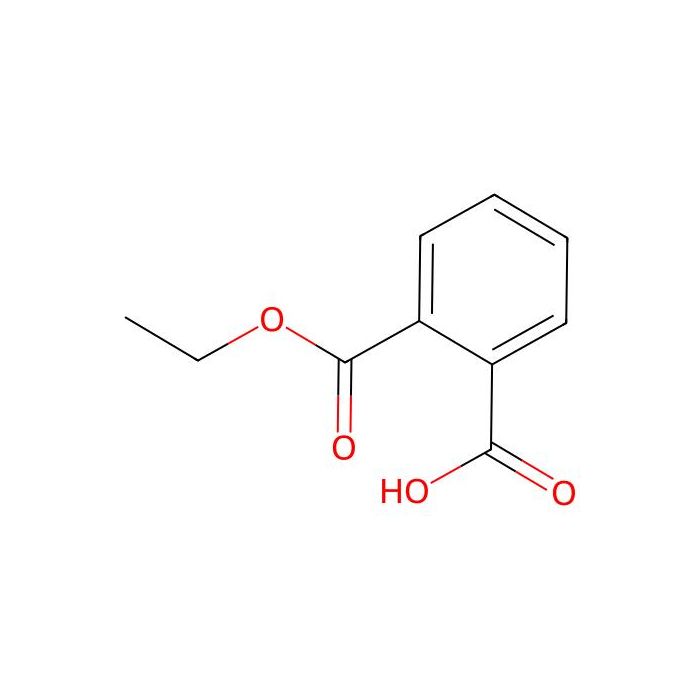
Monoethyl phthalate (MEP) is the monoethyl monoester of phthalic acid, featuring one free carboxylic acid and one ethyl ester on an ortho-disubstituted benzene ring.
Item-specific identifiers (from Product Data):
SKU: M1496271
CAS: 2306-33-4
Category: 小分子和化合物库 (small molecule library)
Grade: Moligand™
InChIKey: Not specified for this item; refer to CoA/Spec Sheet.
SMILES: Not specified for this item; refer to CoA/Spec Sheet.
Literature identity (for reference; not item specifications):
Common name: Monoethyl phthalate; Ethyl hydrogen phthalate
2D structural description: A benzene ring bearing two adjacent carbonyl-derived substituents; one is a carboxylic acid (–C(=O)OH), the other an ethyl ester (–C(=O)OCH2CH3). No stereocenters; aromatic, ortho-disubstituted benzenoid core.
Key structural features:
Aromatic ring (benzene) with ortho phthalate motif
One carboxylic acid (acidic proton; H-bond donor/acceptor)
One ethyl ester (H-bond acceptor; hydrolytically labile)
Overall amphiphilic character due to juxtaposed acid and ester groups
Note: Literature identifiers are provided for general reference. Always verify item-specific structure and identity against the Certificate of Analysis (CoA) provided with this lot.
Synthetic Utility
Monoethyl phthalate (MEP) offers orthogonal reactivity via its carboxylic acid and ethyl ester on an ortho-disubstituted arene, enabling selective functionalization and convergent synthesis of phthalate-derived motifs.
Functional handles and transformations (literature):
Acid to acyl chloride/anhydride: SOCl2 or (COCl)2 afford acyl chlorides; mixed anhydrides via isobutyl chloroformate. Subsequent coupling yields amides, esters, or anilides while retaining the ethyl ester.
Direct amidation/esterification: Carbodiimide-mediated (DCC/EDC) or uronium reagents (HATU, TBTU) with catalytic DMAP for alcohol couplings.
Transesterification: Acidic (p-TsOH) or basic (NaOMe) catalysis to adjust protecting group strategy (e.g., switch to benzyl for later hydrogenolysis).
Selective hydrolysis: Saponify the ethyl ester (NaOH/MeOH–H2O) to regenerate the diacid if needed; control equivalents/time to avoid overreaction.
Nucleophilic aromatic substitution is generally not enabled on unsubstituted phthalates; electrophilic substitutions (nitration, sulfonation) occur on the ring but must be tuned to avoid acyl function degradation.
Retrosynthetic value:
Serves as a linchpin toward imides (via diamide then cyclodehydration) and linkers in conjugation chemistry.
Useful in preparing half-esters for polymer end-capping or as a chelating auxiliary (o-dicarboxylate motif) after appropriate derivatization.
Practical considerations:
Control pH and temperature to balance ester preservation vs transformation.
Use phase-switching extractions exploiting acid/base form for efficient isolation.
Target Specificity
Not applicable. This product is a small molecule (monoester/acid) and not a biological targeting reagent (e.g., antibody, ligand with validated biological selectivity) in this catalog entry.
Item-specific targeting data: Not specified for this item; refer to CoA/Spec Sheet if any binding or screening annotations are provided under the Moligand™ library.
For biochemical studies, any observed target interactions should be empirically determined and validated using appropriate controls and orthogonal assays.
Häufig gestellte Fragen
What is Moligand??
Moligand? is one of Aladdin Scientific's premium product lines, formulated for high-purity applications across multiple workflows. Compared to standard grades in the same workflow, Moligand? products typically offer tighter specifications, more rigorous QC, and stronger lot-to-lot consistency.
How should this product be stored?
Store at ?80 °C. Ultra-low temperature storage is required to maintain the specified shelf life.
How is this product shipped?
This product ships frozen with dry ice and cold packs. Unpack on arrival and transfer it to the storage condition stated above; handle dry ice with insulated gloves in a ventilated area.
What are the CAS number, molecular formula and molecular weight?
The CAS Number is 2306-33-4, the molecular formula is C10H10O4, and the molecular weight is 194.18 g/mol.
What documentation is provided?
Available product documentation, including Certificates of Analysis (COA), Safety Data Sheets (SDS), and specification sheets, is shown in the product document area. Document availability and access follow the current site policy.
Wir verwenden Cookies, um die ordnungsgemäße Funktion der Website sicherzustellen und, soweit zulässig, Ihr Nutzererlebnis zu verbessern. Sie können Ihre Einstellungen jederzeit unter „Einstellungen“ verwalten. Weitere Informationen finden Sie in unserer Cookie-Richtlinie.
Dürfen wir Sie über Rabattaktionen informieren?
Später erinnern
Vielen Dank! Bitte überprüfen Sie Ihren E-Mail-Posteingang, um zu bestätigen.
Products are supplied to verified businesses, institutions, and qualified professionals for research and development use only. Not for use in humans, animals, diagnosis, or therapy.