UltraBio™ Mouse IgG Agarose

Cat. No.: M748148
Zu bestellen verfügbar
GRADE & PURITY BioReagent ? BioReagent grade — tested suitable for life-science and molecular-biology use. Use for cell culture, assays, and biochemical work needing biological compatibility. for IP ? Immunoprecipitation grade — antibodies/reagents suited to pulling down targets. Use in IP/co-IP to capture proteins and their complexes. 50% v/v
★
Size
Deutschland (EU)
USA*
Price
Qty
1ml
M748148-1ml
Auf Bestellung · 8–12 Wochen
38,09€
5ml
M748148-5ml
Auf Bestellung · 8–12 Wochen
147,43€
Enter a quantity for the sizes you want to add.
🧪
Why this grade

BioReagent,for IP,50% v/v BioReagent,for IP for sensitive chromatographic and analytical workflows requiring minimal baseline interference.

🌡

Storage & shipping

Store at 2-8°C,Do not freeze Ships Wet ice,Do not freeze Check lot-specific COA for exact specifications.

📋

Quality documents

SDS, COA, datasheet, and spec sheet available for download. Lot-specific COA accessible via lot number lookup.

📚

Literature proof

Cited in 0 peer-reviewed publications across chromatography, organic synthesis, and cross-coupling reactions.

Übersicht

Aladdin's UltraBio™ Mouse IgG Agarose is produced by high-quality unlabeled non-specific Mouse IgG to 4% agarose gel. This product is commonly used as a negative control for mouse-derived antibody agarose gels such as Anti-Flag Affinity Gel in immunoprecipitation (IP), co-immunoprecipitation (Co-IP), chromatin immunoprecipitation (ChIP), and other immunoprecipitation-related assays. The mouse IgG in this Mouse IgG Agarose is normal mouse IgG, which is an unlabeled, non-specific IgG. This Mouse IgG Agarose can exclude non-specific binding between IgG itself and certain proteins or other biological molecules, thereby reducing background or serving as a negative control. This product has low non-specific adsorption and is very suitable for sample pre-cleaning before immunoprecipitation, as it effectively removes non-specific binding and significantly enhances experimental specificity. Additionally, this agarose essentially does not recognize any antigens.

Aladdin's UltraBio™ Mouse IgG Agarose is stored in PBS containing 0.02% ProClin 300, with a settled gel to storage solution ratio of 1:1(This product is a 50% gel suspension, containing 0.5 ml of settled agarose per milliliter. Our product specifications are based on total volume. Product information is detailed in the table below:

Parameter

Value/Description

Matrix

4% Agarose Microspheres

Ligand

Mouse IgG

Isotype

IgG

Particle Size Range

45~165 μm

Antibody concentration

Approximately 3 mg Mouse IgG/mL Settled Agarose

Maximum Pressure

0.3 MPa,3 bar

Storage Conditions

PBS contains 0.02% ProClin 300, 2-8℃

Shelf Life

1 year

Instructions for Use:

Note: The following experimental procedure is for reference only. It is highly recommended to perform the exact same procedure using specific antibody-conjugated agarose gel.

1. Sample Preparation

1.1 Ensure the sample solution has appropriate ionic strength and pH before loading. Dilute the sample or cell culture supernatant with equilibration buffer, or dialyze the sample against equilibration buffer.

1.2 Clarify the sample by centrifugation or filtration through a 0.22 μm or 0.45 μm membrane to reduce impurities, improve purification efficiency, and prevent column clogging.

1.3 Preparation of protein sample. Lysis cells or tissues with appropriate lysis buffer. The following lysis buffers are recommended for preparing lysates from cells or tissues. For optimal results, Aladdin product C301898 Cell Total Protein Lysate for Western Blotting & Immunoprecipitation is the preferred choice for lysis of cell or tissue samples. Depending on the specific experimental needs, if necessary, Aladdin products P0013B RIPA Lysis Buffer (Strong), P0013C RIPA Lysis Buffer (Medium), or P0013D RIPA Lysis Buffer (Weak) may also be used for sample preparation. If using a self-prepared lysis buffer or one from another manufacturer, ensure that the pH of the lysis buffer is between 6 and 8. when using a self-prepared lysis buffer or one produced by other companies, ensure that the pH of the lysis buffer is 6-8.

2. Buffer Preparation

It is recommended to filter water and buffers through a 0.22 μm or 0.45 μm membrane before use.

Equilibration Buffer: 0.01M PBS,pH7.4.

Wash Buffer: 0.01M PBS,0.05% Tween-20,pH7.4.

3. Immunoprecipitation (IP) Procedure

3.1 Resin Preparation: Add 40 µL of Mouse IgG Agarose suspension (20 µL settled agarose) to a 1.5 mL tube. Centrifuge at 5000 × g for 1 minute. Discard the supernatant.

3.2 Add 0.5 mL of Equilibration Buffer to resuspend the agarose (Place the agarose in the same buffer system as the target protein to protect the protein.). Centrifuge at 5000 × g for 1 minute. Discard the supernatant. Repeat this wash step once.

3.3 Add 300 µL of sample lysate to the prepared agarose from step 3.2. Mix and incubate on a tube rotator at room temperature for 3 hours. Centrifuge at 5000 × g for 1 minute. Discard the supernatant.

3.4 Washing: Add 0.5 mL of Wash Buffer, resuspend the agarose, and mix gently. Centrifuge at 5000 × g for 1 minute. Discard the supernatant. Repeat this wash step three more times. Ensure the removal of non-specifically adsorbed substances.

3.5 Denaturing Elution (SDS-PAGE): Add 100 µL of 1× Loading Buffer to the agarose. Heat at 95°C for 5 minutes. Centrifuge at 5000 × g for 1 minute, and load the supernatant directly onto an SDS-PAGE gel for analysis.

Note: The Standard loading buffer used in laboratories contains β-mercaptoethanol and DTT, which can break the disulfide bonds between the antibody heavy and light chains on the agarose. This method denatures the antibody, rendering the resin unusable for reuse.

Storage

Store at 4℃ for up to 12 months. Do not store at -20℃ or lower temperatures.

Matters needing attention

1.      This product must be fully resuspended by inverting the tube several times prior to use.

2.      For immunoprecipitation assays, it is recommended to include both positive and negative controls. 

3.      Protein samples should be purified as soon as possible after collection and should always be placed at 4℃ or on ice to minimize protein degradation or denaturation.

4.      The non-specific binding capability of this product can be affected by high concentrations of DTT, mercaptoethanol, and guanidine hydrochloride, but it is applicable in Cell lysis buffer for Western and IP, RIPA Lysis Buffer, and NP-40 Lysis Buffer.

5.      To effectively inhibit protein degradation, an appropriate amount of protease inhibitor cocktail can be added to the protein sample.

6.      This product is for R&D only. Not for drug, household, or other uses.

7.      For your safety and health, please wear a lab coat and disposable gloves during the operation.

Specifications

Product Name
UltraBio™ Mouse IgG Agarose
Synonyme
Mouse IgG Affinity Gel | Mouse IgG Affinity Agarose | Mouse IgG agarose gel | Mouse IgG IP Agarose
Note
BioReagent, for IP
Spezifikationen & Reinheit
BioReagent,for IP,50% v/v
Hinweis
Aladdin's official website currently offers M748148-1ml and M748148-5ml products
Molekültyp
Bioreagenzien/Puffer
Product Line
Biologische Produkte
Lagerung und Versand
Konzentration
50% v/v
Storage
Store at 2-8°C,Do not freeze
Verschickt in
Wet ice,Do not freeze
Stabilität und Lagerung
Store at -20℃ for up to 1 year.
Bilder
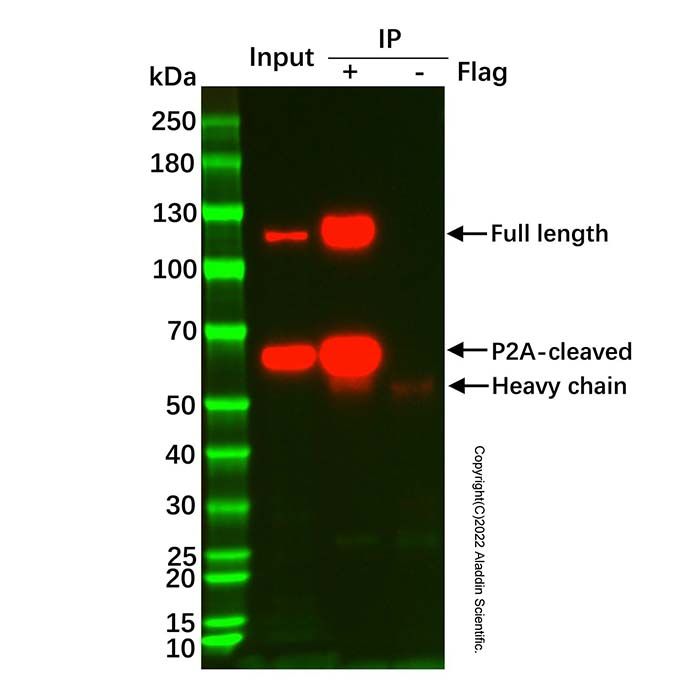
UltraBio™ Mouse IgG Agarose (M748148) - IP 
All lanes: Recombinant DYKDDDDK tag (Binds to Flag tag) Antibody (Ab210603) at 1/2000 dilution 
Lane 1: HEK-293 stably transfected with a P2A-bicistronic vector co-expressing Puromycin Resistance gene and an 11-tag fusion protein (Flag, HA, Myc, S-Tag, GST, His, V5, VSV-G, Strep Tag II, SUMO and EGFP) whole cell lysate 20μg. 
Lane 2: UltraBio™ Anti-DYKDDDDK Agarose (U1508188) IP in HEK-293 stably transfected with a P2A-bicistronic vector co-expressing Puromycin Resistance gene and an 11-tag fusion protein (Flag, HA, Myc, S-Tag, GST, His, V5, VSV-G, Strep Tag II, SUMO and EGFP) whole cell lysate. 
Lane 3: UltraBio™ Mouse IgG Agarose (M748148) IP in HEK-293 stably transfected with a P2A-bicistronic vector co-expressing Puromycin Resistance gene and an 11-tag fusion protein (Flag, HA, Myc, S-Tag, GST, His, V5, VSV-G, Strep Tag II, SUMO and EGFP) whole cell lysate. 
Secondary: Goat Anti-Mouse IgG H&L (HRP) (Ab179001) at 1/20000 dilution 
Predicted band size: 115 kDa 
Observed band size: 64, 117 kDa 
Exposure time: 5.0 s 

Documentation

📋 Safety Data Sheet (SDS)

Comprehensive hazard, handling, storage, and regulatory compliance document.

Download SDS →

✅ Certificate of Analysis (COA)

Lot-specific quality data. Enter your lot number to retrieve the exact COA.

Look up COA →

📊 Datasheet

Quick-reference summary of product specifications and applications.

View datasheet →

🔬 Specification Sheet

Full quality attributes and acceptance criteria for this grade.

View spec sheet →

Advanced Data

Zertifikate (CoA, COO, BSE/TSE und Analyse-Diagramm)
C of A & Other Certificates(BSE/TSE, COO):
Analytical Chart:

Find and download the COA for your product by matching the lot number on the packaging.

2 results found

Lot NumberCertificate TypeDatumArtikel
ZJ26F0636489Certificate of AnalysisJun 16, 2026 M748148
ZJ26F0636488Certificate of AnalysisJun 16, 2026 M748148
FAQs und Artikel
Lösungsrechner
Bewertungen

Kundenbewertungen

Application Protocols

Tested applications, recommended bead volumes, incubation times, and positive controls are not specified for this item. Refer to the CoA/Spec Sheet or product SDS for any available method notes.

Because no item-specific protocols are provided, please consult the Reaction Conditions tab for general literature-based guidance on equilibration, binding, washing, and elution for immunoprecipitation and pull-down workflows. Validate parameters empirically for your sample type and detection method.

Biological Roles

Background on the biological ligand (general, literature):

  • Mouse Immunoglobulin G (IgG): A major class of antibody in mice, composed of two heavy and two light chains forming a Y-shaped molecule. Key regions:
    • Fab regions bind antigens with high specificity.
    • Fc region engages Fc receptors and complement, mediating effector functions such as opsonization and ADCC.
  • Isotypes/subclasses: Mouse IgG commonly includes subclasses (e.g., IgG1, IgG2a/c, IgG2b, IgG3), which differ in Fc-receptor interactions and effector profiles. The specific subclass composition of the immobilized IgG in this product is not specified.
  • Relevance to IP controls: Mouse IgG provides a matched isotype framework to replicate nonspecific interactions attributable to antibody constant regions and the agarose matrix, enabling accurate background subtraction in proteomic and immunochemical workflows.
  • Protein–protein interactions: Numerous cellular and microbial proteins bind to IgG Fc or Fab regions. The immobilized IgG can thus act as a capture reagent for such interactors under appropriate buffer conditions (method-development context).

Note: The above biological roles describe native mouse IgG in general. They are included to contextualize how an immobilized Mouse IgG ligand functions in research assays. No clinical or diagnostic claims are made for this product.

Buffer Applications

This resin is used with aqueous buffers typical for immunoprecipitation and pull-down workflows rather than as a buffer component itself.

General buffer guidance (literature):

  • Equilibration and binding: Phosphate-buffered saline (PBS) or Tris-buffered saline (TBS), pH ~7–8. Include 0.05–0.2% nonionic detergent (e.g., Tween 20, NP-40) and 150 mM NaCl to reduce nonspecific binding as needed.
  • Lysis buffers: For cell/tissue lysates, RIPA or mild nonionic detergent buffers may be used if they preserve the interactions under study. Validate detergent and salt concentrations to balance stringency and retention of complexes.
  • Wash buffers: Same as binding buffer, optionally increased salt (e.g., 300–500 mM NaCl) or mild detergent to reduce background (optimize empirically).
  • Elution: Low-pH glycine buffer (e.g., pH ~2–3) or high-salt/chaotropic conditions; immediately neutralize acidic eluates to protect proteins.
  • Protease/phosphatase inhibitors: Add fresh to lysis and binding buffers to preserve post-translational states where relevant.

Item-specific buffer composition, pH limits, and preservative content are not specified for this item; consult CoA/Spec Sheet. Always confirm compatibility of your buffer system with the immobilized Mouse IgG and agarose matrix.

Green Alternatives

This product is an aqueous, reusable solid-phase affinity resin and does not have a direct “green solvent” alternative. Sustainability considerations (general):

  • Resource efficiency:
    • Reusability: Affinity resins can often be reused across multiple cycles if fouling and microbial contamination are controlled (validate with your target and assay). Reuse reduces material consumption and waste.
    • Aqueous operation: Processes are run in water-based buffers, minimizing organic solvent use.
  • Waste minimization:
    • Avoid excessive single-use plastics by employing reusable gravity columns or spin devices where appropriate.
    • Consolidate wash steps and optimize buffer volumes to reduce aqueous waste.
  • Safety and environmental notes:
    • If the slurry contains preservatives (e.g., azide), collect waste appropriately; do not discharge to drains unless permitted. Preservatives for this item are not specified—consult CoA/SDS.
  • Alternatives in concept (general):
    • For isotype control IPs, laboratories may alternatively use isotype control antibodies with a separate unconjugated agarose support; however, a pre-conjugated Mouse IgG–Agarose minimizes coupling chemistry, reduces chemical waste, and improves reproducibility.

Overall, choosing a ready-to-use, water-based affinity resin aligns with green chemistry principles by limiting hazardous reagents and enabling potential reuse.

Pharmaceutical Uses

This product is designated For research use only and is not intended for human or veterinary use, diagnostic procedures, or GMP manufacturing (Product Data).

Contextual information (general, literature):

  • Agarose-based affinity media are widely used in bioprocess development and manufacturing for protein capture and polishing; however, such applications require GMP-grade resins with detailed regulatory documentation and validated cleaning/sanitization protocols.
  • Mouse IgG–Agarose in research settings primarily serves as a control matrix for immunoprecipitation and assay development, rather than as a process-scale capture medium.

For any translational or manufacturing intent, select resins with appropriate pharmacopeial status, extractables/leachables characterization, and regulatory support files. Such attributes are not specified for this item.

Physical Properties
  • Physical state: Aqueous bead slurry (typical for agarose resins; item-specific appearance not specified)
  • Appearance: Not specified for this item; refer to CoA/Spec Sheet.
  • Composition details (bead % slurry, preservative, buffer): Not specified for this item; refer to CoA/Spec Sheet.
  • Particle size / porosity: Not specified for this item; refer to CoA/Spec Sheet. (Typical agarose resins are tens to hundreds of micrometers in diameter; literature)
  • Density/settling: Agarose beads are slightly denser than water and rapidly settle by gravity (literature, general).
  • pH stability: Broadly compatible with neutral buffered aqueous systems used in IP (e.g., PBS/TBS; general, literature). Exact pH and chemical stability limits are not specified for this item.
  • Temperature sensitivity: Store at 2–8°C; do not freeze (Product Data). Freezing can crack beads and denature the protein ligand (general).
  • Solubility: Insoluble solid phase; beads suspended in water/buffer (general).
  • Viscosity of slurry/RI/UV cutoff: Not applicable/not specified for this item.

Notes for use (general, literature):

  • Equilibrate in the chosen binding buffer prior to loading lysate to minimize dilution and maintain ionic strength.
  • Avoid strong organic solvents, extremes of pH, oxidants, and chaotropes that can damage IgG or agarose unless validated for this specific resin (item-specific compatibility not provided).
Quality and Grades
  • Grade/Purity: BioReagent, for IP (Product Data).
    • Meaning (general): Suitable for immunoprecipitation workflows where background binding and matrix integrity are critical. Typically indicates low particulate contaminants, appropriate buffer quality, and reproducible performance in IP (general description; item-specific QC metrics not provided).
  • Intended use: For research use only (Product Data). Not for human or veterinary use, diagnostic procedures, or GMP manufacturing.
  • Item-specific QC attributes: Not specified for this item; refer to CoA/Spec Sheet.
  • Stabilizers/preservatives: Not specified for this item; refer to CoA/Spec Sheet. Presence/absence of sodium azide or other biocides affects compatibility with certain downstream assays and enzymes (general note).
  • Performance considerations (general, literature):
    • Low nonspecific binding of the bead surface and ligand is essential for clean IP controls.
    • Consistent coupling density and intact IgG orientation help ensure predictable capture of proteins that interact with mouse IgG (e.g., Fc-binding proteins) and enable use as an isotype control matrix.
  • Documentation: For batch-specific details (binding capacity, ligand load, buffer, preservative, microbial limits), consult the CoA/Specification Sheet.
Reaction and Applications

As an immobilized Mouse IgG–Agarose affinity matrix, this product supports protein capture and immunoassay workflows rather than chemical reactions.

Representative research applications (general, literature):

  • Immunoprecipitation (IP) controls: Use as an isotype/negative control matrix when the experimental IP employs a mouse monoclonal antibody. Parallel capture with Mouse IgG–Agarose reveals nonspecific interactions with the matrix and IgG backbone.
  • Pre-clearing lysates: Incubate clarified cell/tissue lysates with the resin to remove proteins that bind nonspecifically to mouse IgG or agarose before the primary IP with a specific antibody.
  • Removal/capture of Fc-binding proteins: Enrich or deplete bacterial or eukaryotic proteins that interact with mouse IgG Fc domains (e.g., Protein A/G/L-binding assessments) in method development.
  • Immunoassay development: Evaluate background signals in pull-down/MS workflows by processing a Mouse IgG control in parallel with the specific antibody pull-down.

Practical tips (general):

  • Gently invert to resuspend; avoid vigorous vortexing that can foam or shear beads.
  • Equilibrate resin in the chosen binding buffer; pre-block with irrelevant protein (e.g., BSA) if high background is observed (optimize empirically).
  • Maintain cold conditions (2–8°C or on ice) during binding to preserve complexes; wash with buffer containing moderate salt and mild nonionic detergent to reduce nonspecific binding.
  • Elution strategies include low-pH glycine, high-salt, or competitive eluents; immediately neutralize acidic eluates to protect proteins (general guidance).
Reaction Conditions

Binding and elution parameters for affinity capture (general, literature guidance; item-specific conditions are not specified and should be optimized empirically):

  • Sample preparation: Clarify lysates by centrifugation and/or filtration to prevent bead fouling.
  • Resin preparation: Gently resuspend; transfer the desired bed volume; wash/equilibrate 3–5 resin volumes with binding buffer.
  • Binding:
    • Temperature: 2–8°C or room temperature as compatible with target stability; cold conditions often preserve labile complexes.
    • Time: 30–120 min end-over-end or gentle rocking; longer incubations may increase yield but can raise background.
    • Buffer: PBS or TBS at neutral pH; include 0.05–0.2% nonionic detergent and 150 mM salt to reduce nonspecific binding as needed.
  • Washing: 5–10 resin volumes of binding buffer; increase salt (e.g., 300–500 mM) or add mild detergent for higher stringency.
  • Elution options:
    • Low-pH glycine (pH ~2–3), rapid collection, immediate neutralization.
    • High salt or chaotropic modifiers for specific interactions (ensure compatibility with downstream analyses).
    • SDS sample buffer for direct SDS-PAGE (denaturing; not compatible with native downstream assays).
  • Regeneration/reuse: Rinse thoroughly with binding buffer after elution; short exposures to low-pH eluent followed by neutralization may be acceptable. Validation is required to confirm capacity retention. Detailed reuse limits are not specified for this item.

Always confirm conditions with small-scale trials before scaling up.

Safety and Handling
  • GHS classification, signal word, pictograms, H-statements: Not specified for this item; consult the product SDS for authoritative safety information.
  • Anticipated hazards (general for protein/agarose resins): Typically non-volatile and low acute hazard, but may contain buffer components or preservatives that require caution. Avoid ingestion, inhalation of dried particles, and contact with eyes/skin. Handle as a biological reagent using good laboratory practice.
  • Storage conditions: Store at 2–8°C. Do not freeze. (Product Data). Shipment: Wet ice; do not freeze. (Product Data)
  • Incompatibilities (general, literature): Avoid strong acids/bases, oxidizers, and organic solvents that can degrade agarose or denature the immobilized IgG. Prevent microbial contamination; keep container closed when not in use.
  • PPE: Laboratory coat, nitrile gloves, and safety glasses. Use eye/face protection if splashing is possible. Work in a clean area to prevent contamination of the resin.
  • First aid (general): If on skin/eyes, rinse with water. If inhaled (e.g., dried particulate), move to fresh air. If ingested, rinse mouth. Seek medical attention as needed. Provide SDS to responders.
  • Spill response: Contain and absorb aqueous slurry with inert material; collect resin for disposal per institutional and local regulations.
  • Waste: Dispose according to local/regional regulations for laboratory biological/chemical waste. Do not discharge preservatives or buffers to drains unless permitted.

Always defer to the SDS and institutional EHS policies for definitive guidance.

Solvent Selection

This product is an aqueous bead slurry and is not used as a solvent. For method development:

  • Compatible media (general, literature): Aqueous buffers such as PBS or TBS for equilibration, binding, and washing. Detergent-containing lysis buffers (e.g., NP-40, Triton X-100) may be used as appropriate for IP workflows provided the protein–ligand interaction is maintained; item-specific compatibility is not provided.
  • Avoid: Organic solvents, strong acids/bases, and chaotropes that can damage agarose or denature immobilized IgG unless validated for this resin.
  • Selection guidance: Choose buffer ionic strength and pH to preserve protein–protein interactions relevant to your IP. Include mild detergents/salts to minimize nonspecific adsorption while retaining target binding (general).

For detailed compatibility and tolerance limits, refer to the CoA/Spec Sheet and validate in small-scale tests.

Storage and Reconstitution
  • Storage: Store at 2–8°C. Do not freeze. (Product Data)
  • Shipping: Shipped on wet ice. Do not freeze. (Product Data)
  • Reconstitution: Not applicable; supplied as an aqueous slurry. If the resin settles during storage, gently invert to resuspend before use. Do not vortex aggressively to avoid bead damage (general).
  • Buffer/preservative content: Not specified for this item; refer to CoA/Spec Sheet. If a preservative is present, minimize exposure and dispose of waste appropriately.
  • Handling tips (general):
    • Keep container tightly closed to prevent evaporation and contamination.
    • Work aseptically when accessing the bottle to prolong shelf life and reduce microbial growth.
    • Rinse the cap and container threads with buffer after dispensing to avoid salt crystallization.
  • Freeze–thaw guidance: Do not freeze; freezing can fracture agarose beads and may denature immobilized IgG, resulting in loss of capacity (general).

For shelf life and reuse guidance, consult the batch-specific CoA/Spec Sheet. Always follow institutional biosafety procedures when handling protein-bearing resins.

Structure and Identity

UltraBio™ Mouse IgG Agarose is an affinity chromatography medium comprising mouse immunoglobulin G (IgG) immobilized on an agarose bead support. It is supplied for research workflows such as immunoprecipitation (IP) and related immunocapture steps.

  • SKU: M748148
  • Product type: Immobilized protein–polysaccharide affinity resin (mouse IgG ligand on agarose)
  • Functional features:
    • Ligand: Mouse IgG (polyclonal or isotype control antibody; exact isotype/subclass and source not specified for this item)
    • Support: Crosslinked agarose matrix (typical for low backpressure gravity/centrifuge IP workflows; general information)
    • Coupling: Covalent linkage to agarose (general for stability in common IP buffers; specific chemistry not specified for this item)
  • Molecular formula: Not applicable to this composite material
  • Molecular weight: Not applicable to this composite material
  • SMILES: Not applicable
  • InChIKey: Not applicable

2D/structural description (general):

  • Agarose matrix: a neutral, linear polysaccharide composed of repeating agarobiose units that form porous hydrogel beads (general).
  • Mouse IgG: a Y-shaped glycoprotein (~150 kDa, general) featuring two heavy and two light chains with Fc and Fab regions; immobilization typically presents Fc/Fab domains for interaction with binding partners (general).

Item-specific identifiers (CAS, CID, structural keys): Not specified for this item; refer to CoA/Spec Sheet.

Synthetic Utility

Not typically applicable. UltraBio™ Mouse IgG Agarose is a bioaffinity resin for protein capture and immunoprecipitation controls, not a reagent for organic synthesis or small-molecule transformations.

For researchers seeking solid supports for chemical synthesis or scavenging in organic media, consider polymer-supported reagents specifically engineered for solvent compatibility and chemical resilience (general). This agarose-based, protein-functionalized matrix is intended for aqueous, biomolecular workflows.

Target Specificity

Item-specific details such as antigen specificity, clone, isotype/subclass, and species reactivity are not provided for this product. UltraBio™ Mouse IgG Agarose is described as an agarose resin bearing mouse IgG; it is not positioned as an antibody targeting a defined antigen.

  • Antigen/epitope: Not applicable/not specified for this item; refer to CoA/Spec Sheet.
  • Clone/isotype: Not specified for this item.
  • Species reactivity: Not specified for this item.

For experiments requiring defined antigen specificity or subclass, use a characterized monoclonal antibody immobilized on a solid phase or an "anti-mouse IgG" capture resin as appropriate to your assay design.

Need help choosing the grade?

Our grade selection guide covers purity, stabilizer status, and application suitability for all variants in our catalog.

View BioReagent grade guide → View for IP grade guide →

Dürfen wir Sie über Rabattaktionen informieren?

Später erinnern

Vielen Dank! Bitte überprüfen Sie Ihren E-Mail-Posteingang, um zu bestätigen.

Hoppla! Benachrichtigungen sind deaktiviert.