QUALITÄT & REINHEITMoligand™?Moligand™ — Aladdin's line of ligands and bioactive small molecules. Use for receptor, pathway, and binding studies needing defined small-molecule tools.≥99%(HPLC)
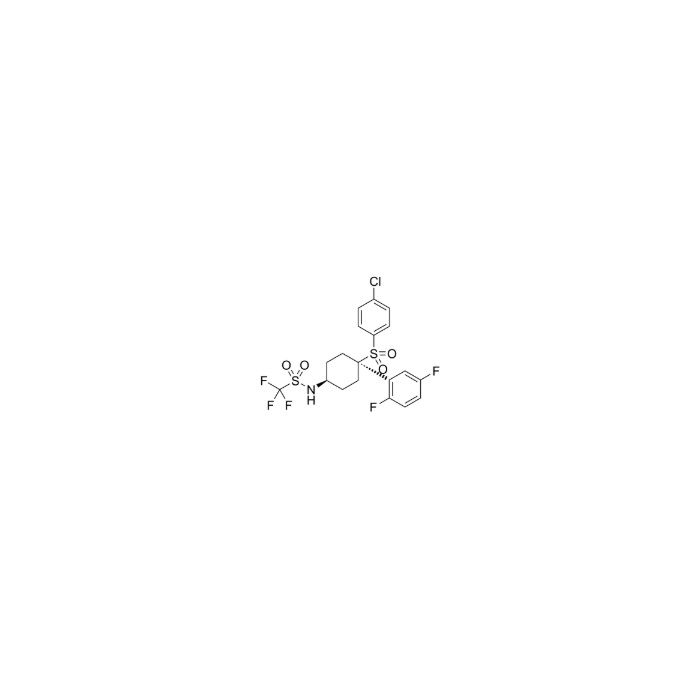
γ-secretase inhibitor; inhibits proteolytic cleavage of amyloid precursor protein (APP) over the Notch pathway. Reduces levels of Aβin the brain (inhibits Aβ40 and Aβ42 in SH-SY5Y neuroblastoma cells with an IC50of 0.65 nM); attenuates plaque deposition. Orally bioavailable.
Storage
Store at -20°C
Verschickt in
Ice chest + Ice pads
Dieses Produkt erfordert Kühlkettenversand. Grundversand und andere Economy-Optionen sind nicht verfügbar.
This compound belongs to the class of organic compounds known as benzenesulfonyl compounds. These are aromatic compounds containing a benzenesulfonyl group, which consists of a monocyclic benzene moiety that carries a sulfonyl group.
External Descriptors
Not available
1. Djoumbou Feunang Y, Eisner R, Knox C, Chepelev L, Hastings J, Owen G, Fahy E, Steinbeck C, Subramanian S, Bolton E, Greiner R, and Wishart DS. ClassyFire: Automated Chemical Classification With A Comprehensive, Computable Taxonomy. Journal of Cheminformatics, 2016, 8:61.
Determine the necessary mass, volume, or concentration for preparing a solution.
Dilution Calculator
Determine the dilution needed to prepare a stock solution.
Reconstitution Calculator
Bewertungen
Kundenbewertungen
Application Protocols
Only item-specific, tested applications would be listed; these are not provided in this record.
Item-specific (Product Data):
Validated applications (e.g., specific assay formats), recommended working concentrations, and positive controls: Not specified for this item; refer to CoA/Spec Sheet.
General guidance (context-only example; adapt to your assay):
Prepare a 10–20 mM DMSO stock.
Generate an 8–12 point concentration–response series (e.g., 0.3 nM–30 µM, half-log steps) in assay buffer, maintaining constant DMSO across wells.
Incubate under conditions appropriate to the biological system (e.g., 30–120 min for many enzyme/cell signaling assays), then read out via your modality of choice.
Include vehicle controls and at least one orthogonal assay or counterscreen to assess off-target/assay interference.
These steps are illustrative and not product-specific protocols.
Biological Roles
Context (literature/general; no medical claims):
MRK 560 has been described as a small-molecule modulator/inhibitor used to interrogate the γ-secretase complex (involving Presenilin components) in biochemical and cellular systems. Researchers employ such tool compounds to dissect intramembrane proteolysis events and downstream signaling cascades.
Experimental roles:
Positive control for target engagement studies addressing proteolytic processing of transmembrane substrates.
Chemical probe to study dose–response relationships, on-target vs off-target effects, and temporal control of pathway inhibition.
Benchmark compound in structure–activity relationship (SAR) investigations for next-generation analog discovery.
Caveats:
Potency and selectivity can be assay- and context-dependent; literature values should be confirmed under your specific conditions.
Off-targets may arise at higher concentrations; comprehensive profiling and appropriate counterscreens are recommended.
Reporting:
Always disclose vehicle percentage, stock solvent, exact concentration ranges, and incubation times when publishing or sharing data.
Item-specific biological potency, isoform selectivity, and binding constants are not provided in this listing; consult primary literature and the SDS for hazard information. For research use only.
Buffer Applications
Not typically applicable as a buffering reagent.
MRK 560 is a hydrophobic small-molecule research ligand, not a buffer component. It is usually delivered to biological systems via organic stocks (e.g., DMSO) and diluted into assay buffers or culture media.
Practical notes (general):
Prepare concentrated DMSO stocks and dilute into the assay buffer (e.g., PBS, HEPES, Tris-based buffers) with vigorous mixing to avoid local supersaturation.
Maintain DMSO at the lowest effective final concentration (often ≤0.1–1% v/v) and include matched vehicle controls.
Item-specific buffer compatibility, pKa, and ionic effects are not specified; optimize empirically for your assay.
Green Alternatives
As a bioactive research ligand used primarily in biochemical or cell-based assays, MRK 560’s “green chemistry” considerations center on solvent and waste minimization rather than substituting the molecule itself.
Greener solvent choices for stock preparation (context):
While DMSO is standard, consider minimizing DMSO volume by preparing higher-concentration stocks and using automated low-volume dispensing.
Ethanol or aqueous cyclodextrin formulations can sometimes substitute for DMSO in tolerant assays, reducing sulfoxide-related assay artifacts. Feasibility is compound- and assay-specific.
Process and waste reduction:
Use microplate-based assays and miniaturized volumes (e.g., 384/1536-well) to reduce solvent and plastic waste.
Adopt low-adsorption labware to decrease overages needed to compensate for binding losses.
Comparative view (general):
DMSO: high solvency, common; moderate EHS footprint; manageable at small volumes.
Aqueous vehicles with solubilizers (e.g., 2‑hydroxypropyl‑β‑cyclodextrin): greener but may alter bioavailability/readouts; requires validation.
PEG400 or cremophor carriers: can enable aqueous delivery but introduce biological confounders; use sparingly and report clearly.
Note: There is no direct “greener alternative compound” to MRK 560 for its specific biochemical role. Sustainability gains come from solvent selection, miniaturization, and robust experimental design.
Pharmaceutical Uses
Scope: For research use only. This listing provides no clinical, diagnostic, or therapeutic claims.
Role in pharmaceutical R&D (general):
MRK 560 can serve as a reference or tool compound in preclinical discovery to benchmark assays probing γ-secretase/Presenilin-related biology, support SAR campaigns, and validate target engagement methodologies.
It may be used as an internal control for analytical method development (e.g., LC–MS bioanalytical assays) where a known small-molecule standard is advantageous.
Formulation context in labs (non-clinical):
Stocks are typically prepared in DMSO at 10–50 mM and diluted into non-clinical test matrices (buffers, cell media) for in vitro work.
No pharmacopeial monograph or excipient status is indicated for this item.
Compliance and documentation:
Not intended for human or veterinary use. Not GMP. For research use only.
When used in regulated studies, qualify the material with in-house or third-party characterization and retain CoA/lot traceability.
Item-specific formulation excipient roles, compendial status, and clinical-use information are not provided and should not be inferred.
Physical Properties
Overview: The product record does not include item-specific physicochemical specifications. Use literature or database values for preliminary planning and confirm experimentally.
Item-specific (Product Data):
Appearance: Not specified for this item; refer to CoA/Spec Sheet.
Molecular Weight: Not specified for this item; refer to CoA/Spec Sheet.
Literature/General expectations for a lipophilic small-molecule ligand (context only):
Physical state: typically a solid (often off-white to light-colored) for many arylamide inhibitors; exact appearance varies by lot/form.
Solubility: commonly soluble in DMSO and DMF; limited aqueous solubility. A co-solvent approach (DMSO→buffer) is often used to prepare working solutions.
Partitioning: such ligands often exhibit moderate-to-high logP/logD; actual values must be taken from a curated database.
Thermal properties (mp/bp): solid compounds of this class often have melting points in the 80–200 °C range; exact mp for MRK 560 should be sourced from literature or an analytical certificate.
Not provided in this item listing (use CoA/Spec Sheet or literature):
Melting point, boiling point, density, refractive index, pKa, logP/logD, UV cutoff/extinction.
Note: Do not treat any literature values as specifications. For regulated or quantitative work, confirm properties experimentally and consult the CoA/SDS.
Quality and Grades
Grade and implications:
Item-specific (Product Data):
Grade/Purity: Moligand™.
Explanation (general):
Moligand™ denotes a research-grade small-molecule ligand suitable for biochemical, cellular, or target-engagement studies. While intended for demanding research workflows (e.g., screening, MoA studies, and positive-control benchmarking), Moligand is not a pharmaceutical or GMP grade.
Typical expectations for such grades include rigorous identity confirmation (e.g., NMR/LC–MS), and purity adequate for discovery research. Exact acceptance criteria (e.g., assay %, residual solvents, water, metal content, stabilizers) are not specified for this item; refer to CoA/Spec Sheet.
Stabilizers/Salts:
Stabilizer presence, counter-ions, or solvate/hydrate state: Not specified for this item; refer to CoA/Spec Sheet.
Recommendations:
For quantitative biology, chromatography, or biophysics, confirm purity and counter-ion form from the CoA and re-verify by in-house QC if your workflow is highly sensitive (e.g., ITC, SPR, high-content screens).
Document batch/lot numbers in data packages; maintain aliquots to minimize degradation or adventitious moisture pickup.
Regulatory status:
For research use only; not for diagnostic, clinical, or therapeutic applications.
Reaction and Applications
Focus here is on applications as a research ligand/standard rather than as a synthetic reagent.
Research applications (general, literature-based context):
MRK 560 is reported as a tool compound in γ-secretase/Presenilin pathway studies, enabling modulation of intramembrane proteolysis processes in biochemical and cellular assays. It is often used as a positive control or comparator in target validation and mechanistic studies.
Utility spans enzyme activity assays, pathway reporter assays, and chemical biology probing of proteolytic events.
Assay setup considerations:
Prepare 10–50 mM DMSO stocks; filter if needed (PTFE, 0.2 µm) to remove particulates.
Perform preliminary solubility and precipitation checks at planned working concentrations. Maintain final DMSO typically ≤0.1–1% v/v in cell-based systems.
Include vehicle controls (matching DMSO %) and concentration–response series (e.g., half-log dilutions) to define potency windows.
Not a general-purpose synthesis reagent:
MRK 560 is not typically used to mediate or participate in organic transformations (e.g., as a coupling partner or catalyst). If employing it as a synthetic reference standard (e.g., for LC–MS RT confirmation), validate purity/identity versus a certified reference.
Item-specific potency, selectivity, and assay-validated concentrations are not provided in this listing; consult primary literature and optimize for your system.
Reaction Conditions
This section focuses on conditions for biological/biochemical assay deployment rather than chemical reaction conditions, as MRK 560 is a research ligand.
Stock preparation (general guidance):
Dissolve in anhydrous DMSO to 10–50 mM. Sonication or gentle warming (≤37 °C) can aid dissolution. Filter through 0.2 µm PTFE if particulates persist.
Store aliquots at −20 °C, protected from light and moisture. Avoid repeated freeze–thaw cycles.
Working solution preparation:
Dilute DMSO stock into assay buffer or media with vigorous mixing; add compound last. Typical final DMSO: 0.1–1% v/v in cell assays; ≤2% in many biochemical assays (verify assay tolerance).
Prepare concentration–response curves (e.g., 8–12 points, half-log spacing). Incubation times vary by assay type (minutes to hours); optimize empirically.
Controls and artifacts:
Include vehicle controls and, where applicable, orthogonal readouts to distinguish on-target effects from solvent or fluorescence/absorbance interference.
Chemical reaction conditions:
Not typically applicable; MRK 560 is not used to catalyze or undergo synthetic transformations within standard reaction families.
Item-specific potency, kinetic parameters, and stability in particular buffers/sera are not provided in this listing; consult primary literature and perform pilot tests.
Safety and Handling
Safety overview: Item-specific GHS details are not provided in this record; handle as a potentially hazardous laboratory chemical and consult the SDS.
Item-specific (Product Data):
GHS Classification: Not specified for this item; refer to SDS.
Signal Word / H-Statements / Pictograms: Not specified for this item; refer to SDS.
Storage: Store at −20 °C.
Shipping: Ice chest + ice pads.
Research Use: For research use only.
General laboratory precautions (good practice):
PPE: lab coat, nitrile gloves, safety glasses; use a certified chemical fume hood for weighing, dissolutions, and transfers.
Avoid inhalation of dust and contact with skin/eyes. Prevent environmental release; collect waste in properly labeled containers.
Solubility handling: Prefer anhydrous DMSO/DMF to prepare concentrated stocks; dilute into buffer immediately before use to minimize precipitation.
Incompatibilities and stability (general for hydrophobic organics):
Avoid strong oxidizers and strong acids/bases unless supported by stability data.
Protect from prolonged exposure to light, moisture, and elevated temperatures. Minimize freeze–thaw cycles by preparing single-use aliquots.
First-aid (summary; defer to SDS):
Skin/eye contact: Rinse with water for ≥15 min; remove contaminated clothing; seek medical attention.
Inhalation: Move to fresh air; seek medical attention if symptoms persist.
Ingestion: Rinse mouth; do not induce vomiting; seek medical attention.
Always consult and follow the SDS specific to this lot before use.
Solvent Selection
Practical dissolution strategy for MRK 560 as a hydrophobic small-molecule ligand (general guidance):
Primary stock solvents (typical):
DMSO (anhydrous): excellent solvating power for aromatic amide inhibitors; widely used for 10–50 mM stocks.
DMF (anhydrous) or NMP: alternatives when DMSO interference is a concern.
Aqueous compatibility:
Direct aqueous solubility is usually low. Prepare a concentrated organic stock (e.g., in DMSO) and dilute into aqueous buffer with vigorous mixing to final DMSO ≤0.1–1% v/v, as tolerated by the assay or cells.
Co-solvent systems:
DMSO + buffer with surfactant (e.g., 0.01–0.05% non-ionic surfactant) can reduce precipitation/adsorption in plasticware.
DMSO + PBS or cell culture media; add compound last to pre-warmed media to improve miscibility.
Adsorption and carryover:
Highly lipophilic ligands can adsorb to polypropylene or glass. Pre-rinsing with working solution or using low-bind plastics can improve recovery.
Comparisons (general):
DMSO: highest solvency; may affect enzyme activity at >1–2%.
Ethanol: volatile, less solvating for high-aromatic scaffolds; more assay-friendly at low %.
2‑MeTHF/CPME: greener but typically not used for bioassay stocks due to aqueous incompatibility.
Item-specific solubility, pKa, and logP are not specified in this listing; confirm with CoA/literature before finalizing solvent plans.
Storage and Reconstitution
Item-specific conditions and practical guidance:
Item-specific (Product Data):
Storage Conditions: Store at −20 °C.
Shipped In: Ice chest + ice pads.
Reconstitution (general for small-molecule ligands):
Solvent: Use anhydrous DMSO to prepare a concentrated stock (commonly 10–50 mM). Mix thoroughly; brief sonication can help. If needed, filter through a 0.2 µm PTFE membrane to remove undissolved particulates.
Aliquoting: Dispense into single-use, low-bind microtubes to avoid repeated freeze–thaw. Typical aliquots: 10–50 µL at working stock concentration.
Light/moisture protection: Store stocks in amber vials or foil-wrapped tubes; purge headspace with inert gas if long-term storage is anticipated.
Handling and stability:
Thaw on ice, vortex to homogenize, and promptly return unused aliquots to −20 °C.
Avoid more than 2–3 freeze–thaw cycles; prepare smaller aliquots if frequent access is expected.
For aqueous working solutions, prepare fresh immediately before use to minimize precipitation or hydrolytic degradation.
Documentation:
Record lot number, preparation date, solvent, and concentration on each aliquot label and in your ELN/LIMS.
Any stabilizers, exact solvent compatibility, and long-term stability data are not specified for this item; consult the CoA for lot-specific guidance.
Structure and Identity
Brief: MRK 560 is a small-molecule research ligand (Moligand grade). Structural identifiers are partially provided; core structural features are not specified in the product record.
Item-specific (Product Data):
Product Name: MRK 560 (SKU: M287545)
CAS: 677772-84-8
PubChem CID: 11577204
InChIKey: Not specified for this item; refer to CoA/Spec Sheet. (Note: listing shows "395917", which is not a standard-length InChIKey.)
SMILES: Not specified for this item; refer to CoA/Spec Sheet.
Molecular Formula: Not specified for this item; refer to CoA/Spec Sheet.
Molecular Weight: Not specified for this item; refer to CoA/Spec Sheet.
Literature/General (for context only; verify against primary databases before use):
MRK-560 is described in the literature as a small-molecule γ-secretase/Presenilin-modulating research tool. Specific stereochemistry and full structural descriptors should be taken from a trusted structure database entry linked to the provided CAS or CID.
Typical features reported for this class include multiple aromatic rings and an amide/urea-type functionality contributing to target engagement and lipophilicity.
2D Structure (descriptive, general):
Likely consists of an aryl–aryl scaffold connected to a carbonyl-containing linker (e.g., amide), with substituents imparting stereochemical preference. Exact ring substitution pattern and stereocenters are not specified in this item listing and must be confirmed from primary references (e.g., PubChem entry for CID 11577204).
Synthetic Utility
Reagent utility versus probe utility:
MRK 560 is supplied as a finished small-molecule probe/ligand rather than as a building block. It is not commonly employed as a reactant or catalyst in synthetic organic chemistry.
If used in synthesis-related contexts (general):
As an analytical reference standard to confirm chromatographic retention times or MS ionization behavior for analog series.
For spike-and-recovery or stability-indicating method development (e.g., forced degradation studies to map impurity profiles of related analogs).
Functional group considerations (general class):
Literature descriptions of MRK-class inhibitors often feature amide/urethane motifs and multiple aromatic rings; these functionalities influence chromatographic behavior (e.g., reversed-phase retention) and ionization (commonly [M+H]+ in ESI).
Retrosynthetic notes (general):
Access to such scaffolds typically involves amide couplings, aryl–aryl ether formations, and stereocenter installation. These notes are for contextual understanding only and do not imply that this supplied product is intended for further chemical modification.
Item-specific reactivity, protecting-group strategies, or synthetic handles are not specified for this item.
Target Specificity
Only item-specific data may be listed here.
Item-specific (Product Data):
Target, isoform selectivity, Ki/IC50, and binding site information: Not specified for this item; refer to CoA/Spec Sheet and primary literature if needed.
No additional target specificity claims are made in this product listing.
Häufig gestellte Fragen
What is the purity of this product, and how is it determined?
This product is supplied at ≥99% purity, determined by HPLC. Lot-specific values are stated on the Certificate of Analysis.
What is Moligand??
Moligand? is one of Aladdin Scientific's premium product lines, formulated for high-purity applications across multiple workflows. Compared to standard grades in the same workflow, Moligand? products typically offer tighter specifications, more rigorous QC, and stronger lot-to-lot consistency.
How should this product be stored?
Store at ?20 °C. Freezer storage is required to maintain the specified shelf life.
How is this product shipped?
This product ships in an insulated container with ice pads. Unpack on arrival and transfer it to the storage condition stated above.
What are the CAS number, molecular formula and molecular weight?
The CAS Number is 677772-84-8, the molecular formula is C19H17ClF5NO4S2, and the molecular weight is 517.92 g/mol. InChIKey WDZVWDXOIGQJIO-UHFFFAOYSA-N.
What documentation is provided?
Available product documentation, including Certificates of Analysis (COA), Safety Data Sheets (SDS), and specification sheets, is shown in the product document area. Document availability and access follow the current site policy.
Benötigen Sie Hilfe bei der Auswahl der Qualität?
Unser Leitfaden zur Qualitätsauswahl behandelt Reinheit, Stabilisatorstatus und Anwendungseignung für alle Varianten in unserem Katalog.
Wir verwenden Cookies, um die ordnungsgemäße Funktion der Website sicherzustellen und, soweit zulässig, Ihr Nutzererlebnis zu verbessern. Sie können Ihre Einstellungen jederzeit unter „Einstellungen“ verwalten. Weitere Informationen finden Sie in unserer Cookie-Richtlinie.
Dürfen wir Sie über Rabattaktionen informieren?
Später erinnern
Vielen Dank! Bitte überprüfen Sie Ihren E-Mail-Posteingang, um zu bestätigen.
Products are supplied to verified businesses, institutions, and qualified professionals for research and development use only. Not for use in humans, animals, diagnosis, or therapy.

 D2615355