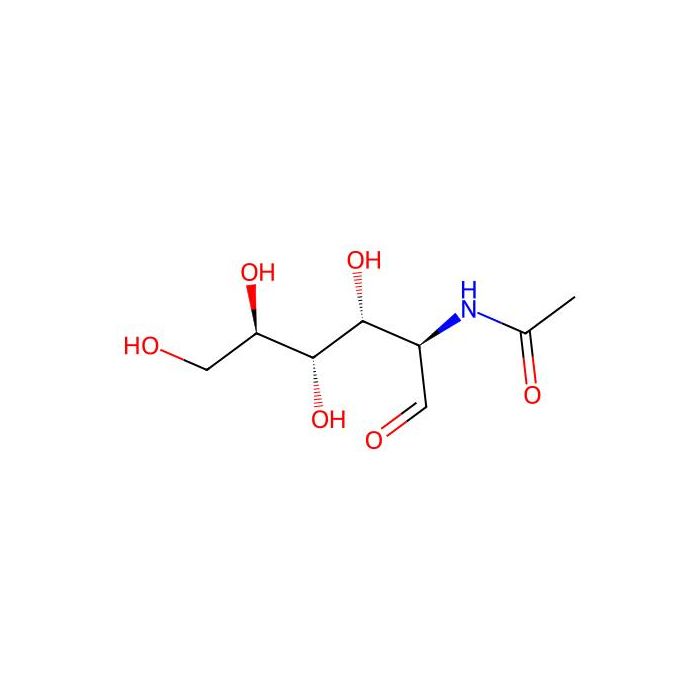
N-Acetyl-D-glucosamine - ≥97% , CAS No.7512-17-6

CAS: 7512-17-6 Cat. No.: A105212 Summenformel: C8H15NO6 Molekulargewicht: 221.21 Beilstein Registry Number: 1727589 EG-Nummer: 231-368-2
Zu bestellen verfügbar
GRADE & PURITY ≥97%
Synonyms
2-Acetamido-2-deoxy-D-glucose 2-Acetamido-2-deoxy-D-glucopyranose N-Acetyl-D-glucosamine N-[2,4,5-Trihydroxy-6-(hydroxymethyl)tetrahydro-2H-pyran-3-yl]acetamide D-GlcNAc
Storage
Store at 2-8°C
Shipped In
Wet ice
★
Size
Deutschland (EU)
USA*
Price
Qty
10g
A105212-10g
—
2 Auf Lager
8,59€
25g
A105212-25g
—
3 Auf Lager
9,46€
100g
A105212-100g
—
2 Auf Lager

13,80€

20,74€
Speichern 6,94 € (33.47%)
500g
A105212-500g
—
3 Auf Lager

63,26€

95,36€
Speichern 32,11 € (33.67%)
Enter a quantity for the sizes you want to add.
🧪
Why this grade

≥97% for sensitive chromatographic and analytical workflows requiring minimal baseline interference.

🌡

Storage & shipping

Store at 2-8°C Ships Wet ice Check lot-specific COA for exact specifications.

📋

Quality documents

SDS, COA, datasheet, and spec sheet available for download. Lot-specific COA accessible via lot number lookup.

📚

Literature proof

Cited in 69 peer-reviewed publications across chromatography, organic synthesis, and cross-coupling reactions.

Specifications

Synonyme
2-Acetamido-2-deoxy-D-glucose 2-Acetamido-2-deoxy-D-glucopyranose N-Acetyl-D-glucosamine N-[2,4,5-Trihydroxy-6-(hydroxymethyl)tetrahydro-2H-pyran-3-yl]acetamide D-GlcNAc
Spezifikationen & Reinheit
≥97%
Biochemische und physiologische Mechanismen
Monosaccharide derivative of glucose found in polymers of bacterial cell walls, chitin, hyaluronic acids and various glycans. Used to identify, differentiate and characterize N-acetyl-β-D-hexoaminidase(s).
Storage
Store at 2-8°C
Verschickt in
Wet ice
Dieses Produkt erfordert Kühlkettenversand. Grundversand und andere Economy-Optionen sind nicht verfügbar.
Aktionsart
MODULATOR
Hinweis
Wherever possible, you should prepare and use solutions on the same day. However, if you need to make up stock solutions in advance, we recommend that you store the solution as aliquots in tightly sealed vials at -20°C. Generally, these will be useable for up to one month. Before use, and prior to opening the vial we recommend that you allow your product to equilibrate to room temperature for at least 1 hour. Need more advice on solubility, usage and handling? Please visit our frequently asked questions (FAQ) page for more details.
Reinheit
≥97%
Namen und Kennungen
Pubchem Sid
Isomere SMILES
CC(=O)N[C@@H](C=O)[C@H]([C@@H]([C@@H](CO)O)O)O
WGK Deutschland
3
Molekulargewicht
221.21
Beilstein
1727589
Reaxy-Rn
1727589
Reaxys-RN_link_address
https://www.reaxys.com/reaxys/secured/hopinto.do?context=S&query=IDE.XRN=1727589&ln=

Documentation

📋 Safety Data Sheet (SDS)

Comprehensive hazard, handling, storage, and regulatory compliance document.

Download SDS →

✅ Certificate of Analysis (COA)

Lot-specific quality data. Enter your lot number to retrieve the exact COA.

Look up COA →

📊 Datasheet

Quick-reference summary of product specifications and applications.

View datasheet →

🔬 Specification Sheet

Full quality attributes and acceptance criteria for this grade.

View spec sheet →

Advanced Data

Zugehörige Ziele (nicht menschlich)
Hdac6 Histone deacetylase 6 (222 Activities)
Activity TypeRelationActivity valueUnitsAction TypeJournalPubMed IddoiAssay Aladdin ID
rep Replicase polyprotein 1ab (378 Activities)
Activity TypeRelationActivity valueUnitsAction TypeJournalPubMed IddoiAssay Aladdin ID
Wirkungsmechanismen
Zertifikate (CoA, COO, BSE/TSE und Analyse-Diagramm)
C of A & Other Certificates(BSE/TSE, COO):
Analytical Chart:

Find and download the COA for your product by matching the lot number on the packaging.

25 results found

Lot NumberCertificate TypeDatumArtikel
G2620034Certificate of AnalysisJul 22, 2026 A105212
G2620032Certificate of AnalysisJul 22, 2026 A105212
G2620031Certificate of AnalysisJul 22, 2026 A105212
G2620030Certificate of AnalysisJul 22, 2026 A105212
K2520075Certificate of AnalysisAug 06, 2025 A105212
H2504737Certificate of AnalysisAug 06, 2025 A105212
G2523163Certificate of AnalysisAug 01, 2025 A105212
G2523164Certificate of AnalysisAug 01, 2025 A105212
G2523165Certificate of AnalysisAug 01, 2025 A105212
J2622035Certificate of AnalysisAug 01, 2025 A105212
E2609135Certificate of AnalysisJun 18, 2025 A105212
F2512056Certificate of AnalysisJun 18, 2025 A105212
E2513493Certificate of AnalysisMay 16, 2025 A105212
I2412093Certificate of AnalysisSep 24, 2024 A105212
I2412092Certificate of AnalysisSep 24, 2024 A105212
I2412091Certificate of AnalysisSep 24, 2024 A105212
E2308212Certificate of AnalysisMay 19, 2023 A105212
E2308215Certificate of AnalysisMay 19, 2023 A105212
E2308307Certificate of AnalysisMay 19, 2023 A105212
H2204263Certificate of AnalysisAug 09, 2022 A105212
H2204256Certificate of AnalysisAug 09, 2022 A105212
H2204254Certificate of AnalysisAug 09, 2022 A105212
K2119058Certificate of AnalysisNov 25, 2021 A105212
K2119181Certificate of AnalysisNov 24, 2021 A105212
E2506235Certificate of AnalysisNov 24, 2021 A105212
Chemische und physikalische Eigenschaften
Spezifische Drehung [α]+39.0 to +43.0 deg(C=1, H2O)
Schmelzpunkt (°C)211°C
Molekulargewicht221.210 g/mol
XLogP3-3.400
Hydrogen Bond Donor Count5
Hydrogen Bond Acceptor Count6
Rotatable Bond Count6
Exact Mass221.09 Da
Monoisotopic Mass221.09 Da
Topological Polar Surface Area127.000 Ų
Heavy Atom Count15
Formal Charge0
Complexity221.000
Isotope Atom Count0
Defined Atom Stereocenter Count4
Undefined Atom Stereocenter Count0
Defined Bond Stereocenter Count0
Undefined Bond Stereocenter Count0
The total count of all stereochemical bonds0
Covalently-Bonded Unit Count1
FAQs und Artikel
Structural Features of Lysozyme and Advances in Its Applications
An Introduction to Research-Grade Carbohydrates: Decoding the “Glycan Language” and a Product-Selection Guide (with Tables 1–3)
Chitinases: Substrate-Specific Degradation Mechanisms, Enzymatic Properties, and Application Directions
Pyran and the “Pyran Family” Research Selection Guide: Key Structural Points, a Classification Roadmap, and Experimental Selection Navigation
Porous Graphitic Carbon (PGC) Chromatography Columns: Creating New Selectivity for Challenging Separations through Molecular Shape and the π-Electron Cloud on the Graphitic Surface
The Dual-Targeted Skin-Brightening Mechanism of 4-MSK: Inhibiting Melanin Production and Reducing Epidermal Pigment Retention
Moisturizing Mechanism of Polyglutamic Acid: From the γ-Glutamyl Structure to Hydration Networks and Surface Film-Forming Behavior
Probiotics, Prebiotics, and Postbiotics in Skin Care: Conceptual Distinctions, Mechanisms of Action, and Their Applications in the Care of Dry, Itchy, and Rough Skin
Phenylethyl Resorcinol (377): Structural Characteristics, Melanogenesis-Regulating Mechanisms, and Related Applications in Formulation Research
Mechanism of Action of Tranexamic Acid in Pigmentation Care: From the Plasmin System to Regulation of Inflammation-Driven Pro-Melanogenic Signaling
Multilevel Moisturizing Mechanisms of Sodium Hyaluronate and Its Derivatives: Molecular Weight Modulation, Crosslinking, Acetylation, and Major Sites of Action
Skin Mechanism of Action of Pro-Xylane: From C-Xyloside Priming and CS/DS Chain Remodeling to the Dermal–Epidermal Junction
How Arbutin Regulates Melanin Production: α/β Anomeric Configuration and Tyrosinase Action
Citations of This Product
Lösungsrechner
Bewertungen

Kundenbewertungen

Dürfen wir Sie über Rabattaktionen informieren?

Später erinnern

Vielen Dank! Bitte überprüfen Sie Ihren E-Mail-Posteingang, um zu bestätigen.

Hoppla! Benachrichtigungen sind deaktiviert.