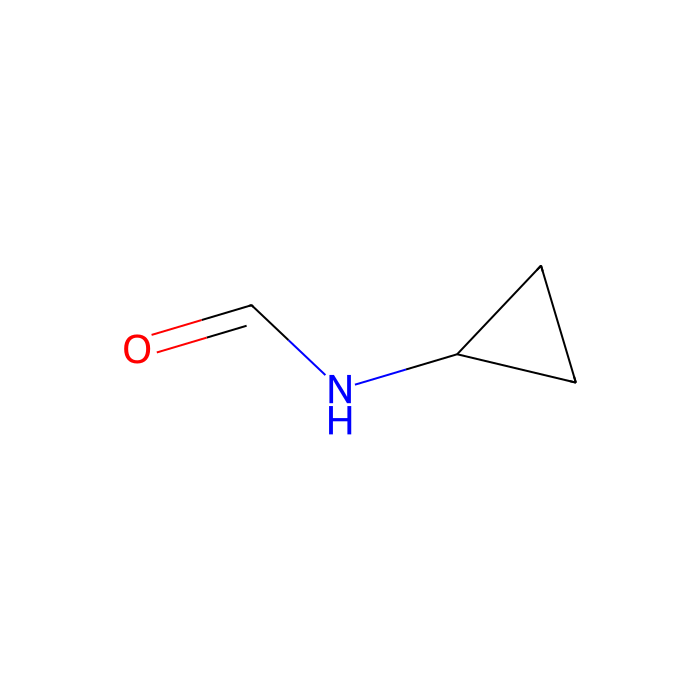
N-Cyclopropylformamide - ≥98% , CAS No.58644-54-5

CAS: 58644-54-5 Cat. No.: N185388 Summenformel: C4H7NO Molekulargewicht: 85.10
Zu bestellen verfügbar
GRADE & PURITY ≥98%
Synonyms
cyclopropylformamide | DTXSID90573112 | CHEMPACIFIC38196 | W10329 | A869387 | AM804092 | BDBM50064284 | CHEMPACIFIC 38196 | Cyclopropyl Formamide | N-cyclopropyl formamide | N-Cyclopropylformamide | N-Cyclopropyl-formamide | AWQVKAURKXXOCG-UHFFFAOYSA-N |
Storage
Store at 2-8°C,Argon charged,Desiccated
Shipped In
Wet ice
★
Size
Deutschland (EU)
USA*
Price
Qty
1g
N185388-1g
Auf Bestellung · 8–12 Wochen
8,59€
5g
N185388-5g
Auf Bestellung · 8–12 Wochen
20,74€
25g
N185388-25g
Auf Bestellung · 8–12 Wochen
64,99€
100g
N185388-100g
Auf Bestellung · 8–12 Wochen
242,88€
Enter a quantity for the sizes you want to add.
🧪
Why this grade

≥98% for sensitive chromatographic and analytical workflows requiring minimal baseline interference.

🌡

Storage & shipping

Store at 2-8°C,Argon charged,Desiccated Ships Wet ice Check lot-specific COA for exact specifications.

📋

Quality documents

SDS, COA, datasheet, and spec sheet available for download. Lot-specific COA accessible via lot number lookup.

📚

Literature proof

Cited in 0 peer-reviewed publications across chromatography, organic synthesis, and cross-coupling reactions.

Specifications

Synonyme
cyclopropylformamide | DTXSID90573112 | CHEMPACIFIC38196 | W10329 | A869387 | AM804092 | BDBM50064284 | CHEMPACIFIC 38196 | Cyclopropyl Formamide | N-cyclopropyl formamide | N-Cyclopropylformamide | N-Cyclopropyl-formamide | AWQVKAURKXXOCG-UHFFFAOYSA-N |
Spezifikationen & Reinheit
≥98%
Storage
Store at 2-8°C,Argon charged,Desiccated
Verschickt in
Wet ice
Dieses Produkt erfordert Kühlkettenversand. Grundversand und andere Economy-Optionen sind nicht verfügbar.
Reinheit
≥98%
Namen und Kennungen
Kanonisches Lächeln
C1CC1NC=O
IUPAC Name
N-cyclopropylformamide
InChIKey
AWQVKAURKXXOCG-UHFFFAOYSA-N
INCHI
1S/C4H7NO/c6-3-5-4-1-2-4/h3-4H,1-2H2,(H,5,6)
Isomere SMILES
C1CC1NC=O
Molekulargewicht
85.10
Reaxy-Rn
2715456
Reaxys-RN_link_address
https://www.reaxys.com/reaxys/secured/hopinto.do?context=S&query=IDE.XRN=2715456&ln=

Documentation

📋 Safety Data Sheet (SDS)

Comprehensive hazard, handling, storage, and regulatory compliance document.

Download SDS →

✅ Certificate of Analysis (COA)

Lot-specific quality data. Enter your lot number to retrieve the exact COA.

Look up COA →

📊 Datasheet

Quick-reference summary of product specifications and applications.

View datasheet →

🔬 Specification Sheet

Full quality attributes and acceptance criteria for this grade.

View spec sheet →

Advanced Data

Taxonomic Classification

Taxonomy Tree

KingdomOrganic compounds
SuperclassOrganic acids and derivatives
KlasseCarboxylic acids and derivatives
SubclassCarboxylic acid derivatives
Intermediate Tree Nodes Carboxylic acid amides
Direct ParentSecondary carboxylic acid amides
Alternative Parents Organonitrogen compounds  Organic oxides  Hydrocarbon derivatives  Carbonyl compounds  
Molecular FrameworkAliphatic homomonocyclic compounds
Substituents Secondary carboxylic acid amide - Organic nitrogen compound - Organic oxygen compound - Organic oxide - Hydrocarbon derivative - Organooxygen compound - Organonitrogen compound - Carbonyl group - Aliphatic homomonocyclic compound
BeschreibungThis compound belongs to the class of organic compounds known as secondary carboxylic acid amides. These are compounds containing a secondary carboxylic acid amide functional group, with the general structure RC(=O)N(R')H (R,R'=alkyl, aryl).
External Descriptors Not available
3D-Struktur
Interaktives chemisches Strukturmodell


Zugehörige Ziele (menschlich)
ADH1A Tclin Alcohol dehydrogenase alpha chain (33 Activities)
Activity TypeRelationActivity valueUnitsAction TypeJournalPubMed IddoiAssay Aladdin ID
ADH7 Tchem Alcohol dehydrogenase class IV (23 Activities)
Activity TypeRelationActivity valueUnitsAction TypeJournalPubMed IddoiAssay Aladdin ID
ADH1B Tclin Alcohol dehydrogenase beta chain (24 Activities)
Activity TypeRelationActivity valueUnitsAction TypeJournalPubMed IddoiAssay Aladdin ID
ADH1C Tclin Alcohol dehydrogenase gamma chain (23 Activities)
Activity TypeRelationActivity valueUnitsAction TypeJournalPubMed IddoiAssay Aladdin ID
ADH4 Tbio Alcohol dehydrogenase class II (23 Activities)
Activity TypeRelationActivity valueUnitsAction TypeJournalPubMed IddoiAssay Aladdin ID
Wirkungsmechanismen
Zertifikate (CoA, COO, BSE/TSE und Analyse-Diagramm)
C of A & Other Certificates(BSE/TSE, COO):
Analytical Chart:

Find and download the COA for your product by matching the lot number on the packaging.

4 results found

Lot NumberCertificate TypeDatumArtikel
C2625405Certificate of AnalysisDec 29, 2025 N185388
C2625415Certificate of AnalysisDec 29, 2025 N185388
C2625443Certificate of AnalysisDec 29, 2025 N185388
C2625444Certificate of AnalysisDec 29, 2025 N185388
Chemische und physikalische Eigenschaften
Molekulargewicht85.100 g/mol
XLogP30.100
Hydrogen Bond Donor Count1
Hydrogen Bond Acceptor Count1
Rotatable Bond Count1
Exact Mass85.0528 Da
Monoisotopic Mass85.0528 Da
Topological Polar Surface Area29.100 Ų
Heavy Atom Count6
Formal Charge0
Complexity58.600
Isotope Atom Count0
Defined Atom Stereocenter Count0
Undefined Atom Stereocenter Count0
Defined Bond Stereocenter Count0
Undefined Bond Stereocenter Count0
The total count of all stereochemical bonds0
Covalently-Bonded Unit Count1
Lösungsrechner
Bewertungen

Kundenbewertungen

Application Protocols

Not applicable. No biological assay or immunoassay protocols are associated with this small-molecule reagent. For practical usage, refer to the “Reaction Conditions,” “Synthetic Utility,” and “Reaction & Applications” sections for laboratory procedures and conditions.

Biological Roles

Applicability: This listing is for a synthetic building block for research use only. No biological activity is assigned to the reagent itself.

Literature/general context

  • Structural motifs: The cyclopropyl group is a common bioisosteric element in medicinal chemistry, often used to adjust lipophilicity and metabolic stability. The formamide functionality provides H‑bonding capacity and polarity but is typically a transient protecting group rather than a persistent pharmacophore.
  • Metabolic considerations: If converted to cyclopropylamine in synthetic sequences, downstream amines are subject to typical biotransformations (oxidation, deamination) in biological systems; these comments are general and not claims for this product.

Compliance note

  • For research use only. Not intended for use in humans or animals. No clinical or diagnostic claims are made.
Buffer Applications

Not typically applicable. N‑Cyclopropylformamide is a small organic amide building block and is not used as a buffering agent. For experimental planning, focus on the “Reaction & Applications,” “Synthetic Utility,” and “Reaction Conditions” sections.

Green Alternatives

Context: This product is a building block, not a process solvent. Greenness considerations focus on the choice of reaction media and reagents used with it.

Greener choices (literature/guidance)

  • Reaction media: Prefer 2‑MeTHF, CPME, EtOAc, or MeOH over chlorinated solvents when compatible with the transformation. Acetonitrile can be a practical compromise with easier recovery than DMF/NMP.
  • Dehydration to isocyanides: Traditional reagents (POCl3, SOCl2, PPh3/CCl4) are hazardous. Consider alternatives such as Burgess reagent, PPh3/CBr4, or triphosgene analogs with caution; greener protocols employing DMSO/Ph3P (Corey-type) variants or T3P have been reported in some contexts. Evaluate EHS profiles and waste.
  • Protection/deprotection: Instead of isolating the formamide, in situ formylation–deformylation sequences may reduce solvent usage and purification steps, especially in flow.

Comparison (qualitative)

  • DCM vs EtOAc: EtOAc has better EHS profile and biodegradability; DCM offers superior solubility but higher environmental impact.
  • DMF/NMP vs MeCN/2‑MeTHF: MeCN/2‑MeTHF are generally favored for lower reproductive toxicity and improved work‑up.

Note: Selection should be guided by your process hazard analysis, solvent selection guides (e.g., GSK/ACS PMI), and performance in your specific reaction.

Pharmaceutical Uses

Formulation/excipient role: Not typically used as an excipient. No pharmacopeial monograph is indicated for this specific reagent.

Process chemistry role (literature/general)

  • Intermediate: Serves as an isolable intermediate en route to cyclopropylamine derivatives, isocyanides, ureas, and carbamates used in API discovery and development.
  • Protecting group strategy: The formyl group can protect cyclopropylamine during multistep sequences, improving handling (reduces volatility/odor vs free amine) and enabling selective transformations at other sites.

Regulatory note

  • For research use only. Not for drug, clinical, or household use. No therapeutic claims are made or implied.
Physical Properties

Item-specific specifications

  • Appearance: Not specified for this item; refer to CoA/Spec Sheet.
  • Grade/Purity: Not specified for this item; refer to CoA/Spec Sheet.

Literature/general values (not item-specific)

  • State at ambient conditions: typically liquid or low-melting solid for small N‑mono‑substituted formamides (literature, qualitative).
  • Molecular formula: C4H7NO (literature)
  • Molecular weight: ~85.10 g/mol (literature)
  • Hydrogen-bonding: secondary amide; H‑bond donor (N–H) and acceptor (C=O) (general property).
  • Polarity: polar aprotic with a protic N–H; higher polarity than typical hydrocarbons; less polar than DMF (general comparison).
  • Expected solubility profile: good solubility in polar organic solvents (e.g., EtOAc, MeOH, DCM, THF); variable in water depending on temperature (literature expectation for N‑mono‑substituted formamides). Quantitative solubilities not specified here.
  • LogP/logD: not widely tabulated; cyclopropyl raises lipophilicity modestly vs formamide (qualitative, medicinal chemistry heuristics).

Not provided for this item (consult CoA/SDS or measure as needed)

  • Boiling point, melting point, density, refractive index, UV cutoff, water/peroxide/metal content: Not specified for this item; refer to CoA/Spec Sheet.
Quality and Grades

Item-specific

  • Grade/Purity: Not specified for this item; refer to CoA/Spec Sheet.
  • Stabilizers/additives: Not specified for this item; refer to CoA/Spec Sheet.

Guidance (general)

  • For building-block amides used in synthesis, typical grades include “>95%” or “>98%” purity by HPLC/GC. If using in catalytic couplings or sensitive transformations (e.g., dehydration to isocyanides), higher purity and low water content are advisable.
  • Water and residual solvent content: For moisture‑sensitive downstream chemistry (e.g., Vilsmeier dehydration), verify Karl Fischer and residual solvent by CoA or measure in‑house.
  • Trace metals/UV cutoff: Not generally specified for small amide building blocks; if using in photochemical steps or analytical detection, request spectral data.
  • What the listed storage implies: Argon and desiccation indicate the supplier intends the material to be kept dry and oxygen‑limited to maximize shelf life and prevent slow hydrolysis/oxidation.
Reaction and Applications

Item-specific use context

  • Catalog category: chemical/biochemical reagent; for research use only.

Synthetic roles (literature/general for N‑formamides)

  • Protected amine equivalent: N‑Cyclopropylformamide serves as a protected form of cyclopropylamine; the formyl group can be removed under acidic or basic hydrolysis to deliver cyclopropylamine when needed.
  • Isocyanide precursor: Dehydration of N‑formamides affords isocyanides (R–NC). Thus, N‑cyclopropylformamide is a direct precursor to cyclopropyl isocyanide—useful in multicomponent reactions (Passerini, Ugi) and ligand synthesis.
  • Electrophile generation: Under Vilsmeier‑type conditions (POCl3/DMF or POCl3 directly), formamides can be activated to imidoyl chlorides or dehydrated; this enables downstream transformations.
  • Reductive transformations: Formamides may undergo reduction to aminals or amines (e.g., with LiAlH4 or borane), offering access to N‑methylated or deprotected products depending on conditions.
  • Cross‑coupling adjunct: While not a coupling partner itself, the cyclopropyl motif is common in medicinal scaffolds; the amide can be converted to the amine, isocyanide, or carbamate that then participates in C–N or multicomponent couplings.

Practical tips

  • Keep dry and under inert gas as supplied to avoid gradual hydrolysis/oligomerization.
  • For dehydration to isocyanide, control temperature, stoichiometry, and base (e.g., Et3N, DIPEA) to suppress side reactions (e.g., ring‑opening or over‑chlorination).
  • During silica purification, add 0.1–1% base to prevent streaking of polar amides.
Reaction Conditions

General, literature-based guidance (not item-specific specifications)

  • Hydrolysis (deformylation to cyclopropylamine):
    • Acidic: 3–6 M HCl, reflux (ethanol/water or dioxane/water), 2–8 h; typical isolated yields for the amine salts are good to excellent after basification/extraction.
    • Basic: 2–5 equiv NaOH or KOH in EtOH/H2O, reflux 2–12 h. Monitor by TLC/LCMS.
  • Dehydration to isocyanide:
    • POCl3 (1.2–2.0 equiv) in DCM or MeCN with base (Et3N/DIPEA, 2–3 equiv), 0 °C to rt to gentle reflux, 1–4 h. Typical literature yields for analogous substrates: 60–90% with careful control of moisture.
    • Alternative: Burgess reagent in toluene/THF (rt to 70 °C) where compatible.
  • Reduction to amine:
    • BH3·THF (1 M) or LiAlH4 in THF/Et2O at 0 °C to reflux; quench carefully. Yields vary with substrate; cyclopropyl ring opening must be avoided by temperature control.
  • Activation to imidoyl chloride:
    • SOCl2 or oxalyl chloride (excess) in DCM, catalytic DMF (trace), 0 °C to rt, 1–3 h, followed by nucleophile addition in situ.

Work‑up and purification

  • Include aqueous neutralization to destroy dehydrating agents; use basic additives (0.1–1% NEt3) on silica to reduce amide tailing. Maintain anhydrous conditions for dehydration steps.

Always optimize on small scale; consult primary literature for the exact procedure relevant to your transformation.

Safety and Handling

Item-specific

  • Storage conditions: Store at 2–8 °C, under argon, desiccated (from Product Data). Shipped on wet ice.
  • GHS classification, signal word, H‑statements, pictograms: Not specified for this item; refer to SDS.

General safety guidance (literature/typical for amides; always defer to SDS)

  • Likely hazards: Low volatility amide liquids can cause skin/eye irritation; avoid inhalation of vapors or aerosols. Secondary amides are not strong sensitizers but handle with care.
  • PPE: safety glasses, lab coat, appropriate chemical-resistant gloves (e.g., nitrile). Use in a fume hood to control vapors and during transfers.
  • Handling: Keep container tightly closed under an inert atmosphere to limit moisture uptake and oxidative degradation. Purge headspace with argon after use. Avoid prolonged exposure to air and elevated temperatures.
  • Incompatibilities: Strong oxidizers, strong acids/bases for extended periods (can hydrolyze or degrade); dehydrating agents convert formamides to isocyanides—avoid unintended contact with POCl3, SOCl2, or oxalyl chloride.
  • First aid (overview): In case of skin/eye contact, rinse with water for several minutes; remove contaminated clothing. If inhaled, move to fresh air. If ingested, rinse mouth; do not induce vomiting. Seek medical attention in all cases. Refer to SDS for detailed instructions.
  • Waste: Collect as organic waste. Do not release to drains. Follow institutional and local regulations.
Solvent Selection

Applicability: This product is a small, polar, secondary amide used mainly as a synthetic building block rather than as a solvent.

General solvent considerations (literature/guidance)

  • Polarity class: polar, H‑bonding solute; dissolves well in many polar organics (EtOAc, MeOH, MeCN, DCM, THF). Water solubility can be moderate but is not guaranteed for all N‑mono‑substituted formamides.
  • Dielectric/miscibility: While DMF/NMF are fully miscible with water, N‑cyclopropylformamide may show reduced water miscibility due to the cyclopropyl moiety (qualitative).
  • Solvent choice by operation:
    • Purification: Normal‑phase silica with EtOAc/hexanes or DCM/MeOH mixtures typically elutes secondary amides; consider 0.1–1% NEt3 to prevent tailing (literature practice).
    • Reactions: For acylation, dehydration, or hydrolysis steps, commonly used solvents include DCM, toluene, THF, acetonitrile, and DMF. For greener choices, see “Green Alternatives.”
  • Comparisons (qualitative):
    • DCM vs EtOAc: DCM offers better amide solubility and faster extractions; EtOAc is greener and often sufficient.
    • MeCN vs THF: MeCN provides higher polarity and easier removal than DMF; THF supports both polar and basic conditions but requires peroxide control in storage.

Note: No item-specific solvent properties are certified here; select based on your reaction matrix and preliminary solubility tests.

Storage and Reconstitution

Item-specific storage

  • Store at 2–8 °C, under argon, desiccated (from Product Data). Shipments are on wet ice.

Handling and preparation (general guidance)

  • Upon receipt: Allow the container to equilibrate to room temperature in a desiccator before opening to minimize moisture condensation. Purge headspace with argon after each use.
  • If solidification occurs at low temperature: Warm gently to ambient temperature and vortex/sonicate to homogenize before dispensing (if applicable to physical state; appearance not specified for this item).
  • Solution preparation: Prepare stock solutions in dry, oxygen-free solvents (e.g., anhydrous DCM, THF, MeCN, or EtOAc) immediately before use. For longer-term solutions, store in sealed, argon-purged vials at 2–8 °C and verify stability by TLC/LCMS prior to use.
  • Freeze–thaw: Avoid repeated freeze–thaw cycling. Aliquot if long-term storage is needed.

Stability considerations

  • Moisture can promote hydrolysis; oxygen and heat can accelerate degradation. Adhere to the inert, desiccated storage instructions to maximize shelf life.

Specifications not provided

  • Appearance, stabilizer (if any), and precise shelf-life: Not specified for this item; refer to CoA/Spec Sheet.
Structure and Identity

Item-specific (from Product Data)

  • SKU: N185388
  • Product name: N-Cyclopropylformamide
  • CAS: 58644-54-5
  • CID: 15475283
  • InChIKey: 16881 (as provided)
  • SMILES: Not specified for this item; refer to CoA/Spec Sheet.

Computed/literature (general chemistry information)

  • Preferred IUPAC name (literature): N-cyclopropylformamide
  • Typical molecular formula (literature): C4H7NO
  • Typical molecular weight (literature): ~85.10 g/mol
  • Representative SMILES (literature): O=CNC1CC1 (one of several equivalent line notations)
  • Functional groups and features: one secondary amide (formamide) bearing a cyclopropyl N‑substituent; contains an H‑bond donor (N–H) and H‑bond acceptor (C=O); small strained three‑membered ring (cyclopropyl) that modulates sterics and electronics.
  • 2D structural description: a formyl carbonyl (O=CH–) attached to a nitrogen; the nitrogen is further bound to a three‑membered cyclopropane ring. No stereocenters present; ring strain is characteristic of cyclopropyl.

Notes

  • Structural data under “literature” are provided for context and method development only and are not the item-specific certificate of analysis.
Synthetic Utility

Key functional elements

  • Secondary amide (formamide): serves as both H‑bond donor and acceptor; can be hydrolyzed, reduced, dehydrated, or activated to imidoyl derivatives.
  • Cyclopropyl group: small, strained ring that resists many conditions yet can undergo ring‑opening under strong acidic, radical, or metal‑mediated conditions—useful for diversification.

Representative transformations (literature)

  • Deformylation to amine: Acidic (HCl, reflux aqueous ethanol) or basic (NaOH, reflux alcoholic) hydrolysis to cyclopropylamine.
  • Dehydration to isocyanide: POCl3 (often with base, 0–25 °C to reflux, DCM/MeCN) or Burgess reagent to afford cyclopropyl isocyanide—useful in Ugi/Passerini MCRs.
  • Conversion to imidoyl halides: POCl3, SOCl2, or oxalyl chloride activation, enabling further nucleophilic substitutions (to thioamides, amidines).
  • Reduction: LiAlH4 or BH3·THF can reduce formamides to amines; conditions dictate selectivity (avoid ring opening).
  • Carbamate/urea formation: Through initial deprotection to amine followed by phosgene equivalents or CDI; or via formamide activation to isocyanate/isocyanide routes.

Retrosynthetic value

  • Acts as a stable, weighable surrogate for cyclopropylamine, facilitating storage and handling and enabling late‑stage unmasking under tunable conditions.
Target Specificity

Not applicable. This product is a small organic reagent and is not an antibody, enzyme, or affinity reagent. No target, epitope, clone, or species reactivity is associated with this item.

Shall we send you a message when we have discounts available?

Remind me later

Thank you! Please check your email inbox to confirm.

Oops! Notifications are disabled.