This compound belongs to the class of organic compounds known as phenol ethers. These are aromatic compounds containing an ether group substituted with a benzene ring.
External Descriptors
Not available
1. Djoumbou Feunang Y, Eisner R, Knox C, Chepelev L, Hastings J, Owen G, Fahy E, Steinbeck C, Subramanian S, Bolton E, Greiner R, and Wishart DS. ClassyFire: Automated Chemical Classification With A Comprehensive, Computable Taxonomy. Journal of Cheminformatics, 2016, 8:61.
Determine the necessary mass, volume, or concentration for preparing a solution.
Dilution Calculator
Determine the dilution needed to prepare a stock solution.
Reconstitution Calculator
Bewertungen
Kundenbewertungen
Application Protocols
No antibody- or assay-specific application protocols are associated with this small-molecule reagent.
General laboratory usage notes (guidance):
For amide coupling or reductive amination workflows, prepare stock solutions (e.g., 0.5–1.0 M) in dry DCM, THF, MeCN, or MeOH as appropriate, and add via syringe or positive displacement pipette.
For aqueous manipulations, convert to the hydrochloride salt in situ by adding HCl in dioxane or ethanolic HCl, then remove solvent and redissolve in the chosen buffer.
Refer to method-specific literature for detailed stoichiometries and controls.
Biological Roles
This product is supplied strictly for research and laboratory use; no clinical or therapeutic claims are made.
General biochemical context (literature/general):
Ionization: As a secondary aliphatic amine, it is predominantly protonated at physiological pH, behaving as a cationic species capable of electrostatic interactions with acidic biomolecules and membranes.
Structural motif: The phenoxyethyl–amine scaffold occurs in various synthetic bioactive molecules as a basic side chain appended to an aromatic ether; it can serve as a handle for conjugation to carboxylate-bearing ligands or labels.
Reactivity in bioconjugation: The amine can be acylated (e.g., with NHS esters) to form stable amide linkages to biomolecules, polymers, or surfaces in aqueous-organic media when presented as the salt for water compatibility.
Metabolic considerations: Secondary amines in general are susceptible to N-dealkylation and N-oxidation by cytochrome P450 enzymes (literature generality), which is informative for designing probe compounds and metabolites for in vitro studies. The phenoxy group may undergo O-dealkylation under certain oxidative conditions.
Note: Any biological testing must be conducted under appropriate approvals and is outside the scope of this catalog entry.
Buffer Applications
This compound is not a dedicated buffering agent and does not constitute a defined buffer system. While the protonated amine can confer basic capacity, it lacks a well-characterized conjugate acid/base pair and buffering range suitable for standardized biochemical buffers.
Practical note (general):
If aqueous use is intended (e.g., for conjugation chemistry), convert to a mineral acid salt (e.g., hydrochloride) and employ an appropriate laboratory buffer (HEPES, phosphate, acetate) to control pH. The amine itself should not be relied upon as the buffer component.
Green Alternatives
While the product itself is an amine building block (not a solvent), greener choices can be made for the media and reagents used with it.
Greener solvent substitutions (general guidance):
Replace chlorinated solvents:
DCM → ethyl acetate or toluene for acylations/extractions when feasible.
Replace petroleum ethers/MTBE in salt precipitations:
Consider 2-MeTHF or cyclopentyl methyl ether (CPME) for quenching and crystallizations.
Polar aprotic alternatives:
Swap DMF/NMP with acetonitrile, propylene carbonate, or Cyrene where compatible.
Alcohols:
Prefer ethanol or isopropanol over methanol for extractions and crystallizations when possible.
Illustrative comparison (literature/general):
2-MeTHF vs THF: similar solvating ability; 2-MeTHF has a better life-cycle profile and higher boiling point (facilitating selective extractions); note its partial water miscibility.
EtOAc vs DCM: EtOAc is biodegradable and less toxic; reactions may proceed more slowly; monitor conversions and adjust bases/catalysts.
Reagent choices:
Couplings: EDC/HOBt alternatives like EDC/Oxyma or CDI can reduce hazardous byproducts.
Reductive amination: NaBH(OAc)3 in EtOH/AcOH or catalytic hydrogenation can avoid cyanide waste from NaBH3CN.
Always confirm solubility and reaction kinetics when transitioning to greener media.
Pharmaceutical Uses
No pharmacopeial status or excipient role is provided for this item. It is intended for research use only.
General formulation/manufacturing context (literature/general):
Intermediate: Secondary amines like N-methyl-2-phenoxyethanamine are commonly used as synthetic intermediates to prepare amides, ureas, and quaternary ammonium salts en route to candidate molecules.
Salt selection for handling: Converting the free base to a hydrochloride, sulfate, or mesylate salt can improve crystallinity, melting point, and hygroscopicity, facilitating purification and solid-dose handling during process development.
Impurity control: Typical concerns include residual solvents, dialkylated tertiary amines (from over-alkylation), and inorganic salts; process routes often incorporate acid-base washes and crystallization to control these.
For any use in regulated manufacturing, obtain a detailed specification, impurity profile, and change-control documentation.
Physical Properties
Note: No item-specific physical specifications were provided. Consult the CoA/Spec Sheet for authoritative values for this lot.
Item-specific (from Product Data):
Storage conditions: Room temperature
Shipped: Normal
Literature/typical properties for N-methyl-2-phenoxyethanamine (for reference only; not item specifications):
Physical state: typically a colorless to pale yellow liquid or low-melting solid depending on purity and temperature (secondary phenoxyethylamines often are low-viscosity liquids).
Odor: characteristic amine odor (literature, general for aliphatic amines).
Basicity: secondary aliphatic amines generally have pKaH ~10–11 (literature range for secondary amines; exact value for this compound not verified).
Solubility profile: free base is miscible with many polar organic solvents (alcohols, ethers, chlorinated solvents) and shows limited solubility in water; the protonated ammonium salt is freely water-soluble (general behavior of secondary amines).
Partitioning: aromatic ether plus secondary amine gives moderate lipophilicity in the free-base form; pronounced pH-dependent logD (general behavior).
Density, refractive index, BP/MP, UV cutoff: Not specified for this item; refer to CoA/Spec Sheet.
Practical notes (general):
Forms stable salts with mineral acids; the hydrochloride salt is often crystalline and hydrophilic.
The free base can absorb CO2 and moisture from air over time; keep containers tightly closed.
Quality and Grades
Item-specific (from Product Data):
Grade/Purity: Not specified for this item; refer to CoA/Spec Sheet.
Appearance: Not specified for this item; refer to CoA/Spec Sheet.
Context and guidance (general):
Interpreting grade terms (when present):
Analytical/Reagent grade: suitable for general synthesis; tight controls on assay and key impurities.
HPLC grade: low UV background and particle counts; intended for chromatographic applications (usually for solvents rather than amines).
Pharmaceutical/intermediate grade: impurity profile suited for scale-up; typically accompanied by detailed specs.
Stabilizers/inhibitors: None specified for this item. Secondary amines generally do not require polymerization inhibitors, but may be supplied as free base or as a mineral acid salt to enhance stability/handling. If salt form is needed, confirm before ordering.
Typical QC for amine building blocks (general): assay by GC/LC, water by Karl Fischer, residual solvents, and identity by NMR/IR/MS. Chiral purity is not applicable here (no stereocenter).
Always review the Aladdin CoA for your lot to confirm assay, residual solvents, and any specific impurity limits prior to use in regulated workflows.
Reaction and Applications
As a secondary aliphatic amine bearing a phenoxyethyl group, N-methyl-2-phenoxyethanamine is a versatile building block for amide, urea, carbamate, and quaternary ammonium derivatives.
Representative applications (literature/general):
Amide formation:
With acid chlorides/anhydrides in DCM, THF, or EtOAc, using base (Et3N, DIPEA) and catalytic DMAP as appropriate.
With carboxylic acids via carbodiimide coupling (EDC/HOBt, HATU, TBTU) under mild conditions.
Sulfonamide synthesis: reaction with sulfonyl chlorides (e.g., tosyl, mesyl) to give the corresponding N-methyl sulfonamides (base scavenger required).
Reductive alkylation: further N-alkylation by reductive amination with aldehydes/ketones (NaBH3CN, NaBH(OAc)3) to furnish tertiary amines.
Quaternization: exhaustive alkylation with alkyl halides to form ammonium salts (useful for phase-transfer or ionic liquid precursors).
Carbamate/urea formation: reaction with chloroformates or isocyanates to access protecting groups or pharmacophore surrogates.
As a pendant amine in polymers/surfaces: the phenoxyethyl spacer imparts aromatic character and spacing; the amine provides anchoring for further functionalization.
Practical tips:
Use the free base for nucleophilic steps; ensure it is dry (azeotrope with toluene or add molecular sieves).
Control pH/acid scavenger carefully to avoid over-acylation or salt buildup.
For workup, exploit pH-switching: extract the free base into organics at basic pH; protonate to move into water during purifications.
Reaction Conditions
General literature guidance for typical transformations of secondary aliphatic amines; adjust to your substrate and scale.
Amide formation with acid chlorides:
Solvent: DCM or THF (anhydrous).
Base: Et3N or DIPEA (2–3 equiv) with catalytic DMAP (0.05–0.1 equiv) if needed.
Temperature: 0 °C to rt; add acyl chloride slowly to control exotherm.
Workup: aqueous bicarbonate wash, then pH-switch if necessary.
Coupling with carboxylic acids (EDC/HATU):
Solvent: DMF, DCM, or MeCN.
Additive: HOBt/Oxyma to suppress N-acylurea formation.
Base: DIPEA (2–3 equiv).
Temperature: rt to 40 °C; 1–16 h typical.
Reductive amination to tertiary amines:
Solvent: MeOH, EtOH, or DCE/MeCN for less polar substrates.
Reagents: NaBH(OAc)3 (3–4 equiv) with AcOH (1–2 equiv) at rt, 4–24 h; or NaBH3CN in MeOH at pH 6–7.
Alternative: catalytic hydrogenation (H2, Pd/C) after imine formation.
Sulfonamide formation:
Solvent: DCM or MeCN.
Base: Et3N or pyridine (2–3 equiv).
Temperature: 0 °C to rt; monitor for completion within 1–4 h.
Quaternization (Menschutkin):
Solvent: MeCN, acetone, or neat.
Reagent: alkyl halide (1.2–2.0 equiv) at 40–80 °C until complete.
Note: No item-specific specifications (e.g., assay, water content) are provided; adjust drying/stoichiometry accordingly. Always validate conditions on small scale.
Safety and Handling
Authoritative safety classification (GHS, pictograms, H-statements) is not provided in the Product Data for this item. Always consult the SDS for definitive guidance.
Item-specific (from Product Data):
GHS Classification: Not specified for this item; refer to SDS.
Signal word / H-statements / Pictograms: Not specified for this item; refer to SDS.
General hazards (literature/analogous compounds):
Secondary aliphatic amines are typically skin/eye irritants and can be harmful if inhaled or ingested. They may cause respiratory irritation, and strong odors can be noticeable.
Combustible organic liquid/solid; vapors from heated material may form flammable mixtures with air.
Incompatibilities (general):
Strong oxidizers, acylating agents, acid chlorides/anhydrides (vigorous reactions), nitrosating agents (can form N-nitrosamines), and strong acids/bases (exothermic neutralization).
Recommended PPE/practices (general lab):
Wear lab coat, gloves (nitrile recommended), and safety goggles; handle in a fume hood to minimize inhalation of vapors/odors.
Avoid contact with skin/eyes; prevent aerosol formation. Use secondary containment for bulk handling.
First-aid overview (general):
Skin/eye contact: Rinse with plenty of water for at least 15 minutes; remove contaminated clothing; seek medical attention if irritation persists.
Inhalation: Move to fresh air; provide oxygen if breathing is difficult; seek medical attention as needed.
Ingestion: Rinse mouth; do not induce vomiting; seek medical advice.
Fire-fighting (general):
Use dry chemical, CO2, alcohol-resistant foam. Combustion may produce COx and nitrogen oxides.
Note: This product is designated for research use only.
Solvent Selection
N-Methyl-2-phenoxyethanamine is a basic, moderately polar organic base. Solvent choice depends strongly on whether you use the free base or a protonated salt.
Polarity/miscibility (general):
Free base: miscible with polar organics (alcohols, acetone, THF, DCM, ethyl acetate) and many ethers; limited solubility in water.
Protonated salts (e.g., HCl): freely water-soluble; also dissolve in alcohols and polar aprotic solvents (DMF/DMSO).
Selection guidance (general):
For nucleophilic amination, alkylation, or acylation: dry polar aprotic solvents (DCM, THF, MeCN) or mildly basic alcohols (MeOH/EtOH) depending on reagent.
For salt handling or crystallization: generate the hydrochloride in i-Pr2O/Et2O or MTBE to precipitate salts from alcohol or DCM solutions.
For analytical prep: dissolve in acetonitrile, methanol, or DMSO and, if needed, adjust with acid to form a clear salt solution.
Comparison (general use-cases):
DCM vs. EtOAc: DCM often provides faster acylation rates with acid chlorides; EtOAc is greener and adequate for many coupling reactions.
THF vs. 2-MeTHF: 2-MeTHF offers similar solubilizing power with a better environmental profile for base-mediated steps.
Aqueous media: use the HCl salt for water-based processes or extractions; adjust pH to control partitioning.
Storage and Reconstitution
Item-specific (from Product Data):
Storage conditions: Room temperature
Shipped in: Normal
General guidance for secondary amines:
Storage: Keep tightly closed under inert atmosphere or dry air to minimize moisture/CO2 uptake and potential discoloration. Store away from strong oxidizers and acids.
Container: Amber glass recommended to reduce light exposure; use PTFE-lined caps to avoid amine/plasticizer interactions.
Stability: Secondary amines are generally stable at ambient conditions; salt forms (e.g., hydrochloride) often provide enhanced shelf stability and crystalline handling.
Reconstitution/solution prep:
Organic media: Dissolve directly in dry DCM, THF, MeCN, EtOAc, MeOH, or IPA to desired concentration.
Aqueous media: Convert to the hydrochloride salt (e.g., treat with 1–2 equiv of HCl in dioxane or ethanolic HCl), remove solvent, then dissolve in water or buffer. Adjust pH cautiously to avoid free-base oiling-out.
Freeze–thaw: Not typically required; if storing solutions, keep in sealed, dry vials at 2–8 °C and use within a few weeks.
For lot-specific stability and impurity limits, consult the CoA/Spec Sheet.
Structure and Identity
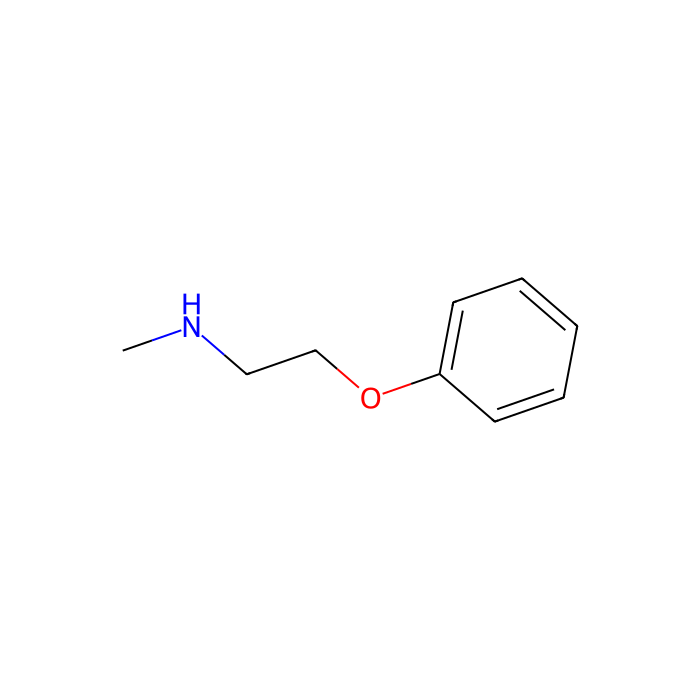
Brief description: N-Methyl-2-phenoxyethanamine is a secondary amine bearing a 2-phenoxyethyl side chain; structurally it is Ph–O–CH2–CH2–NH–CH3.
Item-specific (from Product Data):
SKU: N169984
CAS: 37421-04-8
PubChem CID: 37732
InChIKey (as provided): 111882
Literature/computed (general reference values; not item-specific specifications):
Connectivity (2D description): A phenyl ring substituted by an ether oxygen, which is linked to a two-carbon chain terminating in an N-methylamino group.
Basic site: the secondary amine is strongly basic and readily protonated to give the corresponding ammonium salt (typically isolated/handled as hydrochloride if desired).
No stereocenters or geometric isomerism are present in this structure.
Ether-linked aryl group: offers lipophilicity and a handle for subsequent transformations on the aromatic ring (e.g., electrophilic aromatic substitution), though the phenoxy linkage itself is typically inert under basic conditions.
Retrosynthetic value (general):
Assembled from 2-phenoxyethyl halides/tosylates and methylamine (SN2) or by reductive methylation of 2-phenoxyethylamine.
Amenable to late-stage diversification at nitrogen to generate libraries of amide/sulfonamide analogs.
Named/commonly used transformations (literature):
Acylation via Schotten–Baumann conditions (acid chlorides, aqueous base, biphasic) or Steglich-type couplings (DCC/DMAP).
Reductive amination (Borch conditions with NaBH3CN or sodium triacetoxyborohydride) to introduce tertiary amines.
Carbamate formation with chloroformates; urea formation with isocyanates or CDI-mediated coupling.
N-Alkylation (Menschutkin reaction) for quaternary salts.
Practical considerations:
Use base scavengers (Et3N/DIPEA) to neutralize HX during acylations; monitor for over-acylation or O-acylation by TLC/LC.
Purification: leverage pH-switching extractions and salt formation/crystallization to remove nonbasic impurities.
Target Specificity
Not applicable. This product is a small-molecule amine building block and is not supplied as a biological targeting reagent (no antigen/epitope, clone, or isotype information).
Wir verwenden Cookies, um die ordnungsgemäße Funktion der Website sicherzustellen und, soweit zulässig, Ihr Nutzererlebnis zu verbessern. Sie können Ihre Einstellungen jederzeit unter „Einstellungen“ verwalten. Weitere Informationen finden Sie in unserer Cookie-Richtlinie.
Dürfen wir Sie über Rabattaktionen informieren?
Später erinnern
Vielen Dank! Bitte überprüfen Sie Ihren E-Mail-Posteingang, um zu bestätigen.
Products are supplied to verified businesses, institutions, and qualified professionals for research and development use only. Not for use in humans, animals, diagnosis, or therapy.

 D2320686