Determine the necessary mass, volume, or concentration for preparing a solution.
Taxonomy Tree
| Kingdom | Organic compounds |
|---|---|
| Superclass | Organic nitrogen compounds |
| Klasse | Organonitrogen compounds |
| Subclass | Amines |
| Intermediate Tree Nodes | Tertiary amines |
| Direct Parent | Trialkylamines |
| Alternative Parents | Organopnictogen compounds Hydrocarbon derivatives |
| Molecular Framework | Aliphatic acyclic compounds |
| Substituents | Tertiary aliphatic amine - Organopnictogen compound - Hydrocarbon derivative - Aliphatic acyclic compound |
| Beschreibung | This compound belongs to the class of organic compounds known as trialkylamines. These are organic compounds containing a trialkylamine group, characterized by exactly three alkyl groups bonded to the amino nitrogen. |
| External Descriptors | Not available |
Find and download the COA for your product by matching the lot number on the packaging.
| Lot Number | Certificate Type | Datum | Artikel |
|---|---|---|---|
| Certificate of Analysis | May 20, 2026 | N159018 | |
| Certificate of Analysis | May 20, 2026 | N159018 | |
| Certificate of Analysis | Feb 07, 2025 | N159018 | |
| Certificate of Analysis | Feb 07, 2025 | N159018 | |
| Certificate of Analysis | Jun 18, 2022 | N159018 | |
| Certificate of Analysis | May 08, 2021 | N159018 | |
| Certificate of Analysis | May 08, 2021 | N159018 |
| Empfindlichkeit | Air Sensitive |
|---|---|
| Brechungsindex | 1.41 |
| Flammpunkt (°C) | 25 °C |
| Siedepunkt (°C) | 132°C(lit.) |
| Molekulargewicht | 129.24 |
| XLogP3 | 2.700 |
| Hydrogen Bond Donor Count | 0 |
| Hydrogen Bond Acceptor Count | 1 |
| Rotatable Bond Count | 5 |
| Exact Mass | 129.152 Da |
| Monoisotopic Mass | 129.152 Da |
| Topological Polar Surface Area | 3.200 Ų |
| Heavy Atom Count | 9 |
| Formal Charge | 0 |
| Complexity | 46.500 |
| Isotope Atom Count | 0 |
| Defined Atom Stereocenter Count | 0 |
| Undefined Atom Stereocenter Count | 0 |
| Defined Bond Stereocenter Count | 0 |
| Undefined Bond Stereocenter Count | 0 |
| The total count of all stereochemical bonds | 0 |
| Covalently-Bonded Unit Count | 1 |
H226:Flammable liquid and vapor
H314:Causes severe skin burns and eye damage
H318:Causes serious eye damage
P210:Keep away from heat, hot surface, sparks, open flames and other ignition sources. - No smoking.
P233:Keep container tightly closed.
P240:Ground/bond container and receiving equipment.
P241:Use explosion-proof [electrical/ventilating/lighting/.../] equipment.
P242:Use only non-sparking tools.
P243:Take precautionary measures against static discharge.
P260:Do not breathe dust/fume/gas/mist/vapors/spray.
P264:Wash hands [and …] thoroughly after handling.
P280:Wear protective gloves/protective clothing/eye protection/face protection.
P321:Specific treatment (see ... on this label).
P363:Wash contaminated clothing before reuse.
P301+P330+P331:IF SWALLOWED: Rinse mouth. Do NOT induce vomiting.
P303+P361+P353:IF ON SKIN (or hair): Take off Immediately all contaminated clothing. Rinse SKIN with water [or shower].
P304+P340:IF INHALED: Remove person to fresh air and keep comfortable for breathing.
P370+P378:In case of fire: Use ... to extinguish.
P405:Store locked up.
P403+P235:Store in a well-ventilated place. Keep cool.
P501:Dispose of contents/container to an approved waste disposal plant.
P264+P265:Wash hands [and …] thoroughly after handling. Do not touch eyes.
P305+P354+P338:IF IN EYES: Immediately rinse with water for several minutes. Remove contact lenses if present and easy to do. Continue rinsing.
P317:Get emergency medical help.
P302+P361+P354:IF ON SKIN: Take off Immediately all contaminated clothing. Immediately rinse with water for several minutes.
P316:Get emergency medical help immediately.
Not applicable. No validated bioassay protocols (e.g., WB, IHC, IF, FC) pertain to this small-molecule reagent. For chemical synthesis, consult the Reaction & Applications and Reaction Conditions sections for practical guidance.
This product is supplied strictly for research use; no clinical or diagnostic uses are intended.
Any biological interactions described here are general chemical knowledge and not specific applications for this catalog item.
Tertiary trialkylamines are not standard aqueous buffering agents for biochemical assays due to volatility, odor, and limited water miscibility at higher alkyl content.
Recommendation: For aqueous buffering, use established systems (Tris, carbonate, borate, CHES/CAPS) appropriate to your target pH range.
Consider the environmental and process-safety profile when selecting an organic base.
Context: N,N-dipropylethylamine is a volatile, odorous tertiary amine. While effective, alternatives may reduce VOC emissions, odor, or hazard classifications.
Potential alternatives (literature/practice):
Comparison snapshot (general):
Trade-offs should be evaluated with respect to reaction rate, selectivity, safety, and waste minimization (E-factor).
No therapeutic or clinical claims are made for this material; for research use only.
Regulatory status, pharmacopeial monographs, and residual limits must be established on a per-process basis; consult quality and regulatory teams.
Item-specific specifications: Not specified for this item; refer to CoA/Spec Sheet.
Literature/general properties for tertiary trialkylamines of this size (C8 tertiary amine; for guidance only):
All quantitative values above are literature guidance only and not item specifications.
Item-specific grade/purity: Not specified for this item; refer to CoA/Spec Sheet.
General guidance on grades for tertiary amine bases (context):
For exact acceptance criteria and batch-specific results, consult the product’s Certificate of Analysis.
N,N-Dipropylethylamine is a tertiary aliphatic amine used primarily as a soluble organic base and acid scavenger.
Representative uses (literature/practice):
Practical tips:
All examples are general literature practices and may require optimization.
The following parameters are general literature guidance for tertiary aliphatic amine bases and should be optimized per substrate.
Solvents: DCM, THF, EtOAc, MeCN, DMF, toluene, MTBE, and ethers commonly dissolve both base and substrates. Avoid protic solvents if competing protonation is problematic.
Temperatures: 0–25 °C for exothermic acylations/sulfonylations; 20–80 °C for eliminations or alkylations. Reflux conditions may be used in higher-boiling solvents when required.
Stoichiometry: 1.0–2.5 equiv as HX scavenger (acylations, sulfonylations); catalytic or sub-stoichiometric amounts sometimes suffice in transesterifications with azeotropic removal of alcohol byproducts.
Additives: Trace water scavengers (molecular sieves) improve yields with moisture-sensitive electrophiles. Halide salts can influence phase-transfer behavior in biphasic systems if quaternization is leveraged.
Times/Yields: Acylations often reach completion within 0.5–2 h at 0–25 °C; eliminations/alkylations may require 1–12 h depending on substrate and leaving group. Typical isolated yields in well-optimized systems are 70–95%.
Workup: Quench with aqueous acid (e.g., 1 M HCl) to transfer amine into aqueous phase; wash organics as needed. Re-basify aqueous layer to recover amine if desired, then extract with an immiscible organic solvent.
Drying: If water content is critical, dry the amine over KOH pellets or 3Å molecular sieves and distill under inert gas immediately prior to use.
All values are general literature ranges; they are not specifications for this item.
Item-specific hazard data (GHS, H-statements, pictograms): Not specified for this item; refer to the SDS for authoritative information.
General safety considerations for aliphatic tertiary amines (literature/practice):
Always consult the product’s SDS before use.
This compound is itself an organic base that often serves as a reagent/auxiliary rather than a primary reaction solvent. Selection advice focuses on co-solvent compatibility and process behavior.
Polarity and miscibility (literature/general):
When to choose N,N-dipropylethylamine vs alternatives:
Workup considerations:
Item-specific storage (from Product Data):
Practical handling guidance (general for tertiary amines):
Stability notes:
For definitive shelf-life and retest period, refer to the lot-specific CoA/Spec Sheet.
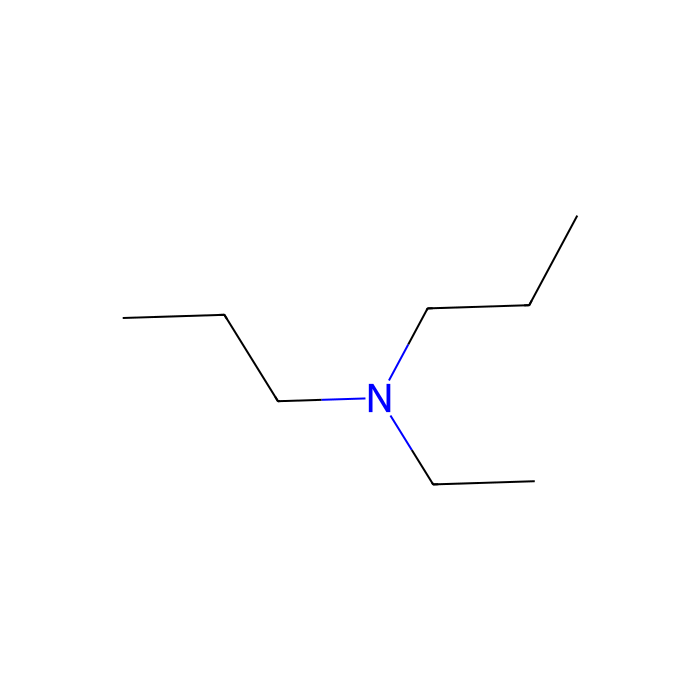
Brief overview: N,N-Dipropylethylamine is a tertiary aliphatic amine bearing one ethyl and two n-propyl substituents on nitrogen. It is a non-protic, nucleophilic base and a common acid scavenger in organic synthesis.
Item-specific (from Product Data):
Literature/Computed identifiers (for reference; not item specifications):
Structural features (general description):
Notes: Where exact identifiers are critical for regulatory or analytical purposes, verify against the item’s CoA/Spec Sheet.
Functional group profile: tertiary aliphatic amine (no N–H), moderately basic, nucleophilic, readily quaternized.
Key reactivity (literature/practice):
Comparisons:
Retrosynthetic value: serves as a convenient, recoverable base in multistep synthesis; quaternary ammonium derivatives expand to PTC-mediated alkylations and SN2 reactions in biphasic systems.
Not applicable. This product is a small-molecule tertiary amine, not a biological macromolecule or antibody. No antigen/epitope or species reactivity is relevant.