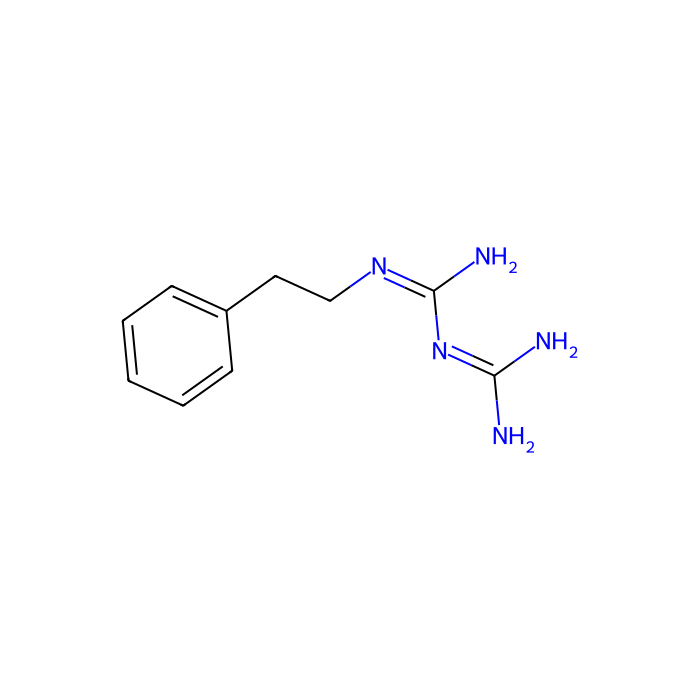
N-Phenethylbiguanide - ≥98% , CAS No.114-86-3

CAS: 114-86-3 Cat. No.: N302245 Summenformel: C10H15N5 Molekulargewicht: 205.26
Zu bestellen verfügbar
GRADE & PURITY ≥98%
Synonyms
Cronoformin | Prestwick2_000179 | Debinyl | HMS3604G03 | Dibein | Fenfoduron | MFCD00242966 | NCGC00016543-02 | MLS006011899 | 1-(diaminomethylidene)-2-(2-phenylethyl)guanidine | 114-86-3 (FREE BASE) | 1-carbamimidamido-N-(2-phenylethyl)methanimidamide |
Storage
Store at 2-8°C
Shipped In
Wet ice
★
Size
Deutschland (EU)
USA*
Price
Qty
1g
N302245-1g
Auf Bestellung · 8–12 Wochen
164,78€
5g
N302245-5g
Auf Bestellung · 8–12 Wochen
393,87€
25g
N302245-25g
Auf Bestellung · 8–12 Wochen
1.178,30€
100g
N302245-100g
Auf Bestellung · 8–12 Wochen
2.872,13€
Enter a quantity for the sizes you want to add.
🧪
Why this grade

≥98% for sensitive chromatographic and analytical workflows requiring minimal baseline interference.

🌡

Storage & shipping

Store at 2-8°C Ships Wet ice Check lot-specific COA for exact specifications.

📋

Quality documents

SDS, COA, datasheet, and spec sheet available for download. Lot-specific COA accessible via lot number lookup.

📚

Literature proof

Cited in 10 peer-reviewed publications across chromatography, organic synthesis, and cross-coupling reactions.

Specifications

Synonyme
Cronoformin | Prestwick2_000179 | Debinyl | HMS3604G03 | Dibein | Fenfoduron | MFCD00242966 | NCGC00016543-02 | MLS006011899 | 1-(diaminomethylidene)-2-(2-phenylethyl)guanidine | 114-86-3 (FREE BASE) | 1-carbamimidamido-N-(2-phenylethyl)methanimidamide |
Spezifikationen & Reinheit
≥98%
Storage
Store at 2-8°C
Verschickt in
Wet ice
Dieses Produkt erfordert Kühlkettenversand. Grundversand und andere Economy-Optionen sind nicht verfügbar.
Aktionsart
ACTIVATOR
Reinheit
≥98%
Namen und Kennungen
Kanonisches Lächeln
C1=CC=C(C=C1)CCN=C(N)N=C(N)N
IUPAC Name
1-(diaminomethylidene)-2-(2-phenylethyl)guanidine
InChIKey
ICFJFFQQTFMIBG-UHFFFAOYSA-N
INCHI
1S/C10H15N5/c11-9(12)15-10(13)14-7-6-8-4-2-1-3-5-8/h1-5H,6-7H2,(H6,11,12,13,14,15)
Isomere SMILES
C1=CC=C(C=C1)CCN=C(N)N=C(N)N
Molekulargewicht
205.26
Reaxy-Rn
22781826
Reaxys-RN_link_address
https://www.reaxys.com/reaxys/secured/hopinto.do?context=S&query=IDE.XRN=22781826&ln=

Documentation

📋 Safety Data Sheet (SDS)

Comprehensive hazard, handling, storage, and regulatory compliance document.

Download SDS →

✅ Certificate of Analysis (COA)

Lot-specific quality data. Enter your lot number to retrieve the exact COA.

Look up COA →

📊 Datasheet

Quick-reference summary of product specifications and applications.

View datasheet →

🔬 Specification Sheet

Full quality attributes and acceptance criteria for this grade.

View spec sheet →

Advanced Data

Taxonomic Classification

Taxonomy Tree

KingdomOrganic compounds
SuperclassOrganic nitrogen compounds
KlasseOrganonitrogen compounds
SubclassGuanidines
Intermediate Tree Nodes Not available
Direct ParentBiguanides
Alternative Parents Benzene and substituted derivatives  Carboximidamides  Organopnictogen compounds  Imines  Hydrocarbon derivatives  
Molecular FrameworkAromatic homomonocyclic compounds
Substituents Biguanide - Benzenoid - Monocyclic benzene moiety - Carboximidamide - Organopnictogen compound - Hydrocarbon derivative - Imine - Aromatic homomonocyclic compound
BeschreibungThis compound belongs to the class of organic compounds known as biguanides. These are organic compounds containing two N-linked guanidines.
External Descriptors biguanides
3D-Struktur
Interaktives chemisches Strukturmodell


Zugehörige Ziele (menschlich)
DHFR Tclin Dihydrofolate reductase (3072 Activities)
Activity TypeRelationActivity valueUnitsAction TypeJournalPubMed IddoiAssay Aladdin ID
CA2 Tclin Carbonic anhydrase II (17698 Activities)
Activity TypeRelationActivity valueUnitsAction TypeJournalPubMed IddoiAssay Aladdin ID
ESR1 Tclin Estrogen receptor alpha (17718 Activities)
Activity TypeRelationActivity valueUnitsAction TypeJournalPubMed IddoiAssay Aladdin ID
NR3C1 Tclin Glucocorticoid receptor (14987 Activities)
Activity TypeRelationActivity valueUnitsAction TypeJournalPubMed IddoiAssay Aladdin ID
PGR Tclin Progesterone receptor (8562 Activities)
Activity TypeRelationActivity valueUnitsAction TypeJournalPubMed IddoiAssay Aladdin ID
ADRB2 Tclin Beta-2 adrenergic receptor (11824 Activities)
Activity TypeRelationActivity valueUnitsAction TypeJournalPubMed IddoiAssay Aladdin ID
CHRM2 Tclin Muscarinic acetylcholine receptor M2 (10671 Activities)
Activity TypeRelationActivity valueUnitsAction TypeJournalPubMed IddoiAssay Aladdin ID
ADRB1 Tclin Beta-1 adrenergic receptor (6630 Activities)
Activity TypeRelationActivity valueUnitsAction TypeJournalPubMed IddoiAssay Aladdin ID
HTR1A Tclin Serotonin 1a (5-HT1a) receptor (14969 Activities)
Activity TypeRelationActivity valueUnitsAction TypeJournalPubMed IddoiAssay Aladdin ID
ADRA2A Tclin Alpha-2a adrenergic receptor (9450 Activities)
Activity TypeRelationActivity valueUnitsAction TypeJournalPubMed IddoiAssay Aladdin ID
AR Tclin Androgen Receptor (11781 Activities)
Activity TypeRelationActivity valueUnitsAction TypeJournalPubMed IddoiAssay Aladdin ID
CHRM1 Tclin Muscarinic acetylcholine receptor M1 (12690 Activities)
Activity TypeRelationActivity valueUnitsAction TypeJournalPubMed IddoiAssay Aladdin ID
DRD2 Tclin Dopamine D2 receptor (23596 Activities)
Activity TypeRelationActivity valueUnitsAction TypeJournalPubMed IddoiAssay Aladdin ID
GABRA1 Tclin GABA receptor alpha-1 subunit (399 Activities)
Activity TypeRelationActivity valueUnitsAction TypeJournalPubMed IddoiAssay Aladdin ID
TSHR Tclin Thyroid stimulating hormone receptor (29986 Activities)
Activity TypeRelationActivity valueUnitsAction TypeJournalPubMed IddoiAssay Aladdin ID
MAOA Tclin Monoamine oxidase A (11911 Activities)
Activity TypeRelationActivity valueUnitsAction TypeJournalPubMed IddoiAssay Aladdin ID
CNR1 Tclin Cannabinoid CB1 receptor (20913 Activities)
Activity TypeRelationActivity valueUnitsAction TypeJournalPubMed IddoiAssay Aladdin ID
DRD1 Tclin Dopamine D1 receptor (9720 Activities)
Activity TypeRelationActivity valueUnitsAction TypeJournalPubMed IddoiAssay Aladdin ID
PTGS1 Tclin Cyclooxygenase-1 (9233 Activities)
Activity TypeRelationActivity valueUnitsAction TypeJournalPubMed IddoiAssay Aladdin ID
SLC6A2 Tclin Norepinephrine transporter (10102 Activities)
Activity TypeRelationActivity valueUnitsAction TypeJournalPubMed IddoiAssay Aladdin ID
HRH2 Tclin Histamine H2 receptor (5428 Activities)
Activity TypeRelationActivity valueUnitsAction TypeJournalPubMed IddoiAssay Aladdin ID
HTR2A Tclin Serotonin 2a (5-HT2a) receptor (14758 Activities)
Activity TypeRelationActivity valueUnitsAction TypeJournalPubMed IddoiAssay Aladdin ID
HTR2C Tclin Serotonin 2c (5-HT2c) receptor (11471 Activities)
Activity TypeRelationActivity valueUnitsAction TypeJournalPubMed IddoiAssay Aladdin ID
AVPR2 Tclin Vasopressin V2 receptor (2912 Activities)
Activity TypeRelationActivity valueUnitsAction TypeJournalPubMed IddoiAssay Aladdin ID
ADORA1 Tclin Adenosine A1 receptor (17603 Activities)
Activity TypeRelationActivity valueUnitsAction TypeJournalPubMed IddoiAssay Aladdin ID
AGTR1 Tclin Type-1 angiotensin II receptor (5176 Activities)
Activity TypeRelationActivity valueUnitsAction TypeJournalPubMed IddoiAssay Aladdin ID
SLC6A4 Tclin Serotonin transporter (12625 Activities)
Activity TypeRelationActivity valueUnitsAction TypeJournalPubMed IddoiAssay Aladdin ID
CRHR1 Tclin Corticotropin releasing factor receptor 1 (2996 Activities)
Activity TypeRelationActivity valueUnitsAction TypeJournalPubMed IddoiAssay Aladdin ID
ADRA1A Tclin Alpha-1a adrenergic receptor (8359 Activities)
Activity TypeRelationActivity valueUnitsAction TypeJournalPubMed IddoiAssay Aladdin ID
PTGS2 Tclin Cyclooxygenase-2 (13999 Activities)
Activity TypeRelationActivity valueUnitsAction TypeJournalPubMed IddoiAssay Aladdin ID
HRH1 Tclin Histamine H1 receptor (7573 Activities)
Activity TypeRelationActivity valueUnitsAction TypeJournalPubMed IddoiAssay Aladdin ID
OPRM1 Tclin Mu opioid receptor (19785 Activities)
Activity TypeRelationActivity valueUnitsAction TypeJournalPubMed IddoiAssay Aladdin ID
DRD3 Tclin Dopamine D3 receptor (14368 Activities)
Activity TypeRelationActivity valueUnitsAction TypeJournalPubMed IddoiAssay Aladdin ID
AVPR1A Tclin Vasopressin V1a receptor (5412 Activities)
Activity TypeRelationActivity valueUnitsAction TypeJournalPubMed IddoiAssay Aladdin ID
OPRD1 Tclin Delta opioid receptor (15096 Activities)
Activity TypeRelationActivity valueUnitsAction TypeJournalPubMed IddoiAssay Aladdin ID
OPRK1 Tclin Kappa opioid receptor (16155 Activities)
Activity TypeRelationActivity valueUnitsAction TypeJournalPubMed IddoiAssay Aladdin ID
HTR3A Tclin Serotonin 3a (5-HT3a) receptor (3366 Activities)
Activity TypeRelationActivity valueUnitsAction TypeJournalPubMed IddoiAssay Aladdin ID
GCGR Tclin Glucagon receptor (2563 Activities)
Activity TypeRelationActivity valueUnitsAction TypeJournalPubMed IddoiAssay Aladdin ID
SLC6A3 Tclin Dopamine transporter (10535 Activities)
Activity TypeRelationActivity valueUnitsAction TypeJournalPubMed IddoiAssay Aladdin ID
GRIN1 Tclin Glutamate (NMDA) receptor subunit zeta 1 (122 Activities)
Activity TypeRelationActivity valueUnitsAction TypeJournalPubMed IddoiAssay Aladdin ID
KCNH2 Tclin HERG (29587 Activities)
Activity TypeRelationActivity valueUnitsAction TypeJournalPubMed IddoiAssay Aladdin ID
CACNA1C Tclin Voltage-gated L-type calcium channel alpha-1C subunit (766 Activities)
Activity TypeRelationActivity valueUnitsAction TypeJournalPubMed IddoiAssay Aladdin ID
PDE3A Tclin Phosphodiesterase 3A (3309 Activities)
Activity TypeRelationActivity valueUnitsAction TypeJournalPubMed IddoiAssay Aladdin ID
ESR2 Tclin Estrogen receptor beta (9272 Activities)
Activity TypeRelationActivity valueUnitsAction TypeJournalPubMed IddoiAssay Aladdin ID
SLC29A1 Tclin Equilibrative nucleoside transporter 1 (1711 Activities)
Activity TypeRelationActivity valueUnitsAction TypeJournalPubMed IddoiAssay Aladdin ID
ADRA2B Tclin Alpha-2b adrenergic receptor (4412 Activities)
Activity TypeRelationActivity valueUnitsAction TypeJournalPubMed IddoiAssay Aladdin ID
ADRA2C Tclin Alpha-2c adrenergic receptor (4876 Activities)
Activity TypeRelationActivity valueUnitsAction TypeJournalPubMed IddoiAssay Aladdin ID
CHRM3 Tclin Muscarinic acetylcholine receptor M3 (7750 Activities)
Activity TypeRelationActivity valueUnitsAction TypeJournalPubMed IddoiAssay Aladdin ID
ADRB3 Tclin Beta-3 adrenergic receptor (5850 Activities)
Activity TypeRelationActivity valueUnitsAction TypeJournalPubMed IddoiAssay Aladdin ID
HTR2B Tclin Serotonin 2b (5-HT2b) receptor (10323 Activities)
Activity TypeRelationActivity valueUnitsAction TypeJournalPubMed IddoiAssay Aladdin ID
Zugehörige Ziele (nicht menschlich)
Mc4r Melanocortin receptor 4 (1205 Activities)
Activity TypeRelationActivity valueUnitsAction TypeJournalPubMed IddoiAssay Aladdin ID
Cyp2d26 Cytochrome P450 2D2 (12 Activities)
Activity TypeRelationActivity valueUnitsAction TypeJournalPubMed IddoiAssay Aladdin ID
Npy1r Neuropeptide Y receptor type 1 (8 Activities)
Activity TypeRelationActivity valueUnitsAction TypeJournalPubMed IddoiAssay Aladdin ID
Cyp2d1 Cytochrome P450 2D1 (13 Activities)
Activity TypeRelationActivity valueUnitsAction TypeJournalPubMed IddoiAssay Aladdin ID
Cckar Cholecystokinin A receptor (90 Activities)
Activity TypeRelationActivity valueUnitsAction TypeJournalPubMed IddoiAssay Aladdin ID
Ntsr1 Neurotensin receptor 1 (48 Activities)
Activity TypeRelationActivity valueUnitsAction TypeJournalPubMed IddoiAssay Aladdin ID
Pde4d Phosphodiesterase 4D (4 Activities)
Activity TypeRelationActivity valueUnitsAction TypeJournalPubMed IddoiAssay Aladdin ID
Bdkrb1 Bradykinin B1 receptor (77 Activities)
Activity TypeRelationActivity valueUnitsAction TypeJournalPubMed IddoiAssay Aladdin ID
Cyp2d4 Cytochrome P450 2D18 (14 Activities)
Activity TypeRelationActivity valueUnitsAction TypeJournalPubMed IddoiAssay Aladdin ID
Hdac6 Histone deacetylase 6 (222 Activities)
Activity TypeRelationActivity valueUnitsAction TypeJournalPubMed IddoiAssay Aladdin ID
Cyp2d3 Cytochrome P450 2D3 (11 Activities)
Activity TypeRelationActivity valueUnitsAction TypeJournalPubMed IddoiAssay Aladdin ID
Plasmodium falciparum (966862 Activities)
Activity TypeRelationActivity valueUnitsAction TypeJournalPubMed IddoiAssay Aladdin ID
Nakaseomyces glabratus (9108 Activities)
Activity TypeRelationActivity valueUnitsAction TypeJournalPubMed IddoiAssay Aladdin ID
Cavia porcellus (23802 Activities)
Activity TypeRelationActivity valueUnitsAction TypeJournalPubMed IddoiAssay Aladdin ID
Mus musculus (284745 Activities)
Activity TypeRelationActivity valueUnitsAction TypeJournalPubMed IddoiAssay Aladdin ID
Rattus norvegicus (775804 Activities)
Activity TypeRelationActivity valueUnitsAction TypeJournalPubMed IddoiAssay Aladdin ID
Monkey (844 Activities)
Activity TypeRelationActivity valueUnitsAction TypeJournalPubMed IddoiAssay Aladdin ID
Nfe2l2 Nuclear factor erythroid 2-related factor 2 (214 Activities)
Activity TypeRelationActivity valueUnitsAction TypeJournalPubMed IddoiAssay Aladdin ID
Slc22a3 Solute carrier family 22 member 3 (35 Activities)
Activity TypeRelationActivity valueUnitsAction TypeJournalPubMed IddoiAssay Aladdin ID
Wirkungsmechanismen
Zertifikate (CoA, COO, BSE/TSE und Analyse-Diagramm)
C of A & Other Certificates(BSE/TSE, COO):
Analytical Chart:
Chemische und physikalische Eigenschaften
Brechungsindex1.6380 (estimate)
Siedepunkt (°C)333.94°c (rough estimate)
Schmelzpunkt (°C)176.5 °C
Molekulargewicht205.260 g/mol
XLogP3-0.800
Hydrogen Bond Donor Count3
Hydrogen Bond Acceptor Count1
Rotatable Bond Count4
Exact Mass205.133 Da
Monoisotopic Mass205.133 Da
Topological Polar Surface Area103.000 Ų
Heavy Atom Count15
Formal Charge0
Complexity236.000
Isotope Atom Count0
Defined Atom Stereocenter Count0
Undefined Atom Stereocenter Count0
Defined Bond Stereocenter Count0
Undefined Bond Stereocenter Count0
The total count of all stereochemical bonds0
Covalently-Bonded Unit Count1
Citations of This Product
Lösungsrechner
Bewertungen

Kundenbewertungen

Application Protocols

No vendor-validated bioassay or analytical protocols are provided for this item. The following are general, literature-informed starting points. Optimize for your system.

  • Stock solution preparation (biological):
    • Free base: 100 mM in DMSO or 10–50 mM in dilute HCl (10–50 mM). Vortex and warm gently (≤40°C) to dissolve; sterile filter (0.22 µm). Store aliquots at 2–8°C for short term.
  • Mitochondrial respiration assays (cell-based; example framework):
    • Prepare serial dilutions in assay medium ensuring ≤0.5% DMSO final. Pre-equilibrate cells, then add compound and monitor OCR/ECAR changes within 5–60 min. Include vehicle and known biguanide controls for benchmarking. Adjust pH to maintain solubility.
  • RP-HPLC quantitation:
    • Column: C18, 150 × 4.6 mm, 5 µm; Mobile phase A: water + 0.1% formic acid; B: acetonitrile.
    • Gradient: 5–30% B over 10–15 min; Flow: 1.0 mL/min; Detection: 210–230 nm or MS.
    • Sample prep: Dissolve sample in water with 0.1% FA or in MeOH; filter before injection.
  • Salt conversion:
    • Dissolve free base in ethanol, add equimolar HCl in ethanol at 0–5°C, stir 30–60 min, then cool to induce crystallization; collect and dry under vacuum.

These are suggested starting points; validate and adjust according to your instrumentation and goals.

Biological Roles

N-Phenethylbiguanide is a synthetic biguanide used in research to interrogate cellular energy metabolism pathways. The notes below summarize literature-based, non-clinical roles; they are provided for mechanistic context only.

  • Enzyme/respiration impact (literature): Biguanides are reported to interact with the mitochondrial electron transport chain (notably complex I), modulating NADH:ubiquinone oxidoreductase activity and cellular ATP/AMP ratios. This, in turn, can influence AMPK activation and downstream signaling.
  • Transport and accumulation (literature): Protonated biguanide species partition based on membrane potential and transporter expression (e.g., organic cation transporters, OCTs). The phenethyl substituent can increase hydrophobic interactions relative to small aliphatic biguanides, impacting uptake/retention.
  • Bio-physical properties: Polycationic under physiological pH, promoting interactions with acidic phospholipids and nucleic acids; however, specific binding is generally weak and governed by electrostatics.
  • Comparative studies: Frequently used alongside metformin or other biguanides to examine structure–activity relationships in oxidative phosphorylation, redox balance, and gluconeogenic flux in cell and mitochondrial preparations.

All statements above are for laboratory research context only. This product is not intended for diagnostic, therapeutic, or other clinical uses.

Buffer Applications

N-Phenethylbiguanide is not a buffering agent and is not typically used to prepare buffer systems.

Practical notes for solution preparation in buffered systems:

  • To obtain clear aqueous solutions, prepare as the hydrochloride salt by dissolving the free base in dilute HCl (e.g., 10–50 mM), then adjust to the desired ionic strength with your buffer (PBS, HEPES, MOPS). Maintain pH below the principal pKa (~11–12) to ensure solubility (literature guidance).
  • For dosing into neutral buffers, first prepare a concentrated stock in DMSO or ethanol, then add to buffer with vigorous mixing. Keep final organic co-solvent ≤1–2% v/v when working with cells or enzymes.
  • Filtration: Use 0.22 µm PVDF or PTFE filters. If precipitation occurs upon dilution, slightly acidify the buffer (pH 6–6.5) or increase ionic strength.

If your objective is true pH control, select a proper buffer system (e.g., phosphate pH 6–8, HEPES pH 6.8–8.2) and treat N-Phenethylbiguanide solely as a solute.

Green Alternatives

While N-Phenethylbiguanide itself is the analyte/reagent of interest, greener choices can be made in its handling and formulation.

Greener solvent choices (when compatible with your application):

  • Replace DMF/CH2Cl2 with ethanol, isopropanol, ethyl acetate, or water (as an acid salt) when preparing solutions, recrystallizations, or washes.
  • For extractions/phase separations, consider ethyl acetate instead of chlorinated solvents if the partitioning allows.

Comparison (general guidance):

  • Task: Dissolve for bioassay stocks

    • Conventional: DMSO
    • Greener option: Ethanol or water (as HCl salt)
    • Trade-offs: DMSO offers broader solubility and stability; ethanol/water may limit solubility but reduce toxicity and waste impact.
  • Task: Salt formation/crystallization

    • Conventional: Acetone/Et2O antisolvent
    • Greener option: IPA/MTBE or ethanol/MTBE systems
    • Trade-offs: Similar performance with reduced VOC toxicity; may require optimization of temperature and seeding.

Process considerations:

  • Use minimal organic co-solvent for aqueous dosing by preparing a concentrated acidified aqueous stock (pH ~2–3) and diluting into buffer.
  • Favor room-temperature operations and avoid excess reagents for salt metathesis to reduce energy and material footprint.
Pharmaceutical Uses

For research use only. No clinical or therapeutic claims are made for this product.

Relevant non-clinical/pharmaceutics contexts:

  • Reference/working standard: Utilized as a chemical reference for analytical method development and QC related to biguanide-class compounds (e.g., system suitability, impurity profiling, recovery studies) in pharmaceutical R&D.
  • Salt selection and solid-state studies: The free base can be converted to pharmaceutically relevant salts (e.g., hydrochloride) to evaluate solubility, polymorphism, hygroscopicity, and stability—useful in pre-formulation research.
  • Permeation and transport research: Serves as a tool compound to study organic cation transporter interactions and permeability across model membranes relative to other biguanides (literature, non-clinical models).
  • Excipients: Not an approved excipient and not typically used as one; no pharmacopeial excipient status.

Documentation: If employing as a standard in regulated methods, ensure characterization by orthogonal techniques (NMR, HRMS, HPLC purity, water/KF) and maintain traceability to an authenticated primary lot with a detailed CoA.

Physical Properties

Item-specific specifications are not provided for this catalog entry. The following are literature-based or general values for the free base to assist with planning; verify against the CoA/SDS for your lot.

  • Physical state/appearance: Not specified for this item; refer to CoA/Spec Sheet.
  • Molecular weight: ~205.26 g/mol (C10H15N5) (literature)
  • pKa: Biguanides are strongly basic; reported conjugate acid pKa for phenethyl biguanides is high (pKa1 ~11–12; secondary protonation sometimes reported near ~3–4) (literature; values depend on ionic strength/medium).
  • LogP/logD: Amphiphilic character; logP expected higher than metformin due to phenethyl group; qualitative: moderate lipophilicity relative to aliphatic biguanides (literature, qualitative).
  • Solubility: Free base is typically sparingly soluble in neutral water, more soluble in polar organics (MeOH, EtOH) and in aqueous acidic media (e.g., HCl) as the corresponding salt (literature, qualitative). The hydrochloride salt is freely water-soluble (literature, qualitative).
  • Melting point, boiling point, density, refractive index, UV cutoff: Not specified for this item; refer to CoA/Spec Sheet.

Notes for handling solutions (general):

  • Dissolve first in a small volume of DMSO, MeOH, or dilute HCl, then bring to final volume with buffer/water to avoid precipitation.
  • The biguanide chromophore has weak UV absorbance above 220–230 nm; for quantitative UV work, determine an empirical ε in your solvent system (literature, general guidance).
Quality and Grades
  • Grade/Purity: Not specified for this item; refer to CoA/Spec Sheet.
  • Appearance: Not specified for this item; refer to CoA/Spec Sheet.

Context and guidance:

  • This listing is intended for research and laboratory use only (per Product Data). When comparing lots or vendors, chemists typically evaluate identity (1H/13C NMR, HRMS), assay purity (HPLC/UPLC area %), and residual solvents/water (GC, KF). Because this is a basic, polyfunctional compound, pay particular attention to:
    • Counterion content: free base vs. adventitious mineral acid salt formation during storage.
    • Residual inorganic salts from synthesis/neutralization.
    • Related biguanide impurities or N-acylated byproducts.
  • UV profile: Biguanides often exhibit low UV absorbance above 230 nm; if using for chromatographic calibration, low-UV mobile phases and detection at 210–220 nm may be necessary (general guidance).
  • Stabilizers: None specified for this item; refer to CoA/Spec Sheet. In general, biguanides do not require stabilizers but are best kept dry and cool to limit hydrolysis or slow oligomerization.
  • Documentation: For regulated workflows (e.g., analytical reference), request CoA including synthesis route summary, impurity profile, and validated HPLC method, as applicable. If using in bioassays, consider confirming free-base content via acid–base titration or chloride assay where relevant.
Reaction and Applications

This compound is primarily used as a research tool and as a functional biguanide building block.

Laboratory/research applications (non-clinical):

  • Cell and biochemical studies: Widely used as a reference biguanide to probe mitochondrial complex I–dependent respiration and AMPK-linked energy sensing pathways (literature). Enables comparative studies versus aliphatic biguanides in metabolism research.
  • Analytical standards: Serves as a calibration/reference material for chromatographic methods quantifying biguanides in complex matrices (QC of synthesis, impurity profiling).

Chemical applications:

  • Precursor to salts: Formation of hydrochloride, sulfate, or organic acid salts to tune solubility and crystallinity; typical neutralization in alcohols or acetone at 0–25°C.
  • Coordination chemistry: The biguanide fragment can chelate transition metals (e.g., CuII, NiII) via bidentate N,N-binding to form stable complexes; useful for model studies of ligand basicity and electronics (literature).
  • Cyclocondensations: Biguanides can condense with orthoesters or carboximidates to give 1,3,5-triazine-2-amines under dehydrating conditions; N-phenethyl substitution directs substitution pattern (literature).

Practical tips:

  • Drying: If precise free-base loading is required, dry under vacuum at ambient temperature and assay for residual water or chloride to rule out partial salt formation.
  • Protonation state control: Define pH when preparing biological solutions; small pH shifts can change solubility by orders of magnitude.
  • Chromatography: On silica, strong tailing may occur due to basic sites; add 0.1–1% triethylamine to mobile phase or use amide/diol stationary phases.
Reaction Conditions

General literature-guided conditions involving biguanides and specifically N-phenethyl-substituted variants are summarized below. Optimize for your system.

  • Salt formation (HCl): Dissolve free base in ethanol or isopropanol, cool to 0–5°C, add 1.0–1.1 equiv conc. HCl in alcohol or gaseous HCl to pH ~1–2, then allow to crystallize at 0–25°C. Typical isolated yields: 80–95% after filtration and drying (literature ranges).
  • Acylation/alkylation: Use mild acyl chlorides or alkyl halides with base (e.g., DIPEA) in acetonitrile or DMF at 0–25°C for mono-functionalization; monitor for over-alkylation. For selectivity, employ protecting groups or pre-form salts.
  • Triazine formation: Heat with triethyl orthoformate (or corresponding orthoester) with catalytic acid (e.g., p-TsOH) at 80–120°C, removing ethanol byproduct; yields vary 40–80% depending on substitution (literature).
  • Metal complexation: Combine ligand with metal salt (e.g., Cu(OAc)2) in ethanol/water at pH 6–8, stirring at ambient temperature to reflux; isolate complexes by precipitation or crystallization.
  • Analytical chromatography: RP-HPLC with aqueous buffer (0.1% TFA or formic acid) and acetonitrile; detection at 210–230 nm. Strong on-column interaction can be mitigated with ion-pair reagents or basic modifiers.

Notes:

  • Dry, oxygen-free conditions are generally not required; however, exclude strong oxidants. Control protonation state for reproducible reactivity.
  • For bioassay stock prep, dissolve at 10–100 mM in DMSO or 10–50 mM in 10–50 mM HCl; filter sterilize (0.22 µm).
Safety and Handling

Follow standard laboratory precautions for handling organic bases and amines. The specific GHS classification and H-statements for this item are not provided here—consult the product SDS for authoritative safety data.

  • GHS/Signal word/H-statements/Pictograms: Not specified for this item; refer to SDS.
  • Likely hazards (general, literature): May cause irritation to skin, eyes, and respiratory tract; harmful if swallowed. Avoid dust formation and inhalation.
  • Storage conditions: Store at 2–8°C (per Product Data). Keep container tightly closed in a dry, well-ventilated area. Protect from moisture and strong acids/bases during storage to prevent degradation or salt formation unless intended.
  • Incompatibilities (general): Strong oxidizing agents; strong acylating agents; isocyanates. Avoid contact with nitrosating agents.
  • PPE: Lab coat, nitrile gloves, safety glasses. Use a fume hood when weighing or preparing solutions.
  • First aid (overview; consult SDS):
    • Inhalation: Move to fresh air; seek medical attention if symptoms persist.
    • Skin/eye contact: Rinse with plenty of water for at least 15 minutes; remove contaminated clothing; obtain medical advice if irritation continues.
    • Ingestion: Rinse mouth; do not induce vomiting; seek medical attention.
  • Spill/cleanup: Avoid raising dust; collect with inert absorbent; dispose according to institutional and local regulations.
  • Fire-fighting: Use water spray, CO2, dry chemical, or foam as appropriate for surrounding materials. Combustion may produce nitrogen oxides and carbon oxides (general consideration).
Solvent Selection

N-Phenethylbiguanide combines a strongly basic, polyfunctional biguanide with a hydrophobic phenethyl group.

  • Polarity/acid–base: Strong Brønsted base; forms salts readily with mineral or organic acids. Free base shows amphiphilic behavior.
  • Recommended solvents (literature/guidance):
    • Stock solutions: DMSO (high), methanol, ethanol. For aqueous systems, pre-dissolve in DMSO or protonate with dilute HCl to form the hydrochloride salt.
    • Preparative crystallizations: Alcohols (EtOH/i-PrOH) with antisolvents (MTBE/Et2O) for salt forms; ethyl acetate or toluene may assist for the free base with co-solvents.
  • Water miscibility: Free base—limited solubility; salt forms—high solubility (literature, qualitative).
  • Dielectric considerations: For NMR or kinetic studies, D2O with a small amount of DCl can give clear spectra of the protonated species; CD3OD or DMSO-d6 for free base characterization.

Comparison (general):

  • Free base vs. HCl salt
    • Solubility in water: Low vs. high
    • Solubility in nonpolar organics: Higher for free base
    • pH impact: Free base raises pH; HCl salt acidic initially

When to choose alternatives:

  • If purely aqueous work is required without organic co-solvent, use the hydrochloride salt.
  • If lipophilicity is needed (e.g., partitioning studies, membrane models), the free base in DMSO/EtOH may be preferred.
Storage and Reconstitution
  • Storage conditions (as supplied): Store at 2–8°C (per Product Data). Keep tightly capped, protected from moisture. Ship on wet ice.
  • Long-term considerations: If extended storage is anticipated, maintain in a desiccator at 2–8°C. Avoid repeated exposure to humid air to prevent partial salt formation or clumping.

Reconstitution and solution handling (general guidance):

  • Free base stock solutions:
    • Organic: Dissolve to 10–100 mM in DMSO, methanol, or ethanol. Mix thoroughly; mild warming (≤40°C) can assist dissolution.
    • Aqueous: Prepare as the hydrochloride by adding the solid to 10–50 mM HCl to reach 10–50 mM stock; alternatively, dissolve in water then titrate with HCl to clear solution.
  • Working solutions: Dilute into buffer with vigorous mixing. Maintain final DMSO ≤1–2% v/v for biological systems. If turbidity appears, lower pH slightly (pH 6–6.5) or increase ionic strength.
  • Filtration: 0.22 µm PTFE or PVDF recommended.
  • Stability (practical notes): Biguanide solutions are generally stable for hours to days at 2–8°C, especially as acid salts; however, assess by HPLC prior to critical experiments. For longer storage, prepare single-use aliquots and freeze at −20°C to −80°C; avoid multiple freeze–thaw cycles.

Always refer to the CoA/SDS for lot-specific details on appearance, purity, and any additional storage precautions.

Structure and Identity

N-Phenethylbiguanide is a small-molecule biguanide bearing a phenethyl substituent on one of the guanidine nitrogens; it is the free base corresponding to the well-known biguanide scaffold.

  • SKU: N302245
  • Product name: N-Phenethylbiguanide (free base)
  • CAS: 114-86-3 (literature)
  • PubChem CID: 8249 (literature)
  • Molecular formula: C10H15N5 (literature)
  • Molecular weight: ~205.26 g/mol (literature)
  • SMILES: NC(=N)NC(=N)NCCc1ccccc1 (literature; linear biguanide linked to phenethyl)
  • InChIKey: Not specified for this item; refer to CoA/Spec Sheet.

Structural features (descriptive):

  • Contains a linear biguanide motif (two imine [C=NH] equivalents flanked by three nitrogens), providing multiple sites for hydrogen bonding and protonation.
  • The biguanide is N-substituted with a 2-phenylethyl group (–CH2–CH2–C6H5), adding hydrophobic/aromatic character.
  • No stereocenters; achiral, planar segments centered on the C=N bonds; conjugation across the biguanide chain.
  • Functional groups: multiple guanidine-like nitrogens (basic), one terminal exocyclic –NH2 equivalent within the biguanide ensemble, and an aromatic phenyl ring.

2D structure in words: a benzene ring connected via –CH2–CH2– to an endocyclic nitrogen of a linear biguanide chain, which consists of alternating N–C(=NH)–N–C(=NH)–NH linkages.

Synthetic Utility

The biguanide functional group provides multiple nucleophilic nitrogens and imine-type centers, enabling diverse transformations.

  • Salt formation/ion pairing: Rapid, high-yield protonation with mineral acids (HCl, H2SO4) to give crystalline salts—useful for isolation and tuning solubility.
  • N-functionalization: The exo-cyclic nitrogens can undergo selective acylation or alkylation under controlled conditions. Protecting strategies (e.g., Boc on one nitrogen) may be used to direct substitution (literature generality for biguanides).
  • Cyclizations to 1,3,5-triazines: Condensation with orthoesters or imidate esters under dehydrating/acidic conditions affords N-substituted 1,3,5-triazine-2-amines—structures valuable as ligands or intermediates (literature).
  • Coordination chemistry: Acts as a bidentate N,N-chelating ligand to form square-planar or octahedral complexes with late transition metals (CuII, NiII, PdII), providing platforms for catalysis or materials studies (literature).
  • Derivatization for affinity probes: The phenethyl handle can be further elaborated (e.g., para-functionalization of the ring prior to biguanidylation or via linker installation on the side chain) to build conjugates for target engagement studies.

Retrosynthetic value:

  • The molecule can be traced back to phenethylamine derivatives and dicyandiamide/guanidine precursors. Biguanidylation typically proceeds via S-methylisothiourea or cyanoguanidine routes, enabling modular SAR libraries around the arylalkyl moiety.
Target Specificity

This product is a small molecule and not an antibody or biological affinity reagent. No target specificity (antigen/epitope/clone/isotype/species reactivity) data are applicable.

  • Tested applications and targets: Not applicable.
  • If used as a biochemical probe, researchers typically define target engagement empirically (e.g., mitochondrial complex I activity assays), but such data are system-dependent and not part of this product specification.

Shall we send you a message when we have discounts available?

Remind me later

Thank you! Please check your email inbox to confirm.

Oops! Notifications are disabled.