N6-Methyl-2′-deoxyadenosine (N6-Me-dAdo) is a precursor of N6-methyl 2′-deoxyadenosine 3′,5′-bisphosphate (N6MABP), a competitive and selective inhibitor of P2Y1 receptors.
N6-Methyl-2′-deoxyadenosine (N6-Me-dAdo) is a precursor of N6-methyl 2′-deoxyadenosine 3′,5′-bisphosphate (N6MABP), a competitive and selective inhibitor of P2Y1 receptors. It is located at the transcription start site and plays a role in increased gene e
Storage
Store at -20°C
Verschickt in
Ice chest + Ice pads
Dieses Produkt erfordert Kühlkettenversand. Grundversand und andere Economy-Optionen sind nicht verfügbar.
This compound belongs to the class of organic compounds known as purine 2'-deoxyribonucleosides. These are compounds consisting of a purine linked to a ribose which lacks a hydroxyl group at position 2.
External Descriptors
purine 2'-deoxyribonucleoside
1. Djoumbou Feunang Y, Eisner R, Knox C, Chepelev L, Hastings J, Owen G, Fahy E, Steinbeck C, Subramanian S, Bolton E, Greiner R, and Wishart DS. ClassyFire: Automated Chemical Classification With A Comprehensive, Computable Taxonomy. Journal of Cheminformatics, 2016, 8:61.
Determine the necessary mass, volume, or concentration for preparing a solution.
Dilution Calculator
Determine the dilution needed to prepare a stock solution.
Reconstitution Calculator
Bewertungen
Kundenbewertungen
Application Protocols
Item-specific tested applications and dilutions are not provided in the Product Data. The following are general, literature-based workflow outlines for typical uses of N6-methyl-2′-deoxyadenosine; they are not validated protocols for this SKU and should be optimized by the user.
LC–MS/MS calibration standard for DNA m6dA quantification:
Prepare a 1–10 mM stock in MeOH or DMSO (weigh by difference; record exact mass and volume). Store aliquots at −20°C.
Enzymatically digest DNA samples to nucleosides (e.g., nuclease P1, then alkaline phosphatase). Clarify by filtration.
Prepare a calibration series (e.g., 0.1–1000 nM) in mobile phase or matrix-matched digest buffer.
Analyze by UPLC–MS/MS using MRM transitions for m6dA; quantify against the calibration curve or using an isotopically labeled internal standard.
Preparation of 5′-DMTr, 3′-phosphoramidite monomer (outline):
Protect 5′-OH with DMTrCl in pyridine (monitor by TLC/HPLC).
Phosphitylate 3′-OH with 2-cyanoethyl N,N-diisopropylchlorophosphoramidite/DIPEA in dry DCM/ACN.
Purify under inert conditions; characterize by 31P NMR, 1H NMR, and HRMS.
Note: These outlines are for experienced users. Consult primary literature and adapt to your instrumentation and regulatory context.
Biological Roles
General context (literature; not a claim about biological use of this SKU):
N6-Methyl-2′-deoxyadenosine (m6dA) is the nucleoside form of N6-methyladenine in DNA. N6-methyladenine is a well-established epigenetic mark in bacteria (e.g., Dam methylation at GATC motifs) and has been reported at lower levels in certain eukaryotes. In DNA metabolism, N6-methylation can influence replication timing, mismatch repair, restriction–modification systems, and gene regulation in prokaryotes.
In analytical biochemistry, m6dA serves as a calibration standard for quantifying endogenous levels of this modification following enzymatic digestion of DNA to nucleosides.
Enzymatic pathways (literature):
DNA adenine methyltransferases (e.g., Dam) transfer a methyl group from S-adenosyl-L-methionine to adenine N6 in specific contexts, generating m6dA in genomic DNA.
Repair/demethylation pathways may include oxidative or hydrolytic removal of the methyl group in various organisms; research into eukaryotic m6dA pathways is ongoing.
Biophysical properties:
Incorporation of m6dA into DNA duplexes can subtly alter base-pairing dynamics and local stability relative to dA•T pairs; effects depend on sequence context and conditions (literature reports show modest Tm changes).
Note: This product is provided strictly for research use; no clinical or diagnostic claims are made.
Buffer Applications
This compound is not a buffering agent. However, buffer selection is relevant for dissolving and handling this nucleoside in biochemical workflows.
Practical dissolution buffers (general guidance):
Neutral to slightly basic buffers (e.g., 10–50 mM Tris, pH 7.5–8.5; 10–50 mM HEPES, pH 7.4–8.0) assist dissolution while limiting depurination.
Phosphate-buffered saline (PBS) can be used for biochemical contexts; avoid high phosphate if subsequent metal-dependent enzymes are involved (chelation/precipitation considerations).
For LC–MS sample prep, volatile buffers (e.g., 5–20 mM ammonium formate or acetate, pH 6.5–8.0) are preferred.
Tips:
Warm gently (30–40°C) and sonicate to aid dissolution; filter through 0.22 µm if needed.
Avoid strong base (≥pH 10) and strong acid to minimize glycosidic bond cleavage.
Prepare fresh solutions or store aliquots at −20°C to limit hydrolysis.
Green Alternatives
For this solid nucleoside, “green alternatives” primarily concern solvent choices and process conditions rather than alternative reagents.
Greener solvent choices (general guidance):
Prefer water and aqueous buffers whenever feasible for dissolution, handling, and enzymatic reactions.
For organic stocks, methanol can be favored over acetonitrile for lower toxicity and better biodegradability; ethanol is another lower-toxicity option if solubility permits.
Use minimal DMSO volumes and dilute promptly into aqueous media to limit environmental load.
Process considerations:
Enzymatic routes (e.g., biocatalytic protection/deprotection, nucleoside phosphorylation) can reduce reliance on hazardous reagents.
Recrystallizations in water–alcohol systems may replace halogenated solvents.
Comparison snapshot (general; not item-specific):
Water/buffer: safest, nonflammable; may require warming/sonication to dissolve.
Methanol: volatile, LC–MS compatible; toxic but comparatively greener than MeCN for many workflows.
Ethanol: renewable and lower toxicity; solubility may be lower than MeOH.
Acetonitrile: excellent chromatographic performance but higher environmental burden.
Tradeoffs: Achieving target concentrations and stability often dictates solvent use. Validate stability and adsorption losses when switching to greener systems (e.g., adsorption to glass/plastic is minimized by adding small amounts of organic modifier).
Pharmaceutical Uses
No therapeutic or clinical use is claimed. For research and manufacturing support contexts (general information; not item-specific):
Potential roles in pharma analytics and process development:
Reference standard: Used to qualify and validate analytical methods (HPLC/UPLC/LC–MS) for detecting N6-methyladenine nucleosides in DNA-related research samples.
System suitability: Spike-in controls for nucleoside profiling methods used in characterization of biologics or gene therapy process samples (after enzymatic digestion of DNA impurities).
Formulary/excipient status:
Not an approved excipient to our knowledge; no pharmacopeial monograph specifically for N6-methyl-2′-deoxyadenosine. Any use in regulated workflows requires internal qualification of the lot/CoA.
Handling for GMP-adjacent labs (general):
Maintain chain-of-custody and document storage at −20°C.
Verify identity/purity via orthogonal methods if employing as a system standard.
Note: All uses are for laboratory research and method development only; not for human or veterinary administration.
Physical Properties
Item-specific (from Product Data):
Appearance: Not specified for this item; refer to CoA/Spec Sheet.
Molecular weight: Not specified for this item; refer to CoA/Spec Sheet.
Physical state: typically a white to off-white crystalline solid (nucleoside class; literature).
Solubility profile (qualitative, literature):
Water: low-to-moderate solubility at ambient temperature (mg/mL range), enhanced by gentle heating or buffering; higher solubility at basic pH due to deprotonation of the exocyclic amine.
Aqueous buffers: soluble at physiological ionic strength with warming/sonication.
DMSO: high solubility; common to prepare concentrated stock solutions (e.g., 10–100 mM) for LC–MS reference use.
Methanol/ethanol: moderate solubility; methanol often preferred for LC–MS standards.
UV absorption (literature): purine chromophore with λmax ~260–270 nm; N6-methylation may slightly red-shift and alter ε.
Melting/thermal: nucleosides typically decompose on melting; report as “decomp.” in some sources.
Note: For exact numeric specifications applicable to this SKU (mp, solubility, UV cutoff, water content, etc.), refer to the CoA/Spec Sheet.
Quality and Grades
Item-specific (from Product Data):
Grade/Purity: Not specified for this item; refer to CoA/Spec Sheet.
How to interpret grade/purity for this compound class (general guidance; not item-specific):
Nucleoside research grade typically targets high chemical purity (e.g., ≥95–98% by HPLC/UPLC) with tight control of related nucleobase/nucleoside impurities (e.g., deoxyadenosine, N1- or N7-methyl isomers, depurinated sugar fragments) and residual solvents.
LC–MS reference/analytical grades emphasize low inorganic residue, well-characterized water content, and a clean UV baseline at 260–280 nm.
For oligonucleotide synthesis, the nucleoside is commonly further derivatized (DMTr-protected, phosphoramidite). When starting from the free nucleoside, monitor residual moisture and trace metals (if specified) to ensure reliable protection chemistry.
Stabilizers/additives: None are typical for solid nucleosides; any stabilizer would be disclosed on the CoA if present.
Recommended QC on receipt (practical tips):
Identity by 1H/13C NMR and HRMS; UV λmax profile at ~260–270 nm.
Purity by HPLC/UPLC with diode-array detection at 260 nm; orthogonal LC–MS if used as a quantitative standard.
Water content by Karl Fischer when solution stability is critical (e.g., preparing gravimetric standards). Exact acceptance criteria should be taken from the item’s CoA/Spec Sheet.
Reaction and Applications
Research applications (general for N6-methyl-2′-deoxyadenosine; expand as needed):
Epigenetics and DNA modification: Used as a reference standard and spike-in for quantifying N6-methyl-deoxyadenosine (m6dA) in genomic DNA by LC–MS/MS after enzymatic hydrolysis to nucleosides.
Enzymology: Substrate or product standard for studies of DNA methyltransferases (dam-like) and demethylases that act on N6-adenine in DNA.
Nucleic acid chemistry: Starting material for protection/activation to prepare the corresponding 5′-O-DMTr, 3′-O-phosphoramidite monomer for solid-phase DNA synthesis incorporating m6dA sites.
Synthetic transformations (typical):
Hydroxyl protection: 5′-O-DMTr under standard DMTrCl/pyridine conditions; 3′-O-protection as TBDMS or 3′-O-phosphoramidite formation.
Base protection: The N6 position is methylated and thus non-acylatable; no exocyclic amine protection required—simplifies monomer preparation compared to adenine.
Glycosidic stability: Avoid strong acid/base; use neutral conditions for acylations and silylations.
Analytical methods:
HPLC/UPLC at 260–270 nm; LC–MS/MS MRM transitions targeting protonated [M+H]+ ~266 m/z and diagnostic fragments of the adenine base/sugar.
Enzymatic digestion protocols (nuclease P1, alkaline phosphatase) for DNA to nucleosides, followed by quantification versus m6dA external or isotopically labeled internal standards.
Practical tips:
Dry solvents and inert atmosphere are not strictly required, but avoid moisture ingress when targeting precise concentrations for analytical work.
For oligo monomer synthesis, confirm absence of dA contamination by HPLC and 1H NMR (distinct N6-methyl singlet).
Reaction Conditions
General literature guidance for typical transformations of N6-methyl-2′-deoxyadenosine (not item specifications):
5′-O-DMTr protection:
Reagents: DMTrCl (1.1–1.5 eq), pyridine or DCM/pyridine, catalytic DMAP optional.
Conditions: 0–25°C, 1–4 h; monitor by TLC/HPLC. Quench with MeOH; work up under mild conditions to avoid depurination.
Conditions: 0–25°C, 0.5–2 h under inert atmosphere; yields commonly 60–85% for well-optimized protocols (literature).
Silyl protection (alternative):
Reagents: TBDMSCl, imidazole in DMF; 3′- or 5′-selectivity tuned by solvent and temperature.
Conditions: RT to 50°C; aqueous workup followed by silica with buffered eluents (e.g., 1% Et3N in hexanes/EtOAc) to protect base.
Enzymatic phosphorylation:
Kinase-mediated conversion to m6-dAMP or m6-dATP under standard kinase buffer (e.g., Tris/Mg2+) at 25–37°C; reaction times 1–24 h depending on enzyme.
Stability considerations:
Avoid strong acid (e.g., TFA, HCl in alcohols) and strong base (e.g., NaOMe/MeOH) which can cleave the N-glycosidic bond; neutral or mildly basic media are preferred.
Analytics:
LC–MS/MS MRM example (literature): positive ESI [M+H]+ m/z ~266; fragment ions characteristic of adenine ring and sugar loss; use aqueous MeOH/0.1% formic acid or ammonium formate for robust response.
Safety and Handling
Item-specific (from Product Data):
GHS Classification: Not specified for this item; refer to SDS.
Signal Word: Not specified for this item; refer to SDS.
H-Statements: Not specified for this item; refer to SDS.
Pictograms: Not specified for this item; refer to SDS.
Storage conditions: Store at −20°C.
Shipping: Ice chest + ice pads.
General safety guidance for nucleosides (literature/standard practice; not item-specific):
Expected hazards: Low volatility, low acute toxicity typical of natural nucleoside analogs; may cause irritation to eyes/skin/respiratory tract as dust.
PPE: Laboratory coat, safety glasses, and suitable gloves (e.g., nitrile). Avoid dust generation; handle in a clean, dry area.
Hygiene: Wash hands after handling. Do not eat, drink, or smoke in the lab. Avoid inhalation of powders and contact with eyes.
First aid (overview; defer to SDS):
Inhalation: Move to fresh air; seek medical attention if symptoms persist.
Skin/eye contact: Rinse with water for several minutes; remove contaminated clothing; obtain medical advice if irritation develops.
Ingestion: Rinse mouth; seek medical advice.
Incompatibilities: Strong oxidizers; strong acids or bases may promote degradation or depurination of the glycosidic bond. Avoid prolonged exposure to light and moisture.
Stability notes: Nucleosides can hydrolyze or undergo base-catalyzed glycosidic cleavage; maintain cold storage and desiccation. Prepare aqueous solutions freshly or store aliquots frozen to minimize degradation.
Always consult the product-specific SDS for authoritative hazard and response information.
Solvent Selection
This product is a polar, hydrogen-bonding solid (modified 2′-deoxynucleoside), not a bulk solvent. Solvent choice is relevant for dissolution, purification, and analytical preparation.
Water/buffer: Dissolves to low–moderate concentrations; solubility improves with gentle heating (30–40°C), sonication, or slight basification (pH 8–9). Avoid strong base which can induce depurination.
DMSO: Excellent solvent for preparing high-concentration stocks (e.g., 10–100 mM) for LC–MS or biochemical assays; miscible with water for subsequent dilutions.
Methanol: Good for LC–MS reference solutions; can be mixed with water and a small amount of base (e.g., 0.1% NH4OH) to aid dissolution for negative/positive ESI methods.
Acetonitrile: Lower solubility alone; use H2O/MeCN blends for HPLC mobile phases.
Alcohols (EtOH, iPrOH): Moderate solubility; EtOH often preferable to iPrOH for easier dissolution.
Practical selection:
Analytical standards: DMSO or MeOH stocks; dilute into water or mobile phase immediately prior to use.
Preparative work: Aqueous buffers (pH ~7–8) or water/MeOH mixtures.
Crystallization/purification: Water–alcohol systems can be tuned for recrystallization; reversed-phase prep-HPLC commonly used.
Quick comparison (general):
DMSO: highest solubility, hygroscopic, strong ESI response.
MeOH: LC–MS friendly, volatile, good solubility.
Water/buffer: biological relevance; may need warming/sonication.
Storage and Reconstitution
Item-specific (from Product Data):
Storage: Store at −20°C.
Shipping: Ice chest + ice pads.
General storage guidance for nucleosides (supporting information; not item-specific specifications):
Solid form: Keep tightly sealed in a dry, inert atmosphere (desiccant recommended). Protect from light. Under these conditions, the compound is typically stable for months to years; verify by CoA.
Aqueous solutions: Prepare fresh when possible. For longer-term use, aliquot and store at −20°C to −80°C. Avoid repeated freeze–thaw cycles.
Organic stocks: 1–100 mM in MeOH or DMSO can be stored at −20°C in amber vials; bring to room temperature and vortex before use. Check for precipitation upon cooling and redissolve by gentle warming if needed.
Reconstitution suggestions (general):
Water/buffer: Add calculated volume to achieve desired concentration; warm to 30–40°C and vortex/sonicate to aid dissolution. Adjust pH to 7–8 if necessary.
LC–MS standards: Prefer MeOH or 50:50 MeOH/H2O with 0.1% formic acid or ammonium formate for consistent ionization; document gravimetric preparation.
Stability checks:
Inspect for discoloration or insoluble particulates. Confirm by HPLC/UPLC at 260–270 nm before critical experiments.
Research Use Only: As stated in Product Data, for research use only.
Structure and Identity
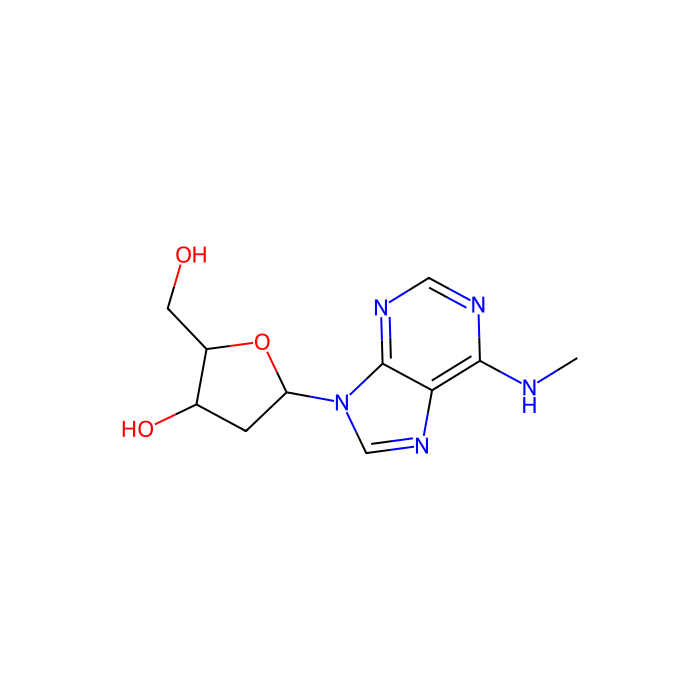
N6-Methyl-2'-deoxyadenosine is a modified purine 2′-deoxynucleoside featuring an N6-methyl group on the adenine base and a 2′-deoxyribose sugar.
Item-specific (from Product Data):
SKU: M122955
CAS: 2002-35-9
CID: 168948
InChIKey: 76306 (as provided)
SMILES: Not specified for this item; refer to CoA/Spec Sheet.
Literature/computed identifiers and features (for reference; not item specifications):
Common names: N6-methyl-2′-deoxyadenosine; m6dA; 6Me-dAdo
Molecular formula (literature): C11H15N5O3
Molecular weight (literature): ~265.27 g/mol
Structural features: purine ring (adenine) bearing an exocyclic N6-methylamino substituent; β-N9-glycosidic linkage to 2′-deoxyribofuranose; free 3′- and 5′-hydroxyls.
Stereochemistry: natural D-2′-deoxyribose configuration; anomeric center at C1′ is β (N9–C1′ bond; nucleoside standard configuration).
2D structure description:
A bicyclic purine core (fused imidazole–pyrimidine) with ring nitrogens at positions typical of adenine; at the exocyclic C6 amine, one hydrogen is replaced by a methyl group (–NHCH3). The N9 position forms the glycosidic bond to the C1′ of the 2′-deoxyribose. The sugar bears –OH groups at 3′ and 5′ and –H at 2′ (deoxy).
Synthetic Utility
Functional group landscape:
Nucleobase: N6-methyl adenine (exocyclic amine methylated), ring nitrogens available for hydrogen bonding but largely non-nucleophilic under neutral conditions.
Sugar: 3′- and 5′-hydroxyls amenable to standard protection (DMTr, TBDMS) and activation (phosphoramidite) strategies; 2′ position is deoxy.
Uses in synthesis:
Oligonucleotide monomer preparation: 5′-O-DMTr protection followed by 3′-O-phosphitylation (e.g., with 2-cyanoethyl N,N-diisopropylchlorophosphoramidite) yields the phosphoramidite for automated DNA synthesis incorporating m6dA.
Conjugation chemistry: 5′-O or 3′-O derivatization with linkers (e.g., succinates, azides) for probe and immobilization strategies after appropriate protecting-group schemes.
Enzymatic phosphorylation: Kinases can convert to the corresponding monophosphate/triphosphate analogs under optimized conditions; chemical phosphorylation routes are also used.
Retrosynthetic perspective:
Compared to dA, the N6-methyl group eliminates the need for base protection (e.g., benzoyl) in many routes, simplifying synthesis and reducing side reactions from acyl migration.
Avoid strongly acidic promoters that risk N-glycosidic bond cleavage; favor neutral to mildly basic catalysts (DMAP, pyridine) for acylations.
Characterization handles:
Distinct N6-methyl singlet in 1H NMR (~3.0–3.5 ppm, solvent-dependent) aids in confirming incorporation and purity relative to dA.
UV and MS fragmentation patterns distinguish m6dA from dA via mass shift (+14 Da) and characteristic adenine fragments.
Target Specificity
Not applicable. This product is a small-molecule nucleoside standard/building block, not an antibody, enzyme, or affinity reagent. No target/epitope specificity, clone, isotype, or species reactivity information is applicable.
Item-specific: No target specificity data provided in Product Data.
For biochemical assays, any sequence or enzyme specificity relates to experimental design rather than inherent specificity of this compound.
Wir verwenden Cookies, um die ordnungsgemäße Funktion der Website sicherzustellen und, soweit zulässig, Ihr Nutzererlebnis zu verbessern. Sie können Ihre Einstellungen jederzeit unter „Einstellungen“ verwalten. Weitere Informationen finden Sie in unserer Cookie-Richtlinie.
Dürfen wir Sie über Rabattaktionen informieren?
Später erinnern
Vielen Dank! Bitte überprüfen Sie Ihren E-Mail-Posteingang, um zu bestätigen.
Products are supplied to verified businesses, institutions, and qualified professionals for research and development use only. Not for use in humans, animals, diagnosis, or therapy.

 F1515026