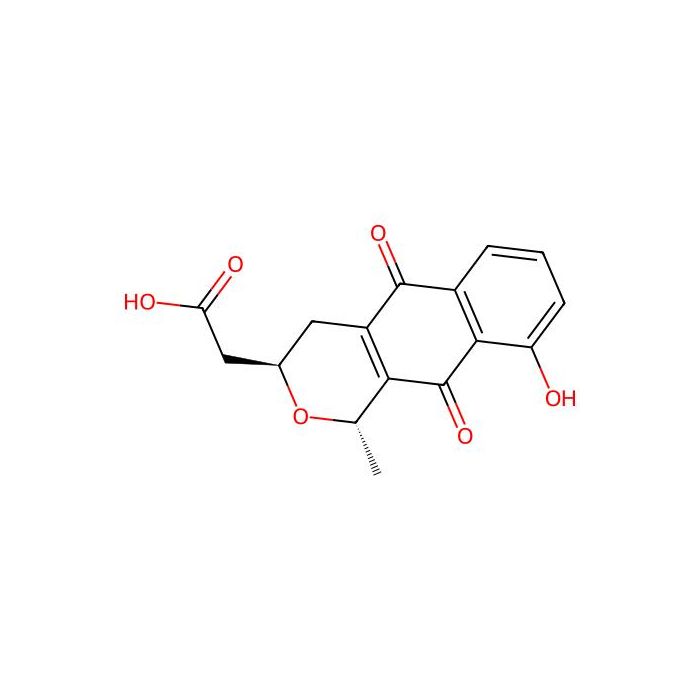
Nanaomycin A is the first selective DNMT3B inhibitor with an IC 50 of 500 nM. Nanaomycin A, a quinone antibiotics , reactivates silenced tumor suppressor genes in human cancer cells Nanaomycin A inhibits in vitro growth of the human malaria parasite Plasmodium falciparum with an IC 80 value of 33.1 nM .
In Vitro
Nanaomycin A (10-10000 nM; 72 hours) has a distinct cytotoxic effect in all three cell lines. Nanaomycin A (0.5, 5 μM; 72 hours) reveals induction of RASSF1A protein expression in A549 cells. Nanaomycin A (5 μM; 72 hours) has an 18-fold relative induction. Nanaomycin A not affects the enzymatic activity of DNMT1. MCE has not independently confirmed the accuracy of these methods. They are for reference only. Cell Cytotoxicity AssayCell Line: HCT116 (colon), A549 (lung), and HL60 (bone marrow) human tumor cell lines Concentration: 10, 100, 1000, 10000 nM Incubation Time: 72 hours Result: Had a distinct cytotoxic effect in all three cell lines. Western Blot AnalysisCell Line: A549 cells Concentration: 0.5, 5 μM Incubation Time: 72 hours Result: Revealed induction of RASSF1A protein expression. RT-PCRCell Line: A549 cells Concentration: 5 μM Incubation Time: 72 hours Result: Had an 18-fold relative induction.
Form:Solid
IC50& Target:DNMT3B 500 nM (IC 50 ) Plasmodium
Spezifikationen
Biochemische und physiologische Mechanismen
Nanaomycin A is the first selective DNMT3B inhibitor with an IC 50 of 500 nM. Nanaomycin A, a quinone antibiotics , reactivates silenced tumor suppressor genes in human cancer cells. Nanaomycin A inhibits in vitro growth of the human malaria parasite
Storage
Store at -20°C
Verschickt in
Ice chest + Ice pads
Dieses Produkt erfordert Kühlkettenversand. Grundversand und andere Economy-Optionen sind nicht verfügbar.
Zertifikate (CoA, COO, BSE/TSE und Analyse-Diagramm)
C of A & Other Certificates(BSE/TSE, COO):
Analytical Chart:
Chemische und physikalische Eigenschaften
Löslichkeit
DMSO : 100 mg/mL (330.82 mM; Need ultrasonic)
Molekulargewicht
302.28
XLogP3
1.300
Hydrogen Bond Donor Count
2
Hydrogen Bond Acceptor Count
6
Rotatable Bond Count
2
Exact Mass
302.079 Da
Monoisotopic Mass
302.079 Da
Topological Polar Surface Area
101.000 Ų
Heavy Atom Count
22
Formal Charge
0
Complexity
563.000
Isotope Atom Count
0
Defined Atom Stereocenter Count
2
Undefined Atom Stereocenter Count
0
Defined Bond Stereocenter Count
0
Undefined Bond Stereocenter Count
0
The total count of all stereochemical bonds
0
Covalently-Bonded Unit Count
1
Sicherheit und Gefahren (GHS)
Signal
Danger
Gefahrenhinweise
H301:Toxic if swallowed
H310:Fatal in contact with skin
Lösungsrechner
Molarity Calculator
Determine the necessary mass, volume, or concentration for preparing a solution.
Dilution Calculator
Determine the dilution needed to prepare a stock solution.
Reconstitution Calculator
Bewertungen
Kundenbewertungen
Application Protocols
Vendor-validated protocols are not provided for this item. The following are general research-use practices for small-molecule standards; adjust to your system and consult primary literature.
Stock solution preparation (common practice):
Dissolve Nanaomycin A in anhydrous DMSO to 10–50 mM. Sonication or gentle warming (<40°C) may assist dissolution. Filter through 0.22 µm PTFE if particulates remain.
Aliquot into amber vials (single-use) and store at –20°C to limit freeze–thaw.
Working solutions for biochemical/cell assays (research use only):
Dilute DMSO stock into assay buffer/media to final DMSO ≤0.1–0.5% v/v. Include vehicle controls.
Protect from light during incubation. Consider including antioxidant controls or thiol scavengers when probing redox-sensitive endpoints.
Analytical QC before use:
Verify purity by HPLC-UV (monitor typical quinone absorbance) and confirm identity by MS/NMR after storage.
Troubleshooting tips:
Precipitation after dilution: Increase mixing time, add minimal cosolvent, or reduce final concentration.
Loss of activity: Check for light/air exposure; prepare fresh aliquots; confirm no bis-adduct formation with media components.
Note: These are general protocols; they are not product specifications. Always tailor conditions to your assay and institutional safety practices.
Biological Roles
Research-only context (no clinical claims):
Natural origin and class (literature): Nanaomycin A is reported as a Streptomyces-derived polyketide belonging to the quinone/naphthoquinone antibiotic family. Compounds in this class often display antibacterial activity in vitro, particularly against Gram-positive organisms, via redox and electrophilic mechanisms.
Enzymology and epigenetics (literature): Nanaomycin A has been reported as a selective inhibitor of DNA methyltransferase 3B (DNMT3B) in biochemical assays, making it a tool compound for exploring DNA methylation pathways and epigenetic regulation in cellular models. Such studies are strictly for basic research.
Redox biology (literature): Quinones can participate in single- and two-electron transfers, interconverting with hydroquinone forms and potentially generating reactive oxygen species under certain conditions. This redox activity underpins many observed cellular responses and is relevant when designing in vitro experiments (control for antioxidant systems and light exposure).
Transport and metabolism (general): In biological matrices, quinones may undergo conjugation (e.g., with glutathione) or enzymatic reduction by NAD(P)H-dependent reductases; these pathways can modulate potency and stability in cell-based systems.
Practical implications for research use:
Carefully control dosing vehicle (commonly DMSO), final solvent percentage, and exposure time.
Include appropriate controls for redox activity (e.g., ROS probes, thiol scavengers) and consider off-target covalent adduct formation in proteome-wide settings.
Buffer Applications
Nanaomycin A is not a buffering reagent and is not used to prepare biological or analytical buffers. It is a hydrophobic small molecule typically handled in organic solvents (e.g., DMSO) and then diluted into assay media at low percentages. For buffer preparation guidance, refer instead to dedicated buffering agents (e.g., phosphate, HEPES, Tris).
Green Alternatives
As a discrete natural product standard, Nanaomycin A itself is not replaceable by a different compound without altering research outcomes. However, greener choices can be made for its handling and any synthetic or analytical workflows involving the compound (general guidance):
Solvent choices (prefer greener where feasible):
Replace dichloromethane or chloroform with ethyl acetate, methyl tert-butyl ether (MTBE), or cyclopentyl methyl ether (CPME) for extractions and chromatography, recognizing potential changes in selectivity and solubility.
Favor ethanol or isopropanol over acetonitrile/methanol where assay compatibility allows.
For stock solutions, DMSO is widely accepted; consider minimizing DMSO percentage in final assay media to ≤0.1–0.5% v/v.
Energy and waste minimization:
Perform reactions/derivatizations at ambient temperature when possible and use catalytic rather than stoichiometric redox reagents (e.g., electrochemical or catalytic aerobic oxidations) in place of heavy-metal oxidants.
Implement microscale reactions and analytical runs to reduce solvent and consumable usage.
Workup and purification:
Use normal-phase silica gel alternatives or supercritical CO2 chromatography when appropriate to reduce halogenated solvent consumption.
Trade-offs:
Greener solvents may have lower elution strength or different selectivity, requiring method redevelopment. Protect the light-sensitive quinone during any process changes (foil-wrapped glassware, amberware).
Pharmaceutical Uses
This product is provided strictly for research use only. It is not an excipient, not GMP-grade, and not intended for human or veterinary use.
General formulation context for research (non-clinical):
Solubilization for in vitro studies is typically achieved with DMSO stock solutions, followed by dilution into aqueous assay media with careful control of final solvent content (≤0.1–0.5% v/v is common in cell assays). Co-solvents (PEG 400, ethanol) or cyclodextrins may be evaluated in preclinical formulation research if higher aqueous concentrations are needed.
For in vivo research performed under appropriate approvals (outside the scope of this catalog), vehicle systems such as PEG/EtOH/saline or lipid-based carriers are sometimes explored for hydrophobic quinones; any such use requires independent risk and regulatory assessment by the researcher.
No pharmacopeial monographs, compendial status, or approved pharmaceutical uses are asserted for this item. Verify all properties and suitability with your institutional guidelines before any formulation-related research.
Physical Properties
Item-specific physical constants: Not specified for this item; refer to CoA/Spec Sheet.
General/literature guidance (non-specification):
Appearance: Quinone natural products in this class are commonly isolated as colored crystalline solids or powders due to their extended conjugation; Nanaomycin A has been reported as a colored solid in the literature.
Solubility profile (typical for quinones/natural-product standards):
DMSO: Generally soluble; widely used for bioassay stock solutions (literature/common practice).
Methanol, ethanol, acetone, ethyl acetate: Often soluble to moderately soluble (literature); actual solubility should be verified experimentally for the supplied lot.
Water: Typically low aqueous solubility unless formulated or adjusted by pH/cosolvents (literature).
Acid/base character: Quinones are neutral, weakly basic/acidic only via phenolic or auxiliary substituents; pKa values, if relevant, depend on specific substituents (literature).
Photochemical and redox properties: Quinones can participate in redox cycling and may be light-sensitive; minimize light exposure during handling (literature).
Do not treat the above as specifications. For exact BP/MP, density, refractive index, logP, pKa, or aqueous solubility of this item, consult the CoA/Spec Sheet or measure under your lab conditions.
Quality and Grades
Item-specific grade/purity: Not specified for this item; refer to CoA/Spec Sheet.
Interpreting grades for small-molecule research standards (general guidance):
Research-grade natural products are often provided at a defined purity by HPLC/UPLC (e.g., ≥95% area). When present, such a statement indicates chromatographic purity under the vendor’s method; it does not guarantee absence of trace isomers or solvents.
Low-residual-solvent specifications, water content, and metal content are typically reported on the CoA where relevant. For Nanaomycin A, such values are Not specified for this item; refer to CoA/Spec Sheet.
Stabilizers/additives:
None are listed in the Product Data. If stabilizers are used, they will appear on the CoA. Quinone-type materials are typically shipped dry without stabilizers and protected from light.
What to verify on receipt:
Confirm identity by orthogonal methods suited to quinones/natural products (e.g., HRMS, 1H/13C NMR, UV–Vis with characteristic quinone bands) and purity by HPLC. Record appearance and color.
If your application is sensitive (e.g., quantitative biological assays), confirm residual solvent profile and water content by KF where needed.
Suitability: This product is intended for research use only, as stated. It is not intended for diagnostic or clinical use.
Reaction and Applications
This product is predominantly used as a reference compound and screening probe in small-molecule libraries. While not a commodity reagent, its quinone functionality affords characteristic reactivity useful for derivatization and mechanistic studies (literature/general):
Assay applications (research use only):
Employed in biochemical and cell-based assays exploring redox biology and epigenetic enzyme modulation; Nanaomycin A has been reported as a selective DNMT3B inhibitor in the literature. Use only for research; no clinical/diagnostic use is intended.
Chemical reactivity and transformations (quinone core):
Reversible redox cycling between quinone and hydroquinone forms under reducing/oxidizing conditions; monitor by UV–Vis and cyclic voltammetry.
1,4-Michael acceptor behavior toward soft nucleophiles (thiols, amines) enabling covalent adduct formation; conditions often mild, in polar aprotic solvents.
Reduction (e.g., Na2S2O4, Zn/AcOH) to hydroquinone derivatives, followed by functionalization (acylation/alkylation) and reoxidation (e.g., Ag2O, Fremy’s salt) for analogue synthesis.
Photochemical and singlet-oxygen reactions may occur due to the conjugated chromophore; ensure light control in reactivity studies.
Analytical applications:
Strong UV–Vis absorbance typical of quinones enables quantitative tracking in HPLC-UV and spectrophotometry; consider diode-array detection to monitor degradation.
Practical tips:
Work under subdued light, dry conditions, and avoid strong nucleophiles unless adduct formation is intended. Validate identity/purity post-manipulation.
Reaction Conditions
General conditions observed for quinone functional-group manipulations and for preparing Nanaomycin A analogues (literature/general; not item specifications):
Reduction to hydroquinone:
Typical reagents: Sodium dithionite (Na2S2O4) in aqueous-organic media; Zn/AcOH; catalytic hydrogenation under mild conditions.
Temperatures: 0–25°C; monitor by TLC/HPLC-UV to avoid over-reduction.
Reoxidation to quinone:
Reagents: Silver oxide (Ag2O), DDQ, Fremy’s salt, or electrochemical oxidation.
Solvents: MeOH, CH2Cl2, or acetonitrile, often at ambient temperature.
Michael additions to the quinone:
Nucleophiles: Thiols, secondary amines.
Solvents: DMF, DMSO, MeOH; bases such as triethylamine may be used sparingly.
Control stoichiometry and time to minimize bis-addition.
Protective handling:
Perform reactions under nitrogen/argon, protect from light (foil-wrapped glassware), and use dry solvents.
Purification:
Normal-phase silica with EtOAc/hexane or gradient to more polar systems; consider reverse-phase HPLC for final polishing. Minimize exposure to basic silica to prevent degradation.
Yields and times:
Highly substrate- and method-dependent; small-scale optimizations are advised. Literature reports for quinone editing often range from 40–80% isolated yield per step under mild conditions.
These conditions are general guidance derived from quinone chemistry literature and may require adaptation to Nanaomycin A’s specific substitution pattern.
Safety and Handling
Authoritative safety information must be taken from the product SDS. The following are general precautions for quinone-type polyketides and research chemicals.
Item-specific hazard data:
Signal Word: Not specified for this item; refer to SDS.
H-Statements: Not specified for this item; refer to SDS.
GHS Classification/Pictograms: Not specified for this item; refer to SDS.
General risk profile (literature/general):
Quinones can be skin/eye irritants and may cause respiratory irritation. Some can undergo redox cycling producing reactive oxygen species in vitro; avoid inhalation and contact.
Light and air can promote degradation; handle quickly and protect from light.
PPE and engineering controls:
Wear lab coat, safety glasses, and appropriate chemically resistant gloves (e.g., nitrile). Handle in a fume hood to avoid dust/aerosols.
Incompatibilities and stability (general):
Avoid strong reducing agents (may over-reduce quinone to hydroquinone) and strong nucleophiles that can cause Michael additions.
Avoid prolonged exposure to bases/acids that could degrade sensitive functionalities; keep away from oxidants that may promote side reactions.
First-aid overview (general guidance; defer to SDS):
Skin/eye contact: Rinse with water for several minutes; remove contaminated clothing. Seek medical attention as needed.
Inhalation: Move to fresh air; support breathing; obtain medical attention.
Ingestion: Do not induce vomiting; rinse mouth; seek medical attention.
Waste: Dispose via licensed chemical waste streams per institutional and local regulations.
Solvent Selection
Selection principles for handling Nanaomycin A in analytical and preparative settings (general/literature-based guidance):
Polarity/solubility class: Moderately lipophilic, conjugated quinone natural product. Typically dissolved for stock solutions in polar aprotic organic solvents.
DMSO: Preferred for biological screening stocks (e.g., 10–50 mM), owing to high solvency and compatibility with aqueous dilution in small percentages.
Methanol or ethanol: Useful for spectroscopic characterization and preparative work.
Acetonitrile or acetone: Often good for chromatography and sample prep.
Ethyl acetate, dichloromethane: Employed for extraction and normal-phase chromatography.
Aqueous handling: Direct aqueous solubility is generally low; use cosolvents (DMSO, MeOH) or formulate with surfactants if required for assays. Filter after dilution to remove precipitates.
Comparison notes (literature/general):
DMSO vs DMF: DMSO is more biocompatible for cell assays; DMF may be used for synthetic transformations but is less favored in bioassays.
MeOH/EtOH offer ease of removal and UV transparency but may promote transesterifications or acetal exchange in sensitive scaffolds.
Practical tips:
Prepare small, single-use aliquots to avoid repeated freeze–thaw and moisture uptake.
Protect from light during dissolution and analysis (wrap glassware/vials in foil).
Storage and Reconstitution
Item-specific conditions from Product Data:
Storage: Store at -20°C.
Shipping: Shipped in an ice chest with ice pads.
General best practices for this compound class (quinone natural products):
Light/moisture protection: Store in amber, airtight containers with desiccant. Minimize headspace and avoid repeated warm–cold cycles. Consider inert-atmosphere storage for long-term stability.
Aliquoting: Prepare small, single-use aliquots upon first opening to avoid multiple freeze–thaw events and moisture uptake.
Reconstitution (research practice; not a specification):
Solvents: Use anhydrous DMSO as primary solvent for concentrated stocks (e.g., 10–50 mM). Methanol or ethanol can be used for analytical preparations.
Procedure: Allow vial to equilibrate to room temperature in the dark before opening to prevent condensation. Add calculated solvent volume, gently vortex/sonicate to dissolve, and, if needed, warm mildly (<40°C). Filter through 0.22 µm PTFE to remove undissolved particulates.
Working solutions: Dilute into buffer/media immediately before use, maintaining final DMSO at assay-compatible levels (often ≤0.1–0.5% v/v). Use amberware and protect from light.
Stability notes (general):
Quinone compounds may degrade upon prolonged exposure to light, moisture, or nucleophiles. Monitor by HPLC-UV over time and replace stocks periodically. For definitive shelf-life and retest dates, refer to the CoA/Spec Sheet.
Structure and Identity
Brief overview: Nanaomycin A is a member of the nanaomycin family of polyketide quinone natural products isolated from Streptomyces (literature). It is supplied here as a research chemical standard.
Item-specific identifiers from Product Data:
CAS: 52934-83-5
PubChem CID: 442757
InChIKey: Not specified for this item; refer to CoA/Spec Sheet.
SMILES: Not specified for this item; refer to CoA/Spec Sheet.
Molecular formula: Not specified for this item; refer to CoA/Spec Sheet.
Molecular weight: Not specified for this item; refer to CoA/Spec Sheet.
Reported to possess a naphthoquinone-type core typical of many Streptomyces-derived quinone antibiotics.
Contains multiple oxygenated functionalities (e.g., quinone carbonyls and additional oxygen substituents) that confer redox activity and electrophilicity characteristic of quinones.
Polyfunctional, conjugated aromatic system; no stereochemical centers are typically emphasized in the core quinone, though side-chain substituents can introduce stereochemistry in related nanaomycins (literature, family-level context).
2D structure in words (literature):
A fused aromatic ring system bearing two conjugated ketone groups (1,4-quinone motif) with additional oxygenated substituents around the ring framework; overall a flat, conjugated scaffold with polarizable π-system and electrophilic sites at the quinone carbons.
Note: Exact connectivities (SMILES/InChI) and elemental composition for the supplied lot are not specified above and should be confirmed from the CoA/SDS or primary literature for Nanaomycin A (CAS 52934-83-5).
Synthetic Utility
While Nanaomycin A is primarily a target molecule/reference standard rather than a general reagent, its quinone core offers useful handles for analogue synthesis and mechanistic organic chemistry (literature/general):
Functional-group reactivity:
Quinone carbonyls: Undergo reversible reduction to hydroquinone; participate in nucleophilic additions (e.g., conjugate additions) and acylations/alkylations after reduction–protection sequences.
Conjugated double bonds: Michael acceptor behavior toward thiols/amines enabling probe or affinity-tag installation (with caution regarding selectivity and potential overreaction).
Phenolic/oxygenated substituents (if present): Amenable to etherification/esterification to tune lipophilicity and redox potential.
Derivatization strategies:
Redox editing: Reduce to hydroquinone, derivatize, then reoxidize to regenerate the quinone with new substituents (Ag2O, DDQ, or electrochemical methods).
Late-stage diversification: Use mild nucleophiles or organometallic soft reagents under controlled conditions to install side chains without degrading the core.
Photoredox/electrochemical methods: Offer selective activation of quinone frameworks with improved functional-group tolerance.
Analytical characterization:
UV–Vis: Strong absorbance bands facilitate reaction monitoring; complementary LC–MS and NMR confirm site of modification.
Caution:
Over-reduction and polymerization can occur; exclude oxygen/water as needed, and work under subdued light to preserve the parent scaffold.
Target Specificity
This section typically applies to biologics such as antibodies or targeted probes with defined binding epitopes. Nanaomycin A is a small-molecule natural product and does not have vendor-validated antigen/epitope specificity data.
Item-specific target data: Not specified for this item; refer to primary literature for any reported biochemical targets (e.g., DNMT3B reported in literature studies) and validate independently in your assay system.
For application-relevant binding/target data, consult peer-reviewed studies and confirm under your experimental conditions.
Häufig gestellte Fragen
How should this product be stored?
Store at ?20 °C. Freezer storage is required to maintain the specified shelf life.
How is this product shipped?
This product ships in an insulated container with ice pads. Unpack on arrival and transfer it to the storage condition stated above.
What are the CAS number, molecular formula and molecular weight?
The CAS Number is 52934-83-5, the molecular formula is C16H14O6, and the molecular weight is 302.28 g/mol.
What documentation is provided?
Available product documentation, including Certificates of Analysis (COA), Safety Data Sheets (SDS), and specification sheets, is shown in the product document area. Document availability and access follow the current site policy.
Wir verwenden Cookies, um die ordnungsgemäße Funktion der Website sicherzustellen und, soweit zulässig, Ihr Nutzererlebnis zu verbessern. Sie können Ihre Einstellungen jederzeit unter „Einstellungen“ verwalten. Weitere Informationen finden Sie in unserer Cookie-Richtlinie.
Dürfen wir Sie über Rabattaktionen informieren?
Später erinnern
Vielen Dank! Bitte überprüfen Sie Ihren E-Mail-Posteingang, um zu bestätigen.
Products are supplied to verified businesses, institutions, and qualified professionals for research and development use only. Not for use in humans, animals, diagnosis, or therapy.